
Key Takeaways
Most Martech teams are stuck in the same loop. They publish another product-led blog post, cut it into a few LinkedIn text updates, send it to an email list, and hope a technical buyer or a VP will care. They usually don't. The content isn't wrong. It's just forgettable.
That's a serious problem in a category where buyers are skeptical, committees are cross-functional, and every vendor claims better orchestration, cleaner data, smarter automation, or faster attribution. Standard content marketing rarely creates enough trust to move a deal forward. It fills a calendar. It doesn't create gravity.
An audio-first strategy does. A strong B2B podcast gives Martech companies a way to hold attention longer, speak with more nuance, and build familiarity with both technical practitioners and executives. It also fits far better into how modern teams buy. Podcasts are now treated as a real demand-generation channel, not a side project. According to Fame's roundup of B2B podcasting trends, B2B podcasting has transitioned from a niche tactic to a top-tier demand-generation channel, and the global podcast advertising market reached about $2.1 billion in 2022 and is projected to reach roughly $4 billion by 2025.
B2B Podcasting for Martech The Ultimate Strategy Guide
If you work in Martech, you've probably felt this already. Your team writes smart content. Your product team gives you deep technical material. Your design team makes it look polished. Then it lands with a thud because your buyer has seen fifty versions of the same argument.

Generic content loses in Martech
Martech buyers don't need more surface-level explainers. They need clarity on integrations, governance, workflow design, reporting logic, implementation tradeoffs, and real operating decisions. A thin blog post can't carry that weight. A generic social post definitely can't.
That's why B2B Podcasting Martech works when other formats stall. Audio gives you time to unpack hard topics without flattening them. You can let a revenue operations leader explain why attribution broke after a CRM migration. You can let a CMO discuss vendor consolidation without reducing it to a listicle. You can let a product marketer challenge a category narrative in their own words.
Practical rule: If your category requires explanation before persuasion, a podcast should sit near the center of your content engine.
Audio belongs inside the stack
The shift isn't just audience behavior. It's infrastructure. Martech teams now plug podcasts into the same systems they use for campaigns, webinars, and lifecycle programs. Episode pages carry UTMs. newsletter signups flow into automation. listener actions can inform retargeting, lead routing, and sales follow-up.
That's what makes podcasting commercially useful instead of merely interesting. The best teams don't treat a show as “brand content.” They treat it like an owned media asset connected to pipeline motion. If you're building that engine, this guide to podcast strategy for B2B brands is worth reading alongside your planning process.
There's another advantage. Podcasts are raw material for a much bigger distribution machine. If your team is also thinking about repurposing workflows, this breakdown of AI podcasts for marketing is a useful companion because it shows how audio can feed broader content production without draining your internal team.
Why Martech Companies Face Unique Content Challenges
Martech content is difficult for structural reasons, not because your team lacks creativity. Most categories in software can survive broad messaging. Martech can't.
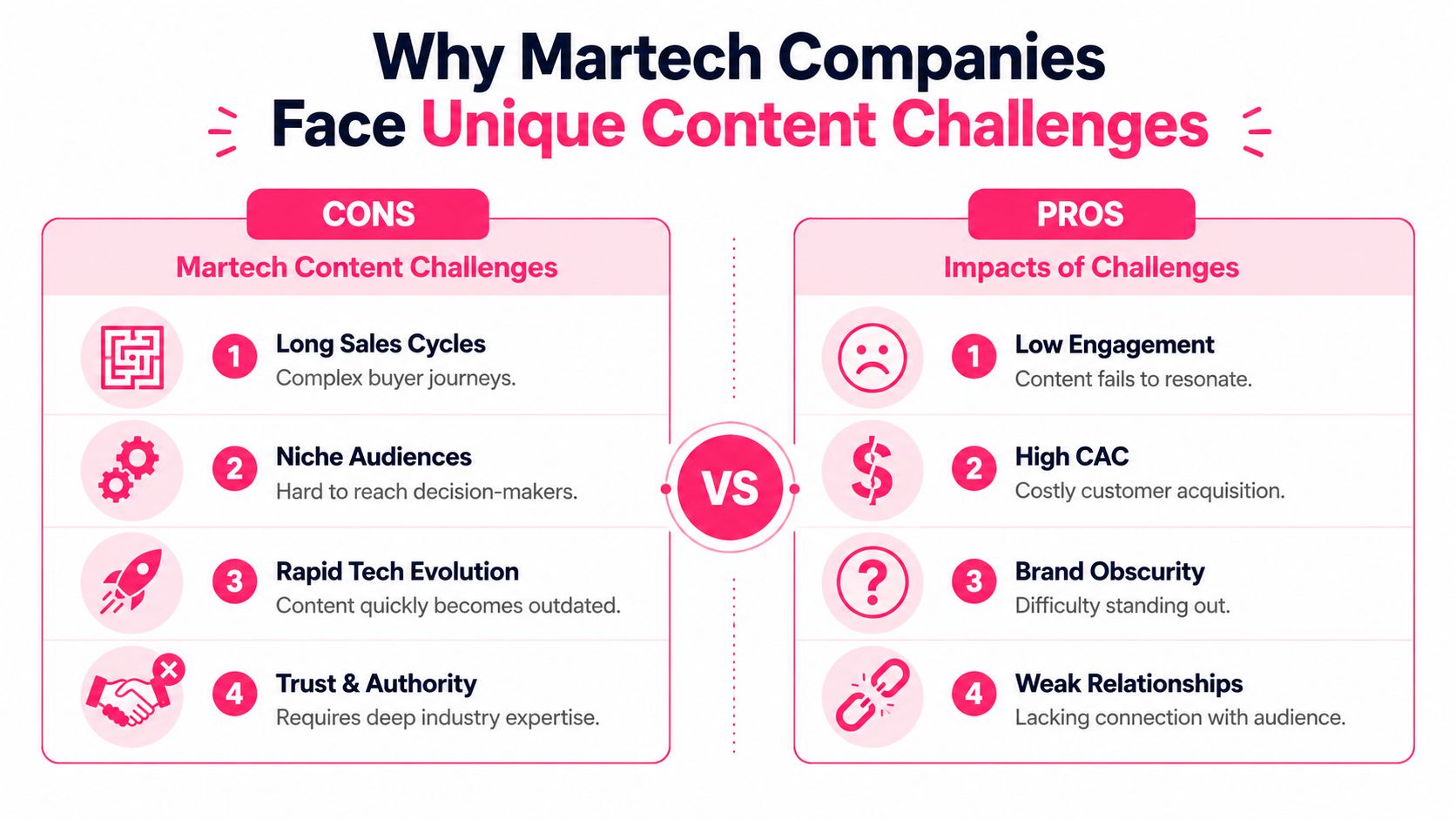
Your buyers don't buy alone
A Martech deal rarely depends on one person liking your positioning. Marketing wants performance. Operations wants clean processes. IT wants stability. Security wants control. Finance wants justification. Legal may want contract precision. That turns every sale into a chain of explanations.
A static blog post rarely survives that environment because it usually speaks to one audience at a time. A podcast can handle the complexity better. You can create conversations that acknowledge technical constraints, strategic goals, and implementation reality in one place.
Research cited by Martech.org on podcast adoption in B2B marketing shows that 24% of B2B decision-makers use podcasts to obtain business-related content, and 43% of buyers say they rely on podcasts for industry-specific information. That matters because it means audio reaches buyers before a demo request, while they're still framing the problem.
The category changes too fast for shallow content
Martech products evolve quickly. Integrations change. privacy expectations shift. AI features get added. Reporting models get revised. A rigid, over-produced content process often can't keep pace.
A podcast is faster to adapt because it lets your team respond in conversation. You can record a focused episode on a new category issue, pair it with a transcript and summary, and distribute the insight across channels without waiting for a major campaign build.
Here's what usually gets in the way:
- Long sales cycles: Buyers need repeated exposure and repeated proof.
- Niche audiences: The people who matter are hard to reach with broad content.
- Rapid product movement: Educational assets age fast.
- Trust threshold: Buyers won't engage unless your team sounds like operators, not copywriters.
For many SaaS teams, the same pattern shows up across adjacent categories. That's why this piece on content marketing for SaaS is useful. It reinforces a point Martech teams know well. You don't win by publishing more. You win by publishing content that reflects how informed buyers evaluate vendors.
Buyers in Martech don't ignore weak content because they're too busy. They ignore it because it doesn't help them make a hard decision.
Podcasts solve for trust, not just reach
That distinction matters. In Martech, the biggest content challenge isn't traffic. It's credibility. A podcast gives your company a format where experts can explain details, disagree intelligently, and expose how they think. That's the material trust is built from.
The Core Framework For An Industry Defining Show
A good Martech podcast doesn't start with microphones. It starts with commercial intent. If your show isn't designed to support account access, category authority, and content repurposing, it becomes a hobby with better artwork.
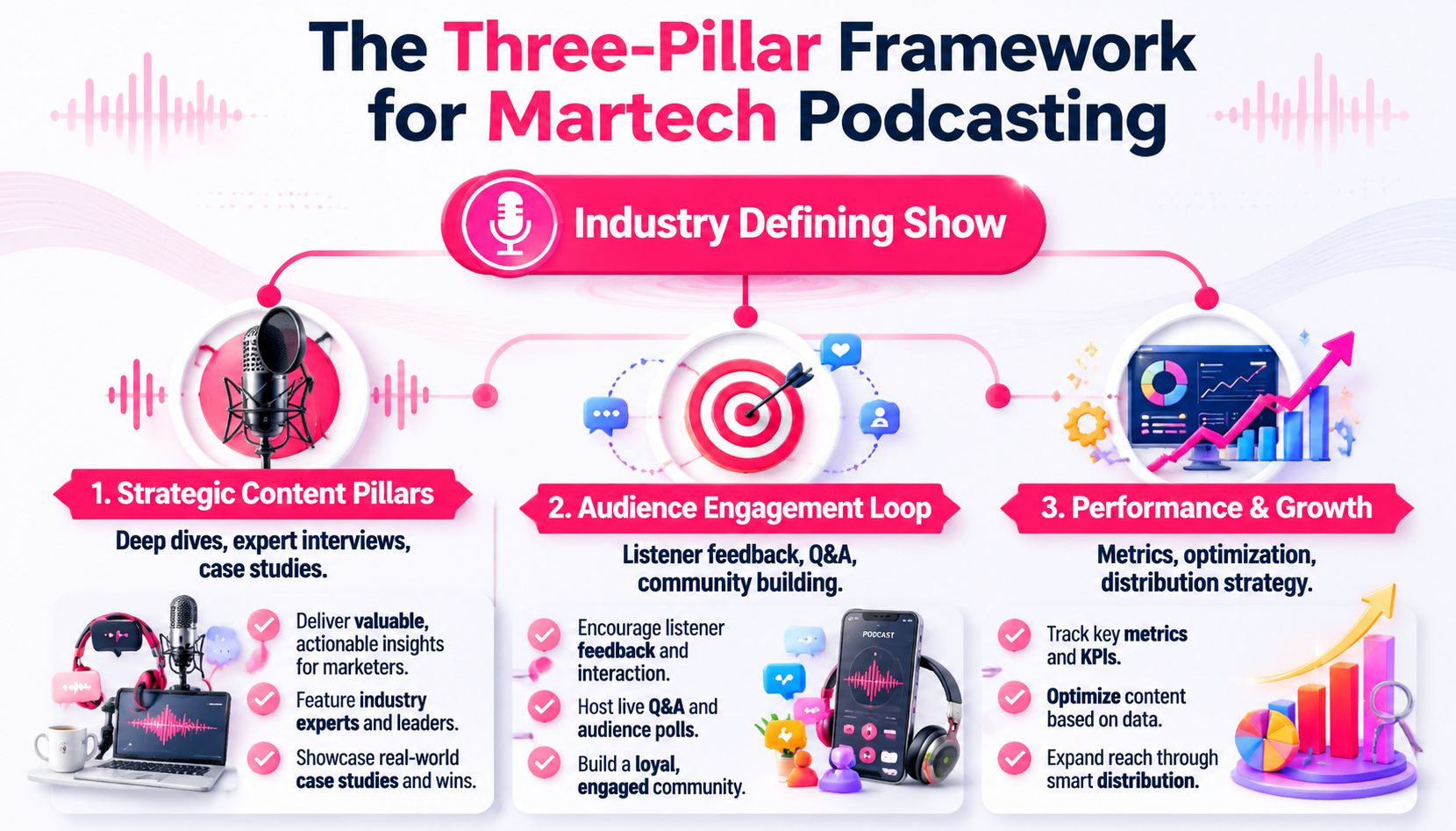
Pillar one is relationship-driven ABM
The most strategic move in Martech podcasting is simple. Invite the people you want to build relationships with.
That means target accounts, ideal partners, respected operators, consultants, analysts, and adjacent technology leaders. A podcast gives your team a reason to start a valuable conversation without pretending it's an outreach sequence. Done right, this turns guest booking into account-based marketing.
Use this operating model:
- Build a guest list from your ICP: Include active opportunities, dream accounts, customers with strong stories, and ecosystem partners.
- Match each guest to a business theme: Attribution design, AI workflow governance, data activation, CDP adoption, lifecycle orchestration, or integration strategy.
- Create follow-up paths before recording: Sales should know which guests matter, what context to capture, and how to continue the relationship after the episode goes live.
A podcast guest should never disappear into a content calendar. They should enter a relationship map.
Pillar two is simplifying the technical
Most Martech companies make one of two mistakes. They either overcomplicate the conversation and lose anyone outside the specialist niche, or they simplify so aggressively that the episode becomes empty.
The right approach is layered communication.
- Start with the business tension: What's broken, costly, slow, risky, or unclear?
- Move to the technical issue: Which workflow, integration, or data dependency creates the problem?
- End with the operating lesson: What should a buyer, operator, or leader do differently?
That structure keeps technical depth intact while making the conversation listenable. It also helps your team serve multiple personas in a single episode.
A strong supporting resource for structuring this kind of show is this B2B branded podcast framework, especially if your company is deciding between executive-led, practitioner-led, or mixed-format programming.
This conversation format also works well on video when hosts know how to direct the flow. The example below shows the kind of on-camera structure that translates well into clips and follow-on assets.
Pillar three is the content multiplication loop
A single recording should produce an entire campaign. If it doesn't, you're wasting the best part of podcasting.
Take a raw 45-minute conversation and split it into assets with different jobs:
| Asset | Job in the funnel |
|---|---|
| Short video clips | Capture attention on LinkedIn and paid social |
| Full transcript | Create searchable source material |
| SEO summary article | Rank for category and problem-led topics |
| Newsletter takeaway | Keep subscribers engaged between episodes |
| Sales snippet library | Give reps proof points and language for follow-up |
Operator insight: Record once, distribute many times, but make each derivative asset native to its platform.
The loop matters because different stakeholders won't consume the same format. A RevOps manager may read the summary. A CMO may watch a clip. A solutions consultant may listen to the full episode. The podcast is the source. The distribution system does the scaling.
Proven Success From Leading Martech Brands
A Martech podcast proves itself in a familiar revenue scenario. Sales needs warmer enterprise conversations. Marketing needs category authority that does more than collect impressions. RevOps needs content that can be tied back to pipeline influence inside the existing stack.
The best shows do all three because they are built as operating assets, not side projects.
Skyword is a clear example. The company used its show to sharpen how the market understood its point of view, then turned that positioning into a stronger content engine. The story is laid out in Skyword's podcast case study on building authority in the marketing sector.
People.ai solved a different problem. It needed a show that could carry serious conversations about data-driven revenue and support a higher-level narrative sales teams could reuse. Future of Marketing took a flagship-show approach and used the podcast as a brand property with enough consistency to stay relevant in a crowded category.
SyncSpider and ButterCMS show another advantage of B2B podcasting for Martech firms. A show can help define the category you want to own, support product education, and create reusable proof for demand gen, sales follow-up, and partner conversations. That matters more than downloads. If the podcast feeds your CRM, supports retargeting audiences, and gives your team sales-ready clips and transcripts, it becomes part of the revenue engine.
Fame case studies in the Martech sector
| Company | What the show accomplished |
|---|---|
| Skyword | Strengthened category positioning and improved brand authority in the marketing sector |
| People.ai | Built thought leadership around data-driven revenue |
| Future of Marketing | Created a flagship B2B marketing show with lasting brand value |
| SyncSpider | Supported category creation and clearer market education |
| ButterCMS | Owned a focused content position with developer and content credibility |
What leading Martech podcast wins have in common
Across these examples, the playbook is consistent:
- They tied the show to a business goal. Category creation, thought leadership, sales enablement, or audience education.
- They built for stack integration. Episode content could be repurposed into email, social, paid retargeting, CRM contact activity, and sales outreach.
- They used the podcast to shape buying criteria. The show taught prospects what matters, which made the sales process easier later.
- They created reusable assets for the whole go-to-market team. Marketing got campaigns. Sales got proof points. Leadership got a platform for strategic messaging.
That is the standard to follow. A Martech podcast should not sit outside your funnel. It should feed the systems you already use and make your existing Martech stack produce more pipeline.
Five Plug and Play Episode Concepts For Martech Podcasts
Most Martech shows fail because every episode sounds the same. Same interview structure. Same abstract questions. Same safe commentary. That gets old fast, especially in a category where different stakeholders need different kinds of proof.
A better approach is format segmentation. That means matching episode style to buyer stage and persona. As noted by Content Allies on B2B podcasting trends, few Martech podcast resources explain how to segment episode formats such as deep-dive tech, product-led storytelling, and executive-level use cases or map those formats to stages of the B2B funnel. That's exactly why most shows drift.
Plug-and-play Martech episode concepts
| Episode Format | Strategic Goal | Target Audience | Example Title |
|---|---|---|---|
| Integration deep-dive | Prove technical credibility and reduce implementation anxiety | RevOps leaders, solutions engineers, technical marketers | How to Connect Your CDP, CRM, and Automation Stack Without Breaking Attribution |
| Executive market view | Establish strategic authority with budget holders | CMOs, VP Marketing, Heads of Growth | The Future of the Martech Stack After Tool Sprawl |
| Workflow teardown | Show practical application in day-to-day operations | Marketing ops, lifecycle teams, demand gen managers | What a High-Functioning Lead Routing Workflow Actually Looks Like |
| Customer decision story | Translate product value into buying logic | Evaluation-stage buyers, cross-functional committees | Why This Team Rebuilt Their Reporting Model Before Buying New Martech |
| Partner roundtable | Expand ecosystem credibility and create co-marketing lift | Agencies, consultants, tech partners, senior practitioners | Where Attribution, Automation, and Data Hygiene Collide |
How to use these formats without sounding repetitive
Don't run one format forever. Rotate them based on what your pipeline needs.
If your team is trying to create trust with technical buyers, push the integration deep-dive and workflow teardown formats harder. If you need more executive awareness, increase strategic market-view episodes. If sales needs content for active deals, publish more customer decision stories because they help buyers hear how peers evaluate change.
Use these rules:
- Match format to funnel stage: Early-stage listeners want category clarity. Mid-stage buyers want workflow detail. Late-stage stakeholders want risk reduction.
- Name episodes around problems, not branding: Buyers search for pains and decisions, not campaign slogans.
- Reuse recurring segments: A familiar structure helps listeners know what kind of value they'll get.
- Brief guests tightly: Ask for examples, turning points, failures, and decisions. Generic opinion is useless.
If you need a larger bank of recurring formats, this list of podcast episode ideas is a practical place to expand your editorial calendar.
The best Martech podcasts don't just publish conversations. They publish useful conversation types.
Your Martech Podcasting Implementation Roadmap
Many teams don't fail because podcasting is too hard. They fail because they launch without wiring the show into the rest of the revenue engine. A Martech podcast only becomes valuable when strategy, systems, and distribution are planned together.
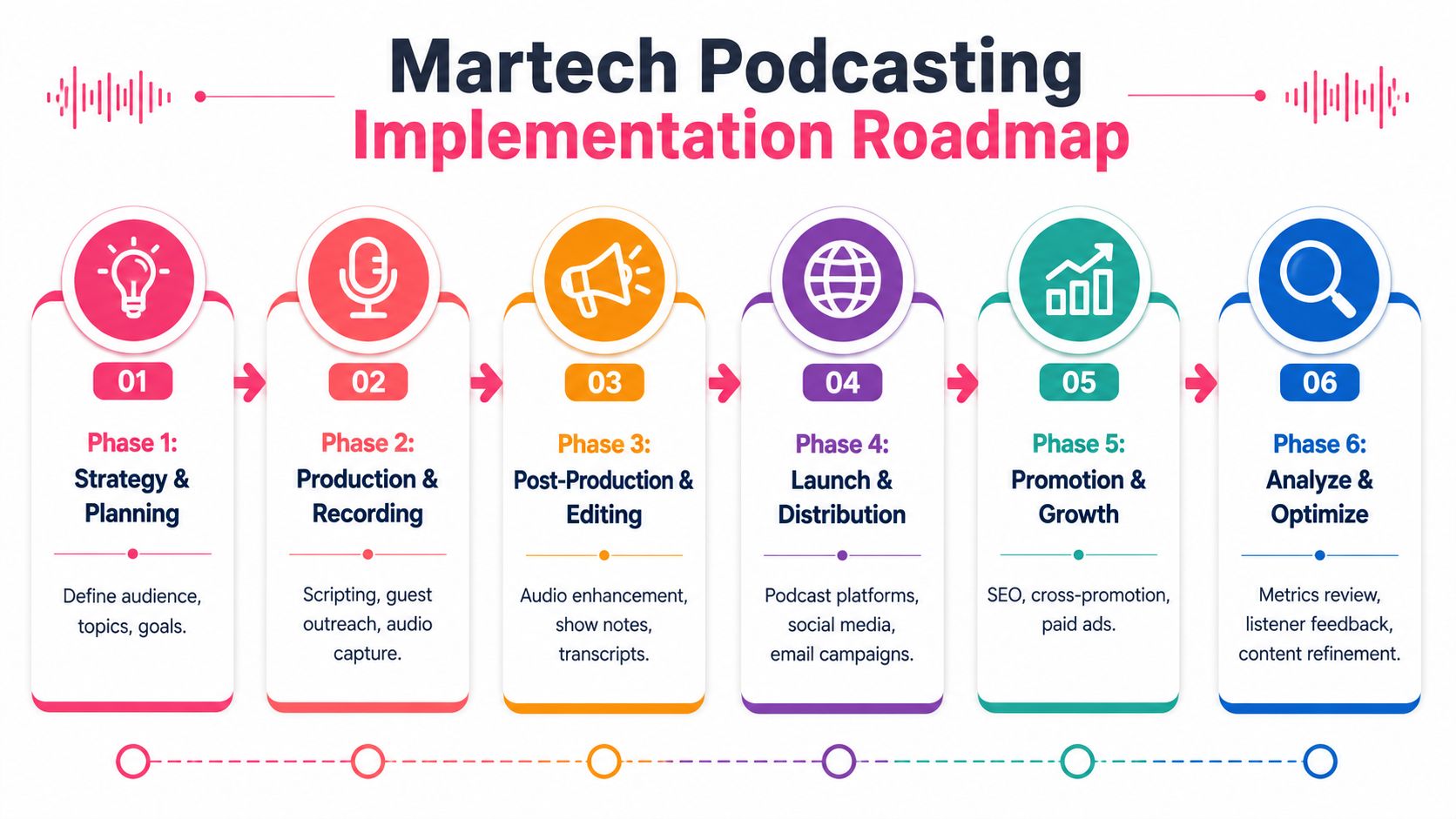
Phase one through three build the foundation
Start with positioning. Define the audience sharply. Pick the host carefully. Lock the show around a clear commercial lane such as attribution, customer data, lifecycle orchestration, AI-enabled operations, or revenue analytics. If your positioning is broad, the content will blur immediately.
Then build the production system. Set episode templates, guest criteria, recording workflow, editorial QA, and repurposing rules. For video-led teams, clean narration and polished post-production matter, especially when you're turning long-form episodes into clips. This voice over video editing guide is a helpful reference for thinking through how spoken content translates into stronger edited assets.
Before launch, create the content engine around the show:
- Episode pages: Each episode needs its own landing page and CTA path.
- UTM discipline: Tag links by episode, channel, and campaign objective.
- Form strategy: Newsletter signups and resource CTAs should tie back to episode themes.
- CRM mapping: Decide what counts as influence, engagement, and follow-up action.
Phase four through six make it measurable
Distribution comes next. Publish through your hosting platform and syndicate across the main listening environments. Then promote clips, summaries, and snippets through LinkedIn, email, partner channels, and paid support where relevant. Keep the message consistent, but adapt the format to the platform.
The most important phase is measurement. A persistent gap in public guidance, according to Martech.org's article on audio content in B2B business, is how to quantify and attribute pipeline and revenue impact beyond basic download and subscriber metrics. That's the problem you need to solve early, not after six months.
Track podcast impact like this:
- Map each episode to a CTA path: demo, newsletter, report, event, or partner page.
- Log guest value separately: target account guest, partner guest, customer guest, or authority guest.
- Review influence in CRM: first touch, assist touch, and opportunity acceleration signals.
- Feed insights back into programming: double down on themes that drive quality conversations.
Stop judging a Martech podcast like a media hobby. Judge it like a pipeline asset with content outputs, relationship value, and measurable influence.
A serious B2B Podcasting Martech program doesn't sit outside the stack. It sits inside it, with clear metadata, defined conversion paths, and reporting that sales and marketing leaders can use.
If you want a partner that understands how to turn a Martech podcast into a revenue-focused content engine, Fame is built for that job. They specialize in B2B shows, understand how to connect podcasting to authority and pipeline, and have the category experience to help Martech brands launch with a real strategy instead of another content experiment.
