December 26, 202519 min read7 sections
A Guide To Podcast Show Notes For SEO And Engagement
By Fame Team
Key Takeaways
- Podcast show notes make your audio searchable, scannable, and shareable for a wider B2B audience.
- High-quality podcast show notes transform your audio into a marketing asset that can pull in organic traffic and lead generation.
- Well-structured podcast show notes, including summaries, timestamps, and actionable resources, can engage busy B2B professionals and make them more likely to subscribe.
Podcast show notes are the written sidekick to your audio episode. They usually include a summary, key takeaways, and links to anything you mentioned. But don't mistake them for a simple description. They're a killer marketing tool that makes your audio searchable, scannable, and shareable for a wider B2B audience.
Why Show Notes Are Your Podcast's Secret Weapon
Ever pour everything you have into an episode, only for it to vanish into the ether? You’re not alone. So many B2B podcasts create incredible audio that never hits its stride because it's invisible to search engines and a pain for busy listeners to get through. This is exactly where high-quality podcast show notes come in.
Stop thinking of them as a summary. Start thinking of them as a strategic growth lever. They transform your audio, which Google can't really understand, into a marketing asset that's searchable, shareable, and actually gets people to do something. Show notes are the bridge connecting your audio content to your real business goals.
Turning Audio into a Searchable Asset
To a search engine, your audio file is a black box. Without some text to go along with it, that brilliant conversation you had about industry trends might as well not exist online. Actionable show notes crack that box wide open.
By creating a text-based companion for your episode, you’re giving Google something to actually crawl and rank. When you strategically weave in relevant keywords for your industry, the exact phrases your ideal B2B customer is using, each episode becomes a long-term magnet for organic traffic. An episode on "scaling SaaS sales teams," for example, can start ranking for that exact term if the show notes are on point, pulling in new, highly relevant listeners months or even years down the road.
As our founder, Tom Hun,t always says, a B2B podcast isn't just about making great audio; it has to be an integrated part of a marketing system. Show notes are the gear that plugs your podcast right into that system, turning it into a reliable engine for discovery and lead generation.
Engaging Busy B2B Professionals
Decision-makers are short on time. They probably don't have 45 minutes to listen to a whole episode just to figure out if it's for them. Well-structured podcast show notes are the perfect fix.
- Quick Value Check: A tight summary lets a busy exec see the episode's core value in seconds.
- Easy Navigation: Timestamps let listeners jump straight to the parts that matter most to them.
- Actionable Resources: Links to reports, tools, or guest profiles deliver immediate value and make your podcast the go-to resource hub.
This whole approach is about respecting your audience's time, which makes them way more likely to subscribe and stick around. It shows you get their challenges and are focused on delivering value, fast. Mastering this is key to unlocking the full, actionable benefits of podcasting for your business and turning casual listeners into qualified leads.
The Anatomy of High-Impact Podcast Show Notes
Alright, let's get past the idea of show notes being a simple summary. It’s time to build the perfect show notes from the ground up. Think of this section as your blueprint, breaking down every essential piece and explaining exactly why it matters in a B2B world. Each element is a building block for engagement, search visibility, and, yes, even lead generation.
Treating your podcast show notes like a strategic asset is non-negotiable. The podcasting world is absolutely packed; by January 2025, Apple Podcasts was home to over 95 million episodes from 4.52 million podcasts. That's nearly double the number from just three years ago.
For B2B teams, this noise means that detailed notes, packed with links, juicy quotes, and clear calls-to-action, are what separate the top-tier shows (those hitting nearly 4,000 downloads in week one) from everyone else.
Start With A Compelling Episode Title and Summary
Your episode title is your headline. It’s the first thing a potential listener sees, and it has to do two jobs at once: grab their attention and signal to search engines what the content is about.
So, instead of a snooze-fest title like "Episode 54 with Jane Doe," try something like "Scaling a B2B SaaS with Jane Doe: From $1M to $10M ARR." See the difference? It immediately shouts value and targets a very specific audience.
Right after the title, you need a hook, a concise summary of 1-3 paragraphs. This isn't a play-by-play recap; it's a sales pitch for the episode's value. Your goal is to answer the listener's only question: "What's in it for me?" Frame the summary around the core problems solved or the biggest insights revealed. A great summary convinces a busy executive that hitting "play" is a solid investment of their time.
This approach transforms your audio from a fleeting moment into a compounding asset, making it both searchable and shareable.
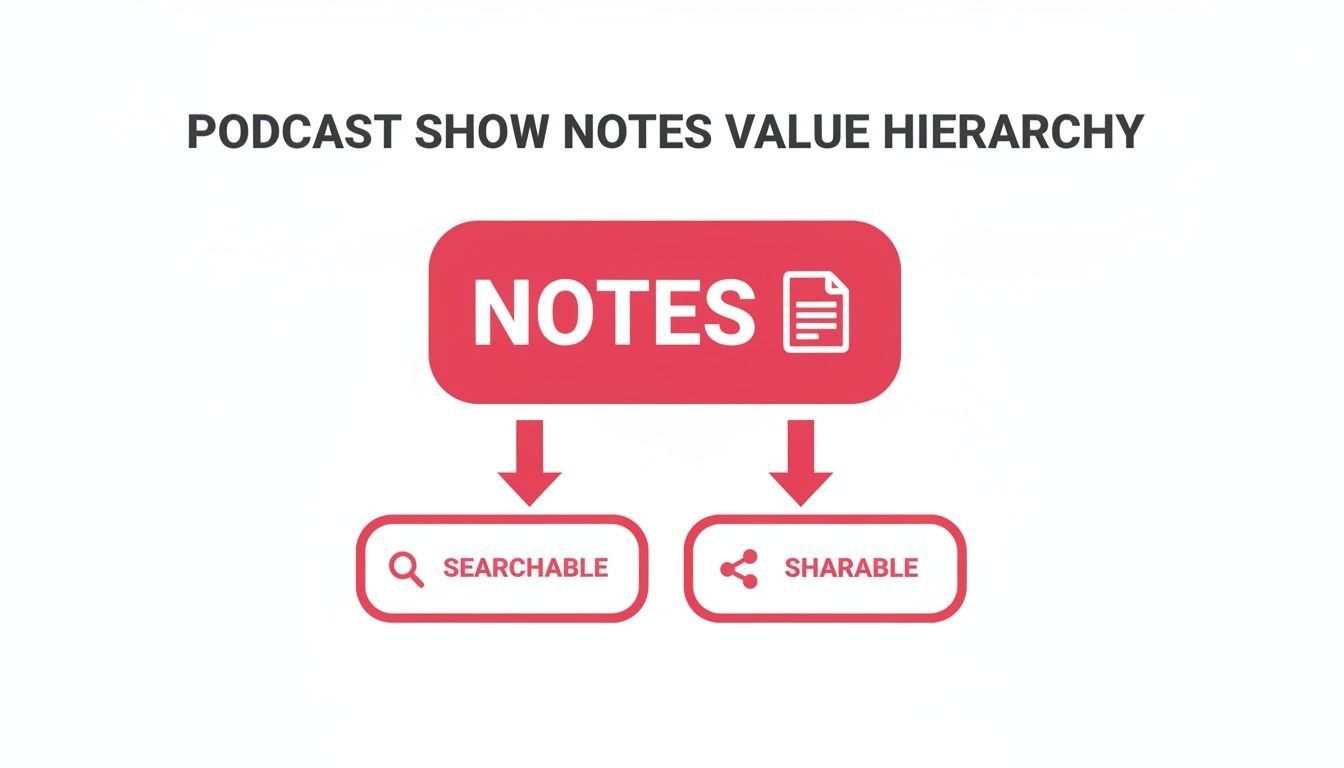
This hierarchy makes it clear: well-structured notes are the foundation for turning audio into a discoverable, evergreen asset for your brand.
To help you piece this all together, here’s a breakdown of what every set of high-impact show notes should include.
Anatomy of High-Impact B2B Podcast Show Notes
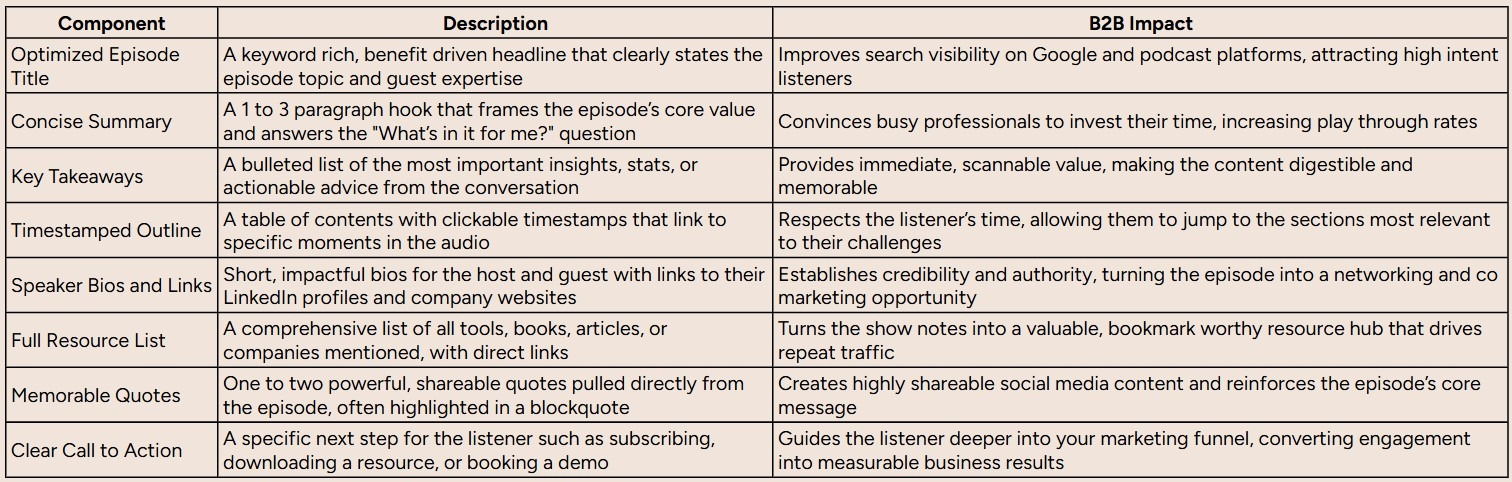
Following this structure turns your show notes from a simple description into a multi-purpose marketing asset.
Use Timestamps and Key Takeaways to Guide Listeners
B2B professionals are short on time. Period. Detailed timestamps (or chapter markers) are a huge sign of respect for their schedule, letting them jump straight to the parts of the conversation that matter most to them.
Think of timestamps as a scannable table of contents. Structure each one with a short, benefit-driven description.
- (02:15) The Common Mistake Founders Make in Early-Stage Hiring: Learn what to avoid when building your initial team.
- (15:40) Unpacking the 'Product-Led Growth' Flywheel: A deep dive into the exact model that fueled growth.
- (32:05) How to Structure a High-Performing Sales Demo: Actionable tips for closing more deals.
Pairing timestamps with a bulleted "Key Takeaways" section gives your audience an even faster path to value. These are the tweetable, memorable soundbites a listener can absorb in 30 seconds. Pulling these requires a sharp ear, but having a solid plan going into the recording makes it much easier. That’s why we always recommend checking out our guide on creating a winning outline for podcast episodes.
Include Speaker Bios and a Full Resource List
Credibility is everything in B2B. A short, impactful bio for your host and guests helps establish authority right from the get-go.
Your guest's bio isn't just a formality; it's a co-marketing opportunity. By highlighting their expertise and linking to their work, you tap into their network and add credibility to your own brand.
Finally, compile a complete list of every single book, tool, article, or company mentioned during the episode. This simple step turns your show notes into a valuable resource hub that people will bookmark and come back to. Every link is a chance to provide value, build relationships with the brands you mention, and keep your audience engaged long after the episode is over.
How to Optimize Show Notes for Search Engines
Let’s be honest: Google is completely blind to your audio file. It can’t listen to your amazing B2B podcast episode. But your podcast show notes? That’s an entirely different story. They are an absolute SEO goldmine.
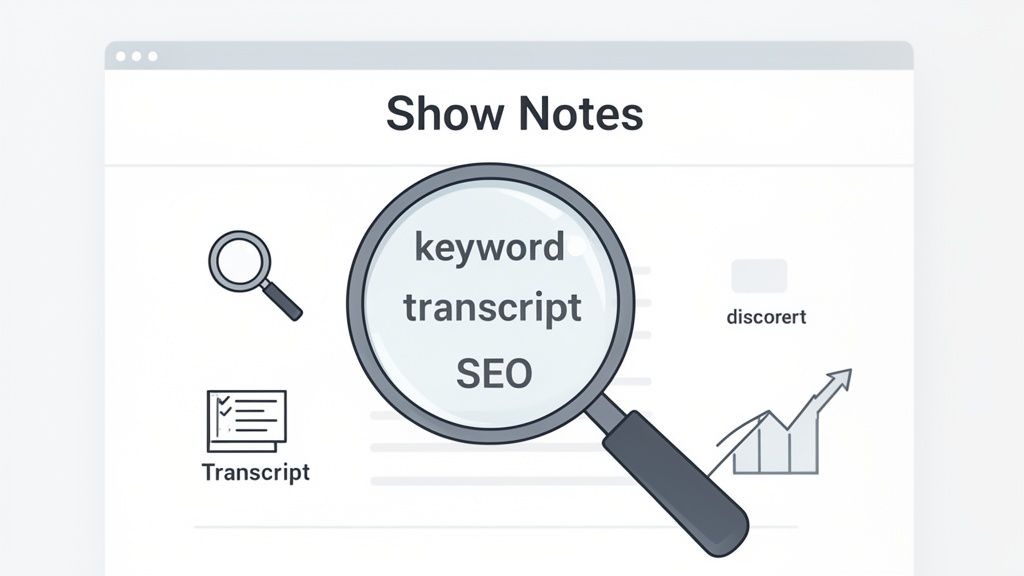
Show notes transform that invisible audio stream into a text-based asset that search engines can actually crawl, index, and rank. If you start treating each show notes page like a dedicated landing page, every episode you publish becomes a long-term engine for attracting your ideal B2B audience through organic search.
This isn’t just a "nice-to-have" anymore. The podcasting world is more crowded than ever, with the total number of active podcasts hitting a record 605,122 in September 2025. With that explosion of content, just having great audio isn't enough to get noticed. It’s the optimized show notes, packed with the right keywords, a smart structure, and a full transcript, that will push your podcast up the search rankings on both Google and in podcast apps.
Conduct B2B Keyword Research
Before you even think about writing, you have to know what your target audience is actually searching for. Solid keyword research is the foundation of any SEO strategy, making sure you’re creating content that people are already looking for.
Start by brainstorming the core topics and problems your episode tackles. Put yourself in your ideal customer’s shoes. What specific question would a VP of Marketing at a SaaS company type into Google about "demand generation" or "account-based marketing"? This process is crucial for generating effective podcast episode ideas that resonate.
Take those initial ideas and plug them into an SEO tool to find related search terms, common questions, and long-tail keywords. These long-tail keywords (phrases of three or more words) are pure gold because they signal someone is much closer to taking action. For instance, instead of a broad term like "podcast marketing," you’d target a super-specific phrase like "how to measure B2B podcast ROI." These keywords attract a far more qualified audience and are usually way less competitive to rank for.
Apply On-Page SEO Best Practices
Once you have your target keywords, it’s time to weave them into the fabric of your show notes. This is classic on-page SEO, and it’s how you signal to search engines exactly what your content is about.
- Keyword-Rich Headlines: Your episode title is your single most important on-page SEO element. Make it compelling for a human but optimized for a search bot. Your primary keyword should appear naturally, as close to the beginning as possible.
- Optimized Summaries: The opening summary needs to include your primary keyword within the first 100 words. Sprinkle in secondary keywords and related terms throughout the rest of the summary to give search engines more context.
- Structured Headers (H2s and H3s): Use subheadings to break up your show notes and outline the episode's key discussion points. Using your keywords in these headers helps both readers and search engines quickly understand the content’s structure. If you want to go deeper, check out our guide on the 7 podcast SEO best practices for explosive growth in 2025.
And while podcast show notes have their own quirks, many core SEO principles, like the ones covered in these strategies for static website SEO, apply directly to getting your pages discovered.
Include a Full Transcript for Maximum Impact
If there's one non-negotiable for blowing up your podcast's SEO footprint, it's including a full episode transcript. A well-written summary is great for the user experience, but the transcript is what gives search engines a mountain of text to crawl and analyze.
A transcript allows every single word spoken in your episode to be indexed by Google. This unlocks the potential to rank for hundreds of niche, long-tail keywords and specific phrases you might never have thought to target.
Transcripts also make your content way more accessible, helping out listeners who are hard of hearing or those who just prefer reading to listening. It's a double win: better SEO and a better experience for your audience. Honestly, it’s one of the highest-impact moves you can make.
Writing Show Notes That Drive Listener Action
SEO gets people to your page. That's a good start. But it's your writing that convinces them to hit "play" and actually do something.
Great podcast show notes are more than just a summary; they’re a sales pitch for your episode. They're a direct line to your listener, designed to turn a passive scroll into a click, a listen, and maybe even a new customer.
This isn’t about just listing what you talked about. It's about finding the story, sparking some curiosity, and making a damn good case for why this audio is worth their time.
Frame the Episode with a Story
Your summary is your hook. Forget listing topics; frame the episode as a story that solves a real problem.
What was the core challenge you tackled? Did your guest barely escape a huge industry screw-up? Did you stumble upon a completely backward solution to a common B2B headache?
Lead with that.
Instead of saying, "We discuss sales strategies," try this: "Most B2B sales teams slam into a wall trying to get past $5M ARR. Our guest, Jane Doe, was stuck there for two years, until she found one unconventional tactic that changed everything."
See the difference? One is a description. The other is a cliffhanger that promises a real payoff.
Pull Quotes That Punch
Somewhere in your episode, your guest said something brilliant. Something that made you pause. Those are your golden nuggets.
Don't just leave them buried in the transcript. Pull out one or two of the most potent quotes and feature them in a blockquote. It breaks up the text and grabs the eye.
A killer quote is the trailer for your episode. It shows off the quality of your content, makes your guest sound like a genius, and gives people a taste of what they’re in for.
These little snippets aren't just for the show notes, either. They're perfectly-sized, high-impact pieces of content you can splash all over social media.
Craft B2B Calls-to-Action That Actually Work
Every episode needs to point your listener to a clear, valuable next step. A generic "Subscribe to our podcast" is okay, but a B2B audience wants more. They respond to CTAs that offer tangible, professional value.
Your call-to-action should feel like the next logical step after listening to the episode.
- Talked about market trends? "Download our full 2025 industry report."
- Detailed a new strategy? "Grab the exact template we used to implement this."
- Featured a top-tier expert? "Book a complimentary strategy session with our team."
The trick is to match the CTA directly to the problem you just spent 45 minutes solving. Make the value crystal clear.
Squeeze Every Last Drop Out of Your Show Notes
All that hard work shouldn't just sit on a single webpage. The smartest B2B podcasters treat their show notes like a content goldmine.
That story-driven summary, those hard-hitting quotes, the key takeaways, they're all ready to be repurposed. Chop them up into engaging posts for LinkedIn or killer threads for X. This is a huge part of what we do with our B2B Social Media Agency services, turning podcast moments into social conversations.
Likewise, these pieces are pure gold for email. As our B2B Email Newsletter Agency team will tell you, a powerful quote or a tight summary from a podcast can seriously boost click-through rates and pull subscribers deeper into your world.
Building an Efficient Show Notes Workflow
Let's be honest: producing high-quality podcast show notes for every single episode can feel like a resource-draining nightmare. The secret isn't working harder; it's moving from a chaotic, last-minute scramble to a smooth, repeatable process.
An efficient workflow does more than just save you hours. It guarantees the kind of consistency and quality that are non-negotiable for building a trusted B2B brand.
The goal is to build a system, a production line for your show notes. This frees you up to focus your creative energy on the content itself, not the tedious logistics of getting it published.
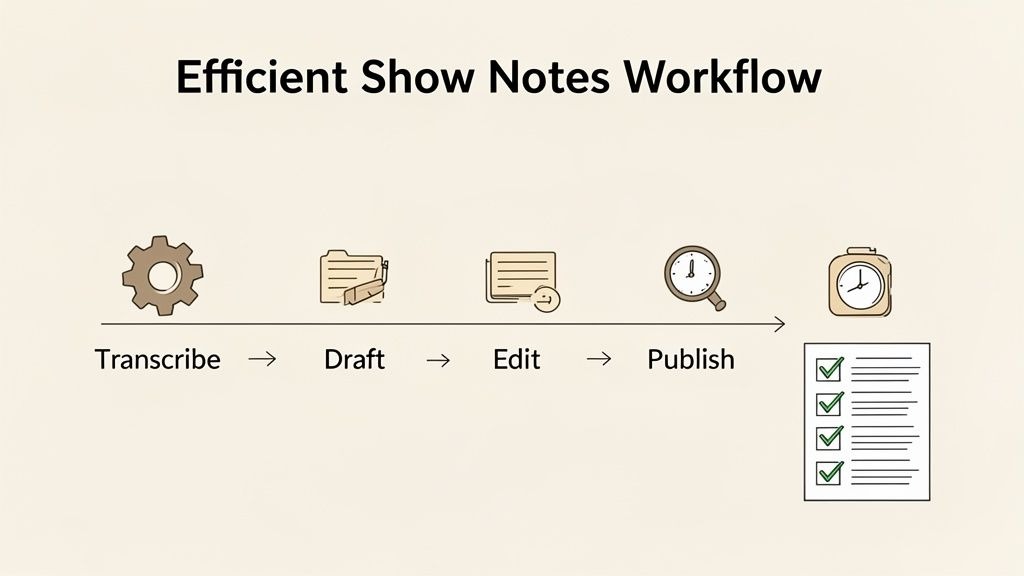
Our Four-Step B2B Show Notes Workflow
A reliable workflow gets rid of the guesswork. By breaking the process down into distinct stages, you can delegate tasks, set clear deadlines, and use the right tools at the right time. Nothing slips through the cracks. This systematic approach is a core part of a solid podcast production workflow.
- Transcription and Foundation: It all starts the moment your episode audio is locked in. The first job is to get a full, accurate transcript. This is the raw clay you'll sculpt everything else from. Services like Descript or the tools built into Riverside can automate this, saving you a ton of manual effort and giving you a searchable text version of the entire conversation.
- Drafting and Structuring: With the transcript ready, it's time to pull out the good stuff. A writer or content manager dives in to identify the key takeaways, memorable quotes, and any important resources mentioned. Using the transcript as a guide, they draft the initial summary and map out the timestamps, turning a raw conversation into a structured, coherent outline.
- Editing and Optimization: This stage is all about polish. An editor reviews the draft for clarity, tone, and accuracy. They’ll sharpen the episode title, punch up the summary, and double-check that all the links work. This is also where the SEO magic happens, weaving in target keywords and optimizing headers to help you get found.
- Publish and Promote: Once the show notes get the final green light, they're published alongside the episode. But the work doesn't stop there. The final step is handing off the finished components (like those killer quotes and the snappy summary) to your marketing team so they can blast it out on social media and in newsletters.
Tools to Supercharge Your Process
The right tech can take your workflow from a slow, manual slog to a fast, efficient machine. Here are a few tools we lean on:
- AI Transcription Services: Tools like Riverside and Descript deliver fast, impressively accurate transcripts that are the bedrock of great show notes. Many can even identify different speakers automatically, which is a huge time-saver.
- AI Writing Assistants: Platforms like ChatGPT or Jasper can be a massive help for generating first drafts of summaries, brainstorming episode titles, or pulling key themes from a transcript. Think of them as a launchpad for your human editor. Once the editing process is complete, the content can be checked with an AI checker to ensure it reads naturally and doesn’t appear AI-generated.
- Project Management Software: You absolutely need something like Asana or Trello to keep the production train on track. You can create a template for each episode, assign tasks to your team, and see exactly where everything stands, from transcription to publication.
The role of podcast show notes in listener acquisition has skyrocketed. With video podcasts now capturing 41% of US audiences, text-based notes remain critical for SEO in a vast ecosystem of over 4.5 million podcasts. For B2B companies, this text is a key lever for driving download growth. Find out more about how the podcasting landscape is evolving.
A systematic approach, backed by the right tools, is what separates podcasts that publish whenever they get around to it from those that become a consistent, authoritative voice in their industry. The easiest way to keep this whole process organized is with a central document, which is why a powerful podcast editorial calendar template is so critical for keeping your content on schedule.
Measuring the ROI of Your Podcast Show Notes
In the B2B marketing world, there's a simple rule: if you can't measure it, it didn't happen. Your podcast show notes are no exception. Far from being a simple transcript, they are a powerful performance marketing channel. Proving their value is the key to justifying your investment in podcasting in the first place.
This isn't about chasing vanity metrics like total downloads. It's about drawing a straight line from this specific asset, the written companion to your audio, to actual business growth. The goal is to show stakeholders that your podcast isn't just building brand awareness; it's a measurable engine driving real results.
Key Performance Indicators to Track
To really prove the value of your show notes, you need to track a mix of SEO, engagement, and conversion metrics. Each one tells a different part of the story, from how people find you to what they do once they're there.
- SEO Metrics: These numbers show how well your notes are pulling in an organic audience. Keep an eye on your keyword rankings for the target terms you picked for each episode. You'll also want to monitor organic traffic to your show notes pages in Google Analytics. This tells you exactly how many new visitors you're reeling in from search.
- Engagement Metrics: Once someone lands on your page, do they stick around? Look at the time on the page. Are people actually reading your summary and takeaways? A high bounce rate might be a red flag that your title isn't matching what's in the content.
- Conversion Metrics: Here’s where the real B2B value shows up. This is all about tracking the click-through rates (CTR) on your calls-to-action. How many people are actually clicking the link to download your latest industry report, sign up for a webinar, or request a demo?
Setting Up Your Measurement Framework
You can't track what you don't set up. The best way to measure the impact of your show notes is by using tracking links and setting up specific goals in your analytics platform.
Slap UTM parameters on every single link in your show notes that point back to your site. This allows you to tag traffic coming specifically from that episode's notes. You'll see exactly which episodes are driving the most valuable actions, whether it's resource downloads or demo requests.
By isolating the traffic and conversions generated directly from your show notes, you can build a clear, data-backed case for your podcast's contribution to the marketing pipeline. It transforms the conversation from "people are listening" to "this episode generated X qualified leads."
This level of tracking gives you the power to sharpen your content strategy. You can double down on the topics and guest types that actually move the needle.
For a deeper dive, check out our complete guide on how to measure podcast performance, which covers a wider range of metrics for your entire show. By connecting your show notes to real business outcomes, you prove they’re an indispensable part of your B2B marketing machine.
Your Podcast Show Notes Questions, Answered
Alright, let's tackle some of the most common questions B2B marketers have when they start getting serious about their show notes. Think of this as your quick-start guide to sidestepping the usual pitfalls.
How Long Should My Show Notes Be?
There's no magic word count, but for the summary, the sweet spot is usually around 200-400 words. That’s just enough to give a busy executive the gist and hook them into listening without making them feel like they're reading a novel.
But the summary is just the appetizer. Truly great podcast show notes are layered. They should also include:
- A bulleted list of key takeaways for the skimmers.
- A timestamped outline for anyone looking to jump to a specific section.
- A full list of every single resource or guest link you mentioned.
And if you toss in a full transcript? The page gets much longer, which is a massive win for SEO. The real goal is to serve two people equally well: the one who wants a 30-second overview and the one who wants to go deep.
Should I Really Bother with a Full Transcript?
Yes. A thousand times, yes. Your summary is for humans, but that full transcript is an SEO powerhouse. It's the single best thing you can do to make every word spoken in your episode discoverable by Google.
Think about it. Your summary might hit a few of your main keywords. Your transcript, on the other hand, is packed with hundreds of long-tail keywords and niche industry phrases your ideal customer is typing into the search bar right now. It dramatically increases your odds of ranking for super-specific queries. Plus, it makes your content accessible to a much wider audience. It's a no-brainer.
Show Notes for an Interview vs. a Solo Episode: What's the Difference?
The fundamental building blocks are the same, but the spotlight shifts.
For interview episodes, your main job is to make your guest look like a rockstar. Their expertise is the main event.
- Spotlight the guest: Drop in their detailed bio, links to their company and LinkedIn profile, and pull out their most brilliant quotes.
- Build a bridge: You want to make it incredibly easy for your audience to connect with the guest. This turns the episode into a co-marketing asset that they'll be excited to share.
For solo episodes, it's all about your ideas and the logic holding them together.
- Focus on the framework: Use detailed timestamps and clear subheadings to map out your argument. You're guiding the listener through your thought process.
- Give them the tools: Link out to every resource you mention. If you're explaining a methodology, make it easy for them to follow along and put it into practice.
Can I Just Use AI to Write My Show Notes?
You can, but you shouldn't rely on it completely. AI tools are incredible assistants, but they're terrible bosses. Use them to speed up your process, not to replace your strategy.
AI is fantastic for tasks like:
- Transcription: Getting a fast, mostly accurate text version of your audio is a huge time-saver.
- First Drafts: It can spit out a decent summary or pull some potential key takeaways to get you started.
- Brainstorming: Stuck on an episode title? Ask AI for a few ideas to get the creative juices flowing.
But a human absolutely must have the final say. An AI can't capture the unique nuance of a conversation, match your brand's specific voice, or write the strategic, context-aware calls-to-action that actually drive business. That part is still on you.
Ready to turn your B2B podcast into a lead-generating machine with show notes that work? At Fame, we specialize in producing podcasts that drive measurable business growth. Learn how our expert team can build a strategic podcasting engine for your brand.
Want us to run this for you?
Fame starts and grows B2B podcasts that generate pipeline. Tell us who you are trying to reach and we will send a costed proposal within 48 hours.
Related content
- Read moreFame Team · July 16, 2026
10 Account Based Marketing Tactics For B2B Growth In 2026
Discover 10 actionable account based marketing tactics for B2B tech. Learn to use podcasts, data, and targeted content to close high-value accounts. - Read moreFame Team · July 16, 2026
The 8 Best Brighton Podcast Agency Picks For 2026
Find the best Brighton podcast agency for your B2B brand. Our 2026 guide reviews top 8 agencies for production, growth & ROI. Expert analysis here - Read moreJune 10, 2026
20 Best Podcast Production Agencies For 2026 (And Why Should You Hire One)
Global podcast and vodcast ad revenues are on track to hit $5 billion in 2026 , up 20% year-on-year. - Read moreApril 13, 2026
Leadership In Marketing: The B2B Podcast Playbook
Most companies still confuse leadership in marketing with job titles, org charts, and budget control. That's outdated.