

Event videography is about capturing live events on video, but that’s just scratching the surface. The real magic is turning those fleeting moments into high-quality marketing assets you can use for months, or even years. It's not just about hitting "record"; it's about building a clear plan to capture footage that helps you hit long-term business goals like generating leads and building your brand.
Turning Fleeting Moments into Evergreen Assets
Think of your last big event as a temporary stage. Once the lights went down and the attendees headed home, what was left? For a lot of marketers, the answer is a frustrating "not much." A huge chunk of the budget gets spent on a single point in time, with little to show for it afterward beyond a few photos and a thank-you email. This is the classic headache: proving the ROI on a big expense that feels like it vanished into thin air.
But what if you treated that event not as a one-off cost, but as a content goldmine? This is where strategic event videography flips the script. It reframes the entire purpose of your event from a singular experience into the kick-off for a year-long marketing campaign.
Beyond the Highlight Reel
Your goal is to move way past the traditional, one-and-done highlight video. We're not just making a sizzle reel. Instead, you're building a whole library of diverse content that serves different purposes all the way through your marketing funnel. This means you have to plan what you're going to capture long before the first guest arrives.
Here's an actionable checklist to get started:
- Action Item: Plan for Authority. Brief your video team to get full recordings of your keynote speeches and panel discussions. These are perfect for establishing your company as a genuine thought leader.
- Action Item: Capture for Engagement. Instruct your crew to capture short, dynamic clips of people networking and those key "aha!" moments. These are dynamite for social media.
- Action Item: Film for Leads. Use insightful snippets from your sessions as lead magnets or to get people excited about your next webinar.
- Action Item: Record for Conversions. Nothing sells like social proof. Film authentic attendee testimonials on the spot; they're incredibly powerful assets for your sales team.
This approach transforms your event into a powerful B2B marketing engine. The key is to start with the end in mind, planning exactly how you'll use every piece of footage. You can get a ton of ideas by exploring different content repurposing strategies that show you how to turn a single event into dozens of marketing pieces.
The demand for this kind of video isn't just a trend; it's a fundamental shift. The corporate video production market is exploding, with industry spending projected to shoot past $30 billion by 2026. This makes sense when you see that over 85% of companies now count on video as a primary marketing tool.
Event video is no longer just a record of what happened. It’s a strategic asset designed to make things happen, drive leads, build trust, and prove the lasting value of your brand's live experiences.
Event videos are incredibly powerful assets, but they have to be made with purpose. To really maximize their impact, it helps to apply proven strategies for creating product videos that convert. Thinking this way forces you to capture every second of footage with a clear marketing goal in mind. When you embrace this approach, you turn a single day's investment into a continuous stream of valuable, evergreen content.
The Event Videography Production Blueprint
Great event videos don't just happen. They're the product of a surprisingly deliberate, phased approach that anyone can execute.
Think of it like building a house. You wouldn't just start throwing up walls, right? You need an architect to draw up the blueprint (pre-production), a crew to build the thing (production), and then a team to handle the interior design and finishing touches (post-production).
Every single phase is critical. A shoot without a plan leads to chaotic, unusable footage. And even the most beautiful shots can fall completely flat if the editing is weak. Knowing this blueprint puts you, the marketer, in the driver's seat. You can steer the project, explain your vision, and ensure the final videos actually hit your business goals.
This whole process is about transforming a live event into a library of marketing assets you can use for months, or even years.
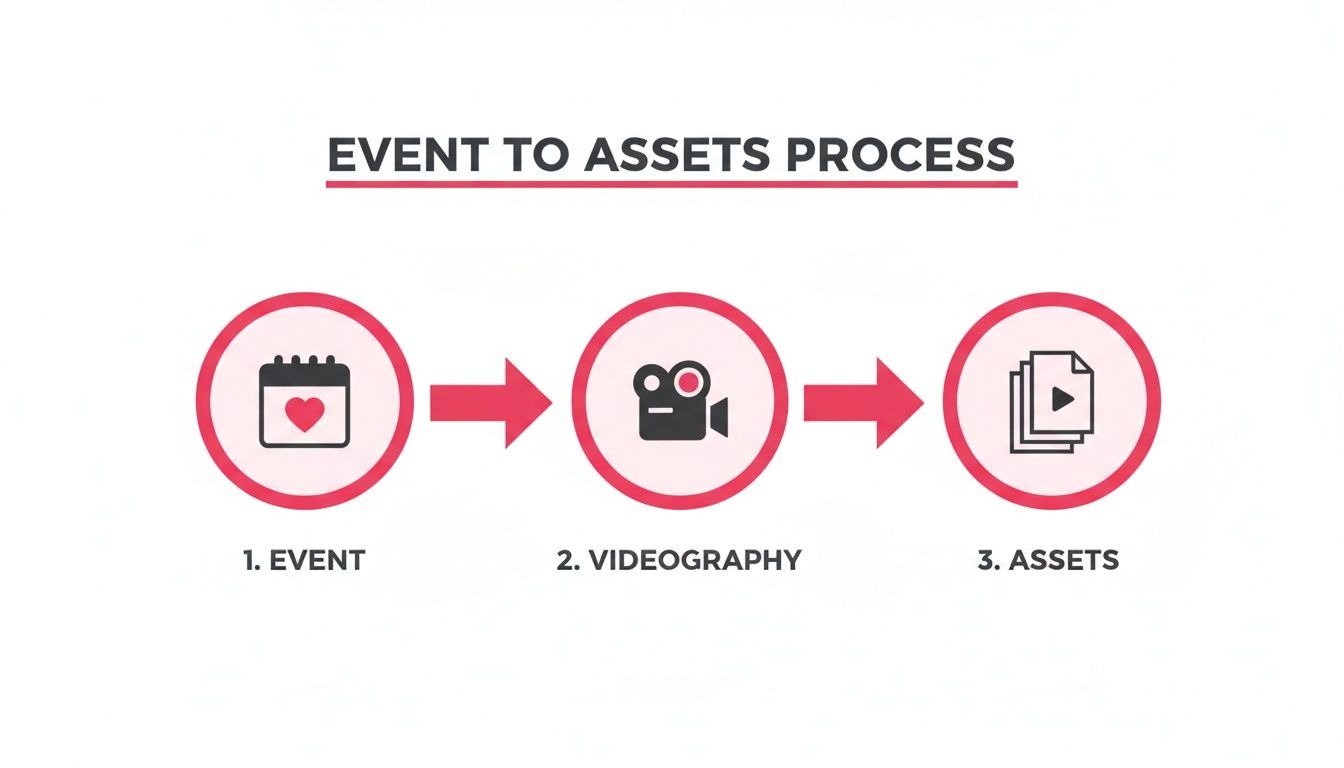
This visual captures a key mental shift: the event isn't the end product. It’s the raw material. Videography is the factory that turns it into something valuable for the long haul.
Phase 1: Pre-Production and Strategic Planning
This is where the magic really begins, the architectural phase. I can't stress this enough: this is the most important stage. Every single decision you make here directly shapes the final videos. If you rush the planning, you’ll end up with generic, forgettable content that misses the mark entirely.
A core piece of this phase is the shot list. Think of it like a chef's recipe. It's a detailed list of every single "ingredient" (each shot) needed to create the final dish (your video). It’s the document that guarantees the crew captures everything from wide shots of the packed room to close-ups of speaker reactions and those carefully placed event banners.
Here's your essential pre-production checklist:
- Define Your Story: What’s the core narrative? Is this story about community? Innovation? Customer success? Get specific and write it down in one sentence.
- Build a Detailed Shot List: Itemize every single shot you need. Keynotes, breakout sessions, networking, attendee interviews, get it all down on paper.
- Scout the Venue: Check out the lighting. Listen for potential audio problems like echoes. Figure out the best spots to place cameras before the event starts.
- Schedule Key Interviews: Don't leave it to chance. Pre-book time with your star speakers, executives, and happiest customers to lock in their soundbites.
- Brief the Crew: Get on a call with the video team. Make sure they understand your brand guidelines, your key messages, and what you’re trying to achieve.
Failing to plan is planning to fail. A solid pre-production process makes sure your investment is focused from the get-go.
Phase 2: Production and On-Site Execution
With a solid blueprint in hand, the production phase is where the plan comes to life. On event day, your job is to work alongside the video crew, almost like an on-site director, to make sure the plan is executed. This is where a professional team really earns its keep.
One of the tell-tale signs of a high-quality production is a multi-camera setup. Using a few cameras at once gives you different angles of the same moment. This is huge for the editors later on, as they can cut between a wide shot of the stage and a tight close-up of the speaker, making the final video way more dynamic and engaging.
Pristine audio is non-negotiable. People will forgive a video that’s a little shaky, but they will click away instantly if the audio is bad. A pro crew uses dedicated mics for speakers and for capturing room sound to ensure every word is crystal clear.
The focus on-site is capturing both the planned shots and the spontaneous moments that give an event its energy. The crew needs to be nimble enough to catch candid networking, genuine audience reactions, and those impromptu testimonials that add a layer of authenticity you just can't script.
Phase 3: Post-Production and Storytelling
This is the final leg of the journey. Post-production is where piles of raw footage are molded into a polished, compelling story. It’s a mix of art and science, where editing, sound design, and motion graphics all come together. The editor steps in as the storyteller, weaving the best shots into a narrative that connects with your audience.
This process involves a few key steps:
- Footage Organization: First, the team has to sort through hours of footage, logging everything and pulling out the strongest takes and soundbites.
- Rough Cut: They assemble an initial version of the video. This is all about getting the story structure and pacing right.
- Fine-Tuning: Next comes the refinement. The edit gets polished with color correction, audio mixing, and the addition of music that fits the mood.
- Graphics and Branding: Finally, motion graphics like lower-thirds for speaker names, branded intros, and clear calls-to-action are added to make the video unmistakably yours.
It's a meticulous process, but it's what ensures the final videos aren't just watchable, they're effective marketing tools. For a closer look at how a dedicated team manages these phases, you can check out the workflow behind professional end-to-end video production services. This is how you guarantee every asset is polished, on-brand, and ready to get you results.
Unlocking Your Key Video Deliverables
So you’ve decided to capture your event with a professional video crew. Smart move. Now what?
The real magic isn’t just getting a single, slick highlight reel. It’s about turning that one event into a full-blown content campaign that feeds your marketing calendar for months to come. This is where you graduate from simply recording an event to strategically producing a menu of powerful marketing assets.
A single day of shooting can arm you with a surprisingly diverse arsenal of videos. Each one is custom-built to grab your audience at different points in their journey. By planning these deliverables before the first camera even rolls, you guarantee the production team captures exactly what you need to build out a robust content library.
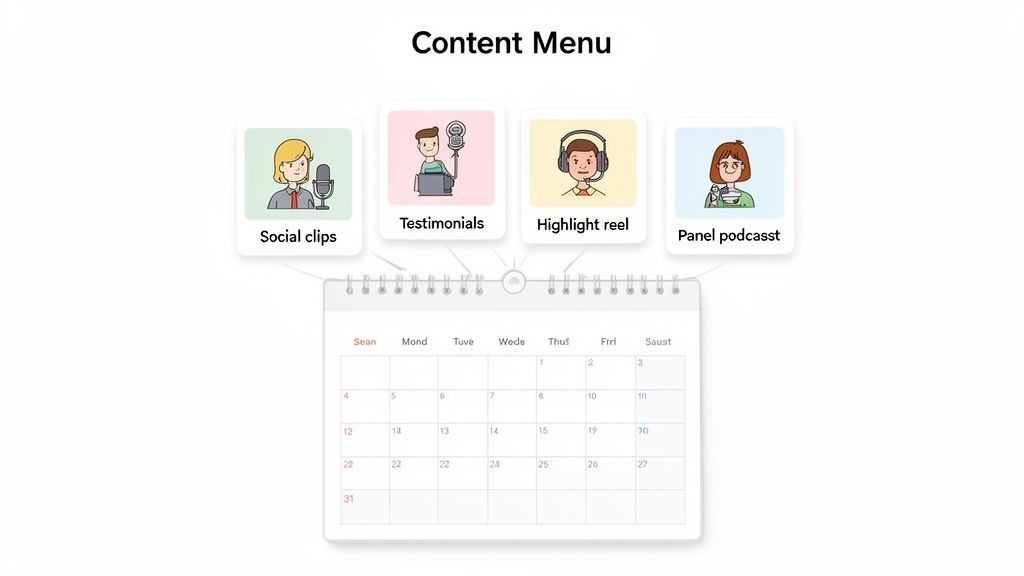
This kind of strategic thinking is what transforms your event footage from a simple recap into a legitimate engine for lead generation, brand building, and sales enablement.
Let’s break down what that looks like in practice. Use this quick-reference table to plan your deliverables and how to put them to work.
Event Videography Deliverables and Their Marketing Applications
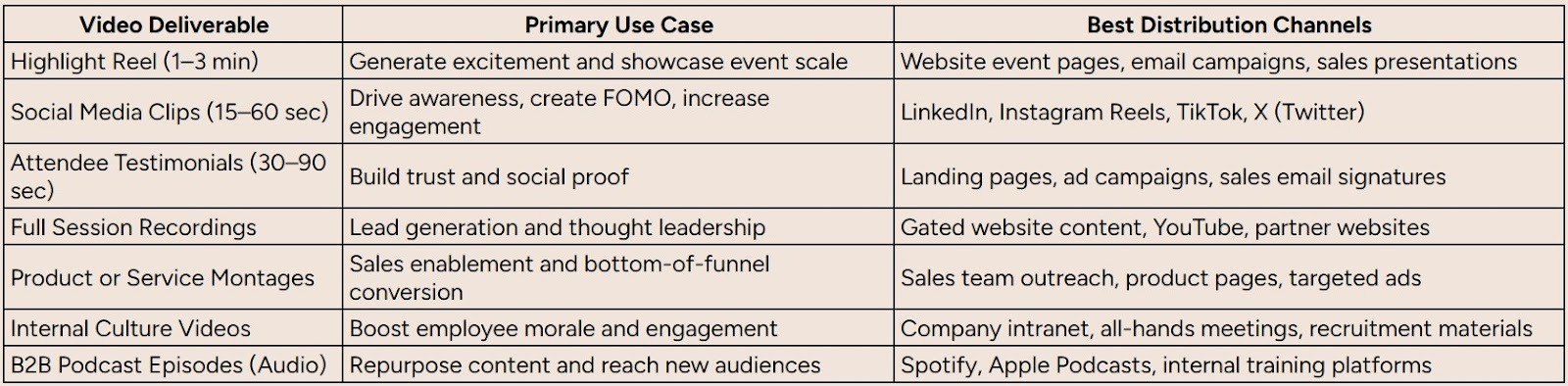
Each of these deliverables plays a specific role. By mapping them out, you ensure every shot captured on the day has a purpose, maximizing the return on your investment.
Top-of-Funnel Assets for Awareness
At the top of the funnel, the name of the game is grabbing attention. The content needs to be short, energetic, and incredibly easy to share.
- The Main Highlight Reel (1-3 minutes): This is your bread and butter. It’s a fast-paced, high-energy sizzle reel that bottles up the event's atmosphere, key moments, and overall vibe. Your Action: Drop it on your website's event page, use it in email campaigns to sell tickets for next year's event, and have it ready to kick off your next big presentation with a bang.
- Social Media Teaser Clips (15-60 seconds): Think bite-sized, vertical videos made for platforms like LinkedIn, Instagram, and TikTok. We're talking quick cuts of speakers, candid networking shots, and crowd reactions, all set to some killer music. Your Action: Use these clips to create buzz and drive traffic directly to a higher-value asset, like a full session recording.
Mid-Funnel Assets for Nurturing and Trust
Once you’ve got someone’s attention, you need to build credibility and earn their trust. This is where mid-funnel content comes in, offering more substance and showcasing real expertise.
Authentic social proof is one of the most powerful tools in B2B marketing. Capturing genuine, unscripted reactions from attendees provides a level of credibility that polished ad copy can never achieve.
Here are the key assets for this stage:
- Attendee and Speaker Testimonials (30-90 seconds): This is non-negotiable. Your Action: Pull aside happy attendees and speakers for quick, informal interviews. Ask them about their biggest "aha" moment or what they loved most. These clips are pure marketing gold for landing pages, sales emails, and social proof ad campaigns.
- Full Session Recordings: Don't let your best content die on the stage. Record your keynotes and most popular panel discussions in their entirety. Your Action: Put this high-value content behind a form on your website. This is a classic, effective strategy for generating leads. It delivers huge value to people who couldn't be there and cements your company as an industry authority.
Bottom-of-Funnel and Internal Assets
Down at the bottom of the funnel, video can be the final push that helps your sales team close deals. It’s also a great way to reinforce company culture internally.
- Product or Service Montages: If your event featured demos or deep dives into your offerings, edit those moments into a focused video. Your Action: Create a dedicated video library for your sales team to send to prospects who are on the fence and deep in the decision-making process.
- Internal Culture and Recap Videos: Don’t forget about your own team! Create a separate, behind-the-scenes video just for them. Highlighting their hard work and celebrating the event's success is a fantastic way to boost morale and foster a sense of shared victory.
Repurposing for Thought Leadership
Beyond the usual video formats, your event footage is raw gold for building a thought leadership platform.
A prime example is stripping the audio from panel discussions or keynote presentations to create B2B podcast episodes. This strategy breathes new life into your content and connects you with an entirely new audience, the people who prefer to listen on their commute or at the gym.
For massive events like conferences and conventions, having a clear plan for your trade show videography is essential to capture the sheer volume of content needed for this level of repurposing. It ensures you walk away with high-quality audio and video from every important session, ready to be transformed into compelling podcast episodes that establish your brand as a leader in its field.
Choosing Your Ideal Production Partner
Finding the right creative partner is easily the most critical decision you'll make. This one choice directly impacts the quality, the strategic thinking, and ultimately, the ROI of your video content.
The right partner does way more than just point a camera; they become a true extension of your marketing team. They get inside your head, understand your goals, and know how to turn them into a compelling visual story.
The world of production partners is vast, running from one-person operations to full-blown agencies. Each has its pros and cons, and the best fit really depends on the scale of your event and what you're trying to achieve with your marketing. Making the wrong call can result in a hard drive full of footage that doesn't move the needle for your business.
Freelancer vs Production Company
A solo freelancer can be a fantastic shooter, perfect for smaller events where you just need simple, clean documentation. Think about capturing a single keynote or a small workshop. They’re usually easier on the budget and a great choice for straightforward jobs.
But here's the catch: relying on one person is risky. If they get sick or a key piece of gear dies on them, you’re left with no backup plan.
A production company, on the other hand, shows up with a full crew and a strategic game plan. They handle everything from pre-production calls and on-site direction to the complex editing workflows after the event wraps. Their model is built for scale and reliability, bringing multiple camera ops, dedicated audio engineers, and project managers to make sure nothing falls through the cracks. For big corporate conferences, trade shows, or multi-day events, their comprehensive approach is a must.
The real value of a great production partner isn't just their technical skill, it's their strategic input. They should be asking why you're creating the video and helping you map the footage back to specific marketing goals, ensuring every shot has a purpose.
You've got to look past the fancy demo reel. Dig into their experience in corporate settings, their ability to handle the pressure of a live event, and their grasp of B2B marketing. Their portfolio shouldn't just show pretty shots; it should prove they can create videos that drive real business results. For a deeper dive, check out the key qualities that define a professional corporate videographer who can really sync up with your brand.
Decoding Pricing Structures
Budgeting for event video can feel like a guessing game because the pricing models are all over the place. Getting a handle on the common structures will help you set realistic expectations and actually compare quotes apples-to-apples.
You’ll typically run into two main pricing models:
- Day Rates: This is common with freelancers or for simple, single-day shoots. A videographer charges a flat fee for a set number of hours on site (like an 8-hour day). Post-production and editing are usually billed on top of that, either hourly or as a separate package. It can be cost-effective for simple jobs, but costs can spiral if the editing gets complicated.
- Project-Based Fees: This is the standard for most production companies. They’ll give you a single, all-in price that covers the entire project from start to finish. That means all the strategy calls, the full crew, and all the editing work needed to deliver a specific list of videos. This model gives you budget certainty and ensures your partner is focused on delivering the final product, not just billing hours.
Essential Questions for Potential Partners
To make sure you find a partner who brings both creative firepower and strategic smarts, you have to ask the right questions. Here's a quick checklist to guide your vetting process:
- Strategic Input: How will you help us connect this video content to our actual marketing goals?
- Team Structure: Who exactly will be on-site, and what are their specific roles (director, audio tech, camera ops)?
- Corporate Experience: Can you show us videos you've produced for other B2B companies in our space?
- Contingency Plans: What’s your backup plan if equipment fails or someone on the team gets sick?
- Deliverables and Timeline: What specific videos are we getting, and what's the turnaround time for editing?
- Revision Process: How many rounds of feedback are included for the main videos?
Asking these questions takes the conversation beyond just price. It becomes a discussion about value, reliability, and strategic fit, and that’s how you find a real partner who will help turn your event into a marketing engine that keeps on running.
Executing a Flawless Event Shoot
A truly great event video doesn’t just happen on the day of the shoot. It starts weeks, sometimes months, before the first camera even gets switched on. The most engaging event videography comes from obsessive planning, which turns what could be a chaotic mess into a smooth, creative process.
Think of it this way: a proactive plan helps you see around corners. You can anticipate problems, slash on-site stress, and let your production crew do what you hired them for: create something amazing.
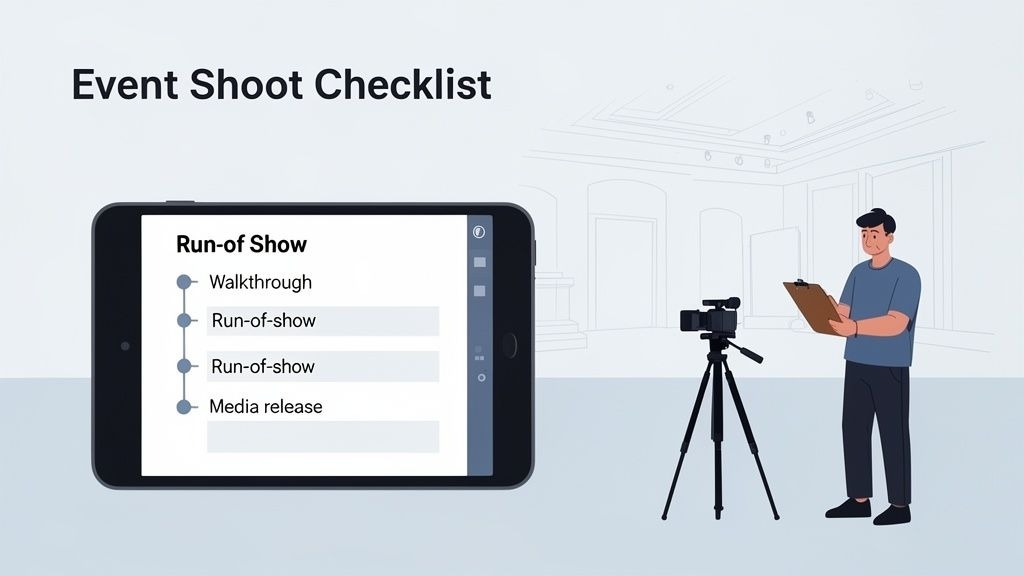
This kind of careful preparation is becoming the norm. The event industry is moving away from pure spectacle and toward measurable impact. Attendees are constantly bombarded with visual noise, so their attention is a precious resource. For B2B companies, this makes every single moment you capture that much more important for hitting your ROI goals. You can get a deeper dive into these industry trends and intentional event strategies on bizbash.com.
Your Pre-Shoot Action Checklist
To give your crew the best shot at success, you have to treat the weeks before the event as a critical planning phase. Your detailed brief and clear logistics are the foundation for everything that follows.
Here’s your action plan for what absolutely has to get done:
- Do a Venue Walkthrough: Get your video team lead to the location with you. You need to scout the best spots for cameras, hunt for power outlets, and listen for audio gremlins like a loud HVAC system or a nasty echo. This one step can save you from massive headaches later.
- Create a Detailed Run-of-Show: Don’t just forward the generic event schedule. Make a specific shot list for the video crew that highlights the "must-capture" moments, the keynote speaker’s big entrance, a key product demo, or the final award ceremony.
- Brief Your Speakers and Interviewees: Give anyone who will be on camera a heads-up. A quick chat helps them feel more comfortable and prepared, which always leads to more natural and compelling footage. It’s a small thing that makes a huge difference.
On-Site Best Practices for a Smooth Operation
When the event finally kicks off, solid communication is your best friend. Even the most detailed plan can fall apart without a good on-site execution strategy.
The goal is to solve problems before they happen. A dedicated point-of-contact for the video team is invaluable, as it prevents the crew from having to pull multiple stakeholders away from their duties to ask logistical questions.
This simple detail can be a game-changer for efficiency. Here are a few more actionable tips:
- Provide Brand Guidelines Upfront: Hand over your logo files, brand colors, and font information ahead of time. This helps the crew frame shots correctly and seriously speeds up the post-production timeline.
- Secure Media Releases: Figure out a simple process for getting consent from attendees who might be featured prominently. Clear signage or a waiver at the registration desk can usually cover your legal bases.
- Trust Your Crew: You hired professionals for a reason. Once the plan is locked in, empower them to do their job. Give them the creative freedom to capture those amazing, spontaneous moments you could never script.
At the end of the day, a seamless shoot is the direct result of a collaborative, well-prepared partnership. While these steps give you a solid framework, working with an experienced partner can make all the difference. An agency offeringE nd-to-End Video Production Services for Businesses handles these logistics intuitively, letting you focus on making your event a massive success.
Measuring Success and Maximizing Your ROI
Getting incredible footage in the can is a huge win, but let's be honest, it's only half the battle. The real magic, the part that makes your event videography investment pay off, happens next. It's all about smart distribution and meticulous measurement. This is how your video clips stop being just "content" and start driving real business results.
A solid distribution plan is your roadmap to maximizing impact. Don't just toss a highlight reel on your website and call it a day. Think bigger. Think about a multi-channel campaign that meets your audience right where they live online.
- Social Media: Drop short, high-energy clips on LinkedIn to create buzz and pull people back to your site.
- Email Campaigns: Weave compelling testimonial videos into your nurture sequences to build that all-important trust.
- Website and Landing Pages: Embed full session recordings or highlight reels to keep visitors on your pages longer and capture more leads.
- Sales Enablement: Give your sales team the ammunition they need, powerful video case studies and product demos, to close deals faster.
Tracking Metrics That Matter
To prove your efforts are working, you have to look past vanity metrics like view counts. They feel good, but they don't pay the bills. True ROI is measured in tangible outcomes. A critical part of any event video strategy is proving its business impact; learning how to measure marketing ROI is non-negotiable if you want to prove your value.
Forget obsessing over views. Instead, focus on the numbers that connect directly to your bottom line. We're talking about things like lead generation from gated video content, pipeline influence from your sales enablement assets, and audience engagement rates on key social platforms. For a deeper dive on this, check out our guide on how to calculate marketing ROI.
The explosion of hybrid events has also opened up exciting new ways to engage and measure. This model has completely changed how B2B companies think about their audience. In fact, one study found that a staggering 86% of B2B organizations saw a positive return on investment within just seven months of running a hybrid event. That tells you event video isn't just about extending reach, it's about actively improving the business.
The ultimate goal is to create a closed-loop system. A system where you can directly trace leads, pipeline, and cold, hard revenue right back to your video content. This is how you justify the budget and prove the lasting value of your entire event strategy.
This final stage is where it all comes together. Putting a sophisticated distribution and measurement plan into action can be tricky, which is why it pays to work with a team that gets the full content lifecycle. The right partner won't just capture amazing footage; they'll help you build and execute a plan that drives real, repeatable growth.
Got Questions About Event Videography? We've Got Answers.
Jumping into event videography can feel like a lot, but don't worry. It's actually pretty straightforward once you get the basics down. Here are the most common questions marketers ask, the stuff you need to know to plan your next shoot and knock it out of the park.
So, when should you book a video crew? Get your partner locked in 2-3 months in advance. I can't stress this enough, especially for the big stuff like conferences or trade shows.
That buffer is gold. It gives everyone enough time to actually plan: to walk the venue, map out the perfect shots, and get the whole crew completely dialed into what you’re trying to achieve. It’s the difference between showing up to film and showing up to create assets that actually move the needle.
Solo Shooter vs. Production Company?
This one trips people up all the time. Think of it like this: a single videographer is perfect for capturing a specific moment, like one keynote speaker or a small, intimate workshop. They’ll handle the camera and maybe some light editing.
A full production company, on the other hand, is your end-to-end strategic partner. You're getting a whole crew, directors, multiple camera ops, audio engineers, plus all the high-end gear and a post-production team to back it up. If your goal is to walk away with a library of B2B marketing content, a production company gives you the scale and strategy to make it happen.
Look, the camera on your phone is amazing. But it has no place at a corporate event. Professional videography means you're guaranteed clean audio, stable and beautifully framed shots, and consistent lighting. More importantly, it brings the strategic eye needed to build polished assets that make your brand look as good as it is.
How Much Should I Budget?
Alright, let's talk money. The honest answer? It depends. The cost swings wildly based on the size of your event, how long it runs, and how many finished videos you need on the other side.
For a small, one-day event with a single shooter, you might be looking at a few thousand dollars. But for a multi-day conference that needs a full crew and a ton of editing, you're likely in the $15,000 to $50,000+ ballpark.
The best approach is to figure out your marketing goals first. Once you know what you need the videos to do, you can find a team and a quote that aligns with those objectives.
Pulling off a professional event shoot has a lot of moving parts, but you don't have to manage it all alone. At Fame, we specialize in making this process seamless.
If you want a partner to handle everything from pre-production strategy to delivering killer video assets that get results, check out our End-to-End Video Production Services for Businesses.
