
Key Takeaways
- Hiring a professional video crew can transform a trade show into a content engine.
- Capturing specific assets like customer testimonials and product demos can fuel marketing for months.
- A well-planned video production can deliver measurable results and maximize event budget returns.
You're spending a small fortune to be at that trade show. The booth, the travel, the team's time—it adds up fast. The real question is, how do you make that investment work for you long after the event wraps up? For a deep dive into what's involved, explore our comprehensive trade show videography services.
The answer isn't just about scanning badges. It's about turning your expensive event presence into a content engine that runs for months. This is where strategic trade show video production comes in. We're talking about hiring a professional video crew to capture specific assets right there on the show floor. It's the secret to transforming a three-day sprint into a marketing marathon.
This guide is your actionable playbook for getting a massive return on your event budget by maximizing what your video crew films on-site.
Turn Your Trade Show Booth Into a Content Goldmine
If you've ever packed up your booth on the last day and wondered, "Was that really worth it?"—this is your plan to make that investment pay dividends long after everyone's gone home.
We're going to break down exactly what your video crew should be filming on-site. The goal is to walk away with a hard drive full of gold, turning that temporary booth into a permanent source of high-impact marketing assets.
Forget generic b-roll. We’re giving you a practical shot list that covers everything from pre-event hype reels to post-show lead nurturing videos.
Your Actionable Filming Framework
With the right plan, you'll come home with a library of footage you can chop up and use everywhere. Here's exactly what to have your video crew capture to fuel your marketing for the next six months:
- Powerful customer testimonials that provide instant social proof for your website and sales team.
- Crisp product demos that clearly show your solution in action, perfect for landing pages.
- Quick-hitting expert interviews with your team to establish thought leadership on social media.
- A high-energy "sizzle reel" of your booth to create FOMO for the next event.
- Authentic behind-the-scenes content that puts a human face on your brand.
By the time you're done reading, you'll have a production plan that can fuel your content calendar for the next six months. Every dollar you spend on a crew will deliver measurable results.
Once you've got all that great footage, our guide on content repurposing strategies will show you how to multiply its value. And remember, great conversations at the booth are often sparked by effective promotional products that people actually want.
Why Video Is Your Most Powerful Tool on the Show Floor
Before you even think about a shot list, let's get one thing straight: professional video at a trade show isn't a "nice-to-have." It's your most critical asset. The show floor is pure sensory overload—a chaotic mess of noise, crowds, and competing messages where your beautiful new banners and brochures just become part of the background hum.
In that kind of environment, video isn't just another piece of content. It’s a magnet.
Think about the sheer efficiency. A tight, 90-second explainer can nail your complex B2B value prop with more punch than a 10-minute pitch from even your best sales rep. It's your perfect spokesperson, delivering a flawless, consistent message every single time, even when your entire team is swamped. Video is what turns a passive passerby into an engaged, educated prospect.
Build Instant Trust and Credibility
One of the toughest jobs at any event is cutting through the skepticism. Attendees are getting hit with sales pitches from every angle, so their guard is naturally up. This is where authentic video, especially testimonials, completely changes the game.
When you capture a happy client on camera, right there at your booth, you're creating undeniable social proof. Their genuine, unscripted praise for your product is infinitely more powerful than any marketing copy you could ever write. It’s a raw, real endorsement that slices through the sales noise and builds immediate credibility with prospects. They see someone just like them who's already found success with you.
"A great video can create an emotional connection before a conversation even begins. It transforms a booth from a simple sales station into an engaging experience, drawing people in and starting the relationship on the right foot."
Capture Attention and Drive Action
Let's be honest, the first goal of any booth is just to stop people in their tracks. A dynamic, professionally shot video loop on a big screen will always beat a static graphic. It's the visual equivalent of a firm, friendly handshake that invites people to stop and see what you're all about.
Different types of video can do different jobs, too. A high-energy sizzle reel can inject some life into your brand, while a crystal-clear product demo can answer a prospect's biggest questions before they even ask. For a deeper look at the various formats, check out our complete guide to business videography.
And the data backs this up. A massive 84% of consumers say they want to see more video from brands. It’s not a fad; it’s a fundamental shift in how people want to learn. The numbers also tell us what works best: explainer videos are the top request at 68%, with video testimonials coming in strong at 57%. These aren't just interesting stats—they're a clear signal that strategic video is a core pillar of modern event marketing. You can learn more about the power of video marketing statistics and how to apply them.
Your Essential Trade Show Video Shot List
Alright, you’ve got the video crew booked. Now what? Time to put them to work and make sure every dollar of that investment pays off for months to come. This isn't just a list of shots to get; it's a battle plan for walking away from the show with a goldmine of high-impact video assets.
Planning is everything. To make your investment truly count, you'll need a clear vision before your crew even steps on the show floor. If you're new to this, it's worth brushing up on the fundamentals of business videography to build a solid foundation.
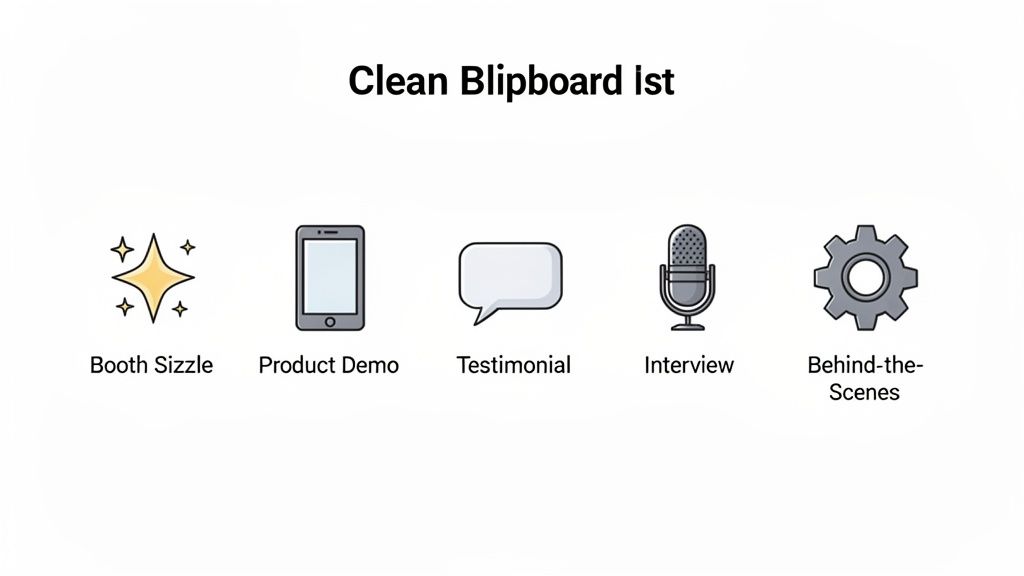
1. The Booth Sizzle Reel
Think of this as the movie trailer for your trade show presence. The sizzle reel is your ace in the hole—a fast-paced, high-energy video, usually 30-60 seconds, that bottles up the life and buzz of your booth. It's your most versatile asset for post-show hype and promoting the next event.
Your crew's mission is simple: capture the excitement. They need to get wide shots of a packed booth, tight shots of your branding, and most importantly, your team engaging with smiling attendees. Dynamic camera movements like slides and pans are your friend here; they create that sense of energy you’re after.
Actionable Filming Tips:
- Focus on People: Capture the handshakes, the laughter, the "aha!" moments. Those genuine human interactions are pure gold for storytelling.
- Show Off Your Brand: Get clean, crisp shots of your booth’s logos, taglines, and any digital displays. This is non-negotiable for brand reinforcement.
- Mix It Up: A good sizzle reel blends wide shots showing the booth's scale with medium shots of demos and close-ups on product details.
2. Live Product Demonstrations
This is where the magic happens. A well-filmed demo is a killer sales tool you can use long after the show floor clears out. Unlike a sterile studio recording, a trade show demo captures your product solving problems in a live, bustling environment, which adds a powerful layer of authenticity.
Tell your videographer to focus on two key perspectives. First, a clear, unobstructed shot of the product in action—think user interface or key physical features. Second, zoom in on the faces of the attendees as they watch. That's where you'll find the "wow" factor.
A great product demo video answers a prospect's biggest questions before they even think to ask them. It takes them from "What is this?" to "I need this" in less than two minutes.
Make sure your presenter is prepped, energetic, and hammers home the benefits, not just the features. And please, don't skimp on audio. Crisp, clear sound is mandatory, so have your crew use a quality lavalier or shotgun mic to cut through the background noise.
3. Candid Customer Testimonials
This might just be the most valuable footage you capture all week. A spontaneous, off-the-cuff testimonial from a happy customer who stops by your booth is marketing dynamite. It's the kind of powerful social proof that is far more credible than any polished corporate message you could ever create.
Find a quiet, well-lit corner of your booth to pull customers aside. The background should be clean and feature your branding, but the star of the show is the customer. Just ask them to speak from the heart about the specific problem your product solved and the results they've seen.
Key Questions to Ask:
- What was your biggest challenge before you started working with us?
- How has our product specifically helped you tackle that?
- What's the most significant result you've seen? (e.g., time saved, revenue up, team happier)
- What would you tell someone on the fence about our solution?
4. Expert and Leadership Interviews
Your trade show booth is a rare opportunity where your company's top minds are all in one place. Seize it. Film short, insightful interviews with your execs, product managers, and lead engineers to establish thought leadership and put a human face on your brand.
The goal isn't a long, meandering conversation. Aim for punchy, 2-3 minute interviews focused on a single topic—a new feature, an industry trend, or your company's vision. These soundbites are incredibly easy to slice and dice for social media, email newsletters, and your website.
5. Main Stage Presentations
If anyone from your team is speaking—whether it's a keynote or a panel—recording it is an absolute must. This is a golden opportunity to capture your company's expertise on a professional stage, positioned as an authority. A multi-camera setup is ideal for capturing the speaker and the audience, but even a single, steady camera shot is better than nothing.
This footage is a content gift that keeps on giving. You can upload the full presentation to YouTube, chop it into short clips for LinkedIn, or even strip the audio for a podcast episode. It’s a powerful way to extend your thought leadership far beyond the people who were physically in the room.
6. Behind-the-Scenes Footage
Finally, don't forget the B-roll. This is all the candid, "behind-the-curtain" stuff that gives your brand personality and makes it feel real. It’s the connective tissue that holds your other videos together and provides an endless stream of content for social media stories.
'Nice-to-Have' Shot Ideas:
- The Build-Up: A time-lapse of your booth being constructed.
- The Team Huddle: Your team getting pumped up before the doors open.
- The Big Picture: Sweeping shots of the trade show floor and venue signage.
- Candid Moments: Your team laughing together, collaborating, and just being human.
We've put together a quick checklist to help you organize your shoot. Think of this as your game plan for capturing a versatile library of video assets.
Trade Show Video Production Shot List
A checklist of essential video assets to capture at your next trade show, organized by priority and potential marketing use.
By following this shot list, you’re not just directing a video crew; you’re building a content engine. You’ll leave the event with more than just a list of leads—you'll have an arsenal of content ready to fuel your marketing for months.
How to Plan a Shoot That Actually Works
Let's be honest: great video doesn't just happen, especially not in the absolute chaos of a trade show floor. It's the direct result of obsessive, meticulous planning.
Think of it this way: you wouldn't show up to build a booth without a blueprint, right? So why would you hire a video crew without a crystal-clear production plan? Success on the show floor is all about the foundation you lay weeks, even months, before the first camera ever comes out of its case.
The whole process really boils down to three distinct phases: Pre-Production, On-Site Production, and Post-Production. Nailing each one is the difference between a stressful, expensive scramble and a seamless, ROI-generating machine.
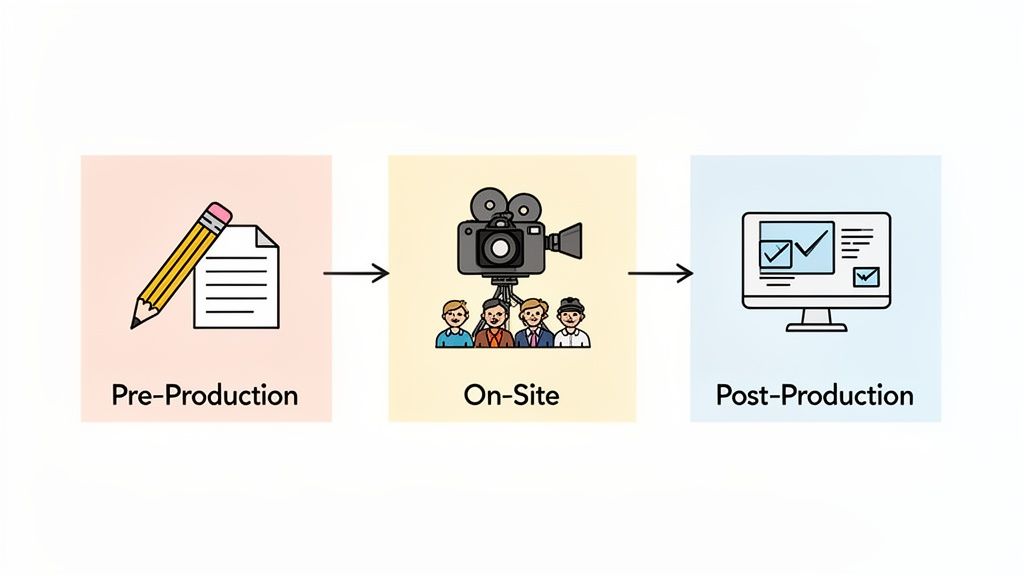
Pre-Production: The Strategic Blueprint
This is where you win or lose the game. Seriously. Pre-production is all about creating an airtight roadmap for your video crew so they know exactly what to capture, who to talk to, and when. The more detail you bake into this plan, the smoother everything will run on the noisy, crowded show floor. Your entire trade show video production strategy lives or dies here.
Your first job is to draft a comprehensive creative brief. This document is your North Star. It needs to clearly outline your goals (leads? brand awareness?), your target audience, the key messages you need to land, and a specific shot list of the videos you need.
With the brief done, you can build out a detailed shooting schedule. This isn't just a simple list of shots; it's a minute-by-minute battle plan that syncs up perfectly with the event's agenda.
- Schedule Interviews in Advance: Lock in times with your execs, partners, and—most importantly—key customers you know will be there. Don't leave your best testimonials to chance.
- Block Time for Demos: Carve out specific slots for filming product demos. Pro-tip: try to schedule these during expected lulls in foot traffic to keep interruptions to a minimum.
- Secure Permissions: Get signed release forms from everyone who will be featured prominently on camera. This is non-negotiable, especially for customer testimonials.
On-Site Production: Executing Under Pressure
Plan in hand, it’s time to execute. The trade show floor is a brutal filming environment. You're fighting unpredictable lighting and a constant roar of background noise. This is exactly where a professional crew earns their keep. Your job is to manage them effectively and direct the on-camera talent to get the absolute best results.
Audio is your biggest enemy. A gorgeous shot with terrible audio is completely unusable. Insist your crew uses high-quality lavalier (lapel) microphones for every single interview and testimonial. This is the only way to isolate the speaker's voice from the surrounding chaos. For lighting, they’ll likely need small, portable LED panels to fill in shadows and make sure your subjects look great without blinding them.
A simple directing trick: Don't ask someone to "give a testimonial." Instead, ask them to "tell me the story" of how your product solved their problem. This one little reframe is the key to getting authentic, compelling soundbites instead of stiff, rehearsed-sounding lines.
Keep your interviews short and to the point. Give your subjects the questions ahead of time so they can gather their thoughts. This helps you get concise, powerful answers that are a dream to work with in the edit.
Post-Production: Shaping Your Story
The show’s over, the booth is packed up, but the real work has just begun. Now you've got a hard drive brimming with raw footage that needs to be organized, edited, and transformed into polished marketing assets. A clear post-production plan is critical for turning all that raw material into a library of valuable content without wasting time or money.
Start by logging all of your footage. This means watching every clip, labeling the good takes, and getting your interviews transcribed. This grunt work up front saves countless hours in the edit bay later. For a deeper look at organizing your assets, check out our guide on the core principles of video production.
From there, create a "paper edit" for each video. This is an old-school trick that works wonders. You literally pull the best soundbites from your transcripts and arrange them into a cohesive narrative on paper before a single clip is touched in the editing software. This forces you to make sure the story is strong and the message is clear from the get-go.
How companies are tackling this whole process is changing, too. The old agency-only model is shifting. Today, 55% of marketers are producing videos in-house. Another 14% outsource the whole thing, while 31% use a hybrid approach. This is happening even though many feel they have an internal skills gap, with 43% reporting a lack of in-house filming and editing talent. You can learn more about the trends shaping video marketing strategies here.
Turn Your Trade Show Footage Into a Content Engine
Your trade show might only last a few days, but the content you capture should fuel your marketing for the next six months.
The event floor is a high-stakes environment. Costs are high, but so is the opportunity. The trick is to stop thinking about your video crew as a day-of expense and start seeing them as an investment in a long-term content factory.
The raw footage you collect is like a block of marble. With a clear plan, you can sculpt it into dozens of high-performing assets. A single shoot day can generate enough material to fill your social media calendar, populate email newsletters, and arm your sales team with killer new tools. This is how you get a massive return on your trade show video production.
From Raw Footage to Marketing Assets
The secret to wringing every drop of value from your footage is simple: repurposing. Every single clip—from a long-form interview to a quick product demo—can be sliced, diced, and remixed into multiple formats. Nothing gets wasted.
Think about a 15-minute interview with your CEO or a key industry partner. That single video file is a content goldmine just waiting to be excavated. With a bit of strategic editing, it can become:
- Five 1-minute social media clips: Each one can zero in on a single, punchy soundbite perfect for LinkedIn, X, or Instagram.
- A full-length podcast episode: Just strip the audio, add an intro and outro, and you have a ready-made podcast.
- A series of quote graphics: Pull the most powerful lines from the transcript and turn them into shareable, visually engaging graphics.
- Snippets for email newsletters: Embed a short, compelling clip in your next email campaign to drive up engagement and click-through rates.
This "create once, publish everywhere" mentality turns one recording session into a month's worth of content. To get the most out of your trade show footage, you'll want a playbook for repurposing video content into a wide array of marketing assets.
The Customer Testimonial Multiplier
Now, let's apply this thinking to one of the most valuable assets you can possibly capture at a trade show: the customer testimonial. That genuine, five-minute chat with a happy client is pure marketing gold.
Don't just post the full video and call it a day. Think bigger. That one testimonial can be transformed into:
- A Powerful Case Study Video: Weave the customer's story together with product shots and on-screen text to create a compelling 2-3 minute video for your homepage or a dedicated landing page.
- Short Social Proof Clips: Edit down the best 15-30 second soundbites into bite-sized clips. These are perfect for social media ads, organic posts, and embedding in sales emails to crush objections.
- A Website Highlight Reel: Stitch together the best moments from several different customer testimonials to create a "wall of love" video that builds instant trust with new website visitors.
- Audio Clips for Sales Calls: Your sales team can use the audio from a testimonial during a call to provide immediate, third-party validation for a claim they just made.
This strategic approach to video is a core piece of any effective B2B marketing machine. For more ideas on how this fits into your bigger picture, check out our guide on how to create a content strategy that drives real results.
By planning your post-production before you even press record, you ensure every shot has a purpose. You're not just capturing moments; you're creating building blocks for future campaigns.
This mindset transforms your trade show video production from a simple event-based task into a sustainable content engine. It's the best way to make sure the conversations and energy from the show floor keep generating leads, supporting sales, and building your brand long after you’ve packed up the booth.
Measuring the Real ROI of Your Video Investment
The trade show is over, the booth is packed away, and you’re sitting on a hard drive brimming with incredible footage. Awesome. But now comes the hard part: How do you prove that hiring a trade show video production crew was actually worth it?
The answer isn't in vanity metrics like views or likes. It’s about tying your video assets directly to real business outcomes. We're talking about tracking how each video clip, testimonial, and product demo influences lead generation, pipeline growth, and ultimately, closed-won deals. It's time to make your video content pull its weight.
The good news is you don’t need some ridiculously complex measurement framework. By focusing on a few critical key performance indicators (KPIs), you can build a rock-solid business case for future event video and show your leadership team exactly what their investment got them.
Tracking Lead Generation and Pipeline Influence
One of the cleanest ways to measure video ROI is to look at its direct impact on lead generation. When you use your trade show videos on your website, don't just toss them onto a generic page and hope for the best.
Instead, place them on dedicated landing pages with a crystal-clear call-to-action and a contact form. This creates a direct line between the video and a new lead.
From there, you can monitor a few business-critical KPIs:
- Video-Driven Conversion Rate: What percentage of people who watch a video on a landing page go on to fill out the form? A high number here is a dead giveaway that your video is doing its job and communicating value effectively.
- Cost Per Lead (CPL): This one’s simple. Divide the total cost of your video production by the number of leads you generated from those video landing pages. It gives you a hard financial metric to stack up against your other marketing channels.
- Sales Qualified Leads (SQLs): Work with your sales team to see how many of these video-generated leads actually become SQLs. This proves your videos aren't just attracting anyone; they're attracting high-quality prospects ready for a sales conversation.
The demand for corporate video is surging—up 15% annually, in fact. This isn't just a trend; it's a fundamental shift in how businesses communicate, partly because AI-assisted tools are making production so much more accessible. Today, 63% of video marketers are already using AI to create or edit videos. You can learn more about where this is all headed by checking out the future of corporate video production.
This simple flow shows how raw footage from one event gets turned into a whole library of marketing assets for social media and your website.
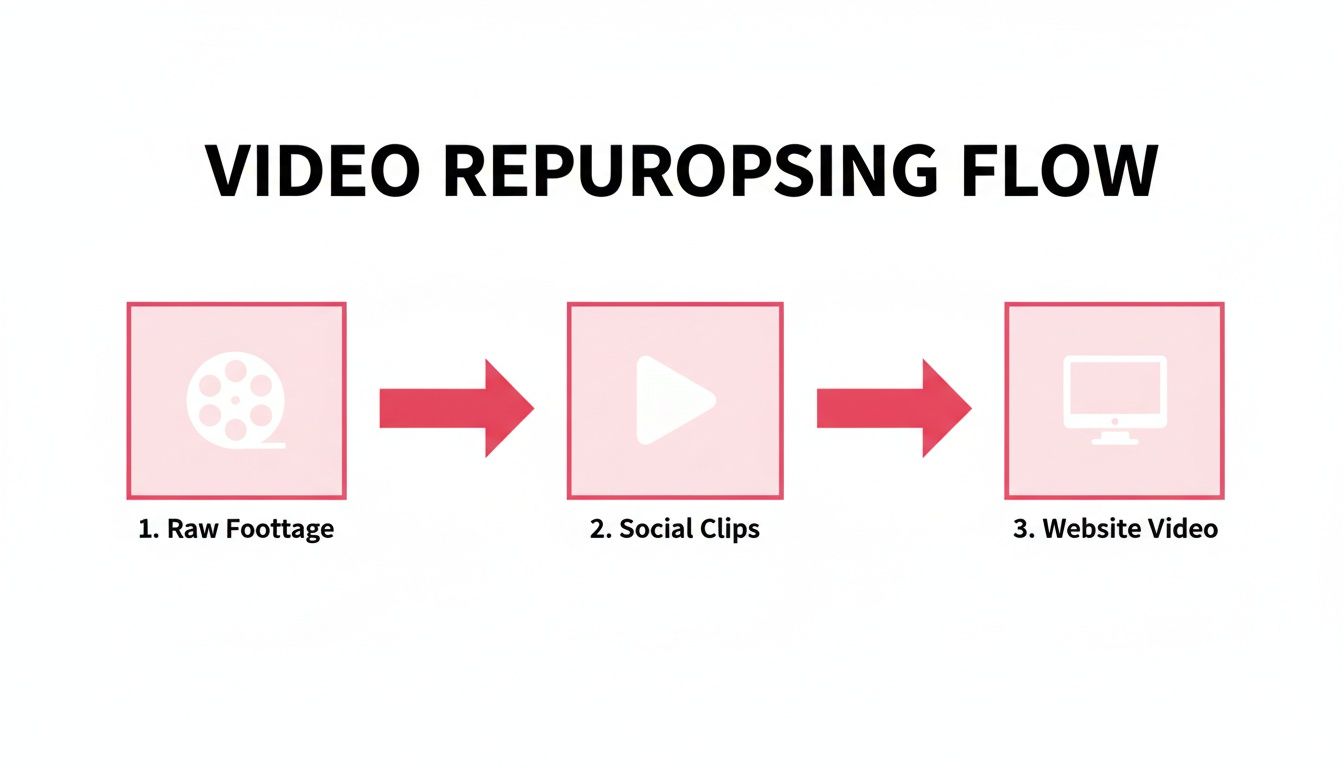
It’s the perfect illustration of content repurposing: one investment in filming on-site generates dozens of assets you can deploy across all your channels.
Measuring Sales Enablement and Brand Awareness
Don't forget that your trade show videos are also absolute gold for your sales team. Give them those customer testimonials and slick product demos to use in their email outreach and during sales calls. You can measure the impact by tracking how these videos influence deal velocity and close rates.
A well-placed customer testimonial video in a follow-up email can be the final piece of social proof a prospect needs to sign on the dotted line. It’s a powerful tool for overcoming last-minute objections.
Finally, while brand awareness can feel a bit fuzzy, you can still track meaningful engagement on social media. Look past the likes and views. Dig into metrics like share rate, comments, and video completion rate. These are much stronger signals that your content is actually resonating with your audience and building a brand they’ll remember.
Your Top Trade Show Video Questions, Answered
Got a few questions about making your trade show video plan a reality? You're not alone. Here are the most common things we get asked by marketers gearing up for a big event.
If you want to go deeper on what a pro crew can do for you, check out our full rundown of trade show videography services.
How Far Out Should I Book a Video Crew?
The sweet spot is at least 4-6 weeks before the event. That gives everyone enough breathing room for the important pre-production work—things like dialing in the shot list, lining up interviews, and sorting out logistics like event passes and equipment.
Heads up, though: for the massive international shows, you'll want to lock in your crew even earlier. Think 8-12 weeks in advance. The good ones get booked up fast.
What's a Realistic Budget for This?
This is the classic "it depends" question, but I can give you some real-world numbers. A simple, one-day shoot with a single videographer might start in the $1,500-$3,000 range. For a multi-day event with a full crew capturing multiple types of content, you're looking at something more in the $10,000 to $25,000+ ballpark.
The best approach? Figure out exactly what you need to capture first. Once you have a clear shot list, you can get quotes that actually match your goals.
If I Can Only Film One Thing, What Should It Be?
Great question. If you have to prioritize, go for customer testimonials and high-quality product demos. Nothing beats them.
Testimonials are pure gold. They provide authentic social proof from happy customers, right in the middle of a bustling, relevant environment—something you just can't fake. At the same time, a sharp, professional product demo captured on the show floor is a killer asset for your website, sales follow-ups, and social media for months to come.
Ready to turn your next trade show from a budget line item into a content-generating machine? Fame Crew has the experienced, vetted crews all over the world to make it happen.
Find your perfect video crew at Fame Crew and let's get rolling.
