

Let's be honest, "business videography" sounds a bit stuffy. But don't let the corporate-speak fool you.
At its core, it’s about using video to solve specific business problems—like drumming up new leads, showing off a complex product, or building a brand that people actually trust. It’s not about just hitting "record"; it's about telling a story that connects with a professional audience and gets them to act. For any B2B company, it's one of the most powerful tools in the toolbox for building relationships with decision-makers.
Why Business Videography Is a Growth Multiplier
Think of business videography as a storytelling engine for your entire company. In a world drowning in blog posts and whitepapers, video cuts through the noise. It puts a human face on your brand, making an abstract piece of software or a complicated service feel tangible and real.
This is absolutely critical in the B2B world. Purchase decisions are high-stakes and built on trust over time, not impulse. A well-produced video can explain a complicated feature in 90 seconds—something that might take a thousand words of dense text. It can showcase a customer's success with genuine emotion, turning a dry case study into a powerful digital referral.
The Strategic Role of Video Content
Great business videography isn't about chasing viral hits. It’s a calculated investment tied directly to your marketing funnel. Every single video has a job to do, guiding potential customers from "who are you?" to "take my money."
Here’s a practical breakdown of how you can use video at each stage:
- Top of Funnel (Awareness): Action Item: Create short, 30-60 second "problem/solution" videos for LinkedIn. Introduce a common industry pain point and briefly explain how to solve it (without pitching your product). This establishes your expertise.
- Middle of Funnel (Consideration): Action Item: Record an in-depth product demo showing exactly how your tool solves the problem you mentioned in your awareness video. Host this on a landing page and use it to capture leads.
- Bottom of Funnel (Decision): Action Item: Send a personalized video message using a tool like Loom to key prospects. Walk them through a specific part of your proposal and address their known concerns directly. This personal touch can be the final nudge they need.
This strategic approach is exactly why the global video production market is exploding. In 2022, the market was valued at a massive $70.40 billion, and it jumped to an estimated $98.99 billion in 2023. The forecast? It’s projected to hit a staggering $746.88 billion by 2030. That’s not just growth; it’s a clear signal that video is central to modern business.
Ultimately, using video isn't optional anymore. It’s a core piece of building a sustainable, growing business. When you communicate your message with clarity and authenticity, you build stronger relationships and drive results you can actually measure. If you're looking to create high-impact corporate videos, getting these fundamentals right is the first, most important step.
The B2B Video Playbook: 4 Videos You Need to Be Making
Okay, so we've established why video is a non-negotiable for B2B. Now let's get into the fun part: what to actually create.
Think of it this way: you wouldn't use a hammer to saw a piece of wood. The same logic applies to business videography. Different video formats are different tools, each designed for a specific job in your buyer's journey. Just throwing content out there and hoping it sticks is a recipe for wasted budget.
Below are four of the most reliable, high-impact video types that form the bedrock of any serious B2B video strategy. Each one solves a different problem, from proving your product's value to building the kind of trust that closes deals.
Product Demo Videos
Forget the dry, feature-list snooze-fests. A product demo video is your chance to show, not just tell. Its only job is to answer the prospect’s burning question: "How does this thing actually make my life easier?"
A great demo feels less like a sales pitch and more like a helpful walkthrough from a trusted colleague. Instead of just listing what your software does, focus on the workflow and the outcome. Show that messy, five-step nightmare of a process and how your product turns it into a one-click automated action. Capture the feeling of relief.
Action Item: Script your next demo video around a single, high-value "job-to-be-done." Start the video by clearly stating the painful problem, then spend 80% of the video walking through the solution inside your product. End with a clear call-to-action, like "Request a personalized demo to see how this works for your team."
Case Study Videos
Case study videos are, without a doubt, your most potent form of social proof. A written testimonial is nice, but seeing and hearing a happy customer talk about their success? That's gold. It’s the digital equivalent of a trusted friend's recommendation, and it builds credibility in a way no marketing copy ever can.
The best ones follow a simple, classic story arc:
- The Problem: Your client sets the stage, explaining the exact challenge they were up against before they found you. This immediately creates a connection with viewers who are in the same boat.
- The Solution: They walk through how your product or service was implemented and how it directly tackled their problem.
- The Result: This is the payoff. Your client shares the hard numbers—the percentage of time saved, the revenue gained, the efficiency boost. Quantifiable results make the story undeniable.
Action Item: Identify your top 3 happiest customers. Reach out and offer them a small incentive (like a gift card or a discount) to participate in a 30-minute recorded Zoom interview. Use the questions from the story arc above as your interview guide. Even a well-edited remote interview can be incredibly powerful.
Thought Leadership Videos
This is where you play the long game. Thought leadership videos aren't about selling your product at all. They’re about positioning the sharpest minds in your company as the go-to experts in your field.
The goal is simple: provide genuine, no-strings-attached value that helps your audience get better at their jobs. Think interviews with your CEO, lively panel discussions on industry trends, or quick, digestible explainers that break down complex topics. A cybersecurity firm, for example, could create a short series on the practical implications of a new data privacy law.
Action Item: Have your CEO or a subject matter expert record a 2-minute video on their phone answering the most common question they get from customers. Post it natively to their LinkedIn profile. No fancy production needed—authenticity wins here.
Event Recap Videos
Trade shows, conferences, summits—they’re a huge investment of time and money. An event recap video is your insurance policy for that investment. A slick, well-produced recap gives your event legs, extending its value long after the last booth has been packed away.
A dynamic recap video does a few jobs at once:
- For attendees: It reignites the energy and hammers home the key takeaways.
- For those who couldn't make it: It creates some serious FOMO (fear of missing out), making them determined to be at the next one.
- For your marketing team: It's a goldmine of content. You can slice it up into dozens of social media clips, promotional snippets, and website visuals to use for months.
Want to really squeeze every drop of value from your next industry gathering? Check out our guide on creating killer trade show videography. It’s the perfect blueprint for turning a three-day event into a year-long marketing engine.
Building Your B2B Video Production Workflow
A great video isn't an accident. It's the result of a great process.
Effective business videography comes down to a structured, repeatable workflow that turns a simple idea into a polished asset that actually gets results. Without a system, you're just gambling with quality, budgets, and deadlines. While this can seem daunting, having a partner to manage the process can make all the difference.
In-House vs. Hiring an Agency
Figuring out whether to build your own video team or partner with an outside agency is a foundational step.
An in-house team lives and breathes your brand. They get your culture, your product, and can turn around simple projects quickly. But—and it's a big but—you're on the hook for some serious upfront investment in talent and gear, and you might find your team's creative well runs dry after a while.
On the flip side, hiring an agency gives you instant access to specialized expertise, high-end equipment, and a fresh creative lens without all the overhead. Many B2B companies land on a hybrid approach: use an in-house crew for daily social content and call in a production partner for high-stakes projects.
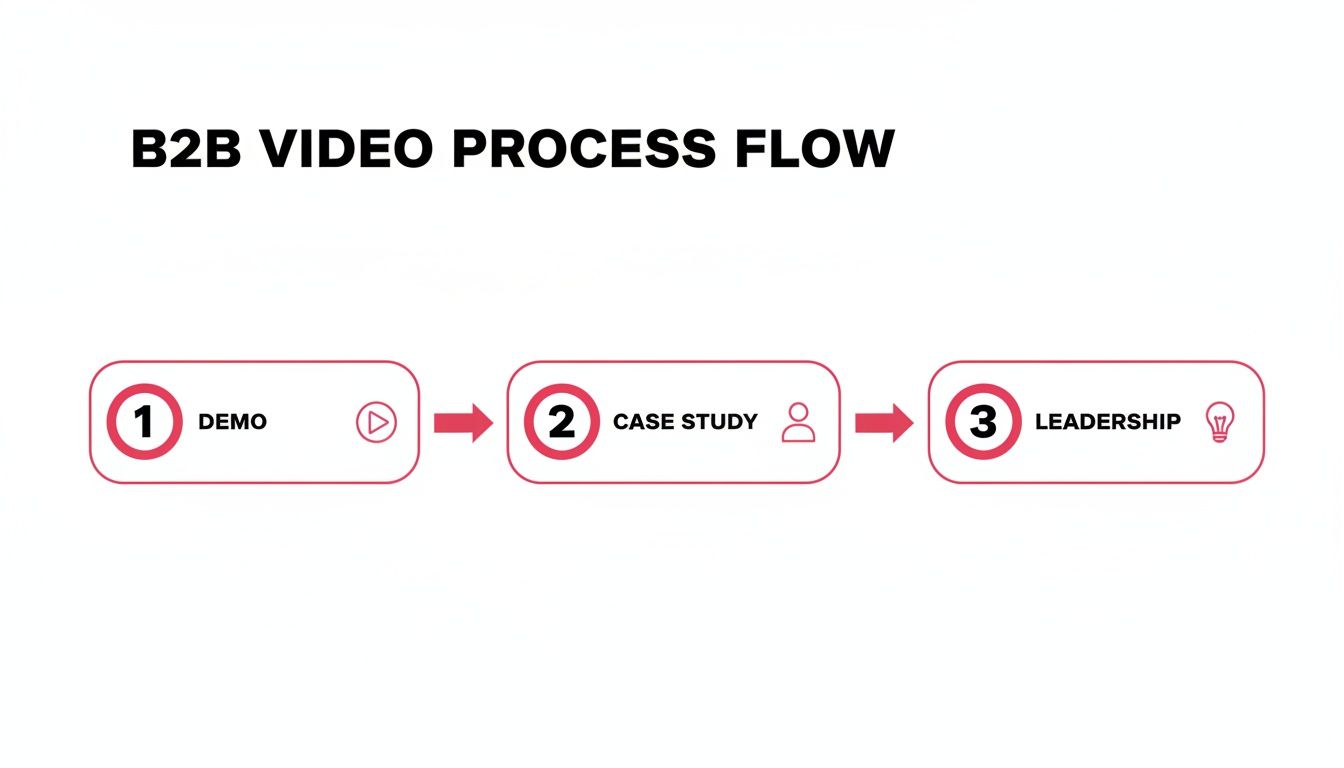
From showing off your product's value to cementing your long-term authority, each format plays a critical role in walking a prospect through their buying journey.
In-House vs. Agency Video Production: A Comparison
Deciding between building an in-house team and hiring an agency is a classic crossroads for B2B marketers. Each path has its own set of pros and cons, and the right choice really depends on your company's specific needs, resources, and long-term goals.
This table breaks down the key factors to help you weigh the decision.
Ultimately, there's no single "right" answer. The best model is the one that aligns with your business objectives. If your strategy relies on a constant stream of simple, on-brand content, building an in-house team might be the way to go. If you need a show-stopping brand film or a complex animated explainer once or twice a year, an agency is your best bet.
The Three Stages of Video Production
No matter who's holding the camera, every video project worth its salt moves through three distinct phases. If you get these right, the whole process feels less like chaos and more like a well-oiled machine.
1. Pre-Production: The Strategic Blueprint
Listen up: this is where 90% of a video's success is determined. Rushing this stage is the single biggest—and most common—mistake companies make. It’s the foundation for everything.
- Define the Goal: What, specifically, do you want this video to do? Generate leads? Educate new users? Build brand love? Get crystal clear on the business objective.
- Know Your Audience: Who are you talking to? What keeps them up at night? What language do they use? Your message has to land with them.
- Craft the Script: Write a tight, focused script that hammers home one core message. Then, read it out loud. If it sounds robotic, rewrite it until it's conversational.
- Create a Storyboard: You don't need to be an artist. Rough sketches on a whiteboard are fine. A storyboard gets everyone on the same page about the visual story before you ever hit "record."
- Nail the Logistics: Lock down locations, schedule your talent (whether they're actors or your own executives), and create a detailed shot list.
2. Production: Bringing the Vision to Life
This is the fun part—the filming. If you nailed pre-production, this phase should be all about execution, not improvisation. You're here to capture all the puzzle pieces for the final edit.
Action Item: Always, always shoot more B-roll (supplemental footage) than you think you need. Those extra shots of the office, the product in action, or your team collaborating are lifesavers in the editing room. They cover up cuts and make the final video way more dynamic.
Your only job here is to get high-quality raw material. That means solid lighting, crisp audio, and stable camerawork. A small mistake on set can become a giant, unfixable headache later.
3. Post-Production: Assembling the Final Story
Post-production is where the magic happens. This is where you take all that raw footage and shape it into a compelling story. It's often the most time-consuming part of the whole process.
- Editing: The clips are cut and arranged according to the script and storyboard. Pacing is everything here; a good editor knows how to create a rhythm that keeps people hooked.
- Color Grading: This is more than just making things look pretty. Color grading adjusts the tone and feel of the footage to create a consistent, professional look that matches your brand identity.
- Sound Design & Mixing: Background music, sound effects, and voiceovers are added. Audio levels are carefully balanced to make sure the dialogue is front and center.
- Graphics & Titles: Any on-screen text, logos, or slick motion graphics are created and woven into the video.
A disciplined workflow turns business videography from a frantic, unpredictable art project into a reliable engine for your marketing. For companies that want a partner to handle this entire process, exploring end-to-end video production services can provide the structure and expertise to create top-tier content, every single time.
Getting The Most Out Of Your Video: Smart Distribution and Repurposing
Hitting "export" on a finished video feels great, but the real work is just beginning. A brilliant video with no distribution strategy is like a billboard in the desert—it might look amazing, but nobody's going to see it. Effective business videography is as much about getting your content in front of the right people as it is about producing it in the first place.
This means you have to kill the "post and pray" mindset for good. Your video needs to be woven into the very fabric of your marketing, showing up in the channels where your B2B audience already lives and breathes. Every placement, from a targeted social ad to a personalized email, needs a purpose.
Strategic Channels for Your Video Content
The goal isn't just racking up views; it's about starting conversations that guide prospects through your funnel. Each channel gives you a different way to do that.
- LinkedIn: This is the B2B playground. You can share native videos directly in the feed and target people by industry, job title, or company size with incredible precision. A sharp case study clip or a thought-leadership soundbite can stop a key executive mid-scroll.
- Email Nurture Sequences: Drop videos into your emails to jolt your engagement rates. A quick product demo can warm up a cold lead, while a welcome video from your CEO can create an instant personal connection with someone who just signed up.
- Your Website: This is your home turf. Feature videos right on your homepage, service pages, and within blog posts. An explainer video can dramatically increase the time people spend on a page, which is a fantastic signal for both SEO and user engagement.
There's a reason video has become almost universal for marketers. By 2026, 91% of businesses were using video as a marketing tool, and a massive 93% called it an essential part of their strategy. This isn't just a corporate trend, either—87% of consumers are actively asking for more video from brands, proving just how vital it is.
The Real Secret: Repurposing Your Content
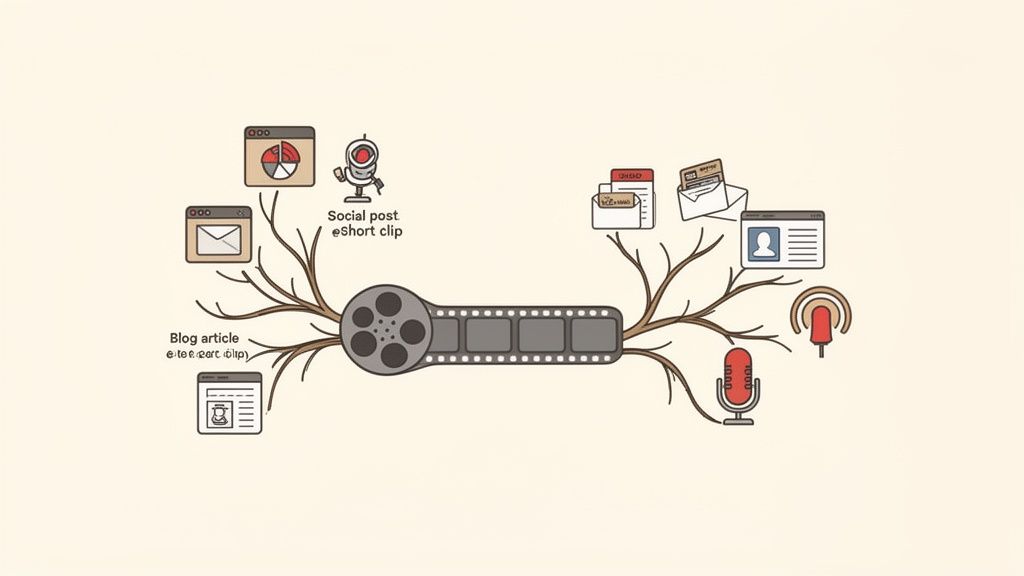
If you want to maximize the ROI on your video, you need to stop thinking about making a video and start thinking about creating a content asset. One long-form piece, like a webinar or a deep-dive interview, is a goldmine. It can be sliced, diced, and repurposed into an entire month's worth of content.
This "create once, distribute many" philosophy is the bedrock of efficient video marketing. It makes every second of production time work harder, stretching the life and reach of your core message across countless platforms and formats.
Think of your main video as a content pillar. From that one pillar, you can carve out dozens of smaller, focused pieces of content designed for different channels.
A Simple Repurposing Framework
Let's imagine you just finished a 45-minute webinar. Here's how you can turn that single recording into a full-blown content campaign:
- Short Social Clips (4-6 of them): Use a tool like Descript or Veed.io to quickly find the most potent 30-60 second soundbites. Reformat them as vertical videos for LinkedIn, adding bold, burned-in captions so people can watch with the sound off.
- Quote Graphics (5-8 of them): Pull out the most powerful one-liners and use a simple tool like Canva to turn them into eye-catching graphics for social media.
- A Blog Post (1): Get the webinar transcribed (services like Otter.ai are great for this) and rework it into a detailed blog post. Embed the full video right at the top for people who'd rather watch.
- A Podcast Episode (1): Strip the audio from the video file, add a simple intro and outro using Audacity (it's free!), and you've got a brand-new podcast episode.
To really get the most out of every video you create, it's worth exploring all the different content repurposing strategies available. When you start thinking this way, you're no longer just "making a video." You're building a content engine that powers your entire marketing machine.
Measuring the ROI of Your Business Videography
How do you prove your videos are actually making the company money? The first step is to stop obsessing over vanity metrics like "views." Moving past that number is what turns your video program from a creative line item into a predictable revenue driver.
When you're reporting up to the executive team, they want to see one thing: business impact. A clear framework for measuring video performance is the only way to show them.
The trick is to match your metrics to the buyer's journey. Not every video is designed to close a deal, but every video should absolutely have a job to do. When you track the right key performance indicators (KPIs) at each stage, you can tell a compelling story about how your business videography is contributing to the bottom line.
Top-of-Funnel Metrics: Engagement and Reach
For your awareness-stage content—think thought leadership clips or event recaps—the main goal is simple: grab attention and build an audience.
- Watch Time: This is the big one. It tells you if your content is actually good. A high average watch time means people are hooked.
- Audience Retention: Use your video host's analytics (like YouTube or Wistia) to pinpoint the exact moments where viewers are dropping off. That data is pure gold for making your next video script even better.
- Shares and Comments: These are strong signals that your content is valuable enough for people to stake their own reputation on by sharing it with their network.
Mid-Funnel Metrics: Lead Generation
Once a prospect knows who you are, the next job is to guide them toward your solution. This is where mid-funnel videos like product demos and case studies come in, and they should be directly tied to generating leads.
Action Item: Use your video player's call-to-action (CTA) feature to add a "Book a Demo" button that appears in the last 10 seconds of your demo videos. Track the click-through rate (CTR) on that button to measure direct conversion.
Integrating your video host with your marketing automation platform lets you see which specific contacts watched which videos, adding a ton of context to their lead score.
Bottom-of-Funnel Metrics: Revenue and Pipeline
This is where the rubber meets the road—connecting video directly to sales. For any content near the bottom of the funnel, the whole point is to show how video views influence real business outcomes. Using your CRM and marketing automation tools, you can finally attribute video engagement to actual dollars.
This level of tracking is precisely why business videography is getting such incredible results for B2B marketers. A recent study found that a staggering 93% of marketers reported strong ROI from video in 2025—the highest number ever recorded. That confidence is why only 5% of companies plan to cut their video budgets, while over half are planning to invest more.
Build a simple dashboard to track these key metrics:
- Demo Requests from Video: Use unique tracking links (UTMs) in your video descriptions or on-page players to see exactly how many demo requests came from someone watching a video.
- Pipeline Generation: Tag contacts in your CRM when they've watched key bottom-funnel videos. This lets you report on how many sales opportunities were influenced by video.
- Closed-Won Deals: The ultimate goal. You can track how many of your new customers watched specific videos on their way to signing a contract.
By connecting these dots, you can finally paint a clear picture of the financial impact your videos are having. For a deeper dive into this, check out our guide on measuring content marketing ROI.
How to Choose the Right Video Production Partner
Picking a video production partner is easily one of the most important calls you'll make in your entire video strategy. This isn't just about hiring a vendor to point a camera and hit record; it’s about finding a strategic ally who actually understands your business and is invested in your growth.
A flashy showreel is table stakes these days. Anyone can string together pretty shots. But it tells you absolutely nothing about whether an agency can turn a cool idea into something that actually moves the needle for your business.
A true partner in business videography gets that it’s not just about the visuals. They understand the long, winding road of a B2B sales cycle. They care more about strategic outcomes than winning creative awards, and they work with you through a clear, collaborative process. They should feel like an extension of your marketing team, obsessed with the same KPIs you are.
Vetting Potential Partners Beyond the Portfolio
To find a team that truly gets B2B, you have to dig deeper and ask the right questions. The answers will tell you everything you need to know about whether they're a strategic fit or just a talented crew for hire.
Here’s a quick checklist to guide your conversations:
- B2B Specialization: Do they live and breathe B2B, especially in your world? An agency that already knows your audience, their pain points, and can speak their language is worth its weight in gold.
- Strategic Approach: Ask them how they define success. You're looking for answers that revolve around lead generation, pipeline influence, and sales enablement—not just views and likes.
- Collaborative Process: What’s their process for pre-production and handling feedback? A great partner will walk you through a structured workflow with clear checkpoints for script approvals, storyboards, and edits. No surprises.
- Team Expertise: Find out who you'll actually be working with. Ask about the experience of the strategist, director, and project manager who will be your day-to-day contacts.
A great B2B video partner is obsessed with your ROI. They see video not as a creative end-product, but as a hard-working asset designed to solve a specific business problem and drive revenue.
Finding an agency that ticks these boxes means you’re not just buying a one-off video; you're investing in a growth engine.
It’s this exact philosophy we built our End-to-End Video Production Services on here at Fame. We blend B2B marketing strategy with top-tier production to make video content that doesn’t just look good—it performs. If you want a partner to handle the entire process from strategy to final cut, we're here to help.
Your Top Questions About Business Videography, Answered
Alright, even with a solid plan, jumping into business videography for the first time brings up some real-world questions. I get it. Below are some quick, no-fluff answers to the common hurdles B2B teams hit, designed to give you the confidence to get moving.
How Much Should We Actually Budget for Video?
This is the big one, isn't it? There's no single price tag because costs scale with the idea. A simple, one-location interview might start around $2,000-$5,000. If you're looking at a more involved product demo with custom graphics and a bigger crew, you're probably in the $7,000 to $15,000 ballpark. High-end brand films with multiple locations and complex editing? Those can easily top $25,000.
What you spend really boils down to three things:
- Scope and Concept: How complex is the idea? How many days and locations do we need?
- Crew Size: Do we just need a videographer, or a full team with a director, sound engineer, and lighting specialist (gaffer)?
- Post-Production Needs: Editing, color grading, motion graphics, and sound design all add to the final cost.
Action Item: Before seeking quotes, create a one-page creative brief that clearly outlines your goal, target audience, key message, and desired distribution channels. This will help production partners give you a far more accurate quote and ensures you're comparing apples to apples.
What’s the Real Difference Between B2B and B2C Video?
While they both use a camera, the game is completely different. Think of it like a textbook versus a blockbuster movie trailer.
B2C video is usually gunning for an immediate, emotional reaction. It tells a story to create desire and push for a quick sale. It’s all about brand love and impulse.
B2B video, on the other hand, is playing the long game. It's about building trust and proving your value over time. Your job is to educate, solve complicated problems, and logically convince a smart buyer who's part of a longer sales cycle. The story has to be built on expertise, data, and real business results. It’s a tool for consideration, not just awareness.
How Long Should My Business Videos Be?
Forget "one size fits all." The right video length is dictated entirely by where it’s going to live and what it needs to do. But there are some solid guidelines to follow.
- Social Media (LinkedIn, X): Keep it short and punchy. You've got under 60 seconds to stop the scroll with a single powerful idea or a killer soundbite.
- Website & Landing Pages (Explainers, Demos): Here, you can stretch it out a bit. Aim for 90 seconds to 3 minutes. That’s enough time to explain a core concept or show off a product’s value without your viewer's attention wandering.
- In-Depth Content (Webinars, Tutorials): For an audience that’s actively looking for answers, longer is better. Videos from 5-20 minutes (or even longer) work great here. They came for deep knowledge, so give it to them. Brevity takes a backseat to value.
Ready to put these ideas into practice but don't want to fly solo? The team at Fame lives and breathes this stuff. We create high-impact B2B video content that actually moves the needle. Check out our End-to-End Video Production Services for Businesses and let's start building your brand's authority.
