June 5, 202618 min read11 sections
Best Sydney Podcast Production Company: 9 Agencies Ranked (2026)
By Michael Twiddy, Head of Growth, Fame
Michael leads Fame's growth efforts, including sales and marketing. LinkedIn
Key Takeaways
- A Sydney B2B podcast agency should focus on authority, sales enablement, and content engine creation.
- The best agency is one that understands the target audience and supports demand generation.
- Agencies should be evaluated on their ability to support business outcomes, not just production quality.
Beyond the mic, most Sydney B2B teams are trying to solve a harder problem than audio quality. They already know how to record a conversation. What they need is a partner who can turn that conversation into authority, sales enablement, executive visibility, and a repeatable content engine. That's where a lot of agency shortlists fall apart.
The best Sydney podcast agency for your company usually isn't the one with the flashiest studio reel. It's the one that understands who the show is for, how episodes support demand generation, and what happens after publish. In a market like Australia, that matters even more because podcast listening is already mainstream. Edison Research's Australian Audio Report says 43% of Australians listen monthly and one-third listen weekly, which makes Sydney a serious market for branded B2B shows, not a niche experiment.
If you're choosing between agencies right now, look past editing and microphones. You need help with positioning, repurposing, guest quality, distribution, and how the podcast fits into the rest of your content mix, including effective social media content strategies. The list below ranks Sydney podcast agencies through that lens, with a bias toward firms that can support business outcomes rather than just polished production.
This guide is part of Fame’s wider directory of B2B podcast agencies - see the full 20 best podcast production agencies if Sydney isn’t a hard requirement and you want the broader field.
How we researched this list: every agency below was checked for an active, reachable website and evidence of current podcast production work as of August 21, 2026. Last reviewed and updated August 21, 2026.
Sydney is Australia’s financial and corporate headquarters city, home to the country’s biggest concentration of enterprise buyers and multinational offices. That scale means Sydney’s podcast market is the most saturated in the country - production quality alone won’t differentiate a show here, so a B2B agency needs a genuine distribution and growth strategy to cut through.
1. Fame
- Agency: Fame
- Market: Sydney
- Best for: Fame ranks first because it's built for B2B companies that care about pipeline, authority, and category positioning, not just publishing episodes.
- Website: fame.so
Fame ranks first because it's built for B2B companies that care about pipeline, authority, and category positioning, not just publishing episodes. That matters if your buyers are senior, your sales cycle is long, and your podcast needs to support marketing, sales, and founder brand at the same time.
Unlike generalist production houses, Fame focuses on business podcasts and wraps strategy, production, guest management, analytics, and repurposing into one system. For Sydney teams, that remote-first model is often a strength rather than a drawback. It makes it easier to work with distributed executives, interstate stakeholders, and international guests without forcing everything through an in-person studio workflow.
Why Fame stands out
Fame is one of the few options on this list with a clear performance commitment. It guarantees a minimum 10% monthly download growth and supports clients with proprietary tools including Fame Host for analytics and the Production Engine for repurposing. The agency also serves over 100 active B2B clients, which gives it a much stronger pattern library for business podcasting than most local production shops.
If you want a Sydney-focused overview of the service model, the dedicated Sydney podcast agency page is the best starting point.
Practical rule: If your internal team is asking how the show will influence demand generation, analyst attention, investor credibility, or executive authority, choose a B2B specialist. A general audio vendor usually won't answer those questions well.
Best for: B2B tech, professional services, and companies building toward expansion, fundraising, IPO, or exit.
Strengths
- B2B-only focus: The service is designed around business outcomes, not entertainment formats.
- Growth commitment: The 10% monthly download growth guarantee creates accountability.
- End-to-end support: Strategy, booking, production, distribution, and repurposing sit under one roof.
- Useful internal tooling: Fame Host and the Production Engine help reduce operational drag after recording.
Trade-offs
- Premium fit: It won't be the right choice for a low-budget pilot with no clear business case.
- No drop-in Sydney studio: Teams that want a local room every week may prefer a studio-led provider.
Visit Fame.
2. Pod Paste
- Agency: Pod Paste
- Market: Sydney
- Best for: Pod Paste has strong credibility with enterprise and technology brands, and that matters if you need stakeholder confidence as much as production quality.
- Website: podpaste.com
Pod Paste has strong credibility with enterprise and technology brands, and that matters if you need stakeholder confidence as much as production quality. A client list that includes Atlassian, AWS, and Xero signals that they know how to work inside larger brand environments where approvals, positioning, and brand standards are stricter.
Their work tends to suit branded podcasts that need polish, narrative structure, and strong creative development. If your company wants a show that feels more like a flagship brand asset than a recurring content operation, Pod Paste is a serious option.
Where Pod Paste fits best
This is a good choice when internal teams want a one-stop partner that can handle concept development, scripting support, production, and launch execution. It's also a practical fit for companies that expect both audio and video outputs, especially when the show needs to look boardroom-safe from day one.
I wouldn't put Pod Paste first for hard-nosed B2B growth accountability. I would put them high for enterprise-grade execution and branded storytelling. If you're comparing local agencies with broader options across the country, this Australia podcast agency overview is a useful contrast point.
Best for: Enterprise brands, larger SaaS companies, and marketing teams that need high production value plus strategic oversight.
Strengths
- Enterprise experience: Familiar with large organizations and brand-sensitive production.
- High-end execution: Strong fit for polished, narrative-led branded shows.
- Audio and video capability: Better suited than audio-only shops for multi-format launches.
Trade-offs
- Bespoke pricing: Budget planning usually starts after a sales conversation.
- Heavier engagement model: Overkill for teams that just need editing and publishing support.
Visit Pod Paste.
3. Pro Podcast
- Agency: Pro Podcast
- Market: Sydney
- Best for: Pro Podcast is one of the more practical choices for Sydney buyers who still want a local studio option.
- Website: propodcast.com.au
Pro Podcast is one of the more practical choices for Sydney buyers who still want a local studio option. Their Sydney CBD presence gives them an edge with executives who record better in person, and their workflow also supports remote and on-location production.
For many companies, that hybrid flexibility is the core value. You can run anchor interviews in a controlled studio, then switch to remote recordings when calendars get messy. That's often the difference between a show that ships and one that stalls.
What they do well
Pro Podcast offers strategy, recording, editing, design, publishing, and amplification support in one production flow. They're a good fit for companies that want one vendor managing the operational side of podcasting rather than patching together freelancers.
The bigger strategic question is how much help you need after production. If your team already knows the audience, format, and promotion plan, Pro Podcast makes sense. If you still need help defining the growth system, compare them with firms that go deeper into podcast production services.
A Sydney studio is useful. It isn't automatically the best answer. For executive podcasts with interstate guests or busy subject-matter experts, remote-first workflows are often faster and more reliable.
Best for: Sydney companies that want a local studio partner with end-to-end operational support.
Strengths
- Flexible recording model: Studio, remote, and on-location options reduce scheduling friction.
- Broad service stack: Useful for teams that want one production partner.
- Corporate-friendly workflow: Good fit for organizations that value process and reliability.
Trade-offs
- Pricing is inquiry-led: You won't know budget fit without talking to sales.
- Studio-first appeal: Their strongest local advantage matters less for distributed teams.
Visit Pro Podcast.
4. Wavelength Creative
- Agency: Wavelength Creative
- Market: Sydney
- Best for: Wavelength Creative has been in podcasting since 2009 and has a long track record with organizations, enterprise clients, and government work.
- Website: wavelengthcreative.com
Wavelength Creative has been in podcasting since 2009 and has a long track record with organizations, enterprise clients, and government work. That history shows up in the way they frame projects. They feel less like a trendy production outfit and more like a mature services firm with established systems.
That's useful if your podcast initiative sits inside a larger communications function. Internal approvals, brand governance, and stakeholder complexity can break lightweight vendors. Wavelength is better positioned for that environment.
Best use case
Their “podcast renovation” service is the differentiator. If you already have a show but it isn't landing, that's more valuable than a standard launch package. Many agencies want the clean slate. Fewer want to diagnose why an existing show underperforms.
They're also one of the more relevant agencies to mention when discussing platform coverage. In English-speaking markets, Apple Podcasts and Spotify are the practical first priorities for distribution and metadata optimization, with smaller apps like Overcast, Pocket Casts, Podcast Addict, and Podbean acting as long-tail discoverability channels, as noted by Wavelength's podcast marketing guidance. If an agency can't speak clearly about distribution beyond “we publish it everywhere,” that's a warning sign.
Best for: Established organizations, government, and enterprise teams with existing communications processes.
Strengths
- Operational maturity: Strong fit for structured organizations.
- Audit and renovation support: Helpful for fixing underperforming shows.
- Enterprise orientation: Better than most local shops for complex stakeholder environments.
Trade-offs
- Availability can be tight: You may need to wait for capacity.
- Pricing isn't transparent: Budget fit requires direct contact.
For a growth-oriented comparison point, see podcast marketing services. Visit Wavelength Creative.
5. DM Podcasts
- Agency: DM Podcasts
- Market: Sydney
- Best for: The trade-off with network-backed production
- Website: dm.org.au
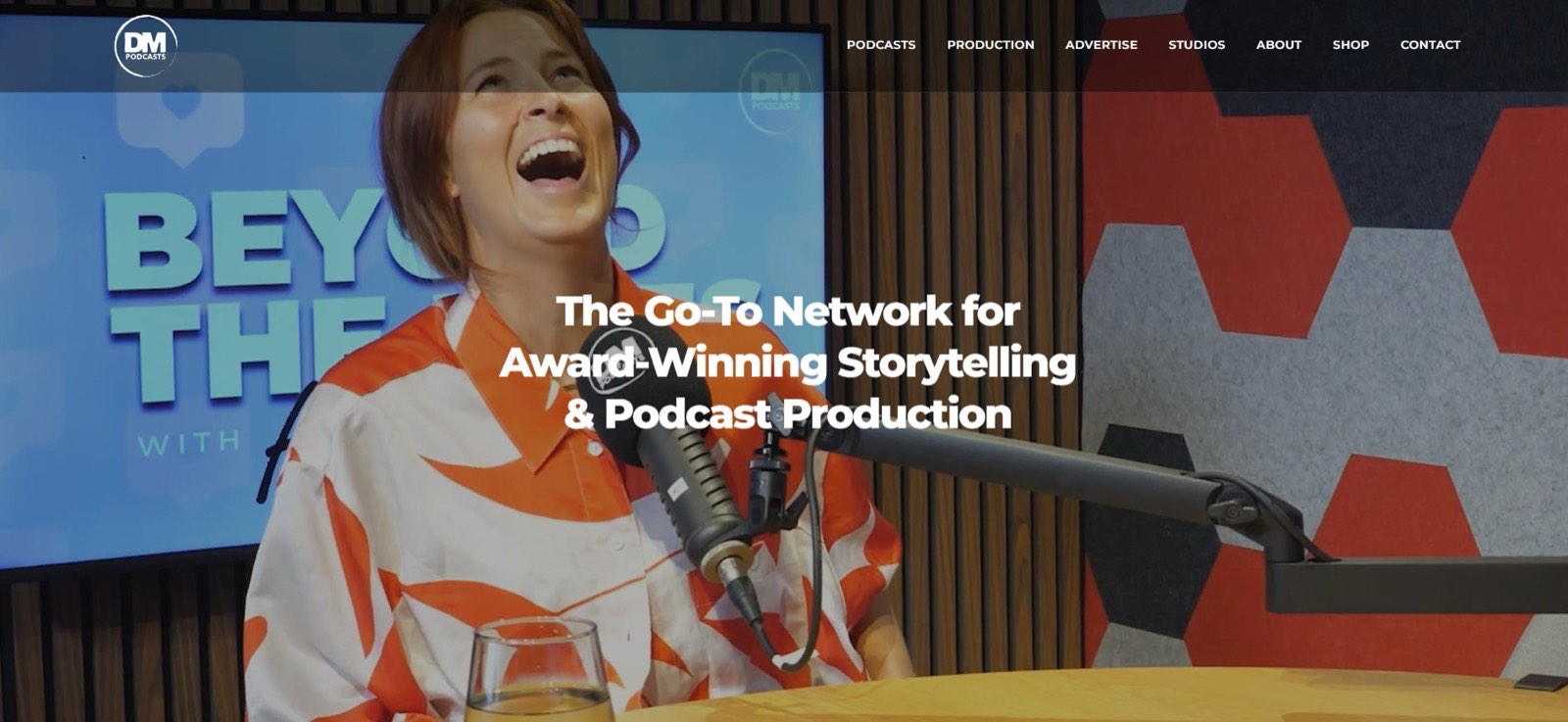
DM Podcasts is interesting because it isn't just a production agency. It also operates as a podcast network. That changes the buying equation. You're not only paying for show creation. You may also gain access to promotion and ad inventory inside a broader podcast ecosystem.
For B2B buyers, that can be useful if distribution is a priority and you don't want to rely solely on organic platform discovery. It can also be less relevant if your main goal is executive thought leadership in a narrow professional niche.
The trade-off with network-backed production
DM Podcasts benefits brands that want a media-company partner with strong cultural production instincts. Their background can help with packaging, launch energy, and audience-facing creative. But the network's center of gravity leans more toward mainstream and entertainment-oriented content than B2B demand generation.
That doesn't make them a weak choice. It makes them a selective one. If you want a polished branded show plus options for paid audience growth, they're worth considering. If you want a business podcast tied closely to pipeline influence, you'll need to push harder on strategy questions and ask for relevant case studies.
Best for: Brands that want production plus network access, sponsorship options, or broader audience reach.
Strengths
- Production plus network model: Useful when audience growth needs paid support.
- Studio access: Helpful for local recording.
- Media sensibility: Strong fit for shows that need entertainment value and energy.
Trade-offs
- B2B isn't the core identity: You may need more internal strategy ownership.
- Custom quoting: Expect a scoped sales process rather than simple packages.
Visit DM Podcasts.
6. Ampel
- Agency: Ampel
- Market: Sydney
- Best for: Ampel sits in a slightly different category from the pure-play podcast shops.
- Website: ampel.com.au
Ampel sits in a slightly different category from the pure-play podcast shops. They approach audio more broadly, including sonic branding, internal communications podcasts, branded audio, and supporting video production. If your company is trying to build a coherent audio identity across multiple touchpoints, that wider lens is useful.
This isn't the agency I'd pick first for a straightforward interview show. It is the one I'd look at when the podcast is part of a bigger brand system.
When Ampel makes sense
B2B companies often ignore internal audio use cases. Leadership updates, employer brand content, partner communications, and training can all benefit from the same production infrastructure as an external show. Ampel is stronger than most local providers if you want one team thinking across those use cases.
Their Sydney CBD studio setup also helps for companies that value in-person recording. Just be clear on whether you need a content engine or a branded audio program. They're not the same brief.
Best for: Brands that want podcasting, internal audio, and sonic identity under one strategy umbrella.
Strengths
- Broader audio expertise: Useful beyond one public-facing show.
- Sonic branding capability: Strong fit for companies investing in brand distinctiveness.
- Studio and video support: Helpful for cross-channel execution.
Trade-offs
- No public pricing: Discovery calls are required.
- Potential overkill: Too much if you only need editing and publishing.
Visit Ampel.
7. Piccolo Podcasts
- Agency: Piccolo Podcasts
- Market: Sydney
- Best for: Piccolo Podcasts earns a place on this list because they make buying easier than most agencies do.
- Website: piccolopodcasts.com.au
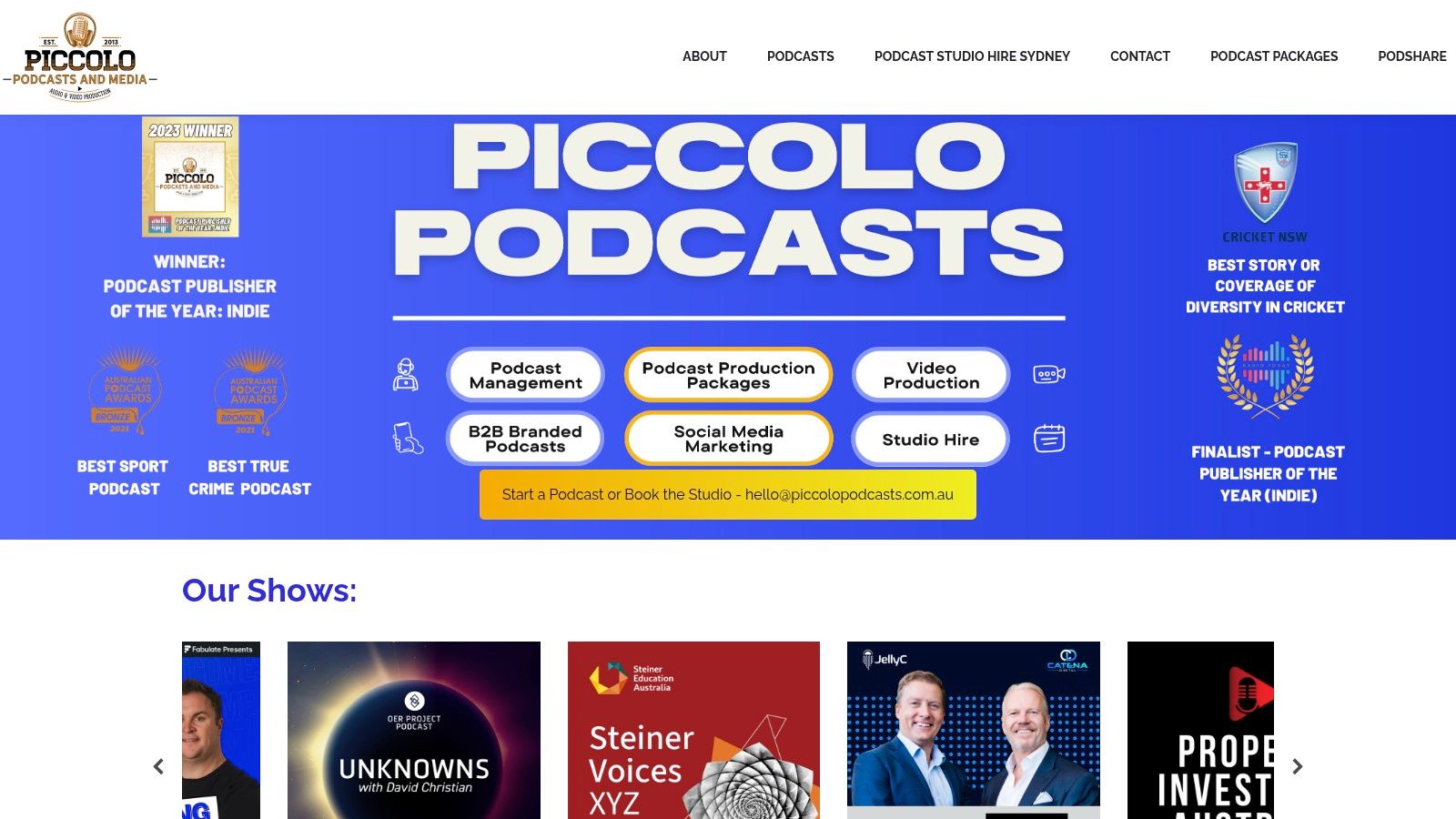
Piccolo Podcasts earns a place on this list because they make buying easier than most agencies do. Their transparent packages and pilot program lower the risk for teams that want to test a show before committing to a full production retainer.
That's a practical advantage. Plenty of companies know they should explore podcasting, but they don't yet have enough conviction for a large upfront investment. Piccolo gives them a structured way to validate the concept.
Why first-time teams like Piccolo
The host coaching and launch support are useful if your internal spokesperson isn't a natural podcaster yet. Most business podcasts don't fail because the executive lacks expertise. They fail because the format is awkward, the host sounds stiff, or the workflow becomes too hard to maintain. Piccolo is good at helping early-stage teams get over that hump.
Their package structure can also make procurement easier, especially for smaller businesses that need predictable scope.
If your team has never shipped a podcast before, a pilot is often smarter than a full season commitment. You learn fast when a real microphone is on and a real approval chain is involved.
Best for: First-time podcasters, smaller businesses, and teams that want pricing clarity.
Strengths
- Transparent packaging: Easier budgeting than with bespoke-only agencies.
- Pilot program: Good low-risk path to concept validation.
- Host support: Helpful for inexperienced internal hosts.
Trade-offs
- Packages still require budget: Transparency doesn't always mean cheap.
- Smaller-team capacity: Larger or faster-moving brands may outgrow the model.
Visit Piccolo Podcasts.
8. SoSo Media
- Agency: SoSo Media
- Market: Sydney
- Best for: Strong fit for agile content teams
- Website: soso.media
SoSo Media is a good example of a boutique agency with a clear operational edge. Their mobile recording model works well for executives, event teams, and brands that want to capture conversations outside a traditional studio.
That sounds like a small detail until you're trying to record around a conference, leadership offsite, or multi-guest event schedule. In those situations, convenience is often what determines whether content gets made at all.
Strong fit for agile content teams
They also lean into video podcasting and short-form social assets, which makes them useful for companies that want one recording session to feed multiple channels. That can work well for event-based content, partner interviews, and leadership series that need quick repurposing.
I'd rank them higher for agility than for deep B2B growth architecture. If your content team already owns messaging and distribution, SoSo Media can be an efficient execution partner.
Best for: Event-led brands, executive teams with tight schedules, and companies prioritizing flexible on-location production.
Strengths
- Mobile production setup: Removes friction for busy guests and event captures.
- Video-friendly workflow: Better fit for multi-format output than audio-only shops.
- Boutique flexibility: Useful for custom or unusual recording scenarios.
Trade-offs
- Bespoke scoping: Budget clarity comes later in the process.
- Advance booking matters: Boutique capacity can get tight.
Visit SoSo Media.
9. Audiocraft
- Agency: Audiocraft
- Market: Sydney
- Best for: Best when story is the product
- Website: audiocraft.com.au
Audiocraft is the creative pick on this list. They're known for strong storytelling, sound design, and narrative craft. If your brand wants a podcast that feels editorial rather than corporate, they're a compelling option.
That doesn't automatically make them the best fit for B2B growth. It depends on what your podcast is supposed to do. If the brief is “make us memorable,” Audiocraft moves up. If the brief is “support pipeline creation,” they move down.
Best when story is the product
Narrative-driven branded podcasts can work well for employer brand, category education, customer stories, and reputation building. Audiocraft is stronger than most agencies when the show needs emotional texture and a less obvious brand hand.
The trade-off is directness. A narrative show may create affinity and differentiation, but it usually needs a stronger surrounding strategy if you expect it to contribute to measurable commercial outcomes.
Best for: Brands that want documentary-style audio and a more editorial, story-led identity.
Strengths
- Excellent storytelling craft: Strong for narrative and editorial formats.
- Premium production quality: Useful when sound design and tone matter.
- Brand differentiation: Helps avoid generic corporate podcast feel.
Trade-offs
- Less direct B2B performance focus: Story quality is the lead value.
- Not the simplest path to demand capture: Needs clear surrounding strategy.
Visit Audiocraft.
Top 9 Sydney Podcast Agencies Comparison
| Vendor | Implementation Complexity 🔄 | Resource Requirements ⚡ | Expected Outcomes 📊 | Ideal Use Cases 💡 | Key Advantages ⭐ |
|---|---|---|---|---|---|
| Fame | Moderate–High, end-to-end, data-driven workflow | Premium budget with client collaboration and a remote-first specialist team | Guaranteed ≥10% monthly download growth with measurable B2B ROI | B2B tech, professional services, and companies preparing for IPOs or exits | Performance guarantee, proprietary platforms (Fame Host & the Production Engine), B2B specialization |
| Pod Paste | High, narrative-led, enterprise-grade production workflows | Enterprise budgets with multiple stakeholder reviews and approvals | Premium branded podcasts that strengthen thought leadership and brand authority | Large enterprises and technology brands investing in flagship branded series | Blue-chip client portfolio, strategic storytelling, premium audio and video production |
| Pro Podcast | Moderate, full-service production with studio and remote recording options | Studio sessions or remote workflows with bespoke pricing | Reliable corporate podcasts with polished production and scalable delivery | Sydney-based businesses wanting studio-quality production or high-volume podcast series | Sydney CBD studio, 300+ podcast portfolio, flexible recording formats |
| Wavelength Creative | Moderate–High, mature workflows for enterprise and government organizations | Enterprise-level engagement with potential waitlists for larger projects | Optimized, award-recognized podcasts supporting organizational communication goals | Government agencies, enterprises, and organizations refreshing existing podcasts | Extensive enterprise experience, podcast audits and renovation expertise |
| DM Podcasts | Moderate, combines production with podcast network operations | Access to multi-show advertising network and Sydney/Melbourne studios | Audience growth supported by network distribution and monetization opportunities | Brands seeking production together with advertising reach and network exposure | Large advertising network, multiple studios, strong entertainment and culture reach |
| Ampel | Moderate, strategy-first sonic branding and podcast production | Studio-based creative resources with strategic audio planning | Consistent audio branding across podcasts, advertising, and internal communications | Organizations developing a unified audio identity or internal podcast programs | Sonic branding expertise, strategy-led production, integrated video support |
| Piccolo Podcasts | Low–Moderate, straightforward production packages and pilot programs | Transparent package pricing with Ultimo studio access and host coaching | Low-risk podcast validation with predictable costs and deliverables | New podcasters, SMBs, and businesses testing podcast concepts before scaling | Transparent pricing, Pilot Program, host coaching, clearly defined scope |
| SoSo Media | Low–Moderate, boutique workflow focused on mobile and on-location production | Mobile recording kits with flexible on-site production logistics | Fast-turnaround episodes with video and social-ready assets | Conferences, executive interviews, events, and on-location podcast recording | Mobile production expertise, video-first workflows, experienced producer support |
| Audiocraft | High, narrative-first creative process with advanced sound design | High creative investment with premium production resources | Cinematic branded podcasts that maximize audience engagement and brand affinity | Brands investing in story-driven podcasts and distinctive audio experiences | Award-winning storytelling, industry-leading sound design, creative workshops |
How to Choose Your Sydney Podcast Partner
Start with the business job of the podcast. If the answer is “we want a show,” you're not ready yet. If the answer is “we need to build category authority with CFOs,” “we want our founder in more enterprise buying conversations,” or “we need a repeatable thought leadership engine,” then you can evaluate agencies properly.
A second filter is workflow fit. Sydney agencies often sell proximity hard, but proximity isn't always the point. Many buyers assume local studio access should decide the shortlist. Sometimes it should. Sometimes it shouldn't. For companies with remote leaders, global customers, or hard-to-book guests, a distributed production model is often the better operational choice. That local-versus-distributed trade-off is one of the more overlooked parts of choosing the best Sydney podcast agency.
You should also press every agency on growth, not just production. The podcast market is large and crowded. Backlinko reports over 619.2 million podcast listeners worldwide, 2,905,698 podcasts on Apple Podcasts as of November 2025, and about 7 million podcast titles on Spotify as of February 2026. That scale is the opportunity and the problem. Publishing isn't enough. Positioning, metadata, distribution, and repurposing all matter.
Then ask how they measure success. Often, agency pages remain vague on this point. In Australia, specialized audience-data tooling such as Podscan's audience analytics and charting environment shows how podcast buying and evaluation are moving toward data-led channel selection rather than vanity metrics. For B2B buyers, that means asking better questions:
- What audience are we trying to reach: Industry, role, buying stage, and geography.
- What happens after publishing: Clips, newsletters, sales enablement, guest amplification, and channel distribution.
- How will we judge progress: Not just downloads, but whether the show supports authority, relationships, and commercial conversations.
- Who owns the workflow internally: Even full-service agencies need responsive hosts and stakeholders.
One more point matters in Sydney. A lot of agency pages still emphasize production quality more than business outcomes. That's the market gap. As noted earlier, Australia is a mature podcast market, and branded podcast buying is becoming more strategic. The right agency should be able to connect the show to brand and revenue logic, not just studio quality.
If you need a B2B-focused option, Fame is one of the few agencies on this list built around that outcome-first model. Other agencies may be a better fit if you want local studio access, narrative storytelling, or a lower-risk pilot. The right choice depends on what job the podcast needs to do inside your business.
If your team wants a podcast partner that focuses on B2B growth, authority, and measurable outcomes, Fame is worth a close look. Their model is designed for companies that need more than editing, especially if you want strategy, production, guest management, and distribution support in one place.
Frequently Asked Questions
Pricing varies by scope - a studio-only rental runs far less than a full-service B2B agency handling strategy, guest sourcing, production and promotion end to end. Get a proposal scoped to your specific show before comparing agencies on price alone.
Want us to run this for you?
Fame starts and grows B2B podcasts that generate pipeline. Tell us who you are trying to reach and we will send a costed proposal within 1 working day.
Related content
- Read moreFame Team · July 16, 2026
10 Account Based Marketing Tactics For B2B Growth In 2026
Discover 10 actionable account based marketing tactics for B2B tech. Learn to use podcasts, data, and targeted content to close high-value accounts. - Read moreFame Team · July 16, 2026
The 8 Best Brighton Podcast Agency Picks For 2026
Find the best Brighton podcast agency for your B2B brand. Our 2026 guide reviews top 8 agencies for production, growth & ROI. Expert analysis here - Read moreJune 10, 2026
20 Best Podcast Production Agencies For 2026 (And Why Should You Hire One)
Global podcast and vodcast ad revenues are on track to hit $5 billion in 2026 , up 20% year-on-year. - Read moreApril 13, 2026
Leadership In Marketing: The B2B Podcast Playbook
Most companies still confuse leadership in marketing with job titles, org charts, and budget control. That's outdated.