
Trade show videography isn't just about pointing a camera at your booth. It's the strategic art of creating high-impact video content at industry events to grab attention, pull in qualified leads, and walk away with a goldmine of marketing assets.
To execute this, you must transform your booth from a static display into a living, breathing content factory. Your goal is to capture everything from product demos and genuine customer testimonials to impromptu interviews with industry experts. This content won't just die when the event ends; it will fuel your marketing campaigns for months to come.
Why Video Is Your Most Valuable Player on the Show Floor
Let's be real, trade shows have changed. They're no longer about handing out stress balls and scanning badges. Today’s show floor is a high-stakes, high-energy environment where you have mere seconds to make a lasting impression. To succeed, deploy a smart videography plan as your secret weapon for cutting through the chaos and connecting with serious buyers.
Forget the basic booth tour video. A well-executed strategy is about building a treasure trove of marketing assets that deliver real, tangible results. Use high-quality video not just to stop people in the aisles, but to build serious brand authority and shorten complex sales cycles.
Capitalize on a Changing Landscape
The way people attend trade shows has shifted, too. Major U.S. events are seeing attendance numbers bounce back to pre-pandemic levels, which is great news. But here’s the catch: attendees are more focused than ever. They show up with a clear agenda, looking for quality conversations, not just a casual stroll through the hall.
This focused mindset means your marketing has to be sharper and more compelling than the booth next door. Video is perfectly built for this challenge. Use it to communicate a complex value proposition quickly, powerfully, and in a way that makes your brand stick in their minds long after they've left. To really get a handle on how video drives growth, you need to master trade show lead generation by engaging these high-intent prospects in a way that resonates.
From Event Presence to Pipeline Growth
A smart video strategy is what turns your significant trade show investment into measurable pipeline growth. Seriously. The content you create on-site becomes the engine for your digital campaigns for the next quarter, or even the next year.
Here’s a quick look at the actions video empowers:
- Stop traffic. Display dynamic visuals on a large screen to stop attendees in their tracks far more effectively than a static banner ever could.
- Build social proof. Capture authentic customer testimonials on camera to create powerful, trustworthy content for your website, ads, and social channels.
- Fuel your content machine. Leverage one event to create dozens of assets: sizzle reels, short social clips, audio for podcasts, and in-depth product demos.
- Cement your brand identity. Use professional video to reinforce your company’s image and learn more about creating powerful brand recognition in our guide.
Actionable Takeaway: Treat your trade show presence as a content creation opportunity. This shifts the focus from a one-time expense to a long-term asset-building activity. Every interview and product demo becomes a piece of a larger marketing puzzle, delivering ROI far beyond the event itself.
Building Your Pre-Show Video Game Plan
A great trade show video doesn’t just happen. The footage that actually drives ROI is born from a meticulous game plan, figured out weeks, sometimes months, before you even think about packing your bags. Showing up with a camera crew and just "hoping for the best" is a surefire way to burn cash and end up with a hard drive full of useless footage.
Think of pre-production as laying the foundation of a house. Get it right, and everything else stands strong. A solid plan means every shot has a purpose, every interview delivers a key message, and every minute of filming ties back to your actual marketing goals. This is how you go from a vague wish like "let's get some good footage" to a concrete, actionable strategy.
Define Your Tangible Video Outcomes
First, define what success actually looks like. Starting with generic goals will only get you generic content. You must anchor your entire plan in specific, tangible assets you can use the minute you get back from the show. This simple shift in thinking turns your videographer from a passive documentarian into a strategic partner focused on delivering exactly what you need.
Instead of broad objectives, set specific, measurable goals. For instance:
- Action: Secure three high-quality customer testimonials to feature on your homepage and drop into your lead-nurture email sequence.
- Action: Film five distinct product demonstration clips, each under 90 seconds, specifically for a LinkedIn video ad campaign.
- Action: Capture a 10-minute keynote presentation from your CEO to use as a gated webinar and position them as a thought leader.
- Action: Produce one dynamic, 2-minute "sizzle reel" that captures the event's energy for post-show recaps and promoting next year's booth.
Tying your video goals to specific marketing campaigns is non-negotiable. This not only guides your on-site crew through the chaos but also gives you a clear way to measure ROI later. If you need a hand with this, thinking about how to create a content strategy can provide a powerful framework to make sure your video efforts support the bigger picture.
Actionable Takeaway: Your shot list is your bible on the trade show floor. When things get crazy, and they will, it's the one document that ensures you walk away with the critical assets you need, not just a random collection of clips.
This isn't just about filming; it's a simple but powerful process. You capture valuable moments, use that footage to engage your audience in a meaningful way, and ultimately, grow your business.
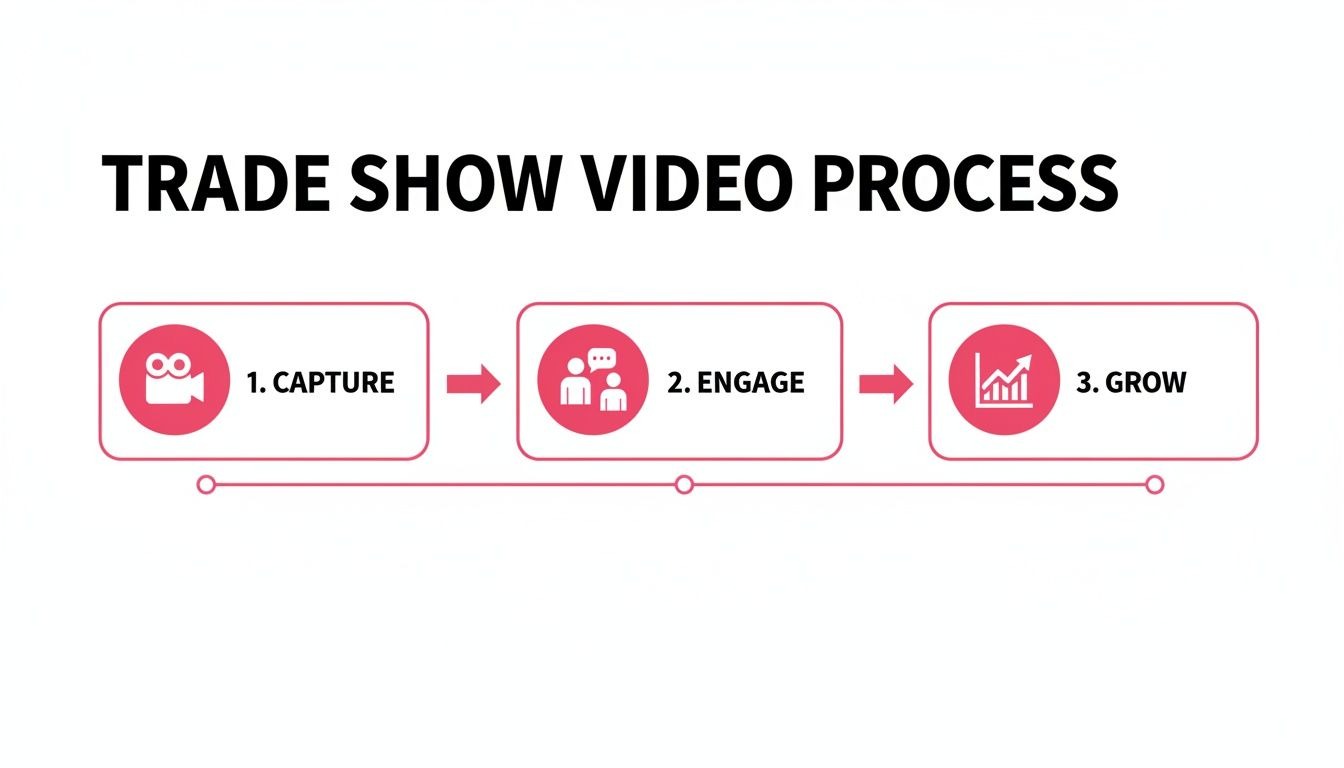
The capture phase is just the starting line. The real magic happens when you strategically use that content to spark conversations and drive long-term growth.
Your Pre-Show Production Checklist
With your goals locked in, it’s time to nail down the logistics. I can't stress this enough: a pre-production checklist is essential for a smooth shoot. It’s your safety net, making sure nothing, from legal permissions to crew schedules, falls through the cracks.
Use this practical checklist to guide you through the pre-show planning. We've used a version of this for countless events, and it saves us from major headaches every single time.
Trade Show Video Pre-Production Checklist
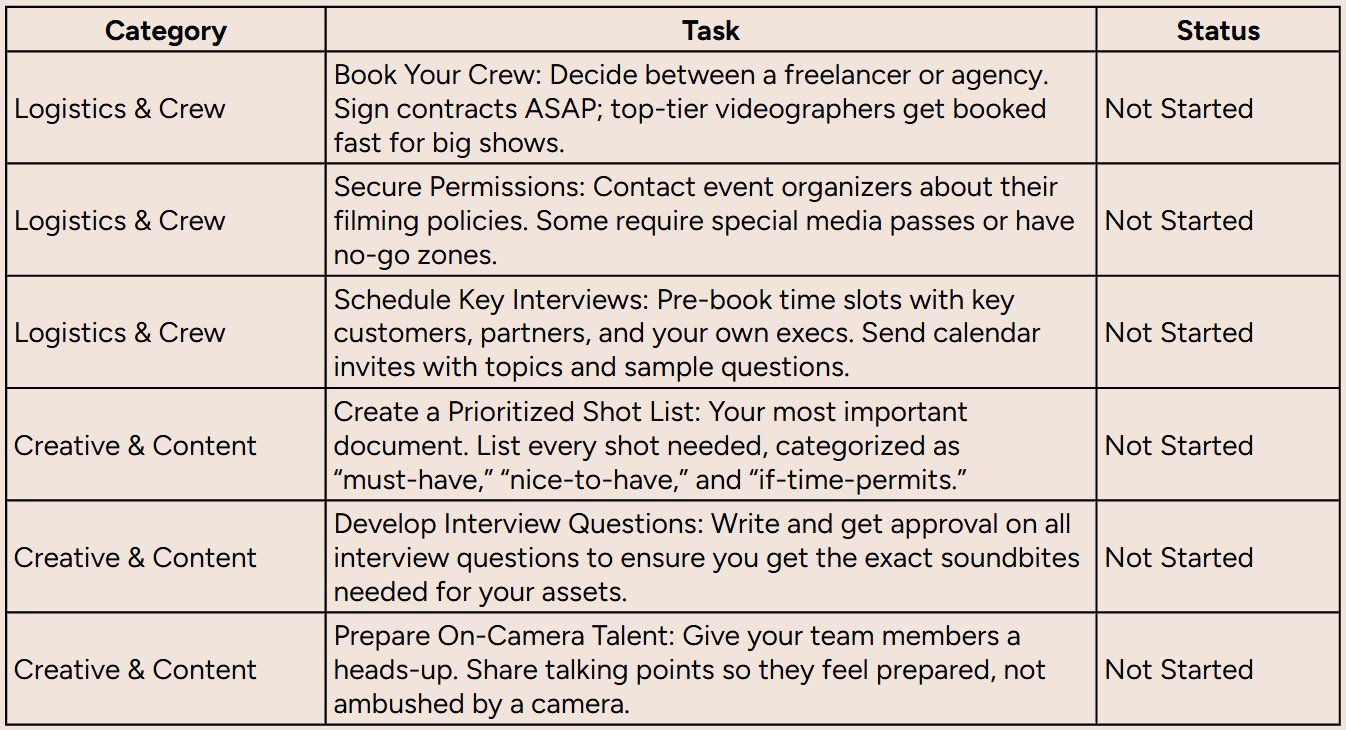
Working through this checklist transforms your plan from an idea into a strategic framework. It eliminates the on-site guesswork. This level of prep frees up your crew to focus on what they do best: capturing creative, high-impact footage, knowing all the logistical details are already buttoned up.
Assembling Your On-Site Crew and Gear
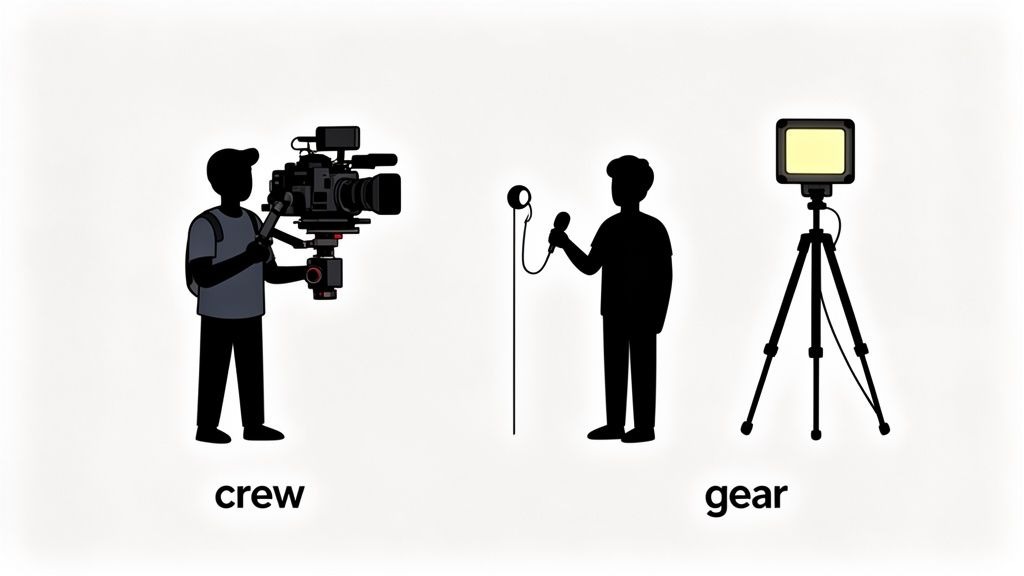
Your final video will only ever be as good as the team and tools you have on the ground. This is especially true on a chaotic trade show floor. Having the right crew and equipment isn't just a nice-to-have; it's the difference between capturing high-impact marketing assets and coming home with a hard drive full of shaky, unusable footage.
The right choice here goes back to your goals. Are you aiming for candid, man-on-the-street interviews and energetic booth B-roll? A nimble, solo videographer might be all you need. But if you're planning polished executive interviews or cinematic product demos, you’ll need a more structured, multi-person crew.
Choosing Your Video Production Team
Your first big decision is who to hire. You’ve really got two main paths: hiring freelance videographers directly or partnering with a full-service production agency. Each has its pros and cons, and the best fit depends on your budget and the scope of your project.
A solo freelancer is often more budget-friendly and flexible. This is perfect for smaller-scale projects where you just need someone to capture great shots without a ton of logistical overhead. An agency, on the other hand, provides a complete, managed solution, think a director, camera operators, and sound technicians, ensuring a higher level of polish. This is crucial for high-stakes projects.
Actionable Takeaway: It’s not about which option is "better," but which one aligns with your goals. For simple B-roll and a few testimonials, hire a talented freelancer. For a comprehensive video package that needs to scream professionalism, partner with an agency.
Understanding costs is key, especially as the corporate video production market grows. The market is expanding by 15% annually and is projected to top $30 billion by 2026. High-end productions can drive costs up significantly, so it’s vital to align your budget with the results you expect.
Essential Questions to Ask Your Potential Crew
Before you sign on the dotted line, you need to vet your potential partners. A flashy portfolio is a good start, but you need to dig deeper to make sure they can handle the unique chaos of a trade show.
Ask these non-negotiable questions:
- "Can you show me examples of trade show videos you've filmed before?" Look for experience in loud, crowded, and poorly lit environments. Anyone can make a quiet office look good.
- "What's your standard equipment package for an event like this?" They must immediately mention professional audio gear (lavalier mics, shotgun mics) and stabilization tools (gimbals, tripods).
- "How do you handle audio on a noisy show floor?" This is a deal-breaker. A pro will talk about using directional mics, proper placement, and techniques to isolate voices from the background din.
- "What’s your process for delivering the raw footage?" Clarify timelines, file formats, and how they’ll get the files to you (e.g., hard drive, cloud transfer) before the event even starts.
If you're looking for specialized support, exploring professional event videography crew services can connect you with vetted experts who live and breathe these environments: https://www.fame.so/crew-services/event-videography
Must-Have Gear for Professional Results
Even the best crew can't overcome bad equipment. While your videographer will handle the specifics, knowing the key pieces of gear helps you communicate your vision and understand what it takes to get the shot.
For Crystal-Clear Audio
- Lavalier Mics (LAVs): Insist on these small microphones that clip onto a speaker's shirt. They're essential for interviews because they capture clear dialogue by isolating the speaker's voice.
- Shotgun Mics: These directional mics mount on the camera or a boom pole. Use them for capturing ambient sound or dialogue when a LAV mic isn't practical.
For Smooth, Stable Shots
- Tripods: Use a tripod for any stable shot. Static interviews and product demos need to avoid that shaky, amateur look.
- Gimbals: Employ these motorized stabilizers to allow the camera operator to move smoothly through the crowd, creating those dynamic, cinematic shots that add energy and polish to your final video.
Capturing High-Impact Footage on the Show Floor
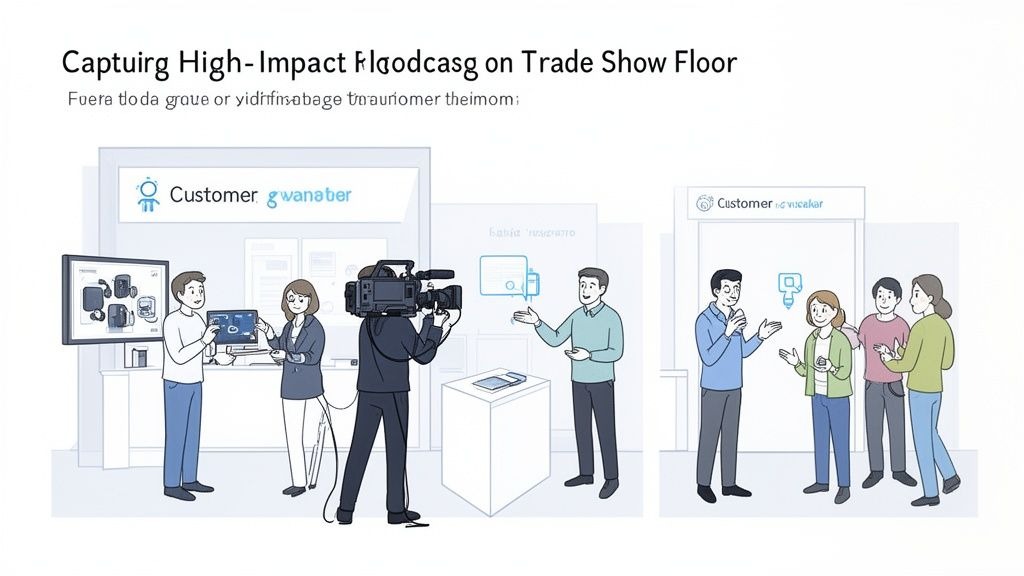
All that pre-show planning is your map, but the trade show floor is the actual journey. This is where your strategy gets put to the test amidst the chaos of loud conversations, flashy booths, and endless foot traffic. Pulling off high-impact video here means sticking to your plan while being ready to improvise at a moment's notice.
Your shot list is your anchor in this controlled chaos. It’s what keeps your crew focused on the must-have assets you defined earlier, making sure you leave with footage that actually serves a purpose back at the office. The game is all about managing your time and hitting those priority shots that will fuel your post-show campaigns.
Mastering the Must-Have Shots
Every solid B2B videography plan revolves around a few core, high-value shots. Think of these as the versatile building blocks that will feed your marketing machine for months. Sure, spontaneous moments are great, but you can't leave these foundational elements to chance.
Prioritize these essential shots:
- Customer Testimonials: Authentic praise from happy clients is pure marketing gold. Find a clean, well-lit corner in your booth and start rolling.
- Product Demos: Don't just show features; show solutions. Capture your product in action, zeroing in on how it solves a real pain point for your ideal customer.
- Executive Interviews: Position your leadership as the experts they are. These interviews are perfect for thought leadership content and can be chopped up for all kinds of channels.
- Booth B-roll: This is the visual glue for all your videos. Get wide shots of the busy booth, your team chatting with attendees, and close-ups of your branding.
Focusing on these specific formats aligns with what audiences actually want to see. Data shows that product demonstrations (39%) and sales-focused videos (37%) are top performers for B2B marketers. Nail these, and you'll get far more engagement than with less targeted content.
Coaching Authentic Customer Testimonials
Getting a customer to agree to a testimonial is half the battle. Getting them to sound natural on camera is the other half. The goal here is authenticity, not a stiff, rehearsed pitch. Your job is to make them forget the camera is even there.
Instead of feeding them a script, have a real conversation. Ask open-ended questions that get them telling a story.
Ask questions like:
- "Can you walk me through the specific problem you were dealing with before you found us?"
- "What was that 'aha' moment when you realized our solution was actually working?"
- "If you were explaining the biggest benefit to a colleague, what would you say?"
This approach pulls out genuine emotion and powerful, specific soundbites. You're there to guide the conversation, not dictate the answers.
Actionable Takeaway: A great testimonial feels like you're eavesdropping on a conversation between two people who are passionate about solving a problem. Your job as the director is to create the environment for that conversation to happen.
Filming Demos That Showcase Value
A product demo on a noisy show floor has to be visually punchy and instantly understandable, even with the sound off. Keep your shots tight, focusing on the user interface or the physical product. If you can, use screen recordings or graphic overlays to add clarity.
Structure the story simply: problem, action, result. Show the challenge, the specific action they take with your product, and the immediate, valuable outcome. This structure makes the benefit crystal clear without needing a long voiceover, perfect for social media, where most people watch on mute.
If you’re thinking bigger, like turning those executive interviews into a podcast series, you need the right setup. Our ultimate guide to video podcasting equipment for B2B brands has everything you need to know about capturing pro-level audio and video.
Directing Executive Interviews and Capturing B-roll
When interviewing your own execs, you want to capture their expertise in a way that feels human and relatable. Give them talking points, not a script, so they sound knowledgeable but not robotic. Find the quietest corner of your booth you can, or better yet, book a separate meeting room to get clean audio. This is non-negotiable for quality content.
Finally, block out dedicated time for B-roll. Don't just try to squeeze it in between interviews. Have your camera operator spend a solid 30 minutes just capturing the vibe: attendees interacting with your team, close-ups of hands on a keyboard during a demo, laughter, handshakes, and wide shots of the bustling aisles. This is the footage that will bring your sizzle reel to life and make everything you create feel dynamic.
Turning Raw Footage into a Content Goldmine
The event might be over, but the real work has just begun. You've come back with hours of raw footage, a digital goldmine just waiting to be tapped. Post-production is where you take all that potential and hammer it into a versatile portfolio of marketing assets that'll fuel your campaigns for months to come.
A smart post-production workflow isn’t about frantically editing everything at once. It's about being methodical: organizing, prioritizing, and crafting content that aligns with the goals you set before you ever stepped foot on the show floor. This is how you squeeze every drop of ROI from your event investment, turning a three-day show into a year-long content engine.
Building Your Post-Production Assembly Line
Before you even think about opening your editing software, you need a system. The very first step is to get every single clip organized. It might sound tedious, but trust me, a well-organized project file will save you (or your editor) countless hours of frustration down the road.
Start with a dead-simple folder structure. Logic is your best friend here:
- Interviews: Create subfolders for each person (e.g., CEO_Interview, Customer_Testimonial_JaneDoe).
- Product Demos: Group clips by the product or feature being shown (e.g., ProductA_Demo, NewFeature_Walkthrough).
- B-Roll: Categorize these shots by what they are (e.g., Booth_Crowd_Shots, Team_Interactions, Branding_Closeups).
- Audio: Keep all your audio in its own folder, with files clearly labeled to match their video counterparts.
Once everything has a home, it's time to log the footage. This means watching everything and making notes. I like to use time-stamped comments on the best takes, the most powerful soundbites, and the most compelling b-roll shots. This log essentially becomes the treasure map for your entire editing process.
Actionable Takeaway: Your post-production workflow should be an assembly line, not a scramble. By methodically sorting and logging your assets first, you empower your editor to focus on creative storytelling instead of searching for a needle in a digital haystack.
Prioritizing Edits for Maximum Impact
With all your footage neatly sorted, you can now decide what to create first. The key here is to let your immediate marketing needs dictate the schedule. What campaigns are launching next month? What content does your sales team need right now to help them close deals?
A typical priority list I've seen work well looks something like this:
- The "Quick Wins" for Social Media: Pull the best 1-2 soundbites from your executive or customer interviews. Chop them into short, vertical videos with captions. These can be turned around in just a few days to ride the post-show wave of excitement.
- The Main Event Sizzle Reel: This is your 60-90 second flagship asset. It’s a high-energy montage of the best b-roll, key interview moments, and punchy music to capture the event's vibe. It’s perfect for your website, email recaps, and as a promo for next year's show.
- Standalone Customer Testimonials: Edit each customer interview into a polished 1-3 minute story. These are absolute gold for your homepage, sales decks, and lead-nurturing emails.
- In-Depth Product Demos: Create clean, focused videos that show your product in action. These are invaluable for your product pages and for your sales team to send directly to prospects.
This tiered approach gets high-impact content out the door fast while you systematically chip away at the bigger editing projects.
Slicing and Dicing for Every Channel
The real magic of trade show videography is its adaptability. A single 10-minute interview can be strategically sliced and diced into a dozen different pieces of content. This is where you get that exponential value from your initial effort. To truly make your trade show footage a 'content goldmine' and extend its lifespan, understanding effective content repurposing strategies is essential for modern marketers.
Here’s a practical look at how one asset can spawn many:
Original AssetRepurposed Content Pieces10-Minute CEO Interview1. A 2-minute thought leadership clip perfect for LinkedIn.2. Three 30-second vertical clips for Instagram Reels or TikTok, each hitting on one key takeaway.3. An audio-only version to feature on your company podcast.4. Quote graphics for Twitter and LinkedIn, pulling the most powerful lines.5. A full-length version for your YouTube channel and website's resource hub.
This multi-platform mindset ensures you’re meeting different segments of your audience on their home turf. For a deeper dive, check out our guide on powerful content repurposing strategies that can help you turn one video shoot into a month's worth of material. When you start seeing every clip as a source for multiple assets, you build a sustainable content pipeline straight from the trade show floor.
Common Questions About Trade Show Videography
Even with the best-laid plans, jumping into trade show videography for the first time brings up a ton of questions. How much is this going to cost? What are the rules? How do we film anything good in that chaotic environment? It's easy to get overwhelmed.
Let's cut through the noise and tackle the real-world problems you’re almost guaranteed to face. Think of this as your practical field guide. Getting these answers straight now will save you a world of headaches (and money) on the show floor.
How Much Should We Budget for Trade Show Videography?
This is the million-dollar question, right? The honest answer is: it completely depends on what you're trying to achieve. Your budget could be $2,000 for a single freelance videographer grabbing some B-roll, or it could easily top $20,000 for an agency crew producing cinematic interviews and product demos.
The key is to stop thinking about a magic number and start thinking about the outcome. To build a realistic budget, you need to get specific about what you need:
- Crew Size: Can a solo shooter handle it, or do you need the polish that comes from having a dedicated sound tech and a director? Every extra person on the crew adds to the day rate.
- The Gear: Basic camera and audio are table stakes. But if you’re dreaming of multi-camera 4K interviews, slick lighting setups, or a gimbal for smooth walking shots, the cost will creep up.
- Editing & Post-Production: This is the part everyone forgets. A quick sizzle reel is one thing; editing ten individual customer testimonials with custom graphics and animations is a whole different beast.
- Travel Costs: If your go-to crew isn't local, you'll be on the hook for their flights, hotels, and per diems.
Instead of asking, "How much does it cost?" change the question to, "What do we need to accomplish?" Go to your potential video partners with a concrete list, say, three customer testimonials, one sizzle reel, and five short social clips, and ask them to quote that specific scope of work. This immediately frames the conversation around the value you’re getting, not just the price tag.
Navigating Permissions and Legal Concerns
The absolute last thing you want is a tap on the shoulder from event security telling you to pack it up, or worse, a legal notice after the event. Getting your permissions sorted out is non-negotiable.
Your first stop should be the event organizer’s website. Look for their media policy. Most big trade shows require you to register for a media pass to film on the exhibition floor. Get this handled weeks in advance.
But the event's rules are just one piece of the puzzle. You also need to think about individual consent.
Actionable Takeaway: Always, always, always get a signed release form from anyone who is a primary subject in your video. This is especially true for customer testimonials or partner interviews. A quick verbal "okay" on camera won't protect your company if you plan to use their face all over your marketing materials.
For general B-roll of the crowd walking past your booth, you're usually in the clear; people in a public space don't have a high expectation of privacy. But if your camera lingers on one person for more than a few seconds, it’s just good practice (and smart legally) to get their permission. Keep a clipboard with a stack of release forms handy and make signing one a standard part of your process.
Handling a Noisy and Unpredictable Environment
Let’s be real: trade show floors are a videographer's nightmare. They’re loud, the lighting is awful, and it’s always crowded. This is the triple threat to quality video. So how do you walk away with professional-looking content? It all comes down to the right gear and the right techniques.
- For Audio: This is your biggest battle. Any pro worth their salt will use lavalier (clip-on) microphones for interviews. Period. These little mics isolate the speaker's voice from the surrounding chaos, and it's the only way you'll get clean, usable dialogue.
- For Lighting: The overhead fluorescent lights at a convention center make everyone look terrible. A small, portable LED light panel can be a game-changer. Your camera operator can use it to fill in harsh shadows and create a much more flattering, professional look for interviews without a massive, disruptive setup.
- For Stability: Shaky footage screams "amateur hour." A tripod is non-negotiable for any sit-down interview. For those smooth, cinematic shots of you walking through the crowd or showing off the booth, a gimbal (a motorized stabilizer) is your best friend.
Ultimately, your best bet is to hire a crew that has experience in these exact environments. Before you sign a contract, ask to see examples of their work from other trade shows. If they can make a chaotic convention floor look and sound fantastic, you know they can handle the job.
Ready to elevate your B2B marketing with a podcast that builds authority and drives real growth? Fame is a specialized production agency that helps companies like yours launch and scale podcasts that deliver measurable results.
