

A powerful B2B social strategy is more than just scheduling posts. It's a calculated system for building authority and generating demand. Stop chasing the dopamine hit of likes and start connecting with high-value buyers where they spend their time. The goal: transform your social channels from a passive megaphone into a measurable engine for business growth.
This guide provides an actionable playbook to make that happen.
Moving Beyond Vanity Metrics in B2B Social
Let’s be honest: a huge chunk of what passes for B2B social media is a complete waste of time. Too many companies are stuck pushing polished graphics and company announcements, only to get pity-likes from their own employees.
That approach is a trap. It’s chasing vanity metrics, likes, follows, shares, that feel productive but do nothing for the bottom line. Low engagement is just a symptom of a much bigger problem: a total lack of strategy. Without one, your social channels become a costly, time-sucking obligation that delivers zero pipeline. It’s time to shift from just ‘doing social’ to deliberately engineering a strategic ecosystem where every post serves a specific business goal.
Before we dive into the step-by-step playbook, let's zoom out. An effective social strategy isn't just about posting content; it's about integrating social media into your core business operations. It’s a shift from tactical noise to strategic impact.
Table: Key Pillars of a Modern B2B Social Strategy
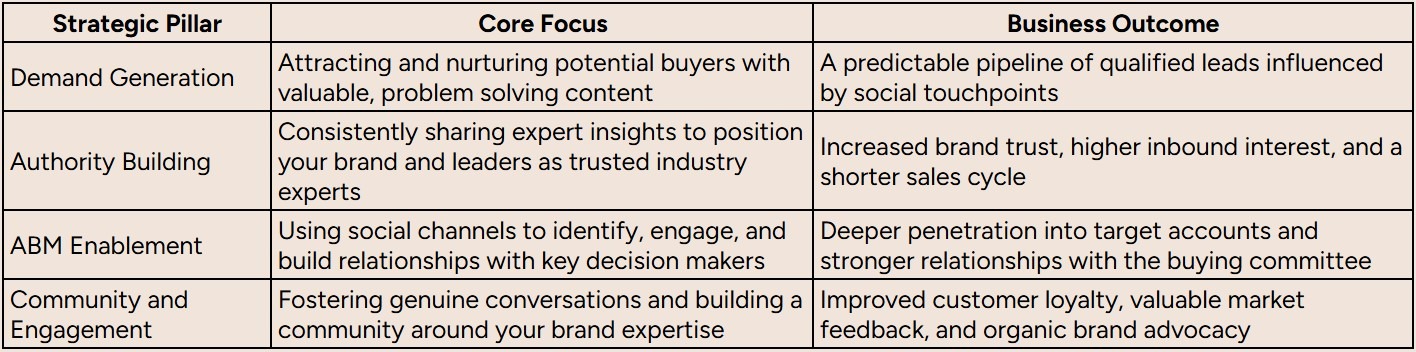
This table frames our entire approach. We're not just creating posts; we're building a multi-faceted engine that supports critical business functions, from sales to customer success.
Engineering a Strategic Ecosystem
A modern B2B social strategy must function as a central hub for multiple business goals, not just a content distribution channel. Its real job is to support and accelerate objectives across the entire organization.
Here are the pillars in action:
- Demand Generation: Instead of just broadcasting, actively pull in and nurture potential customers. Your content should guide them smoothly into your marketing funnel.
- Authority Building: Consistently share expert insights and valuable content. This positions your company and key people as the undisputed authorities in your niche.
- Account-Based Marketing (ABM) Enablement: Use social platforms to identify, engage, and build real relationships with the decision-makers at your dream accounts.
The ultimate goal is to transform your social media from a cost center into a measurable asset. You need to connect your social activities directly to business outcomes, demonstrating a clear return on investment.
To do this, you must link social performance to tangible results. We wrote a whole guide on how to calculate marketing ROI that will give you a solid framework for proving the value of your efforts.
Focus on metrics that actually matter, like qualified leads, pipeline influence, and customer acquisition cost, to ditch the vanity metrics and build a social strategy that genuinely drives revenue.
Mapping Your Audience and Selecting Channels
A winning B2B social strategy never starts with a content calendar. It starts with a deep understanding of your customer. Before you think about what to post, you must know exactly who you're talking to and where they hang out online, whether that’s LinkedIn, niche Slack communities, or even following the best startup podcasts for industry insights. Spraying content across every platform is a fast pass to burning cash with zero return.
The goal isn't just to target a company. It's to map the entire buying committee inside that company. In B2B, one person rarely makes the final call. You have an internal champion, a technical buyer, an economic buyer, and a cast of influencers. Your social strategy must have something for each of them.
Go Beyond Surface-Level Personas
Most B2B personas are useless. They stop at demographics like job title and industry. To make an impact, you have to get into the psychographics and the day-to-day reality of your audience. That means finding answers that reveal what's really going on in their world.
The best way to do this? Talk to your sales team and your best customers.
Ask them these questions:
- What are their biggest professional frustrations? Not the big problem your product solves, but the day-to-day headaches they deal with.
- Where do they actually go for information? Get specific. Ask about the newsletters they subscribe to, the podcasts they listen to, and the industry folks they follow.
- What does their approval process really look like? Find out who has to sign off on a purchase. This maps the entire buying committee.
- What kind of content would make them look like a genius to their boss? This question gets right to their internal drive for career progression.
The most powerful insights come from truly understanding your audience's workflow. If you know what a day in their life looks like, you can create content that fits right into it instead of just interrupting it.
This level of detail turns a generic "Marketing Manager" persona into a real person. Suddenly, they're not just a job title; they're someone struggling to prove ROI, listening to a specific marketing podcast, and needing a data-backed business case to get their CFO to sign off on the budget.
Choosing Your Channels with Purpose
Once you have a crystal-clear picture of your audience, picking social channels becomes a strategic move, not a guessing game. Instead of trying to be everywhere, focus your firepower on the platforms where your ideal customers are actually paying attention.
Assign a specific job to each platform in your B2B social strategy. While there are many options, start by mastering the main players. For a deeper dive, explore guides on the best B2B marketing channels to drive growth.
For most B2B companies, LinkedIn is command central. Its dominance is hard to overstate. A whopping 95% of B2B marketers use it for organic content because that's where decision-makers actively look for industry insights. A staggering 80% of B2B social leads come from LinkedIn.
But that doesn't mean you should ignore everything else. Assign a different role to other platforms:
- X (formerly Twitter): Use this as your real-time listening post. Jump into trending industry conversations, share quick commentary, and connect with journalists or event attendees. Prioritize timeliness and conciseness over deep thought leadership.
- YouTube: Make this your educational hub. Use it to host product demos, webinar recordings, customer stories, and deep-dive tutorials. Treat it as the library for your most valuable, evergreen video content that answers complex customer questions.
By putting your resources where you can make real connections, you ensure every bit of effort moves your ideal customer along their journey.
Building Your Content Engine and Editorial Workflow
A great B2B social strategy isn't about random acts of content. That’s a recipe for burnout. It’s about building a repeatable, scalable engine that pumps out high-value material consistently. This engine has two core parts: sustainable content pillars and an intelligent editorial workflow.
First, establish your content pillars. These are the 3-5 core topics your brand commits to owning. They should sit at the intersection of your company's expertise and your audience's biggest challenges. Instead of wondering, "What should I post today?", use these pillars as your North Star to ensure every piece of content reinforces your authority.
For example, a B2B SaaS company selling project management software might choose these pillars:
- Remote Team Productivity: Actionable tips, workflow breakdowns, and expert interviews on managing distributed teams.
- Agile Methodologies: Practical guides breaking down complex frameworks for non-developer leaders.
- Leadership & Scalability: Real-world insights from founders on growing teams and clearing operational hurdles.
These aren't just topics; they're a promise to your audience about the value you'll consistently deliver.
Turning One Big Idea Into a Month of Content
The secret to consistency isn't creating more content; it's getting more out of the content you already have. You have to work smarter. The best way to do this is by "atomizing" one cornerstone asset, like a podcast, webinar, or blog post, into dozens of smaller social media posts.
This is how you get maximum mileage out of your best ideas.
One podcast episode can become a month's worth of content. Here's how: pull out a key quote for a text post, a surprising stat for an infographic, a 60-second clip for a Reel, and a contrarian take for a LinkedIn thought leadership post.
This flowchart shows how this process works, starting from understanding your audience and moving to creating specific content for each channel.
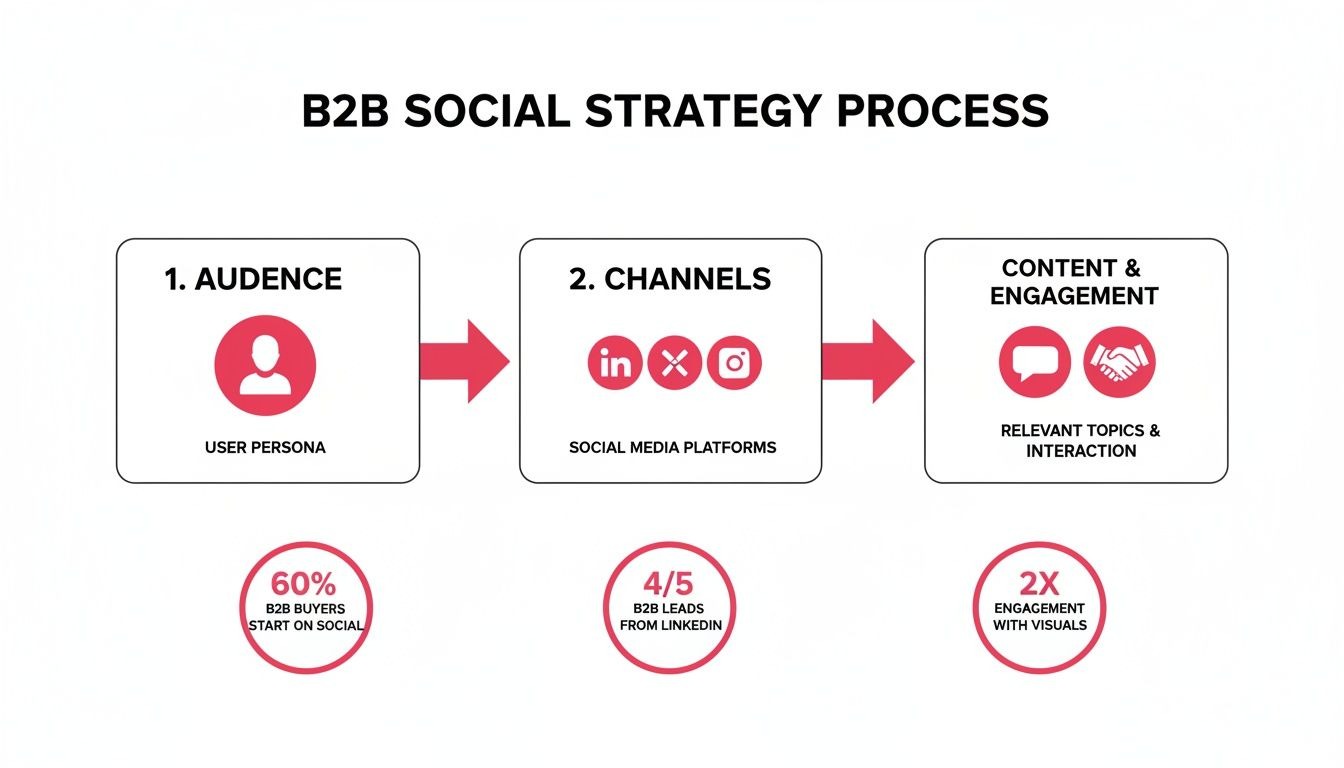
The takeaway: let your audience's needs directly shape what you create and where you post it. It's not one-size-fits-all.
This isn’t just a tactic anymore; it’s essential. With social media being the number one distribution method for 90% of B2B marketers, you can't afford to post something once and let it die. Repurposing is the only sustainable way to keep up.
Picking the Right Format for the Right Job
Different formats achieve different goals. A short, punchy video is great for grabbing attention, but won't work for a complex tutorial. A well-rounded social plan uses a mix of formats designed to attract, engage, and convert your audience.
Here’s a simple framework for choosing formats:
- Short-Form Video (Reels, Shorts): Use these as your attention-grabbers for top-of-funnel awareness. Create quick tips, highlight a shocking stat from a report, or share a killer audiogram from a podcast guest.
- Carousels & Infographics (LinkedIn): Use these to break down complex topics into digestible, step-by-step visuals. They're highly shareable and position you as a helpful expert.
- Text & Thread Posts (LinkedIn, X): Use this format to share a strong opinion, tell a story, or ask a question that sparks conversation and drives engagement in the comments.
- Live Streams & Webinars (LinkedIn Live, YouTube): Use live video when you need to go deep. It’s the ultimate format for in-depth education, product demos, and direct audience interaction like Q&A panels.
A huge mistake I see all the time is people creating the content first and only then thinking about the format. Flip that. Start with the platform and its native format, then adapt your core message to fit perfectly. A carousel isn't just a bunch of text slides; it's a visual story.
This format-first mindset ensures you're not just throwing content at the wall but delivering it in a way your audience wants to consume it.
Building an Editorial Calendar That Actually Works
Your editorial calendar is the heart of your content engine. It's more than a schedule; it's a strategic document connecting content to business goals, marketing campaigns, and industry events. A good calendar provides structure while leaving room for spontaneity.
At a minimum, your calendar should track this for every post:
- Pillar: Which of your content pillars does this support?
- Cornerstone Asset: Is this repurposed from a podcast, blog, or webinar? (Link to it!)
- Format: Video, carousel, text post, etc.
- Channel: Where is it going?
- Call to Action (CTA): What’s the next step you want someone to take?
- Campaign: Is this tied to a specific launch or theme?
This level of detail is what separates the pros from the amateurs. It stops the last-minute scramble and ensures everything you post is intentional. If you're starting from scratch, check out this guide on how to create a content calendar to get a jumpstart.
When you combine strong pillars with a smart workflow, you build a sustainable system that consistently drives authority and demand.
Amplifying Your Reach and Enabling Sales
Creating brilliant content is only half the job. It's a waste of effort if the right people never see it. This is where strategic amplification comes in, turning your content from a nice-to-have into a machine that builds your brand and actively helps your sales team close deals.
This isn't about posting and praying. It's a system that blends organic hustle, paid precision, and targeted outreach to get your insights in front of your ideal customers and open doors for real conversations.

An effective B2B social strategy requires a deliberate, multi-pronged approach to distribution. Let's break down how to make that happen.
Tapping into Organic Reach That Actually Works
Before you spend a single dollar on ads, activate the assets you already have. This isn't about gaming algorithms; it's about building genuine engagement by leveraging your internal network.
One of the most potent and shockingly overlooked tactics is building an employee advocacy program. Your employees’ combined networks are almost certainly larger and more trusted than your corporate brand page. When they share company content, it feels more authentic and reaches a wider, more relevant audience.
Here's how to make it dead simple for them:
- Set Up a Content Hub: Create a dedicated Slack channel or use a simple tool to share pre-approved posts and talking points.
- Encourage a Personal Touch: Ask employees to add their own spin. A quick "Loved this insight from our latest report" is infinitely better than a generic copy-paste job.
- Celebrate the Wins: Give public shout-outs to employees who are actively sharing and driving engagement. A little recognition goes a long way.
On top of that, authentically engage in niche online communities. Find the LinkedIn Groups, Slack communities, or industry forums where your ideal customers ask questions. Don't spam links to your content. Answer questions, provide real value, and build a reputation as a helpful expert first.
Precision Targeting with Paid Social
Once your organic engine is humming, use paid social to put your best content directly in front of your ideal buyers with precision. For B2B, LinkedIn Ads is the undisputed king for lead generation and account targeting.
A common mistake is simply "boosting" posts and hoping for the best. Instead, build targeted campaigns designed for specific outcomes.
The real power of paid social isn't just reaching more people; it's reaching the exact right people at the exact right time. You can target by job title, company size, industry, and even specific account lists, ensuring your budget is spent with zero waste.
For instance, run a lead gen campaign promoting a high-value webinar exclusively to VPs of Marketing at SaaS companies with over 200 employees. That level of focus is what separates a successful paid strategy from a money pit. Match your best content to hyper-specific audiences to turn views into qualified leads.
For more ideas on getting your content seen, check out our guide on powerful content distribution strategies.
Executing Social ABM Plays
This is where your B2B social strategy becomes a direct sales enablement tool. Account-Based Marketing (ABM) on social media is about using platforms like LinkedIn to identify and engage key decision-makers at your target accounts. This is not about sending spammy, automated connection requests.
It's a thoughtful, multi-touch process designed to warm up cold accounts and give your sales team an "in" for valuable conversations.
Here's an actionable ABM play you can run right away:
- Map the Buying Committee: Work with sales to pinpoint 5-7 key contacts at a single target account (e.g., the Head of Engineering, the CTO, a Senior Project Manager).
- Engage Authentically: For two weeks, have your sales rep and a key executive from your company genuinely engage with their public posts. That means thoughtful comments, not just drive-by "likes."
- Share Hyper-Relevant Content: Tag one of the key contacts in a post sharing a piece of content that speaks directly to a pain point relevant to their role. For example: "@JaneDoe, saw you were discussing scaling engineering teams. This article on managing technical debt might be interesting."
- Send a Personalized Connection Request: Only after building this initial familiarity, send a connection request that references your previous interactions or their content.
This "social selling" approach transforms a cold outreach into a warm introduction, dramatically increasing the odds of getting a positive response and booking that first critical meeting.
Measuring Performance and Optimizing for ROI
If you can't measure it, you can't improve it. And you can't justify the budget for it. The whole game of B2B social media measurement is moving past vanity metrics, like follower counts and likes, and focusing on numbers that show business impact.
Build a solid framework that connects your team’s daily posts and campaigns directly to marketing objectives and revenue. It’s about creating a clear, data-backed story you can confidently present to leadership.
Linking Social Metrics to Business Goals
To prove your work's value, organize your metrics into tiers that map to the buyer's journey. This helps you avoid getting lost in data and start telling a story that makes sense to non-marketers.
Think of it as a pyramid, with broad metrics at the bottom and hard revenue numbers at the top.
- Brand Awareness: These top-of-funnel metrics tell you if you're getting on the radar. Track share of voice (how often your brand is mentioned vs. competitors) and overall reach to see how far your message is traveling.
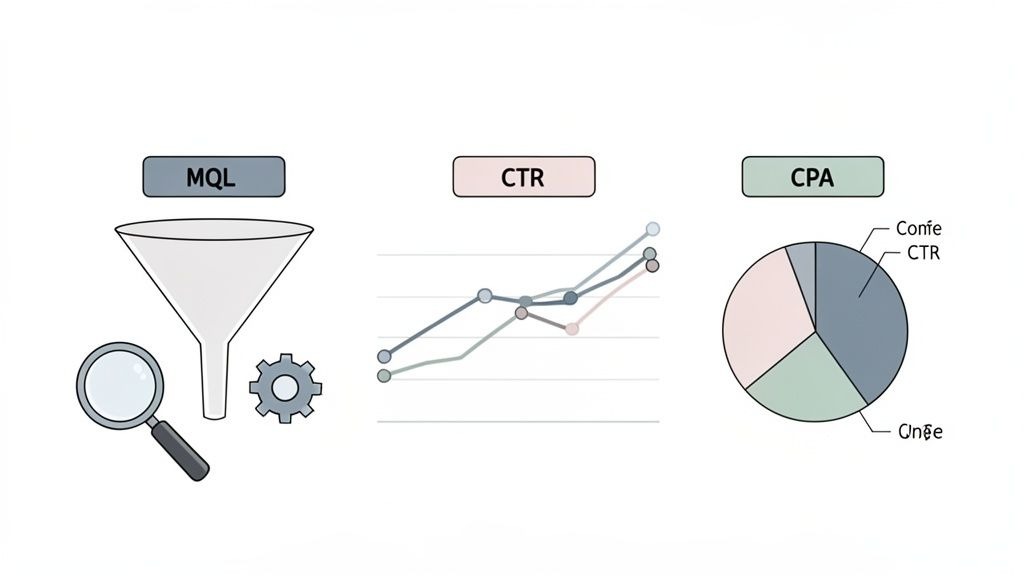
- Audience Engagement: This is the middle of the pyramid, where you learn if your content is resonating. Go beyond simple likes. Analyze comment sentiment (are people having real, positive conversations?), click-through rate (CTR) on your links, and share rate.
- Pipeline Influence: This is the top, where social media proves its value. Track social-sourced MQLs (Marketing Qualified Leads), SQLs (Sales Qualified Leads), and the cost per acquisition (CPA) from your social channels.
Here's where most people go wrong: they report on all these metrics as if they're created equal. The real skill is connecting them. For example: "Our increased share of voice on LinkedIn last quarter directly correlated with a 15% rise in website traffic from the platform, which generated 22 new MQLs."
That’s a narrative. That's a story that shows impact, not just a data dump.
Building a Clear Reporting Framework
When showing results to leadership, simplicity and consistency are your best friends. Don't show them a spreadsheet with 50 data points. Build a clean dashboard that highlights trends and clearly connects social activities to business outcomes.
Your monthly report should answer three basic questions:
- What did we do? (e.g., We launched a 3-part video series on agile methodologies).
- What were the results? (e.g., The series got 50,000 views, a 4.5% CTR to the landing page, and drove 12 demo requests).
- What are we doing next? (e.g., We're doubling down on video and running an A/B test on thumbnail creative to push that CTR even higher).
This simple "What? So What? Now What?" structure shows you're not just reporting numbers, but thinking strategically and constantly improving. While we're focused on social ROI here, it's also smart to understand how to measure overall marketing ROI for real business growth.
Optimizing for Better Results Over Time
Data is useless if you don't act on it. The most important part of this process is using what you learn to run experiments and make smarter bets. Your measurement should feed a constant cycle of optimization.
Here are a few ways to put your data to work immediately:
- A/B Test Your Creative: Did that carousel post crush the single-image post you ran last week? Great. Test more carousels. Systematically test your headlines, visuals, and calls-to-action to figure out what your audience actually responds to.
- Refine Audience Targeting: Dive into your analytics. Who are your most engaged followers? Look at their job titles, industries, and company sizes. Use that data to sharpen the targeting on your paid ads.
- Double Down on What Works: If a post about remote team productivity got twice the engagement of anything else you published last month, that's a massive signal. The market is telling you what it wants; make more content around that pillar.
When you start treating your B2B social strategy like a series of data-guided experiments, you stop guessing. It becomes a dynamic system that gets smarter and delivers a better return with every post.
Building Your Team and Tech Stack
Let's be honest: a killer B2B social strategy isn't a one-person show. It takes a dedicated team with the right tools.
Executing day in and day out requires a specific blend of creativity, analytical skills, and a genuine love for community. Pulling together this crew and their toolkit is the final piece of the puzzle. It’s what turns your brilliant strategy into a well-oiled machine that actually gets results.
How you structure that team will change with your company's size. A startup might have one marketer juggling everything, while an enterprise will have specialists for each role. No matter the scale, the core jobs that need doing don't really change.
Assembling Your Social Media Dream Team
A top-tier B2B social team is a mix of different talents. It's so much more than just scheduling posts. You need storytellers, data nerds, and relationship builders working in sync. For a really deep look at this, we've put together a complete guide on building a modern content marketing team structure.
But for now, here are the essential players you need on the field:
- The Strategist/Manager: This is the captain. They own the high-level plan, set KPIs, manage the budget, and ensure social media supports business goals.
- The Content Creator: Your storyteller. This is the writer, designer, or video editor who transforms your content pillars into posts, carousels, and clips that people actually want to see. They understand what works on each platform.
- The Community Manager: The voice of your brand. They reply to comments, jump into conversations, and turn followers into fans.
- The Data Analyst: This person lives in the numbers. They pull insights from analytics to prove ROI and help the team make smarter decisions about what to create next.
Curating Your Essential Tech Stack
The right software doesn't just save you time, it supercharges what your team can do. A good tech stack streamlines everything from creating content to reporting on its impact, freeing up your people to focus on high-value tasks.
Your tech stack should make your strategy easier, not more complicated. Start with the basics that solve your most immediate headaches. Don't buy a shiny new tool until you know exactly what problem it's supposed to fix.
Here are the key categories to build your stack around:
- Social Media Management: Use these as your command centers. Platforms like Sprout Social or Agorapulse let you schedule, monitor, and report across all channels from one place.
- Content Creation: Use tools to make great content, fast. Think Canva for slick visuals and Descript for easy video and podcast editing. These make pro-level content accessible.
- Employee Advocacy: Use platforms to get your team to share content and unlock organic reach. Tools like GaggleAMP or Oktopost make it simple for employees to find and post pre-approved content.
- Social Listening: Know what people are saying. Use tools like Brand24 to monitor brand mentions, track competitors, and spot industry trends as they happen.
A Few Common B2B Social Strategy Questions
When you're mapping out a sophisticated B2B social plan, a few tough questions always seem to pop up in leadership meetings. Let's tackle the big ones I hear all the time.
How Long Until We Actually See Results?
This is the million-dollar question, isn't it? The honest answer is: it depends on your goals.
If you're playing the long game of building a brand and authority, you need patience. That trust isn't built overnight. Expect a 6-12 month runway of consistently delivering high-value content before you feel real momentum.
But for more immediate demand gen, things can move much faster. A well-targeted paid social campaign can start generating qualified leads within the first 1-3 months.
What's a Realistic Budget for This?
Your budget should never be an arbitrary number. It needs to directly reflect your goals. To ensure no part of your strategy gets left behind, split your budget across three key buckets.
- Your Toolkit: Set aside funds for the essential platforms that help you manage, create, and analyze everything. This can run from a few hundred to a few thousand dollars a month, depending on your stack.
- Content Creation: Don't skimp here. Whether it's design, video editing, or writing, high-quality content is non-negotiable. Factor these costs in from day one.
- Paid Amplification: You have to pay to play. Dedicate a healthy slice of your budget to paid social ads, especially on LinkedIn, to guarantee your best content reaches your ideal customers.
The single biggest mistake I see is when companies treat social like a sales megaphone. Your B2B buyers are allergic to being sold to on these platforms. They're looking for insights that make them better at their jobs, not another demo. If you build trust by educating and helping, the sales conversations will follow. It's that simple.
The most critical error is running your social channels like a B2C brand, full of flashy promos and hard sells. A winning B2B social strategy is all about building long-term trust and authority, not chasing short-term sales.
Ready to turn your B2B expertise into a powerful demand-generation engine? At Fame, we help B2B companies build authority and drive pipeline with strategic podcasting. Learn how we can help you grow.
