December 6, 202522 min read12 sections
The 10 Best B2B Marketing Channels To Drive Growth In 2026 (Ranked)
By Fame Team
Key Takeaways
- To achieve a measurable return on investment in B2B marketing, it's crucial to identify and focus on the channels that align with your business's growth stage and target audience.
- A strategic podcast can serve as a powerful force multiplier in B2B marketing, fueling efforts across various platforms, attracting ideal customers, and generating social media content.
- LinkedIn is a premier platform for B2B marketing, offering a dynamic ecosystem for building brand awareness, generating high-quality leads, and establishing executive thought leadership, particularly for companies with a clearly defined ideal customer profile.
The B2B marketing landscape is more crowded than ever, with new platforms and strategies emerging constantly. It’s easy to get lost in a sea of options, from Account-Based Marketing (ABM) to paid social and complex automation. The real challenge isn't knowing what's available; it's identifying which channels will deliver a measurable return on investment for your specific business goals and target audience. Generic advice leads to wasted budgets and missed opportunities. Success requires a strategic approach, focusing on the channels that align with your growth stage, whether you're a startup needing brand authority or an enterprise preparing for an IPO.
This guide cuts through the noise. We'll break down the top B2B marketing channels, providing actionable insights on when to use each one, what key performance indicators (KPIs) to track, and how to execute with precision. Understanding which channels truly deliver results requires accurate measurement of their financial impact, so it's crucial to learn how to calculate marketing ROI to justify your spend and optimize your strategy effectively.
More importantly, we'll reveal how a strategic podcast can act as a powerful force multiplier. A podcast is not just a standalone channel; it’s a content engine that fuels your efforts across nearly every other platform. It helps attract ideal customers, builds relationships with partners through guest appearances, improves SEO by converting episodes into blog posts, and generates a steady stream of social media content. This guide will explore the best B2B marketing channels that will move the needle for your business and show you how to integrate them for maximum impact.
1. LinkedIn Marketing: The Undisputed B2B Powerhouse
With over a billion professionals globally, LinkedIn is the premier platform for B2B marketing. It's far more than a social network; it's a dynamic ecosystem for building brand awareness, generating high-quality leads, and establishing executive thought leadership. B2B organizations leverage LinkedIn to target decision-makers with surgical precision, using filters like job title, industry, and company size to ensure their message reaches the right audience at the right time.
For this channel to be effective, consistency and value are paramount. It’s about contributing to the professional conversation, not just broadcasting a sales pitch. This makes it one of the best B2B marketing channels for nurturing long-term relationships.
When to Use This Channel
LinkedIn is ideal for B2B companies with a clearly defined ideal customer profile (ICP). It excels at every stage of the funnel, from building top-of-funnel brand awareness with C-level executives to nurturing mid-funnel leads through targeted content and direct engagement. It's particularly powerful for high-ticket sales that require building trust and credibility over time.
Actionable Implementation & Examples
To maximize your LinkedIn efforts, focus on a multi-pronged approach that blends organic content with strategic outreach.
- Executive Thought Leadership: Encourage key executives to consistently post valuable insights, not just company news. A CFO sharing their perspective on financial modeling trends will build more authority than a simple product announcement.
- Content Repurposing: A podcast serves as a powerful content engine for LinkedIn. A single episode can be repurposed into dozens of assets: short video clips for the feed, text-based posts with key takeaways, and carousel posts visualizing data points discussed. This strategy amplifies your reach and reinforces your message.
- Relationship Building: Use your podcast to foster strategic connections. Inviting potential partners or ideal customers as guests is a powerful relationship-building tool. Promoting the episode on LinkedIn not only provides value to your audience but also strengthens your bond with the guest.
- Targeted Outreach: Use Sales Navigator to identify and connect with key decision-makers. Personalize your connection requests by referencing a recent post they made or a mutual connection, moving beyond generic templates.
2. Email Marketing & Automation: The High-ROI Workhorse
Despite the rise of newer platforms, email marketing remains one of the best B2B marketing channels due to its unparalleled return on investment, often cited at over $40 for every $1 spent. It is the definitive channel for nurturing leads, retaining customers, and building direct relationships. B2B marketers use sophisticated email automation to deliver personalized, segmented campaigns triggered by specific user behaviors, ensuring messages are both timely and relevant.
This isn't about blasting a generic newsletter to your entire database. Effective B2B email marketing is a science of segmentation, personalization, and value delivery that guides prospects through the buyer's journey.
When to Use This Channel
Email marketing is indispensable for B2B companies with an established lead generation engine. It is the primary tool for mid-funnel lead nurturing, moving marketing qualified leads (MQLs) toward a sales-ready state. It's also highly effective for customer onboarding, upselling, cross-selling, and building long-term loyalty. If you need to communicate directly and consistently with a known audience, email is your go-to channel.
Actionable Implementation & Examples
A successful email strategy integrates automation with high-value content to create a seamless user experience.
- Behavior-Triggered Workflows: Instead of a one-size-fits-all drip campaign, build automated sequences based on user actions. If a prospect downloads a whitepaper on "AI in Finance," trigger a workflow that sends them a related case study, an invitation to a relevant webinar, and finally, a demo offer.
- Segmented Content Distribution: Use your email list to promote high-value assets. For instance, when you release a new podcast episode featuring an industry expert, send a targeted email to the segment of your audience most interested in that topic. This provides value and drives engagement with your core content.
- Progressive Profiling: Use smart forms in your emails and on landing pages to gather more information about your leads over time. Instead of asking for 10 fields at once, ask for their company size on the first conversion, their biggest challenge on the second, and so on. This enriches your data without creating friction.
- Rigorous A/B Testing: Continuously test elements like subject lines, calls-to-action (CTAs), and send times to optimize performance for your specific audience. Discovering that your C-suite audience opens emails at 7 AM on Tuesdays can dramatically lift engagement rates. For more guidance, explore these B2B email marketing best practices on fame.so.
3. Account-Based Marketing (ABM): The High-Value Targeting Strategy
Account-Based Marketing (ABM) flips the traditional marketing funnel on its head. Instead of casting a wide net to capture as many leads as possible, ABM is a hyper-focused strategy where marketing and sales teams collaborate to target a curated list of best-fit, high-value accounts. It treats each account as a market of one, delivering personalized, coordinated campaigns across multiple channels to engage key decision-makers.
This precision makes ABM one of the best B2B marketing channels for companies with a high average contract value. The goal is not just lead generation; it's about opening doors, deepening relationships, and accelerating the sales cycle within specific, pre-identified organizations. Companies like Demandbase and 6sense have built entire platforms around this methodology, proving its effectiveness in driving significant revenue.

When to Use This Channel
ABM is most effective when your Ideal Customer Profile (ICP) is concentrated within a finite number of identifiable companies. It is the go-to strategy for enterprise sales, high-ticket SaaS, and complex B2B services where purchase decisions involve multiple stakeholders over a long sales cycle. Use ABM to land new strategic accounts, expand your footprint within existing customers, or engage accounts that have shown high purchase intent.
Actionable Implementation & Examples
A successful ABM strategy requires deep alignment between sales and marketing, supported by a strong content engine and precise targeting technology. For more detailed strategies, you can check out these actionable account-based marketing examples.
- Create Account-Specific Content: Develop tailored content that addresses the specific pain points of a target account. This could be a custom landing page, a co-branded whitepaper, or a webinar addressing their industry's unique challenges.
- Integrate Intent Data: Use platforms like 6sense or Bombora to identify which of your target accounts are actively researching solutions like yours. This allows you to prioritize outreach when buying signals are strongest.
- Leverage Podcasts for Hyper-Personalization: A podcast becomes a powerful ABM tool. Invite a key decision-maker from a target account as a guest on your show. This creates a high-value, non-sales interaction that builds a genuine relationship and positions your brand as an industry peer.
- Use Multi-Channel Orchestration: Coordinate your outreach across channels. Run targeted ads on LinkedIn for employees at a specific company, follow up with personalized emails referencing that ad content, and arm your sales team with insights from those engagements. This creates a cohesive and immersive brand experience for the target account.
4. Content Marketing & Thought Leadership
Content marketing is the strategic foundation of modern B2B growth, moving beyond sales pitches to deliver genuine value. By creating and distributing relevant, educational content like blogs, whitepapers, and research reports, businesses can attract, engage, and convert their ideal customer profile. This approach establishes authority, builds trust over long sales cycles, and positions key executives as go-to industry thought leaders.
A B2B podcast is an exceptionally powerful form of content marketing. It acts as a central channel to attract ideal customers through engaging discussions, but its true value lies in how it supports other channels. A podcast allows you to build strategic relationships by featuring partners as guests, enhances SEO when each episode becomes a blog post, and fuels your social media with a steady stream of video clips for platforms like YouTube Shorts, Instagram Reels, and TikTok. A podcast isn't just a channel; it's a content engine that powers your entire marketing ecosystem.
When to Use This Channel
This channel is essential for B2B companies in complex industries where education and trust are prerequisites for a sale. It is particularly effective for businesses targeting sophisticated buyers who conduct extensive online research before engaging with a sales team. Content marketing is a long-term play, ideal for building a sustainable inbound lead engine and differentiating your brand in a crowded market.
Actionable Implementation & Examples
A successful content strategy requires a "hub and spoke" model, where a central piece of pillar content is repurposed to fuel multiple channels.
- Build Your Hub Around a Podcast: Launch a podcast focused on the core challenges of your ideal customer. This not only attracts your target audience but serves as a powerful relationship-building tool when you feature industry experts, partners, or even ideal customers as guests.
- SEO: Publish a full transcript and a detailed blog post for each episode on your website.
- Social Media: Edit the video recording into 2-3 short, engaging clips for YouTube Shorts, Instagram Reels, TikTok, and LinkedIn. Create quote graphics with key takeaways.
- Email: Use the episode as the centerpiece for your weekly newsletter.
5. Webinars & Virtual Events: Capturing Engaged Audiences
Webinars and virtual events are powerful tools for B2B lead generation and nurturing, attracting engaged professionals actively seeking education and solutions. They offer a direct, interactive format for presenting in-depth content, showcasing product value, and establishing brand authority. B2B firms use these events to educate prospects, qualify leads, and accelerate pipeline velocity by delivering immense value in a controlled setting.
Unlike static content, the live, interactive nature of a webinar creates a sense of urgency and community. This makes them one of the best B2B marketing channels for capturing high-intent leads who are ready to learn and engage directly with your brand.
When to Use This Channel
This channel is ideal for B2B companies looking to generate a high volume of marketing-qualified leads (MQLs) for a specific campaign or product launch. It excels in the middle of the funnel, where prospects are evaluating solutions and require deeper, more educational content. Webinars are particularly effective for complex products or services that benefit from a live demonstration and Q&A session.
Actionable Implementation & Examples
A successful webinar strategy goes beyond just the live presentation; it involves strategic promotion, engagement, and follow-up.
- Compelling Value Proposition: Frame your webinar title as a solution to a key pain point. Instead of "Our New Software Features," try "How to Cut Reporting Time by 50% with Automation." This immediately communicates value.
- Strategic Promotion: Begin promotion at least three weeks out using a multi-channel approach: email blasts, social media announcements, and paid ads. This builds anticipation and maximizes registration. For a deeper dive, you can learn more about building a robust B2B demand generation engine.
- Leverage External Experts: Invite a recognized industry expert or a key partner to co-host. This adds credibility, expands your promotional reach to their audience, and provides a fresh perspective.
- Repurpose Your Content: A single webinar can fuel your content calendar for weeks. Edit the recording into short video clips for social media, convert the key takeaways into a blog post, and use the slide deck as a downloadable asset to capture more leads post-event.
6. Search Engine Marketing (SEM) & Google Ads
Search Engine Marketing (SEM) is the art of capturing high-intent prospects at the exact moment they are searching for a solution. By bidding on keywords relevant to your business on platforms like Google Ads, you can place your message directly in front of decision-makers who are actively looking to buy. This immediate visibility makes SEM one of the best B2B marketing channels for driving qualified traffic and generating leads with measurable ROI.
Unlike channels focused on building awareness over time, SEM offers direct, bottom-of-funnel impact. When a CFO searches "enterprise resource planning software," your ad can be their first stop. This immediacy is powerful, but it requires strategic management of keywords, bids, and ad copy to ensure you are attracting the right audience without overspending.
When to Use This Channel
SEM is ideal for B2B companies with a clear understanding of the search terms their ideal customers use. It is highly effective for capturing bottom-of-funnel demand, launching a new product, or entering a competitive market where you need immediate visibility. If you have a well-defined value proposition and a landing page designed to convert, SEM can deliver a predictable stream of MQLs and sales opportunities.
Actionable Implementation & Examples
A successful SEM strategy hinges on precise targeting and continuous optimization. Salesforce, for example, bids heavily on competitor keywords like "HubSpot alternative" to capture buyers in the final stages of their decision-making process.
- Campaign Structure by Intent: Organize campaigns around the buyer's journey. Create separate campaigns for top-of-funnel informational keywords ("what is ABM"), mid-funnel consideration keywords ("best ABM platforms"), and bottom-of-funnel transactional keywords ("Terminus pricing").
- Granular Ad Groups: For each keyword theme, create a specific ad group. If you sell project management software, have separate ad groups for "Gantt chart software," "agile project tools," and "Kanban board solutions" to ensure your ad copy is highly relevant.
- Landing Page Congruence: Ensure your landing page directly reflects the promise made in your ad. If your ad promotes a free trial, the landing page should prominently feature the trial signup form, not a generic homepage. This improves your Quality Score and lowers your cost-per-click.
- Leverage Ad Extensions: Use sitelink, callout, and structured snippet extensions to add more information to your ad and occupy more screen real estate. This provides more reasons for a prospect to click and can significantly increase your click-through rate.
7. Industry Events & Trade Shows: The Face-to-Face Advantage
In an increasingly digital world, in-person and virtual events remain a cornerstone of B2B marketing. Industry events, from massive conferences like Dreamforce to niche trade shows, offer unparalleled opportunities for direct engagement. They concentrate your target audience in one place, allowing for high-impact relationship building, lead generation, and competitive intelligence gathering in a short period.
The power of this channel lies in its ability to humanize your brand and accelerate the sales cycle. A single handshake or meaningful conversation can build more trust than dozens of emails, making it one of the best B2B marketing channels for high-consideration purchases where personal connection is key.
When to Use This Channel
Industry events are ideal for B2B companies looking to make a significant impact on a specific vertical or target market. They are particularly effective for launching new products, entering new markets, or accelerating pipeline for key accounts. If your sales process benefits from live demos, direct executive access, and building personal rapport, trade shows should be a priority in your marketing mix.
Actionable Implementation & Examples
Success at events is determined by preparation and follow-through, not just booth presence. A strategic approach is essential to maximize ROI.
- Set Pre-Event Meetings: Don't wait for prospects to find you. Use the attendee list (if available) or LinkedIn to identify high-priority accounts and schedule meetings with your on-site executives before the event begins. This guarantees focused, high-value conversations.
- Train Your Booth Staff: Equip your team with more than just product knowledge. Train them on specific discovery questions to qualify leads effectively. Role-play scenarios to ensure they can quickly identify a decision-maker and understand their core pain points.
- Host a Side Event or Dinner: Create a more intimate setting by hosting a private dinner or happy hour for top prospects and customers. This controlled environment fosters deeper relationships away from the chaotic trade show floor.
- Leverage Content Opportunities: A speaking slot is a powerful authority builder. You can also use the event as a content creation hub. For example, set up a small station at your booth to record short podcast interviews with industry experts, partners, or even customers attending the event, turning foot traffic into valuable, reusable content.
8. Influencer & Analyst Relations: Leveraging Third-Party Credibility
In B2B, purchasing decisions are rarely made in a vacuum. Buyers actively seek external validation, which is where influencer and analyst relations become one of the most powerful B2B marketing channels. This strategy leverages the credibility of established industry analysts (like Gartner or Forrester) and respected influencers to build trust and guide market perception. It’s about earning a seat at the table where industry narratives are shaped.
Effective analyst and influencer relations are not about one-off campaigns; they are about building sustained, mutually beneficial relationships. By securing positive mentions in analyst reports or co-creating content with a trusted expert, you borrow their authority, significantly shortening the trust-building cycle with potential customers.
When to Use This Channel
This channel is crucial for B2B tech companies, especially those in competitive or emerging markets where differentiation is key. It's highly effective for businesses aiming to establish themselves as a category leader, validate a new product offering, or influence high-stakes enterprise buying decisions. If your buyers rely on reports like the Gartner Magic Quadrant to create their vendor shortlists, an active analyst relations program is non-negotiable.
Actionable Implementation & Examples
A proactive and strategic approach is essential to gain traction with analysts and influencers.
- Identify and Tier Your Targets: Don't try to engage everyone. Identify the 5-10 key analysts and influencers whose opinions truly matter in your market. Prioritize them based on their reach and relevance to your ideal customer profile. For example, a company like HashiCorp focuses on analysts specializing in infrastructure automation.
- Schedule Proactive Briefings: Don't wait for them to call you. Schedule quarterly briefings to update your key analysts on your company’s progress, product roadmap, and market vision. Brief them on major launches 2-3 weeks in advance to ensure they are informed.
- Provide Exclusive Value: Give analysts unique data, early access to research, or introductions to innovative customers. This makes you a valuable resource for them, not just another vendor vying for attention. Sponsoring or co-authoring a report can also elevate your profile significantly.
- Use Your Podcast as a Relationship Engine: Invite an industry analyst or a prominent influencer to be a guest on your company podcast. This provides them with a platform to share their expertise while giving you an opportunity to build a deeper relationship and align your brand with their authority. This collaboration creates valuable content that can be amplified across all your marketing channels.
9. Marketing Automation & CRM Integration
Marketing automation platforms are the central nervous system of a modern B2B marketing strategy. Paired with a robust CRM, they empower businesses to scale personalized communication, nurture leads methodically, and align marketing activities directly with sales objectives. By automating repetitive tasks, scoring leads based on behavior and fit, and providing deep analytics, these systems ensure that high-value prospects receive the right message at precisely the right moment in their buying journey.
This channel is less about generating initial demand and more about maximizing the value of the demand you already have. It turns a leaky funnel into a streamlined pipeline by ensuring no lead is left behind, making it one of the best B2B marketing channels for improving efficiency and driving measurable revenue growth. Platforms like HubSpot, Pardot, and Marketo are foundational to these efforts.
When to Use This Channel
Marketing automation is essential for B2B companies that have achieved a consistent flow of inbound leads and need to manage them at scale. It is particularly effective for businesses with longer sales cycles that require multiple touchpoints and ongoing education to convert a prospect into a customer. It bridges the critical gap between marketing-generated interest and sales-readiness, ensuring a smooth handoff.
Actionable Implementation & Examples
Effective automation relies on a well-defined strategy, not just powerful software. Focus on creating seamless, data-driven customer journeys.
- Define a Unified Lead Scoring Model: Work directly with the sales team to create a scoring model based on both demographic/firmographic fit (e.g., job title, company size) and behavioral signals (e.g., pricing page visits, demo requests). This alignment ensures that a Marketing Qualified Lead (MQL) is truly ready for sales outreach.
- Behavior-Triggered Nurture Workflows: Create automated email sequences triggered by specific high-intent actions. For example, if a prospect downloads a case study on a particular feature, enroll them in a workflow that delivers more content related to that use case, followed by an invitation to a targeted webinar.
- Leverage Podcast Engagement: Use podcast consumption as a key data point. If a known lead in your CRM listens to a podcast episode featuring a specific partner or customer, trigger a workflow that alerts their account owner and suggests a follow-up referencing that exact content. This creates a highly relevant and personalized touchpoint.
- Progressive Profiling: Instead of using long, intimidating forms, use progressive profiling to gather information over time. Ask for a name and email on the first conversion, then ask for company size and job title on the next. This improves conversion rates while enriching lead data with each interaction.
10. Paid Social Media Advertising (LinkedIn, Facebook, Twitter)
While organic social media builds community, paid social advertising allows B2B companies to guarantee reach and target specific professional audiences with laser precision. Platforms like LinkedIn, Facebook, and even Twitter offer robust ad-targeting capabilities that go far beyond organic efforts, enabling businesses to place their message directly in front of key decision-makers based on demographics, job titles, industries, and behaviors.
This channel is about accelerating results and scaling what works. By putting a budget behind your best content, you can drive brand awareness, generate qualified leads, and nurture prospects through the funnel much faster than relying on organic reach alone. It's a critical component in the list of best b2b marketing channels for companies seeking predictable pipeline growth.
When to Use This Channel
Paid social is ideal for B2B companies looking to amplify high-value content, drive registrations for events or webinars, or run highly targeted Account-Based Marketing (ABM) campaigns. It's particularly effective for reaching niche audiences that are difficult to engage through other channels. Use it to promote gated assets like whitepapers to capture leads, or to retarget website visitors who have shown interest but haven't yet converted.
Actionable Implementation & Examples
A successful paid social strategy requires continuous testing, optimization, and high-quality creative to cut through the noise.
- Platform-Specific Targeting: Leverage each platform's unique strengths. Use LinkedIn for hyper-specific job title and company targeting in ABM campaigns, like HubSpot does. Use Facebook's Lookalike Audiences to find new prospects who share characteristics with your best customers, a tactic ServiceTitan uses to reach SMB contractors.
- Amplify Your Best Content: Turn your best-performing organic content into paid ads. A podcast clip that received high engagement organically is a perfect candidate for a paid video ad campaign. This ensures your most resonant messages reach a much wider, yet still relevant, audience.
- Retargeting with Custom Audiences: Upload your email list or use pixel data to create custom audiences of known contacts and website visitors. Serve them targeted ads that nurture them toward the next step, such as an invitation to a webinar or a demo request.
- Systematic A/B Testing: Don't just set and forget your campaigns. Continuously test different ad creatives, headlines, and calls-to-action to identify what resonates most with your audience. Refresh ad creative every 2-4 weeks to combat ad fatigue and maintain performance.
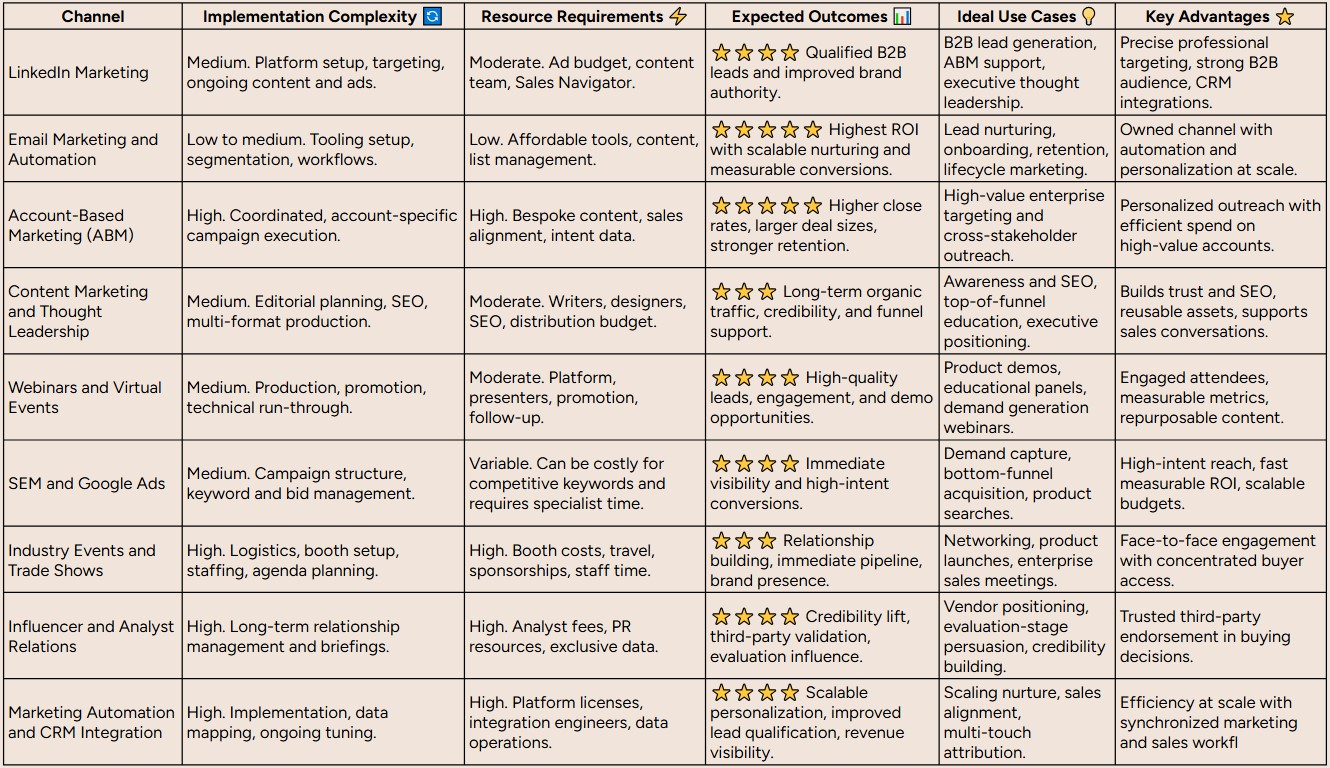
Top 10 B2B Marketing Channels Comparison
Choosing Your Channels: Strategy Over Tactics
Navigating the landscape of the best b2b marketing channels can feel overwhelming. We've explored ten powerful avenues, from the precision of Account-Based Marketing and the directness of Email Marketing to the broad reach of SEM and the community-building power of Industry Events. Yet, the most crucial takeaway isn't found in mastering a single platform but in understanding how they interconnect to create a powerful, cohesive growth engine. The era of siloed marketing is over; success now lies in strategic integration.
The temptation is to chase the newest trend or simply allocate budget to the channels you’re most familiar with. However, a truly effective B2B marketing strategy is built on a foundation of deep customer understanding, not on tactical whims. Your ideal buyers don't live in a single channel. They listen to podcasts on their commute, scroll through LinkedIn during a break, search Google for solutions to a pressing problem, and attend virtual events to stay informed. Your brand must be present in these moments, not as an interruption, but as a trusted resource.
The Power of a Central Content Hub
A recurring theme throughout our exploration is the central role of high-value content. Without it, your LinkedIn posts are empty, your emails lack substance, your paid ads fail to convert, and your SEO efforts stall. This is where a strategic asset like a B2B podcast becomes a game-changer, acting as a central hub that fuels multiple channels simultaneously.
Consider the ripple effect:
- Content Marketing & SEO: Each podcast episode becomes a detailed blog post, complete with a transcript and show notes. This creates a consistent stream of long-form, keyword-rich content that builds topical authority and attracts organic search traffic.
- Social Media Amplification: A single 30-minute interview can be repurposed into dozens of high-impact micro-assets. Think short video clips for LinkedIn and YouTube Shorts, audiograms for Twitter, and quote graphics for Instagram. You're no longer just posting on social media; you're distributing valuable insights that drive engagement and authority.
- Relationship Building & Partnerships: A podcast isn't just a marketing channel; it's a networking and business development tool. Inviting key partners, prospects, or industry thought leaders as guests provides unparalleled access and strengthens critical relationships in a collaborative, non-salesy context.
- Email Marketing: Episodes provide a consistent, valuable reason to connect with your email list. Instead of just sending promotions, you're delivering expert conversations and actionable takeaways directly to their inbox, nurturing leads and reinforcing your brand's expertise.
This integrated approach transforms your marketing from a series of disconnected activities into a synergistic system. Your podcast becomes the "sun," and your other channels become the "planets" that draw energy and life from it. This model is not just efficient; it's how you build a resilient brand that dominates its niche.
Your Actionable Path Forward
The path to optimizing your B2B marketing mix doesn't require a complete overhaul overnight. It begins with a strategic audit and a focused plan. Don't try to master all ten channels at once. Instead, identify the one or two with the most significant potential for immediate impact based on your current resources and goals.
- Audit Your Current Mix: Where are you seeing the best results right now? Where are the most glaring gaps between your efforts and your goals? Use data, not assumptions, to guide this assessment.
- Identify a Focus Area: Select one channel to optimize (e.g., LinkedIn) and one new channel to test (e.g., a podcast). Commit to executing them with excellence.
- Build Your Content Engine: Acknowledge that content is the fuel. Instead of creating one-off assets, invest in a scalable content engine like a podcast that can consistently feed all your other initiatives.
By focusing on an integrated strategy rather than isolated tactics, you move beyond just generating leads. You begin building a brand, establishing unshakeable authority, and creating a predictable pipeline of ideal-fit customers. The best b2b marketing channels are the ones that work together, powered by a core belief in delivering exceptional value.
Ready to build a content engine that establishes authority and fuels every other marketing channel? Fame specializes in producing turn-key B2B podcasts that drive measurable pipeline and transform expert conversations into your most valuable marketing asset. Learn how Fame can become the strategic centerpiece of your B2B marketing.
Want us to run this for you?
Fame starts and grows B2B podcasts that generate pipeline. Tell us who you are trying to reach and we will send a costed proposal within 48 hours.
Related content
- Read moreFame Team · July 16, 2026
10 Account Based Marketing Tactics For B2B Growth In 2026
Discover 10 actionable account based marketing tactics for B2B tech. Learn to use podcasts, data, and targeted content to close high-value accounts. - Read moreFame Team · June 10, 2026
20 Best Podcast Production Agencies For 2026 (And Why Should You Hire One)
We painstakingly collated the 20 best podcast production agencies in the world. If you are considering starting a podcast, review this list! - Read moreApril 13, 2026
Leadership In Marketing: The B2B Podcast Playbook
Most companies still confuse leadership in marketing with job titles, org charts, and budget control. That's outdated. - Read moreApril 7, 2026
14 Top Enterprise Podcast Production Companies (2026 Guide)
Your CEO wants a category-defining platform before the next board meeting. Sales needs a reason to start better conversations with target accounts.