

Your CEO wants a category-defining platform before the next board meeting. Sales needs a reason to start better conversations with target accounts. Brand is under pressure to build credibility ahead of a funding round, acquisition, or IPO. At the same time, the standard content mix keeps missing the mark. Whitepapers get skimmed. Webinars rarely hold attention. Campaigns produce impressions without creating trust.
That is the point where enterprise podcast production earns a serious look.
For enterprise teams, the appeal is not novelty. It is access and depth. A well-run show gives executives a repeatable way to speak to buyers, partners, analysts, and customers for 30 minutes at a time instead of fighting for a few seconds in a feed. That changes the quality of attention you can earn.
It also changes how content works across the business. One recorded conversation can support executive positioning, sales outreach, customer marketing, recruitment, event promotion, and search visibility. The format is flexible, but the business case only holds up when the show is tied to a clear outcome.
This serves as the primary filter for evaluating vendors. Enterprise podcast production is not just about recording clean audio or shipping episodes on schedule. It is about setting a business goal first, then building the show around it. That goal might be pipeline generation, account access, executive visibility, customer trust, internal alignment, or market credibility before a major company milestone. The production partner matters because the wrong one will optimize for downloads while your leadership team is asking about revenue influence.
Execution usually breaks much earlier than companies expect. Teams launch without a clear audience, invite guests who do not support the go-to-market motion, pick hosts who are not prepared to carry strategic conversations, and approve reporting that says nothing about business impact. Good agencies help prevent that. The stronger ones also bring an operating system for planning, production, promotion, and measurement. If you want a reference point for what that service model looks like, this breakdown of a podcast production service for B2B brands is useful.
The provider list in this guide matters, but the list is only part of the job. The larger decision is fit. Some teams need a partner that can support ABM and sales enablement. Others need premium narrative production for brand authority. Others need a practical execution partner that can help them get from strategy to launch without creating internal drag.
Use this guide as a playbook first and a shortlist second. The right agency is the one that can help your team define the goal, build the show around it, and prove the investment was worth it.
1. Fame

Fame is the strongest fit if your definition of enterprise podcast production is business-first, not studio-first.
Most agencies can edit audio. Fewer can tie the show to account access, executive positioning, and measurable audience growth in B2B markets. That is where Fame stands out. The agency focuses on B2B podcast production for companies that want authority and pipeline, not a vanity show.
Why Fame ranks first
Fame is built around a repeatable operating model. That matters in enterprise settings because internal stakeholders do not want creative ambiguity. They want a process.
The offer includes strategy, host coaching, guest sourcing support, production, design, publishing, and promotion. The team also uses its own podcast production service infrastructure, including Fame Host and Fame AI, to keep execution tight across multiple moving parts.
Fame’s positioning is unusually direct. It guarantees substantial monthly download growth. If the team does not hit that target over the first six months, the seventh month is free. That kind of accountability is rare in this category.
Best fit and trade-offs
This is the agency I would shortlist first for B2B tech, professional services, and expert-led brands where the host matters as much as the content.
Practical advantages:
- B2B specialization: Fame is built for thought leadership, demand generation, and guest-led relationship building.
- Operational depth: The team handles the work that usually stalls internal launches, including project management and promotional execution.
- Clear commercial orientation: The emphasis is on growth and ROI, not awards.
Trade-offs:
- Narrow focus: If you want a consumer entertainment show, this is not the right partner.
- Host commitment required: Even with a done-for-you model, internal leaders still need to show up prepared.
If your show must influence pipeline, ask every agency how they source guests, repurpose episodes, and support distribution after publishing. That is where enterprise results are won or lost.
2. Pacific Content
Pacific Content fits a specific enterprise brief. The company wants a show that can survive legal review, reflect brand standards, and feel editorially credible the first time a customer, investor, or analyst hears it.
That is different from hiring a vendor to record interviews and clean up the audio. Pacific Content built its name on narrative branded podcasts, and that shows up in the work. The team puts real weight on concept development, reporting, story structure, and finish.
Where it fits best
Pacific Content makes sense when the podcast sits closer to brand strategy than campaign execution. That usually applies to public companies, regulated industries, and large brands using audio to shape market perception over time.
The upside is clear. A strong narrative series can give an enterprise a distinct voice instead of another executive interview feed that sounds like every other show in the category.
That aligns with one of the clearest long-term business benefits of podcasting for brands. A well-produced series can build trust, authority, and recall across a buying committee long before a prospect fills out a form.
Trade-offs
- Better for brand equity than direct demand capture: If your primary goal is pipeline creation through guest relationships or sales follow-up, other partners may fit better.
- Higher production load: Narrative shows require more stakeholder input, tighter editorial control, and more revision cycles.
- Longer launch timeline: Expect more pre-production work on format, scripts, and approvals before the first episode goes live.
I would shortlist Pacific Content for enterprises that treat the podcast as a flagship media property, not a content repackaging exercise. If the brief is credibility, polish, and strategic brand storytelling, it earns serious consideration.
3. Lower Street

A common enterprise scenario looks like this. The team has executive buy-in, a budget, and a clear reason to launch a show, but no one wants podcast production to become another internal operating burden. Lower Street fits that gap well.
It sits between pure production support and full strategic guidance. For enterprise teams, that usually means faster progress from idea to launch without building an in-house studio, editorial process, and post-production workflow from scratch.
The practical strength is operating discipline.
Lower Street appears well suited to companies that need structure around the show, not just cleaner audio. Format development, episode planning, launch support, and multi-channel production all matter more at the enterprise level because the podcast has to map to a business goal. That goal might be category authority, executive visibility, customer education, partner relationships, or a longer-term brand play tied to pipeline and market perception.
Audio and video support also matters here. Many enterprise shows no longer live only in a podcast app. They need full episodes, short video clips, social cutdowns, and a YouTube presence that gives the content team more surfaces to distribute and measure.
What stands out
Lower Street looks like a strong option for teams that want a polished show with enough strategic input to avoid the usual early mistakes. That includes unclear format decisions, inconsistent publishing cadence, and production plans that break once legal, brand, and executive schedules get involved.
Its client mix also suggests experience with stakeholder-heavy environments. That matters. Enterprise podcast production usually slows down on approvals, scheduling, and revision rounds, not on editing.
Trade-offs
- Custom scoping is part of the model: Budget, timeline, and deliverables will depend on format, volume, and how much strategy your team expects upfront.
- Video adds coordination: If the show includes remote video, clip production, and channel-specific assets, expect more review cycles and more internal owners.
- Best results still require internal ownership: Even with a capable partner, someone on your side needs to own approvals, guest priorities, and success metrics.
Choose Lower Street if the goal is to launch a brand-safe podcast program that can stand up to enterprise scrutiny and keep running after episode three. It makes the most sense for teams that want a partner to help set the system up properly, then execute it with consistency.
4. Caspian Studios
A common enterprise scenario looks like this. The team gets approval for a branded podcast, records a strong first episode, then promotion stalls because no one owns guest logistics, clips, paid amplification, or follow-up reporting. Caspian Studios is built for that gap.
Caspian Studios fits B2B companies that want the show run as a demand generation program, not just a production workflow. The appeal is not only audio quality. It is the operating system around the show: format development, guest booking, host prep, post-production, distribution, and campaign support.
That makes Caspian more relevant for enterprise teams with revenue pressure, executive stakeholders, and limited internal bandwidth. If the business case for the podcast is tied to audience growth, account engagement, or category positioning, a partner with distribution capability usually creates more value than a shop that only edits episodes.
Where Caspian is strongest
Caspian is a good fit for companies that need each episode to feed a broader content engine. A single recording can become sales enablement, social clips, newsletter content, and channel-specific assets through podcast marketing services built for post-launch distribution.
Its format range also matters. Interview shows are easier to sustain. Scripted or blended-narrative shows can create more brand distinction, but they require tighter planning, stronger subject matter structure, and more review time from internal stakeholders. Caspian appears well suited to teams that understand that trade-off and want help managing it.
Trade-offs
- Distribution adds cost and scrutiny: Paid promotion, creative testing, and repurposing can improve reach, but they also raise the bar on positioning, targeting, and reporting.
- Stakeholder management still sits with the client: An agency can run the process, but someone in-house still needs to approve themes, prioritize guests, and connect the show to pipeline goals.
- More ambition means more complexity: Scripted elements, executive hosts, and multi-channel rollout plans usually extend timelines.
Choose Caspian if the goal is to build a podcast program that supports brand and demand at the same time. It is less suited to teams looking for a simple recording partner and more suited to teams that need a repeatable system they can defend internally with clear business intent.
5. Content Allies

Content Allies is a sensible choice for enterprises that think about podcasting through a revenue lens.
Its orientation is clear. The show should help sales and marketing, not sit in a brand silo. That usually means guest selection tied to target accounts, interview themes aligned with category pain points, and post-production assets built for distribution.
Where Content Allies is strongest
The agency is particularly well suited to interview-led B2B shows. If your team wants to build relationships with prospects, customers, and partners through the guest roster, this model fits.
The value is less about cinematic storytelling and more about process discipline:
- Guest strategy: Booking that aligns with account-based motion.
- Recording support: More hand-holding for busy executives.
- Repurposing: Social, SEO, and other podcast marketing services that keep episodes working after launch.
This approach also addresses a significant market gap. One of the biggest unresolved issues in enterprise podcast production is ROI attribution between listens and pipeline, as outlined in Fame’s article on podcasting tips and ROI gaps. Agencies that design shows around sales conversations have an advantage because they give teams clearer operational hooks into revenue.
Trade-offs
Content Allies is less compelling if you want a highly produced documentary-style brand show. The sweet spot is business podcasts that need to support account access and executive visibility.
If your sales team wants warmer intros and your marketers want reusable content, this is a credible option.
6. Sweet Fish
A common enterprise scenario looks like this. The marketing team approves a podcast, then asks for YouTube cuts, LinkedIn clips, paid social creative, and sales enablement assets from the same recording. Sweet Fish fits that model well because the production system is built around video distribution, not just audio delivery.
That matters if the show is supposed to do more than publish episodes. Enterprise podcasting works best when each recording session produces multiple assets your team can use across channels. Sweet Fish is a strong option for brands that want the podcast to function as a repeatable content engine instead of a standalone brand project.
Where Sweet Fish is strongest
The advantage is operational practicality. Sweet Fish has spent years running B2B content programs, so the offering reflects the work involved: scheduling busy guests, recording clean video, editing for several formats, publishing consistently, and turning one conversation into usable distribution assets.
That makes them a credible fit for companies with a clear audience and an existing demand engine.
If your team is still defining that system, this guide on how to produce a podcast for repeatable business use is a useful benchmark for evaluating vendors. The right agency should help you connect format, workflow, and distribution to a business goal such as category visibility, pipeline support, or executive branding.
Best fit and trade-offs
Sweet Fish is a better fit for B2B brands that already have confident on-camera hosts or executives. The value increases when marketing can effectively distribute the clips, run paid promotion, and feed sales with episode-derived content.
The limits are clear too:
- Best fit: Video-first B2B shows with strong internal distribution.
- Less ideal: Narrative series, investigative formats, or heavily scripted brand storytelling.
- Operational upside: Efficient content repurposing from a single recording session.
Sweet Fish also offers an in-person studio option. That can help when executive presentation is part of the strategy, especially for leadership content tied to a funding milestone, category push, or major brand campaign. But studio quality does not solve positioning problems. The show still needs a defined audience, a clear point of view, and a reporting model that shows whether the program is influencing reach, relationships, or revenue.
7. Resonate Recordings
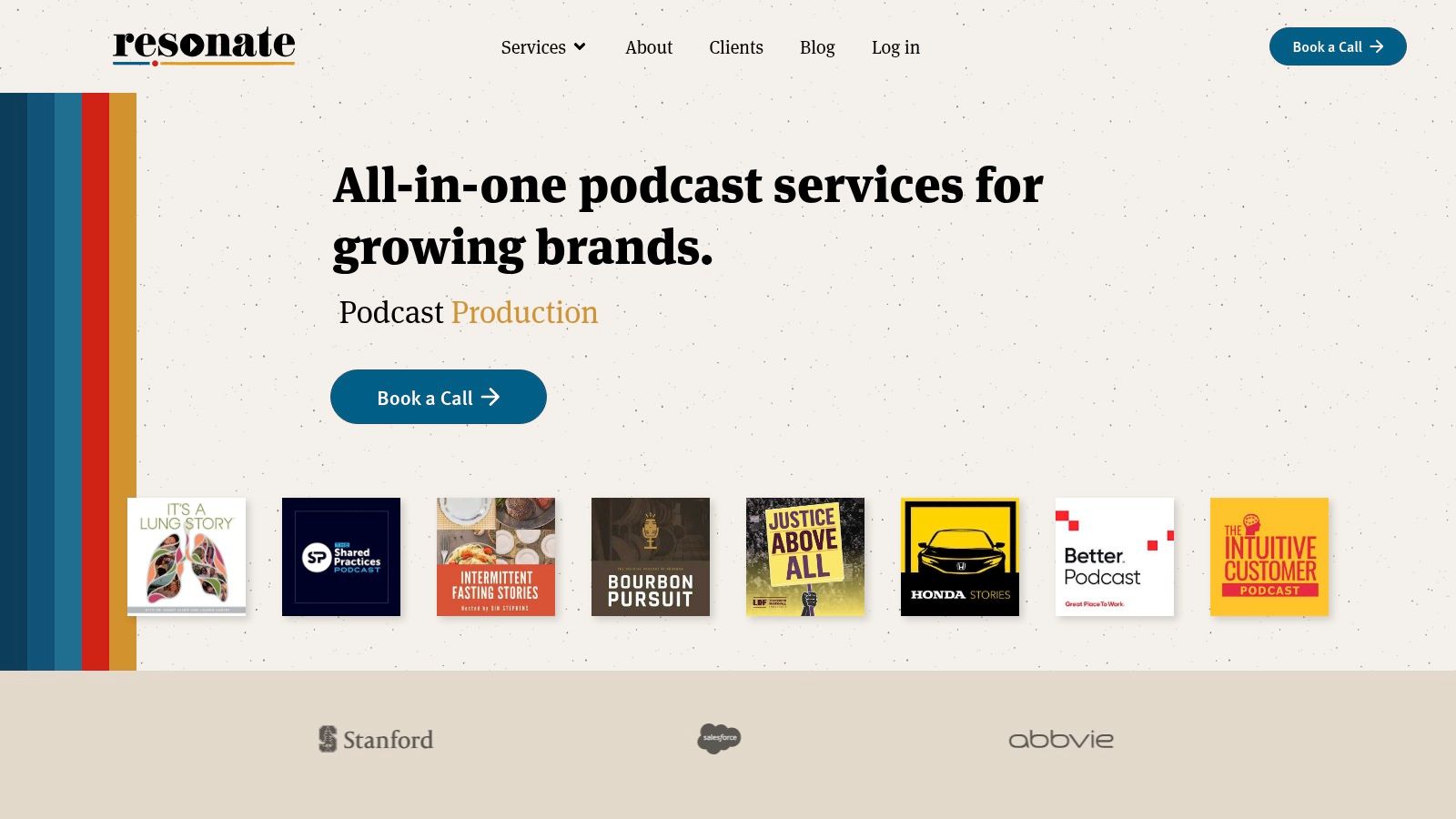
A common enterprise podcast problem shows up after launch, not before. One team wants a customer show, another wants an executive series, and a third needs internal comms support. The strategy may be sound, but the program stalls because production, hosting, approvals, and reporting sit across too many tools and too many owners.
Resonate Recordings is a practical option for that situation.
A key benefit here is operational clarity. Resonate combines production, hosting, and analytics in one system, which can make procurement simpler and reduce handoff issues between vendors. For enterprise teams managing multiple stakeholders, that matters because the primary cost is often not editing quality alone. It is the time lost in coordination, missed deadlines, and unclear ownership.
This makes Resonate a stronger fit for companies treating podcasting as a repeatable marketing or communications function, not a one-off brand experiment. If the goal is to support several shows, standardize publishing, and keep reporting in one place, their model fits the way larger organizations work.
Teams still building that operating model should compare every vendor against a clear enterprise podcast production workflow and launch process. The right partner should be able to explain how ideas get approved, how episodes move to publish, who owns QA, and how results get reported back to marketing leadership.
Best fit and trade-offs
Resonate is well suited to enterprises that value process control, predictable delivery, and fewer moving parts.
The trade-off is creative differentiation. If your primary goal is a highly original editorial concept or a story-driven branded series with a distinctive voice, a more specialized narrative firm may push the format further.
That does not make Resonate a weaker choice. It makes them a better choice for a different job.
- Best fit: Multi-show programs, centralized marketing teams, and organizations that want production, hosting, and analytics under one roof.
- Less ideal: Brands chasing a standout narrative format or a heavily produced signature show.
- Operational upside: Cleaner governance, simpler workflows, and easier scaling across business units.
8. JAR Audio
JAR Audio fits enterprise teams that are trying to achieve something harder than steady episode output. They need a show people remember, share internally, and associate with the brand long after the episode ends.
That changes the production brief.
JAR’s strength is narrative audio. The work tends to rely on tighter story structure, stronger scripting, more deliberate sound design, and a clearer editorial point of view than a standard interview show. For enterprise buyers, that matters when the podcast is tied to a bigger objective such as category positioning, reputation ahead of a major company milestone, or a brand campaign that needs more depth than a webinar feed can deliver.
What JAR does well
JAR is a strong fit when the story itself carries the business value. That often applies in sectors like travel, financial services, healthcare, or mission-driven organizations, where customer context, trust, and emotion affect how the market perceives the brand.
In those cases, a narrative format can hold attention differently than an executive Q&A. Instead of asking the audience to pull out a few useful talking points, it gives them a reason to stay through the full arc. That makes JAR more relevant for enterprise podcast strategies aimed at brand lift, audience trust, and message retention than for pure demand capture.
The upside is differentiation. A well-produced narrative series can give a company a recognizable editorial identity, which is rare in B2B audio.
What to watch for
This approach requires more from the client side. Narrative production usually means more rounds of concept development, tighter legal and brand review, and slower approvals because every script choice affects the final story.
That creates a trade-off. Teams that need a weekly pipeline show, a fast-turn executive thought leadership program, or an account-based guest strategy may find this model too slow and too resource-intensive for the return they need.
JAR is best evaluated as part of the larger business case, not just the vendor shortlist. If the goal is memorable brand storytelling with a clear editorial signature, they are a serious option. If the goal is volume, repurposing efficiency, or sales-led guesting, other firms in this list are built more directly for that job.
9. Motion
Motion fits a common enterprise scenario. The team already knows why the show exists, usually to support category authority, executive visibility, partner relationships, or pipeline. The problem is turning one recorded conversation into enough useful assets to justify the effort.
That is Motion’s lane.
The agency is a strong match for B2B companies that treat podcasting as part of a broader content operation, not a standalone brand play. A recorded interview can become clips for social, founder posts, blog inputs, customer follow-up material, and sales-enablement content. If the show is designed well, each episode supports multiple channels instead of asking the podcast alone to carry the ROI.
Practical value
Motion’s value is operational. It helps teams keep the show moving through guest coordination, scheduling support, and post-production repurposing. That matters for subject-matter experts who can record consistently but do not have time to manage production details week after week.
This model also works well when internal teams already understand the basics of podcast recording equipment and setup and need outside help on execution and distribution rather than show design from scratch.
For enterprise buyers, the question is not whether more assets can be created from an episode. They can. The question is whether those assets map to a business goal. Motion makes more sense when the podcast feeds a repeatable GTM motion, such as executive thought leadership, account-based outreach, customer education, or category positioning.
Trade-offs
Motion is best for teams that value consistency, speed, and repurposing output over editorial experimentation. If the goal is a highly produced narrative series or a brand-defining audio story, other firms on this list are better aligned.
The upside is efficiency. The risk is sameness.
A standard interview format can perform well for a long time if the host has a clear point of view, the guest strategy is disciplined, and the content gets distributed after publication. Without those pieces, the team may end up producing a clean show that creates activity but not business impact.
For enterprise podcast production, that is the right frame for evaluating Motion. Not just "Can they produce episodes?" but "Can this operating model turn one executive conversation into enough usable marketing and sales assets to justify budget over the next 12 months?"
10. Podigy
Podigy is less of a strategic agency and more of a production machine. That is why some enterprise teams should consider it.
If you already know your positioning, your host, your guest model, and your distribution plan, you may not need an expensive strategy-heavy partner. You may need a reliable team that edits quickly, writes clean show notes, and keeps quality consistent.
Best use case
Podigy is strong when internal marketing already owns the show strategy and just wants dependable execution.
The appeal is straightforward:
- Editing and mastering: Consistent post-production without building an internal bench.
- Show notes and transcripts: Useful for content repurposing and accessibility.
- White-label support: Helpful if another agency leads strategy and Podigy handles delivery.
That makes Podigy a practical option for teams that have already sorted the front end and now need an efficient back end. It also pairs well with internal teams that have invested in the right podcasting equipment needed to capture strong raw recordings.
Trade-offs
Podigy will not solve audience strategy or executive messaging for you. If the show lacks a clear purpose, better editing will not fix it.
Still, for enterprises that want a production partner rather than a strategic operator, Podigy is one of the cleaner choices.
11. Castos Productions
Castos Productions fits companies that need an enterprise podcast program to run cleanly from day one.
A common launch scenario looks like this. Brand owns messaging. Comms wants approvals. Web needs embeds. Marketing ops wants reporting. Legal wants a record of what shipped and when. Once production, hosting, publishing, and analytics are split across different vendors, simple tasks turn into handoffs.
Castos is appealing because it brings those functions together inside one system. That does not make the show more original. It does make the operating model easier to manage, which matters if the podcast is meant to support a broader program tied to demand generation, executive visibility, or category education.
Why that matters
For enterprise teams, operational simplicity has value. Fewer tools usually means fewer process gaps, cleaner ownership, and less time spent chasing assets across email threads and shared folders.
That trade-off is easy to justify in the early and middle stages of a program. If the business goal is to launch consistently, publish on schedule, and give stakeholders a clearer reporting setup, an integrated provider can reduce friction faster than a more customized studio model.
Best fit
Castos Productions makes the most sense for:
- Teams that want production and hosting under one vendor
- Brands building a repeatable show process for the first time
- Marketing leaders who care more about execution discipline than highly conceptual creative
The constraint is straightforward. Castos is stronger as a systems choice than as a creative partner. If your roadmap calls for a high-production narrative series designed to shape market perception, other firms on this list are built for that. If your priority is getting a business podcast launched, distributed, and managed with less operational drag, Castos is a sensible option.
12. FRQNCY Media
A VP of marketing gets budget for one audio project this year. The choice is not a weekly interview show. It is a high-stakes series the company can put in front of customers, analysts, recruits, and investors without apology.
FRQNCY Media fits that assignment.
Their strength is narrative branded audio with clear editorial structure. That usually means heavier research, tighter scripting, more deliberate interview selection, and sound design that supports the story instead of filling space. For enterprise teams, that changes the role of the podcast. It becomes a brand asset with a longer shelf life, not just another content cadence to maintain.
When FRQNCY is the right choice
FRQNCY makes sense when the business goal is perception change. That can mean reframing a category, giving an executive team more authority around a complex issue, or releasing a limited series that supports a major company moment such as market expansion, a repositioning effort, or IPO-stage brand scrutiny.
This model asks for conviction up front. Teams need alignment on audience, thesis, approvals, and what success looks like before production starts. If that work is done well, the result is often more useful than a standard show because sales, PR, executive comms, and content teams can all use the same series.
Limits
The trade-off is straightforward. Narrative production takes more time, more stakeholder input, and more budget discipline than a conversational interview format.
It also carries higher execution risk. If the editorial angle is weak or internal reviewers water down the point of view, the series can end up expensive and forgettable.
FRQNCY is a strong choice for brands that already know why the show needs to exist and what business outcome it should support. If the priority is testing the channel cheaply or building an always-on publishing engine, other providers on this list are better suited to that job.
13. FieldCast
A VP of Sales needs every rep aligned on the new pitch before Monday. HR has to roll out manager training across six regions. The CEO wants a consistent internal message after a restructuring. Public podcast distribution does not solve those jobs. FieldCast is built for the private side of enterprise podcast production.
That makes it useful in a different part of the podcast strategy. Instead of chasing external reach, FieldCast helps companies distribute audio securely for onboarding, training, internal communications, sales enablement, and executive updates.
Where FieldCast earns its place
Internal teams usually do not need another content channel. They need a format people will readily consume.
Private audio works well because employees can listen between meetings, on commutes, or while traveling. A sales team can get product updates quickly instead of sitting through a long slide deck. A leadership team can explain context, tone, and priorities in a way email rarely handles well.
FieldCast pairs that use case with controlled distribution and production support. For enterprise buyers, that matters more than broad syndication.
Best fit and trade-offs
FieldCast is a strong choice for large, distributed organizations that treat podcasting as an operational tool. If the goal is faster onboarding, clearer internal messaging, better field alignment, or more consistent manager communication, the ROI can be straightforward. Better adoption, less meeting time, and fewer message gaps.
The trade-off is scope. A private podcast will not build category awareness or create external demand on its own. It belongs in the execution layer of an enterprise podcast program, not the brand reach layer.
That distinction matters during vendor selection. If the business case is internal adoption and controlled access, FieldCast deserves a place on the shortlist. If the business case is thought leadership, audience growth, or pipeline influence, another provider in this guide will fit better.
14. Message Heard
A global brand team approves a podcast because the company needs more than demand capture. It needs a show that can hold up with customers, analysts, investors, and hires across multiple markets. That is the kind of brief where Message Heard makes sense.
Message Heard brings an editorial approach that sits closer to publishing than content production. That changes the output. The shows tend to have a clearer point of view, stronger narrative structure, and better judgment around what a brand should say directly versus what should come through the reporting, guest mix, and framing.
Where it earns a place on the shortlist
This is a fit for enterprise teams using podcasting as a brand asset, not just a campaign asset. If the business goal is category credibility, executive positioning, or stronger reputation in complex markets, Message Heard can help shape a series that feels substantive instead of promotional.
That matters in enterprise podcast production because vendor choice should follow the outcome you need. Some providers are built to maximize pipeline efficiency. Others are better at high-trust storytelling that supports larger company objectives, including expansion into new regions, a reputation reset, or a more mature market presence before a major corporate milestone.
Message Heard is stronger in that second category.
Best fit and trade-offs
The upside is editorial quality and international range. For teams based in Europe, or companies speaking to audiences across regions, that perspective can improve guest selection, framing, and tone.
The trade-off is speed and commercial sharpness. If your team needs a weekly production engine tied tightly to ABM, sales follow-up, and lead attribution, a more overt B2B operator may be easier to manage. Time zone friction is also real if a North America based team expects constant back-and-forth during development.
I would shortlist Message Heard when the podcast needs to sound credible enough to represent the brand at a higher level. If the program will be judged on influence, trust, and staying power, not just form fills, it deserves consideration.
15. Gimlet Creative
Gimlet Creative matters for a specific reason. A leadership team asks what a branded podcast could become if the company treated it like a flagship brand investment instead of a content series. Gimlet is still one of the clearest reference points for that conversation.
Its role in an enterprise podcast strategy is less about vendor selection and more about strategic calibration. The studio helped set the standard for narrative branded audio with higher production values, sharper editorial framing, and a stronger sense of story than the usual interview format.
Why it still matters
For enterprise teams building a business case, that history has practical value. Past Gimlet work often helps marketing leaders show executives what premium audio can do for brand perception, talent positioning, or market authority when the objective goes beyond demand capture.
That distinction matters.
A vendor list is only useful if it helps a team match production style to business outcome. If the goal is pipeline contribution, several studios on this list are easier to activate and measure against revenue programs. If the goal is to secure budget for a higher-concept show tied to brand stature, investor visibility, recruiting strength, or a major corporate milestone, Gimlet remains a credible benchmark for what "premium" sounds like.
The practical reality
Gimlet is not the straightforward agency relationship many buyers expect from an independent production partner. Access, scope, and fit are more selective, which changes how enterprise teams should evaluate it.
- Best use: Internal inspiration, creative benchmarking, and setting the bar for ambitious branded storytelling.
- Buying reality: Less accessible and less standardized than working with a specialist B2B podcast agency.
- Best-fit buyer: Large brands with the budget, patience, and internal alignment for a bigger audio initiative.
I would not place Gimlet on a standard operational shortlist for teams that need a repeatable production engine. I would use it as a reference point while building the program plan, then choose a partner based on the business goal, approval process, and production model required to get the show launched and sustained.
16. ProPodcast Production
A common enterprise brief sounds like this: launch a branded show, keep the production process predictable, and avoid turning a straightforward interview program into a six-month creative project. ProPodcast Production fits that assignment well.
The value here is operational clarity.
For teams building a podcast as part of a broader marketing engine, that matters. A polished show that publishes on schedule, supports executive visibility, and gives sales and content teams reusable material often produces better business results than a more ambitious concept that takes too long to approve or sustain.
Where it fits
ProPodcast Production suits companies running interview-led formats, executive commentary, customer conversations, or subject-matter-expert content. The model is a better match for steady publishing than for custom narrative development.
It also stands out for APAC-based companies, or global teams that want regional production support without adding unnecessary workflow complexity. Clear packaging and defined process can reduce internal friction, especially when marketing, comms, and leadership all need visibility into scope, timelines, and deliverables.
That makes it easier to treat the podcast as a repeatable program instead of a one-off brand experiment.
Trade-offs
ProPodcast Production is a fit for execution-focused teams. Buyers looking for high-concept storytelling, heavy editorial development, or a prestige audio piece tied to a major brand moment will probably want a different type of partner.
For the right use case, that trade-off is rational. Enterprise podcasting only works when the format matches the goal. If the objective is consistent thought leadership, credible market presence, and a production process the team can maintain, clean execution is often the smarter investment.
Enterprise Podcast Production: 16-Provider Comparison
| Provider | Implementation complexity (🔄) | Resource requirements (⚡) | Expected outcomes (📊) | Ideal use cases (💡) | Key advantages (⭐) |
|---|---|---|---|---|---|
| Fame | 🔄 Moderate: repeatable end-to-end process; 4–6 week launches | ⚡ $2.5k–$5k/mo plus host time; proprietary tooling & distributed team | 📊 Predictable audience growth, aiming for significant monthly growth targets | 💡 B2B thought leadership, demand-gen, IPO/exit prep | ⭐ Performance guarantee, proprietary tech, full-service growth focus |
| Pacific Content | 🔄 High: narrative concepting and editorial-heavy workflows | ⚡ Premium, custom pricing, significant editorial & production time | 📊 Strong brand/reputation lift and high production value | 💡 Enterprise reputation-building, compliance-heavy sectors | ⭐ Journalism-grade storytelling; Fortune 500 experience |
| Lower Street | 🔄 Moderate–High: enterprise scoping and custom programs | ⚡ Custom pricing, high-touch global team, audio + video capabilities | 📊 High production value with cross-channel distribution | 💡 Enterprise programs needing strategy, format & GTM support | ⭐ Recognizable enterprise roster; multi-channel workflows |
| Caspian Studios | 🔄 Moderate: supports interview, blended, scripted formats | ⚡ Integrated production plus paid distribution; enterprise budgets | 📊 Audience growth via paid campaigns; turnkey delivery | 💡 B2B tech/SaaS series with paid growth focus | ⭐ Production + growth bundled; clear enterprise processes |
| Content Allies | 🔄 Moderate: white-glove production aligned to sales goals | ⚡ Custom pricing, engineer-on-call per recording, ABM integration | 📊 Pipeline influence and sales enablement outcomes | 💡 ABM-aligned podcasts for revenue-driven B2B programs | ⭐ Sales-focused approach; engineered recording support |
| Sweet Fish | 🔄 Moderate: video-first workflows, optional in-person studio | ⚡ Studio/travel costs for Creator House, video editing resources | 📊 Strong video-led distribution and repurposed short-form assets | 💡 Video-first B2B shows and long-running series | ⭐ Video expertise; operational experience from long-running shows |
| Resonate Recordings | 🔄 Low–Moderate: documented SLAs and process-driven delivery | ⚡ Plan-based pricing; hosting plus production consolidation | 📊 Predictable, scalable production with clear SLAs | 💡 Enterprises standardizing production across teams | ⭐ Consolidated hosting+production; mature workflows |
| JAR Audio | 🔄 High: narrative/documentary-style production cycles | ⚡ Premium budgets, extensive research, scripting & sound design | 📊 Deep engagement and brand affinity; binge-worthy series | 💡 Brands seeking immersive narrative branded podcasts | ⭐ High-quality storytelling; strong enterprise portfolio |
| Motion | 🔄 Low–Moderate: designed for interview/conversational shows | ⚡ Standard enterprise budgets, social repurposing focus | 📊 Consistent thought leadership content and social reach | 💡 Tech/SaaS companies prioritizing LinkedIn/social distribution | ⭐ Social-first repurposing; content engine for busy teams |
| Podigy | 🔄 Low: standardized editing, mixing, and fast turnarounds | ⚡ Per-episode pricing, clients manage strategy & booking | 📊 Reliable, quick post-production at scale | 💡 Enterprises needing dependable white-label editing services | ⭐ Fast turnaround; transparent per-episode pricing |
| Castos Productions | 🔄 Low–Moderate: package-based with hosting integration | ⚡ Best value with Castos hosting, clear package pricing | 📊 Efficient launch-to-distribution with built-in analytics | 💡 Teams wanting vendor consolidation (production + hosting) | ⭐ Integrated production+hosting; simple packaged offers |
| FRQNCY Media | 🔄 High: cinematic, investigative production like film | ⚡ Significant budget and long production cycles | 📊 Category-defining, award-caliber flagship content | 💡 Enterprises investing in high-end narrative flagship shows | ⭐ Cinematic sound design; investigative storytelling expertise |
| FieldCast | 🔄 Moderate: secure distribution and internal workflows | ⚡ Platform fees plus production; secure hosting & analytics | 📊 Improved internal engagement, training completion metrics | 💡 Private/internal podcasts for training, sales enablement, comms | ⭐ Private podcast specialization; tech + production combined |
| Message Heard | 🔄 High: investigative/narrative with international scope | ⚡ Premium pricing, editorial teams and global coordination | 📊 High-impact branded podcasts with global reach | 💡 European/global enterprises seeking journalism-grade shows | ⭐ Award-winning production; strong international portfolio |
| Gimlet Creative | 🔄 Very High: historic cinematic studio now within Spotify | ⚡ Extremely high budgets, ad-ecosystem integration | 📊 Groundbreaking narrative work and brand prestige | 💡 Large brands pursuing top-tier cinematic branded content | ⭐ Historical gold standard in storytelling innovation |
| ProPodcast Production | 🔄 Low–Moderate: package-driven corporate production | ⚡ Clear package pricing, remote recording support, APAC HQ | 📊 Reliable, polished interview-style shows at scale | 💡 APAC enterprises or global teams wanting consistency | ⭐ Process-driven reliability; strong APAC focus |
From Shortlist to Launch Making Your Decision
Choosing an enterprise podcast production partner is a strategic decision, not a technical one.
The first mistake companies make is shopping for production before they define the job the podcast needs to do. If you skip that step, every vendor pitch sounds reasonable, and the decision comes down to subjective creative preference. That is the wrong way to buy this category.
Start with the business objective.
If the show needs to support qualified pipeline, guest-led relationship building, and executive thought leadership, prioritize agencies with a clear B2B operating model. Fame, Content Allies, Motion, and Caspian Studios fit that mold in different ways.
If the priority is brand authority through premium editorial storytelling, look harder at Pacific Content, JAR Audio, FRQNCY Media, or Message Heard.
If the job is internal communication, enablement, or secure distribution, FieldCast deserves a separate evaluation because public audience growth is not the point.
Once that objective is clear, narrow the format. Most enterprise teams should not start with the most creative option. They should start with the format they can sustain operationally.
A few rules usually help:
- Choose interview-led shows when executive access, guest relationships, and content repurposing matter most.
- Choose narrative shows when the brand needs deeper differentiation and has the patience for a longer production cycle.
- Choose private podcasts when the value sits inside internal adoption, training, or alignment.
Then pressure-test each vendor on execution.
Do not ask only about editing quality or launch timelines. Ask how they help with guest strategy, host preparation, approvals, promotion, and performance reporting. Ask what happens after episode one. Ask what assets the team gets beyond the audio file. Ask how they handle weak guest episodes, delayed approvals, and executive scheduling issues.
Those answers tell you more than a polished portfolio page.
Measurement is where the mature buyers separate themselves from everyone else. Downloads matter, but enterprise leaders need a fuller view. The useful questions are:
- Did the guest list open doors with target accounts?
- Did sales use the content in outreach?
- Did executives gain stronger market visibility?
- Did the show create reusable assets for LinkedIn, SEO, and nurture?
- Did the podcast help shape category perception?
This is also why a narrow shortlist is better than a long comparison spreadsheet. Pick two or three agencies whose operating model aligns with your business outcome, then bring them into a strategic conversation. A serious partner will talk about your market, your buying committee, your internal bandwidth, and your distribution motion. A weak one will stay focused on microphones and intros.
One final point. Enterprise podcast production works best when companies stop treating the podcast as a media side project. The show is the front-end conversation layer of a broader go-to-market system. It can influence brand, sales, partnerships, recruitment, and internal alignment, but only if the team builds it that way from the start.
The right partner helps you do exactly that. Not just launch a show. Build an asset.
If you want a partner that treats enterprise podcast production as a revenue and authority engine, Fame is the place to start. The team specializes in B2B shows, handles strategy through promotion, and focuses on measurable business outcomes rather than generic production deliverables.
