
It’s Monday morning in your LA office. Your paid social CPL has climbed again. SEO is still compounding too slowly to help this quarter. Sales wants warmer conversations, but your market is tired of the same gated guides and webinar follow-up sequences. You do not need more content for content’s sake. You need a channel that earns attention and keeps it long enough to build trust.
A well-run B2B podcast earns its keep in that exact scenario.
The business case is straightforward. A strong show gives buyers repeated exposure to your point of view. It helps your team book conversations with operators, executives, and partners who would ignore a cold outbound email. It also creates source material your team can reuse across sales enablement, email, social clips, event promotion, and account-based outreach. When the agency behind the show understands distribution, measurement, and how B2B buyers evaluate risk, the podcast starts influencing pipeline instead of sitting in the brand bucket.
Los Angeles gives buyers plenty of choice. That is useful, but it also creates noise. A polished reel and a good-looking studio do not tell you whether an agency can build a show that sales uses or that marketing can defend in a budget review.
That is the filter behind this ranking. It is built for B2B teams looking for the best Los Angeles podcast agency based on pipeline influence, category authority, and operating discipline. Entertainment credentials matter less here than guest quality, repurposing systems, distribution process, and whether the agency can connect audience growth to business outcomes.
One practical point before you shortlist anyone: set up measurement early. If you care about proving channel contribution, connect podcast traffic and conversion paths to tools like Google Analytics before launch. Teams that wait usually end up with download reports, anecdotal feedback, and no clean way to show how the show supported revenue.
1. Fame
A common failure pattern looks like this. The marketing team launches a polished show, gets internal praise, then struggles to prove why it deserves budget three quarters later. For B2B teams trying to tie content to pipeline, Fame is a logical starting point because its model is built around authority and growth, not production alone.
That difference matters. Editing, artwork, and studio quality are table stakes. The harder job is turning a podcast into a channel sales can use, prospects trust, and leadership can justify in a budget review.
Fame focuses on B2B brands, especially companies that need expert-led content, repeatable distribution, and a clear point of view in crowded categories. The agency also publicly talks about a download growth guarantee, which signals a higher level of accountability than the standard “we’ll make you a great show” pitch. For teams comparing premium firms in this category, this roundup of B2B podcast agencies gives helpful context on where Fame sits.
Why Fame ranks first
The main reason is operating fit for demand generation teams.
Fame is built for companies that want a show to support category education, executive visibility, and qualified demand. That changes how the engagement should be judged. I would not score this kind of partner on audio quality first. I would score it on guest selection, episode packaging, repurposing discipline, distribution process, and whether the show creates useful sales and campaign assets after publication.
That is where Fame stands out in this list. The agency has a clear B2B positioning, an end-to-end model, and a sharper performance orientation than many LA shops that came up through entertainment or general branded content.
Practical rule: If an agency starts with microphones and editing workflows before it can explain audience strategy, conversion paths, and content reuse, it is probably selling a production service, not a growth channel.
What works well with Fame:
- Strong B2B fit: Good match for long sales cycles, expert buyers, and category-driven messaging.
- One team across the workflow: Strategy, production, distribution, and growth are handled together, which reduces handoff issues.
- Clear accountability: A performance promise changes the conversation from “did we ship episodes?” to “did the show grow and get used?”
Trade-offs to know:
- Higher structure: Teams looking for a casual executive side project may find the process too rigorous.
- Narrower ideal customer profile: The fit is strongest for B2B companies. Consumer brands or entertainment-led formats may want a different creative style.
2. Lower Street
Lower Street is the agency I’d shortlist when the show needs to sound polished enough for brand leadership, but still stay anchored to a real business goal.
They’ve built a strong reputation in branded podcasting, and they’re especially good when your topic is complex, dry on the surface, or easy to make forgettable. That’s a useful skill in B2B, where many internal experts know the material but don’t naturally package it into episodes buyers will choose.
Where Lower Street fits best
Their strength is narrative framing.
That makes them a strong option for companies that want more than a standard interview format. If your team wants a show buyers remember, not just one they politely skim past, Lower Street is worth a hard look. They’re also mentioned in LA market coverage as delivering for enterprise clients such as PepsiCo and BCG, which signals they can operate at larger brand standards (as noted earlier in LA agency research).
For teams comparing specialist firms, this broader roundup of podcast agencies helps frame where Lower Street sits in the premium tier.
Trade-offs to know:
- Strongest use case: Branded shows where story craft matters as much as subject-matter depth.
- Potential drawback: If you just need a simple executive interview podcast, their storytelling muscle may be more than you need.
- Budget reality: Premium positioning usually means premium spend, even when pricing isn’t listed publicly.
A common mistake is hiring a narrative-first agency for a show that really needed a demand-gen operator. Format should follow business objective.
Website: Lower Street
3. Pod People

Pod People makes sense for brands that want one partner across audio, video, launch support, and ongoing growth work.
That matters if your internal team already knows the podcast won’t live only in Apple Podcasts or Spotify. The best B2B shows become multi-format assets. They feed YouTube, short-form social, landing pages, and sales enablement. Pod People is built closer to that operating model than agencies that treat the episode itself as the final deliverable.
Best for cross-channel podcast programs
The appeal here is breadth.
They can support branded audio and video podcasts, launch planning, audits, paid growth work, and YouTube execution. If your team needs a larger production bench and you expect guests, executives, and shoots to happen across cities, that kind of flexibility matters.
If you’re still evaluating what a true full-service engagement should include, this guide on podcast production service is useful context before you scope agencies against each other.
Pros:
- Multi-format support: Better fit than audio-only shops if video is part of the plan.
- Launch plus growth: Good option when you need more than editing.
- Operational range: Helpful for distributed teams and larger marketing organizations.
Cons:
- Heavier process: Larger-scope shops can move slower than a focused boutique team.
- Custom pricing: You’ll need a scoped conversation, which can make apples-to-apples comparisons harder.
Website: Pod People
4. Sound That BRANDS
Some agencies are production vendors. Sound That BRANDS feels more like a branded-content partner.
That difference shows up in how they talk about concepting, scripting, talent management, sound design, promotion, and measurement together. For a B2B team that wants tighter brand control and in-person collaboration in LA, that integrated structure is attractive.
A good pick for brand-safe execution
They’re based in Studio City and focus on end-to-end branded podcast development.
This is the type of partner I’d consider when the podcast has to satisfy multiple stakeholders at once: brand, comms, executive leadership, and marketing. Agencies with that orientation usually handle approvals and messaging discipline better than creator-first studios.
If your team is weighing how much post-launch support matters, compare that against what strong podcast marketing services should include.
Where they stand out:
- Brand alignment: Strong fit for companies that need messaging discipline.
- Hands-on collaboration: Helpful for LA teams that want face time.
- Process clarity: Their positioning suggests they understand the difference between content craft and business deployment.
Where to be careful:
- May be too specialized: If you need a broad content studio beyond podcasting, another partner may cover more ground.
- Pricing isn’t public: Expect a scoped engagement rather than an off-the-shelf package.
Website: Sound That BRANDS
5. QCODE
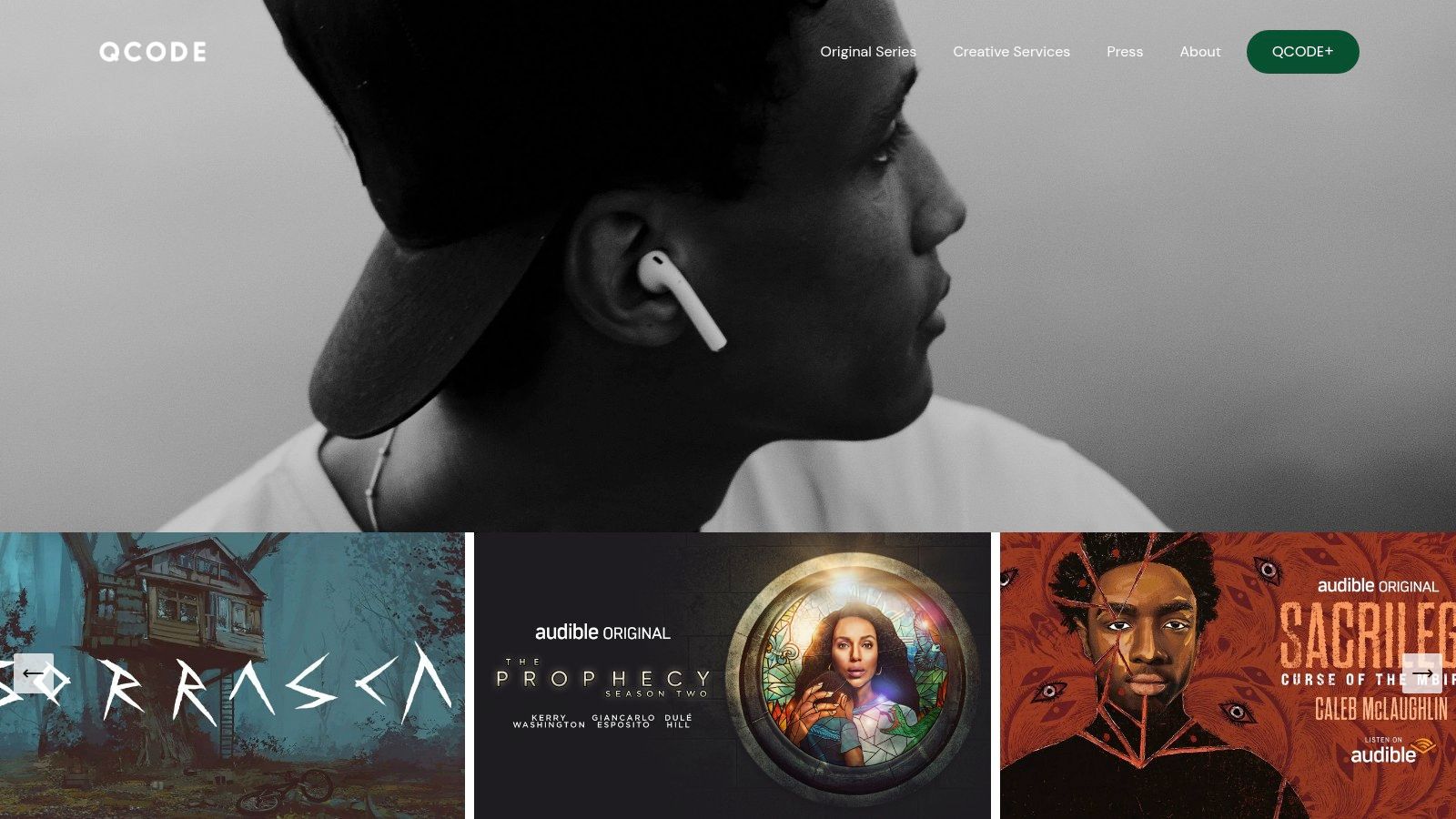
QCODE is what you hire when craft is paramount.
They’re known for high-end storytelling and studio-grade execution, and that matters if your podcast needs to sound premium from day one. Their Creative Services and Daylight Media capabilities also suggest a broader commercialization mindset than a pure editing shop.
Strong option for premium brand storytelling
For some B2B teams, that level of craft is worth paying for. It can help when your buyers are senior, your category is crowded, and your content needs to signal polish immediately.
The caution is strategic fit. QCODE’s reputation leans entertainment and premium narrative. That doesn’t rule them out for B2B, but it means you should scope pipeline goals explicitly. Don’t assume a beautifully produced show will naturally become a growth asset.
A useful gut check is to compare potential partners against real podcast agency case studies and ask whether the outcomes line up with your actual goals.
What I’d like:
- Elite production values
- Strong concept-to-execution support
- Commercialization awareness beyond simple publishing
What I’d press on in the sales process:
- B2B buyer understanding
- Distribution ownership
- Measurement expectations after launch
Website: QCODE
6. Pacific Content
Pacific Content is a strong choice for enterprise brands that care about strategy as much as production.
They aren’t physically based in LA, but I’d still include them for LA-based teams because large organizations often care less about ZIP code and more about operating maturity. If your stakeholders want a polished process, strong audience thinking, and the confidence that comes with enterprise-facing work, Pacific Content belongs in the conversation.
Better for large brands than scrappy teams
Their positioning fits bigger companies that want original branded podcasts with a strategic wrapper around them.
That usually means they’re less ideal for lean startup teams that need speed, flexibility, and a tighter budget. But for established brands, especially those building executive visibility or category authority, the trade-off can be worth it.
LA teams that are also comparing adjacent creative partners may find this list of video production companies in Los Angeles useful if podcast video is part of the broader content plan.
A few practical takeaways:
- Best fit: Enterprise marketing teams with approval layers and brand standards.
- Less ideal: Founders who need a lightweight, fast-moving operator.
- Real advantage: Audience strategy, not just polished sound.
Website: Pacific Content
7. Podify

Podify is a more practical, speed-oriented option than many premium agencies on this list.
That can be exactly what a lot of B2B teams need. Not every company wants a cinematic flagship show. Sometimes the smarter move is launching quickly, proving audience interest, and building an operating rhythm before investing in a more custom format.
Good for teams that want momentum fast
Podify offers strategy, guest sourcing, editing, distribution support, analytics, and optional video podcast packages.
I like that structure for mid-market teams that want a faster path to launch and don’t want to sit in a six-week strategy cycle before the first episode gets recorded. Productized services can also make internal approvals easier because the scope is easier to understand.
Pros:
- Faster time to launch
- Clear packaging
- Useful mix of production and growth support
Cons:
- Less bespoke: Complex enterprise workflows may outgrow a packaged model.
- Confirm terms carefully: If any offer includes revenue-share mechanics, get those details in writing before signing.
Website: Podify
8. GrodMedia

GrodMedia is a smart pick if you think of the podcast as the center of a content system, not a standalone channel.
That’s an underrated distinction. A lot of agencies can produce episodes. Fewer are disciplined about turning each episode into social assets, web content, and campaign material your team can reuse.
Useful for thought leadership and institutional brands
Their work is a good fit for universities, education-focused organizations, and brands with a strong thought-leadership angle.
That also makes them relevant for B2B companies selling into complex markets where teaching the audience matters more than entertaining them. If the goal is trust and repeated exposure across formats, GrodMedia’s repurposing emphasis is valuable.
Don’t buy a podcast if what you really need is a content engine. Buy the partner that can turn one recording session into assets your team will publish for weeks.
Why consider them:
- Repurposing mindset: Good for lean teams that need every episode to do more work.
- Thought-leadership fit: Strong for educational and expertise-led content.
- Video integration: Helpful if your distribution strategy extends beyond audio apps.
Why they won’t fit everyone:
- Boutique scale: Large-volume production demands may stretch a smaller shop.
- Custom scope: You’ll likely need a consultative buying process.
Website: GrodMedia
9. Podhead Studios

Podhead Studios is the most production-floor option on this list.
If your team already has strategy, hosts, and content direction figured out, and what you really need is a reliable downtown LA studio for video podcast recording, they’re compelling. Public pricing and a clear studio setup reduce friction in the buying process.
Best when production is the bottleneck
They offer a downtown LA studio, multi-camera capture, set design, live editing, optional postproduction, and social clips.
That’s useful for brands that have internal marketers who can run editorial and promotion but don’t want to build a studio operation themselves. It’s also one of the easier fits for teams prioritizing YouTube and short-form video alongside the podcast.
The limitation is obvious. This is more studio-first than strategy-first.
If you need guest sourcing, messaging architecture, or B2B distribution strategy, Podhead likely works better as part of your stack than as your only partner.
Quick read:
- Hire them for: Video podcast execution and dependable in-studio production.
- Don’t hire them for: End-to-end demand-gen strategy.
- Best buyer: An in-house content team that already knows what it’s making.
Website: Podhead Studios
Top 9 LA Podcast Agencies Comparison
The Final Take Your Agency Is Your Growth Partner
A VP of Marketing signs off on a podcast budget, then gets the first question from finance: how will this create pipeline? That question decides whether an agency becomes a long-term partner or an expensive production vendor.
That is the standard that matters here.
Los Angeles has no shortage of capable producers, studios, and editors. As noted earlier, access to recording talent and production infrastructure is easy to find. The harder problem is finding a partner that understands how a B2B podcast should work inside a demand generation system. That means tighter positioning, stronger guest selection, cleaner repurposing workflows, and reporting that ties the show to audience growth, sales conversations, and revenue influence.
The trade-off is straightforward. Some agencies are built to make a show sound polished. Others are built to help a marketing team turn episodes into authority assets that sales, content, and executive teams can all use. If the goal is a founder-led brand show, a studio-first provider can be the right buy. If the goal is category authority with a specific buying committee, the agency needs to think like a B2B operator, not just a producer.
This is why our ranking methodology puts more weight on business outcomes than on audio quality alone. Good sound is expected. Demand-gen teams need more than that. They need an agency that can support message discipline, create usable content from every recording, and show whether the program is contributing to reach, trust, and qualified pipeline.
Procurement teams usually get stuck on the same issue. Many agencies can show polished trailers, recognizable logos, and attractive clips. Far fewer can explain how the show will fit into campaign planning, influence target accounts, or justify continued spend after quarter one. That gap is where buying mistakes happen.
The practical move is to match the agency to the job. Hire a strategic partner if podcasting needs to contribute to revenue. Hire a specialist studio if the team already owns strategy, distribution, and measurement in-house. Do not pay for high-end strategy twice. Do not expect a post-production shop to build a category media engine.
Among the agencies on this list, Fame is built for B2B podcast programs tied to measurable marketing outcomes, making it a strong contender for companies that need a podcast program to contribute to pipeline.
