
You're a marketing leader at a Tampa company, and the brief sounds simple: launch a podcast. The actual job is harder. You don't need more content for content's sake. You need a show that helps your brand sound credible, attracts the right guests, gives sales something useful to share, and turns executive time into assets that keep working after the episode goes live.
That's where most local options fall short. A studio can rent you cameras, mics, and an engineer. That's useful, but it isn't the same as a podcast agency. B2B teams usually need strategy, repurposing, distribution, and a process that fits around busy subject-matter experts. If the partner can't connect the show to pipeline, authority, and content operations, you're just producing polished files.
That gap matters in Tampa because podcast consumption is already mainstream, not niche. Nielsen data cited by Advertise in Tampa says 566,261 Tampa Bay consumers listened to or downloaded a podcast in the past 30 days, representing 21.8% of the adult population. If you're building thought leadership in this market, there's already a real audience there to reach.
This guide ranks the best Tampa podcast agency options for 2026 with a practical B2B lens. The focus isn't who has the prettiest set. It's who can help you build a show that supports demand gen, brand authority, and a smarter content automation strategy.
1. Fame
Fame is the strongest choice here if your definition of the best Tampa podcast agency is tied to business outcomes, not local studio access. It's a B2B-focused agency, not a general production shop that happens to offer podcasts. That distinction matters because B2B podcasting usually breaks when teams treat it like a creative side project instead of a distribution and authority channel.
The agency is remote-first, which will be a drawback if you want a Tampa room for every recording session. But if your buyers, guests, and subject-matter experts are spread across cities anyway, a remote operating model is often a feature, not a bug. It reduces logistics and keeps the process centered on cadence, messaging, and growth.
Why Fame ranks first
Fame's positioning is narrow in the right way. It focuses on B2B brands, handles end-to-end production, and ties the show to ICP-focused strategy, guest development, promotion, and repurposing. It also states a minimum monthly download growth guarantee and supports delivery through its own systems, Fame AI and Fame Host.
For teams comparing specialist firms, Fame belongs in any shortlist of B2B podcast agencies. It's built for companies that want the show to help with category authority, executive visibility, and sales relevance, not just publishing consistency.
Practical rule: If your team asks, “Who will own guest outreach, episode planning, clips, show notes, and promotion?” and nobody has a clean answer, you need an agency model, not a studio booking.
A few trade-offs are straightforward:
- Best for B2B operators: Fame is strongest for tech, SaaS, services, and other B2B firms that care about lead quality and authority.
- Less ideal for local-only studio needs: If your priority is walking into a Tampa set every week, a local production house may fit better.
- Higher service depth: This is a managed service. That usually means a bigger investment, but also less internal coordination.
If your team wants hands-off execution plus strategic support, Fame is also one of the more complete options for AI tools for podcasters and multi-asset workflows around each episode.
Best fit: B2B companies that want a podcast tied to growth, positioning, and executive thought leadership.
Website: Fame
2. BlueBox Digital

BlueBox Digital is a good pick for teams that need reliable production without a lot of friction. It sits in a useful middle ground. You're not just renting a bare room, but you're also not buying a high-end B2B growth program. For many Tampa marketing teams, that's a workable balance.
Its setup is especially appealing if video matters as much as audio. A lot of business podcasts now live on YouTube, LinkedIn, and sales enablement pages as much as they do in podcast apps, so production quality across formats matters more than it used to.
Where BlueBox is strongest
BlueBox looks strongest when the internal strategy is already set and the team mainly needs dependable execution. A dedicated producer during sessions is a practical advantage. So is the emphasis on social cutdowns and livestream-ready production.
If your team already knows the show concept, guest mix, and publishing cadence, BlueBox can plug into the workflow cleanly. If you still need help building the audience or turning episodes into a repeatable growth engine, you'll probably need broader podcast marketing services than BlueBox appears to emphasize.
Tampa buyers are also evaluating agencies through a broader digital lens. Salem Surround's Tampa office explicitly bundles digital audio alongside SEO, social, online reputation, and email services. That's a useful market signal. Buyers aren't only asking who can record a podcast. They're asking who can fit audio into a bigger content and media system.
BlueBox makes more sense when production quality and turnaround are the bottleneck. It makes less sense when strategy and distribution are the bottleneck.
Best fit: B2B teams that want a polished local production partner with video capability and predictable delivery.
Website: BlueBox Digital
3. IntellisMedia
IntellisMedia brings something many local studios don't: public-media credibility. If your brand wants a polished, editorially disciplined sound, this is one of the more credible names in the Tampa area. The affiliation with WUSF and the University of South Florida gives it a broadcast-oriented feel that can be valuable for institutions, healthcare brands, and professional services firms.
That won't matter to every buyer. Some B2B companies need speed, volume, and repurposing more than they need a public-radio tone. But if your brand is sensitive to trust and presentation, IntellisMedia has a real edge.
Why editorial polish matters
A lot of business podcasts sound competent but forgettable. IntellisMedia is a better fit for teams that care about the listening experience, host coaching, and a cleaner editorial standard. It also stands out because it offers consulting around distribution, hosting, and marketing, rather than stopping at engineering.
The audience angle in Tampa supports this. Start.io's Tampa breakdown shows the 25 to 34 age group accounts for 33.6% of podcast and audiobook listeners, which suggests local consumption is concentrated among working-age adults. For B2B brands, that makes authority-building content more relevant than many teams assume.
A few practical trade-offs:
- Strong on quality: Good option when your leadership team cares about sounding credible from episode one.
- Less built for high-speed content machines: University-affiliated operations can be more structured and less flexible than private shops.
- Better for brand trust than aggressive growth: This feels more editorial than performance-marketing-led.
Best fit: Organizations that want broadcast-grade production and a more polished, institutional presentation.
Website: IntellisMedia
4. CMR Studios
CMR Studios is the enterprise-safe option on this list. It has long production experience, broad capabilities across audio and video, and the kind of operational maturity larger organizations tend to trust. If you're buying for a corporate communications team instead of a startup content team, that matters.
This isn't a podcast-native growth agency. It's a production house with the infrastructure to support podcast work as part of a larger media program. That can be exactly right if your show sits alongside training content, brand films, internal communications, or event media.
Best use case for CMR
CMR makes sense when complexity is the main problem. Maybe you need on-location capture, executive filming, scripted segments, or a podcast that ties into broader video production. In that context, depth of facilities and team reliability can matter more than niche podcast positioning.
If your team is still sorting out process, this is the kind of environment where it helps to understand how to produce a podcast before vendor conversations start. Production-heavy partners are most effective when you already know what kind of show you're building and how it fits into the business.
What works well here:
- Large-scope production: Better suited for companies with broad content needs beyond podcasting.
- Experienced crews and facilities: Helpful for high-stakes executive or branded content.
- Less emphasis on audience growth: You may need separate strategy support for guest sourcing, distribution, and demand gen use cases.
Best fit: Enterprises that need a seasoned production partner and may wrap podcasting into a broader communications or video program.
Website: CMR Studios
5. Tampa Studio Collective

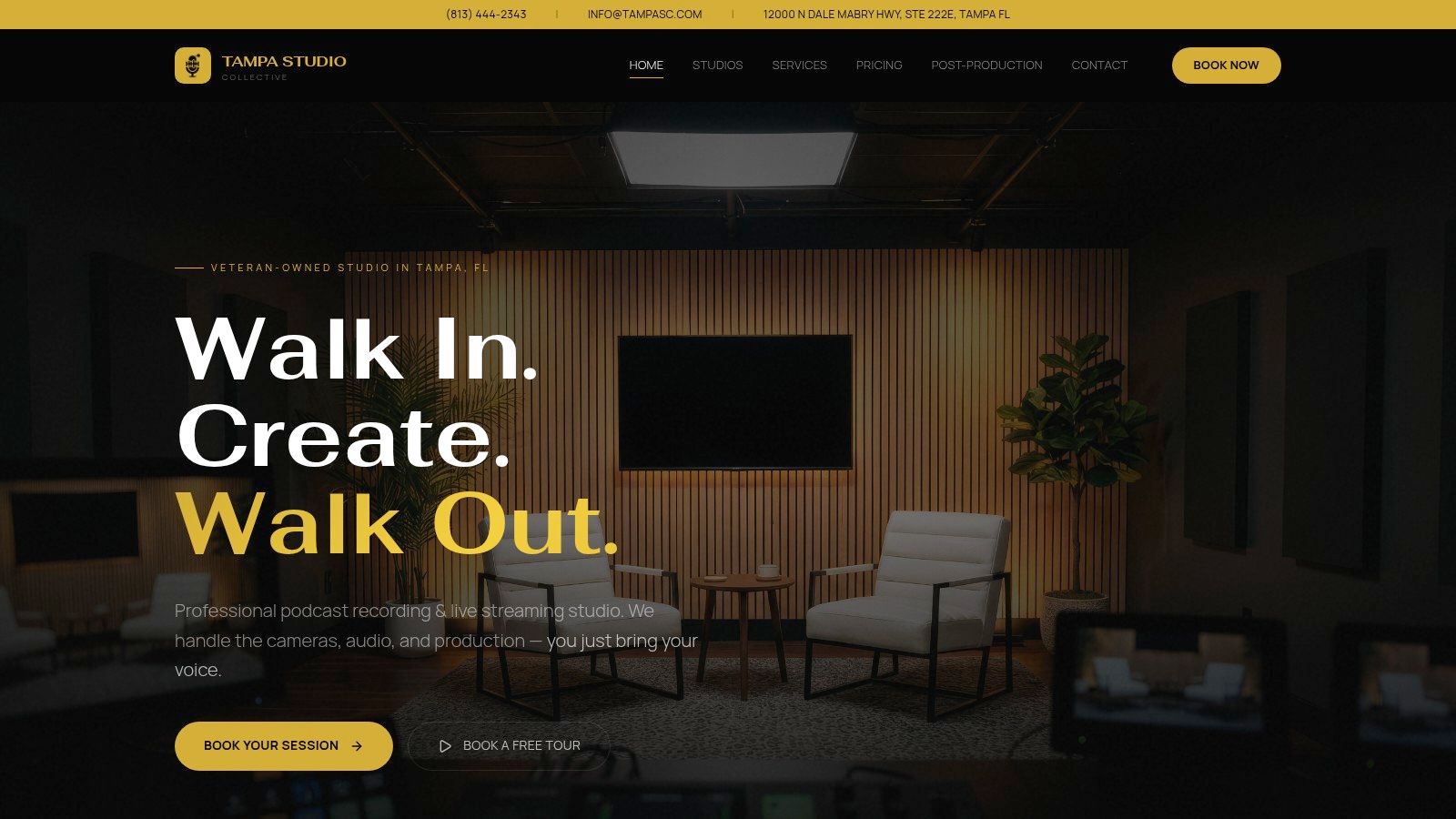
Tampa Studio Collective is one of the cleaner choices for teams that want a simple, walk-in-and-record setup. The appeal is practical. You get a sound-treated environment, an engineer in the session, and a workflow built for businesses that don't want to fiddle with technical setup.
That makes it especially useful for local executives who want to batch several episodes in one block. For many B2B teams, convenience is a bigger factor than people admit. If recording feels complicated, the show slips.
Where it fits in a B2B workflow
This is a production-first option with useful add-ons like clips, captions, and livestream support. It's also relevant for webinar-style content and recorded conversations that can live beyond the podcast feed. If your team runs field marketing, customer education, or executive roundtables, that flexibility helps.
If local presence matters, Tampa Studio Collective also gives you a clear Tampa Bay execution option while still connecting to broader production ecosystems, including Tampa podcast crews and recording support.
The best local studio is the one your executives will actually show up to, on time, every month.
The trade-off is strategy depth. Tampa Studio Collective looks well suited for capture and post-production, but not for long-term audience growth, guest booking, or campaign-level podcast distribution.
Best fit: Tampa teams that want a reliable studio and fast production workflow for recurring podcast or webinar content.
Website: Tampa Studio Collective
6. Studio 21A
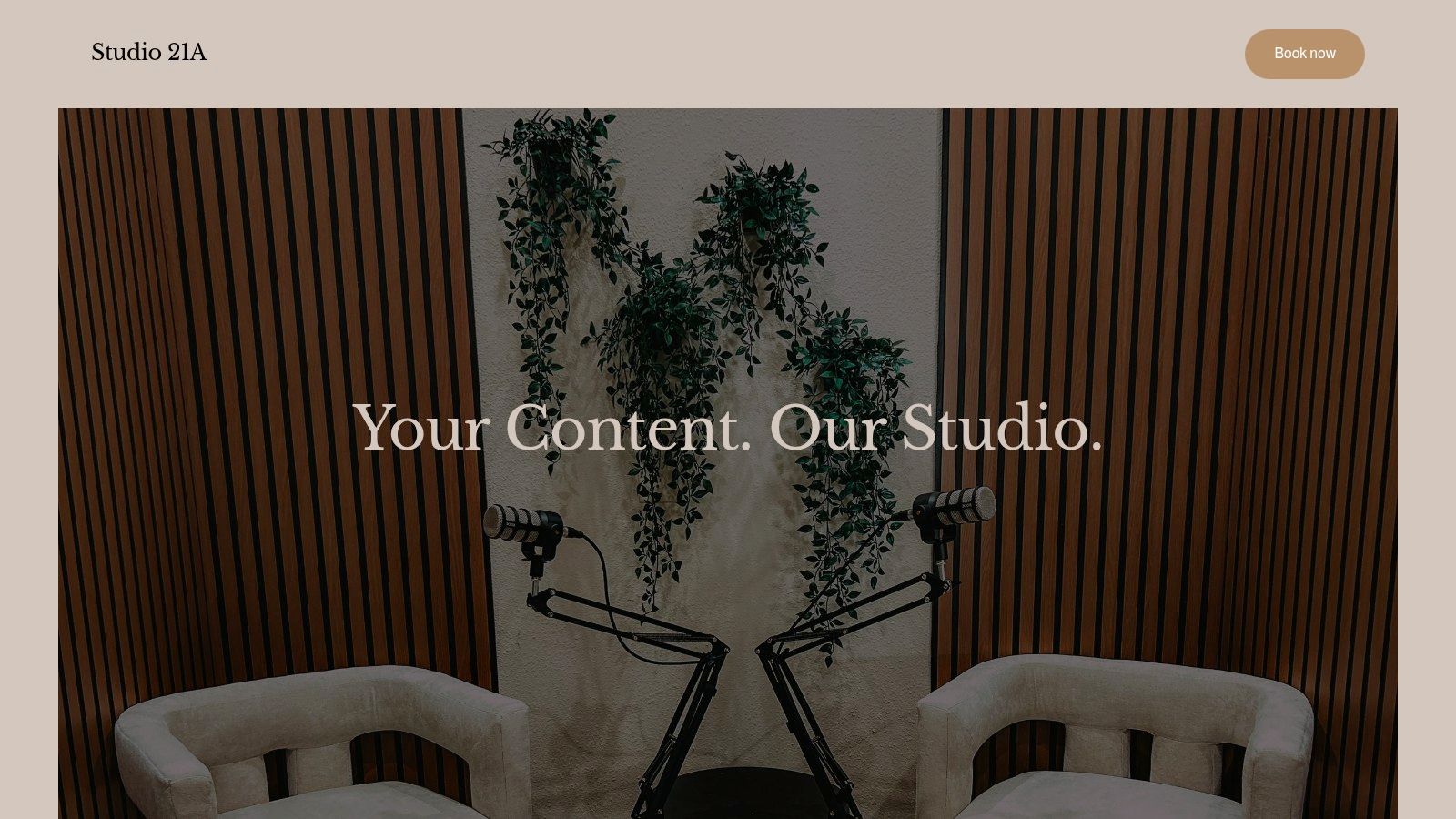
Studio 21A is a practical option for companies that want flexibility more than a big managed-service package. Because it sits inside a marketing agency environment, it's a little more brand-aware than a pure equipment rental setup. That doesn't automatically make it a strategy partner, but it does help.
The useful part is the tiered model. Some teams already have producers, editors, or content leads in-house and only need the room. Others need staffed sessions and distribution support. Studio 21A gives both paths.
Why the model works
This kind of studio is often a good match for in-house marketing teams that want to keep ownership. You can use the space, keep control of the show, and bring in support where needed. That's often more efficient than overbuying a full-service agency if you already have the people to run the program internally.
It also reflects how buyers in Tampa are shopping. GoodFirms' Tampa media-buying directory organizes firms in an outcome-oriented, performance-and-specialization frame. That matters because agencies increasingly win business by showing how execution connects to measurable marketing outcomes, not just by offering creative services.
Studio 21A's limitation is the same as its advantage. Flexibility is great, but the burden stays on your team to define success, manage the editorial calendar, and build distribution if those aren't already solved.
Best fit: In-house marketing teams that want a convenient Tampa studio with some agency adjacency, but still plan to own the strategy.
Website: Studio 21A
7. Voxa Studios
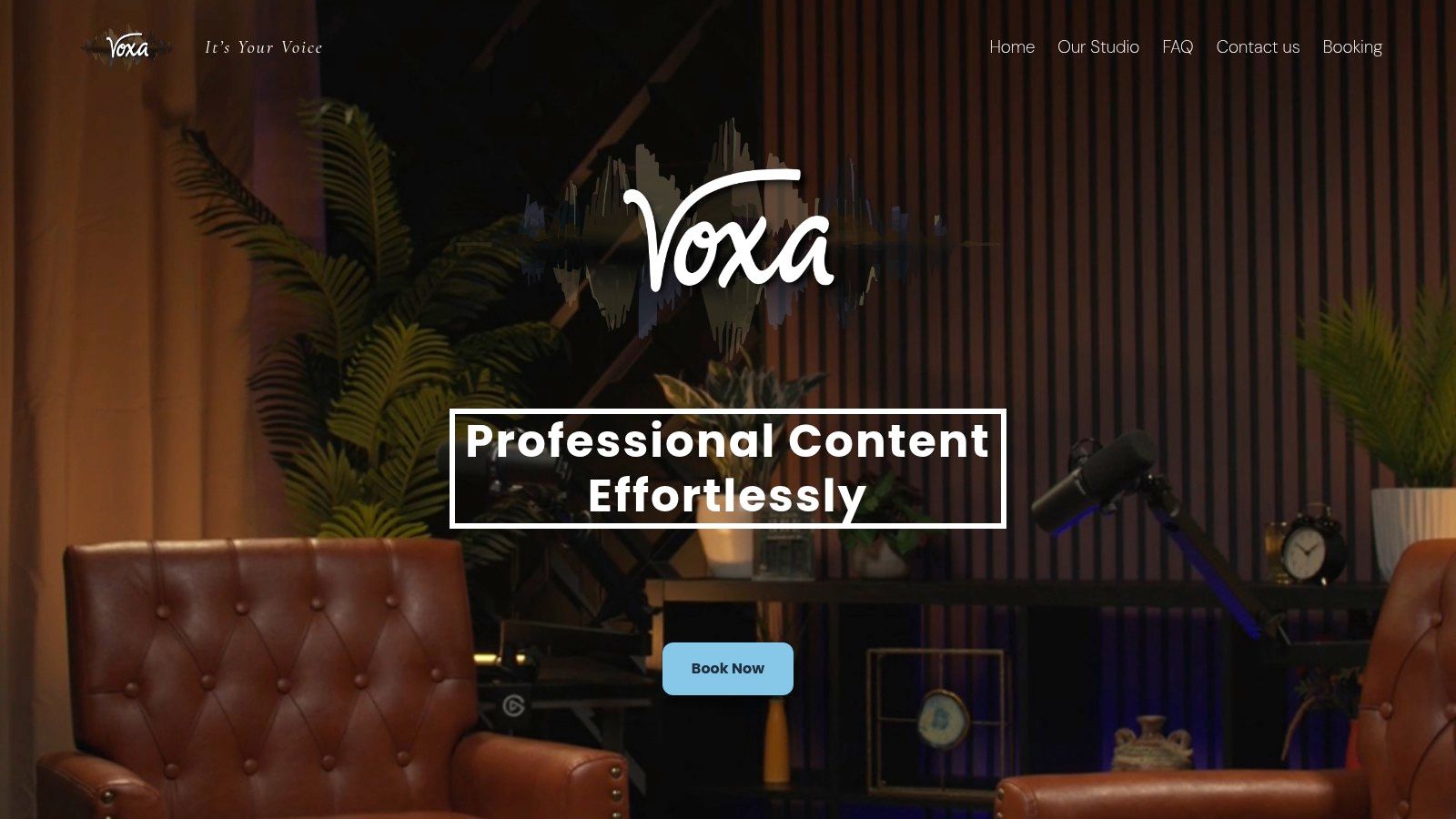
Voxa Studios is one of the more relevant Tampa options if your team is thinking video-first. That matters more now than many podcast buyers expect. A lot of “podcast strategy” conversations are still stuck in an audio-only model, while actual discovery increasingly happens on video platforms and social feeds.
For founder-led brands, consultants, and B2B teams that care about YouTube and LinkedIn distribution, Voxa's orientation is useful. It looks built to reduce technical friction so leaders can focus on the conversation, not the setup.
Video-first is no longer optional
Edison Research's Q1 2025 data shows YouTube is the most-used podcast platform in the U.S., with 33% of weekly podcast consumers naming it their primary service, compared with 24% for Spotify and 15% for Apple Podcasts. That shift is why agencies and studios built around multi-camera capture now matter more.
Voxa appears well aligned with that reality. If your team wants one recording session to become a full episode, short clips, and branded video assets, this is the kind of partner worth considering.
What to like:
- Strong for visual podcasts: Better fit if you want on-camera hosts and guest interviews.
- Efficient recording experience: Useful for busy operators who need batch days.
- Less visible on growth services: You may still need outside help for strategy, guest ops, and promotion.
Best fit: Brands prioritizing video podcasts, executive interviews, and social-ready content capture.
Website: Voxa Studios
8. MixxedMedia by Maxx Forman
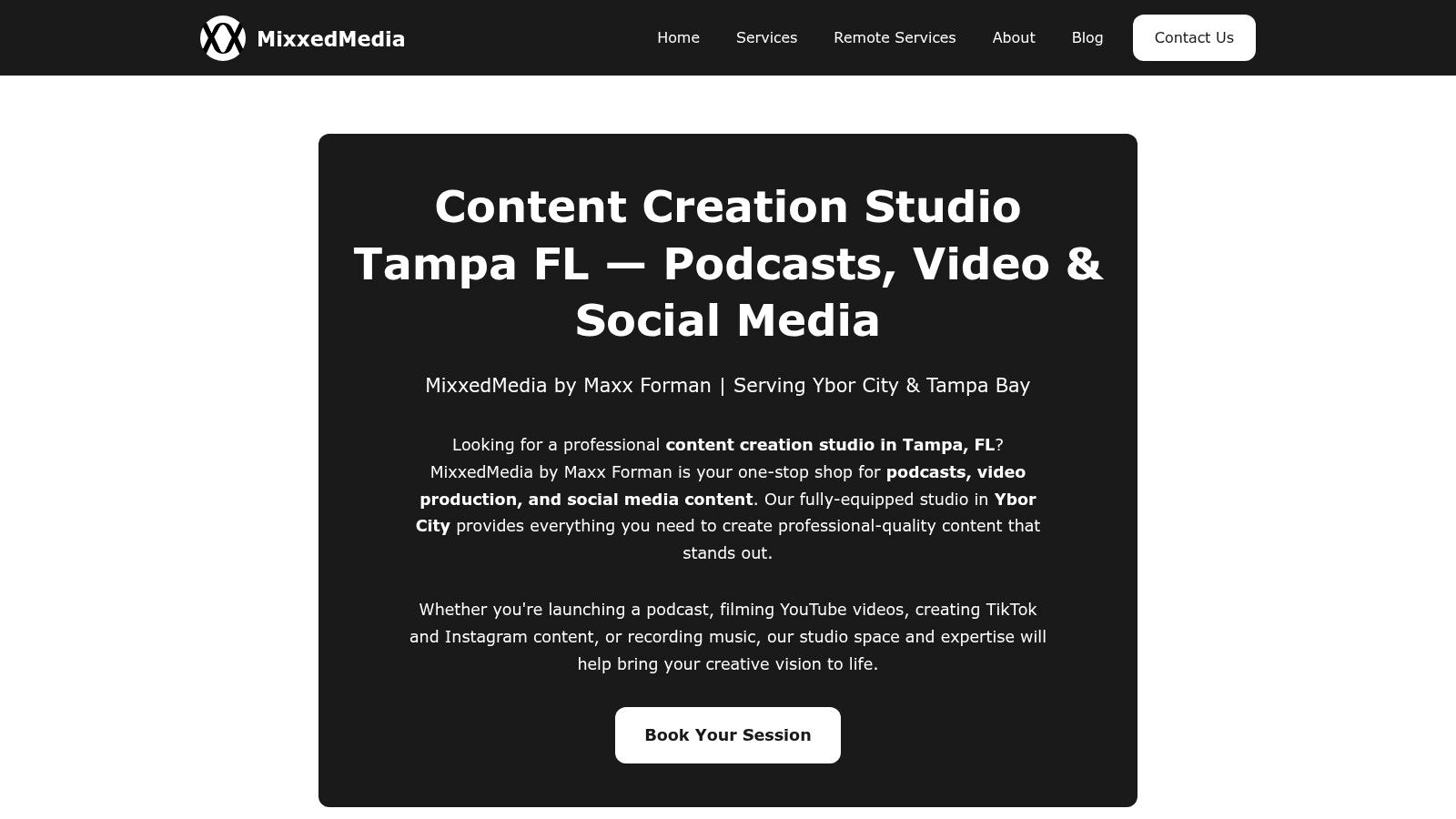
MixxedMedia is a smart option for teams that want to leave a session with a backlog, not just one episode. That batch-production angle is underrated. If your show depends on executives carving out time repeatedly, momentum usually dies. If you can record several conversations in one block and turn them into a publishing runway, the show has a much better chance of staying alive.
Its Ybor City location also makes it appealing for local brands that want a distinctive studio setting without overcomplicating the process.
Best for content batching
MixxedMedia fits the team that thinks in content systems. One recording day can produce long-form episodes, social clips, and extra branded video if the session is planned well. That's useful for lean marketing teams trying to extract maximum value from limited expert time.
The limitation is that batching only works if the editorial plan is solid. Without episode themes, guest targets, and repurposing rules, you'll produce volume without much strategic value.
Batch recording saves time. It doesn't fix weak positioning.
Best fit: Businesses that want to bank multiple episodes and social assets in a single production day.
Website: MixxedMedia
9. Diamond View
Diamond View is the outlier on this list. It isn't a podcast-first shop, and that's exactly why some enterprise buyers will like it. If your podcast is only one part of a much larger campaign involving high-end video, animation, branded storytelling, or launch support, Diamond View enters the conversation.
This isn't the best fit for most mid-market B2B teams launching a steady executive interview show. It's more relevant when the content effort is large, brand-led, and tied to broader campaign production.
When Diamond View makes sense
For bigger organizations, podcasting often isn't a standalone channel. It might support a category campaign, a product narrative, or a senior leadership brand push. Diamond View's broader creative range makes it useful in that context.
If you're comparing that model with a dedicated B2B podcast approach, it helps to look at what a focused operator can build from zero. This B2B marketing podcast case study is a useful example of the more specialized route.
Diamond View's trade-off is obvious. You get scale and creative power, but podcasting won't be the center of gravity.
Best fit: Enterprise brands that need podcast production folded into a larger creative or campaign environment.
Website: Diamond View
10. Speakeasy Podcast Network
Speakeasy Podcast Network takes a different angle from the studio-heavy firms on this list. Its value isn't just recording. It's the network and community model around the shows. For local creators and regional brands, that can be useful if cross-promotion and ecosystem access matter more than a pure agency relationship.
That also means it's less suited to the needs of a national B2B demand-gen team. If your goals are pipeline influence, account-based distribution, or executive positioning in a niche industry, you may outgrow the model.
Local network value
Where Speakeasy stands out is local relevance. It can make sense for Tampa Bay businesses that want to plug into a regional creator scene, collaborate, and build awareness with nearby audiences. That's a different use case from the typical B2B podcast strategy, but it's still legitimate.
The broader buyer lesson is this: many Tampa pages still lean hard on studio quality, while B2B buyers often care more about outcomes. Edison Research age data cited by Second Sol Studios reports that 54% of podcast listeners in the U.S. are 18 to 34 and 37% are 35 to 54. That reinforces why working-age audiences are already there. The primary differentiator is whether the partner can turn that attention into authority and commercial relevance.
Best fit: Local brands, entrepreneurs, and regional businesses that value community reach and network effects inside Tampa Bay.
Website: Speakeasy Podcast Network
Top 10 Tampa Podcast Agencies Comparison
| Provider | Implementation Complexity 🔄 | Resource Requirements ⚡ | Expected Outcomes 📊⭐ | Ideal Use Cases 💡 | Key Advantages ⭐ |
|---|---|---|---|---|---|
| Fame | Medium–High, strategic, managed lifecycle | Premium investment; proprietary software & dedicated team | Predictable growth (guaranteed ≥10% monthly downloads); pipeline-focused ROI | B2B tech/service firms treating podcasting as core demand-gen | Pure B2B focus, performance guarantee, end-to-end service |
| BlueBox Digital (BlueBox Studio) | Low–Medium, production-led, process-driven | On-site 4K multi-camera set, producer; transparent hourly rates | High-quality audio/video with same‑week delivery | Teams needing reliable video + podcast production | Purpose-built set, published pricing, fast turnaround |
| IntellisMedia (WUSF / USF) | Medium, broadcast workflows + consulting | Broadcast-trained engineers; university media facilities; quote pricing | Broadcast/NPR-style audio quality with distribution strategy | Organizations seeking editorial polish and credibility | Public media pedigree, strategic distribution consulting |
| CMR Studios | High, enterprise-grade, multi-format production | Extensive studios, video stages, large crew, high budget | Scalable, polished productions integrated into brand work | Large enterprises with complex AV and campaign needs | Decades of experience; full script-to-screen capabilities |
| Tampa Studio Collective | Low, walk-in, engineer-included sessions | On-site engineer, 4K capture, packaged pricing | Fast episode turnaround (≈72 hrs); ready social clips | Brands wanting streamlined in-person recording & livestreams | Clear pricing, fast delivery, creator-friendly workflow |
| Studio 21A (by The 21st Agency) | Low–Medium, flexible DIY or staffed options | Downtown studio access; agency marketing input; hourly rates | Brand-aligned episodes with optional pro direction | Marketing teams seeking agency-adjacent production | Transparent hourly pricing, marketing-aware support |
| Voxa Studios | Low–Medium, video-first, streamlined process | Multi-camera video setups, broadcast audio; on-site focus | Strong video assets for YouTube/LinkedIn; efficient shoots | Video-first brands and leaders needing batch content | Video specialization, efficient batch workflows |
| MixxedMedia by Maxx Forman | Low, batch-focused, high-volume sessions | Multi-camera setup; flexible half/full-day bookings | Large-content output from single sessions (episodes + clips) | Teams aiming to batch-record pilot seasons or libraries | Flexible booking, optimized for high-volume production |
| Diamond View | Very High, full-scale agency campaign integration | Emmy-winning studio teams, VFX/3D, very high budgets | World-class video and immersive campaigns including podcasts | Fortune 500s or high-budget integrated brand campaigns | Top-tier production, end-to-end campaign execution |
| Speakeasy Podcast Network | Low–Medium, community/network model | Local studios, network promotion channels, events | Regional audience growth and monetization opportunities | Local businesses, creators, and regionally focused brands | Local network cross-promo, monetization & community support |
From Shortlist to Launch. A Buyer's Checklist for Choosing Your Partner
Most companies don't need “podcast production.” They need a repeatable authority engine that happens to use a podcast as the anchor format. That's why the best Tampa podcast agency for one team can be the wrong choice for another. A founder-led SaaS company usually needs guest strategy, content repurposing, and a publishing process that doesn't eat the exec team's calendar. A local brand running a community show may just need a reliable studio and fast edits.
Use your discovery calls to figure out which kind of partner you're really buying. Start with strategy. If the first conversation stays focused on camera angles, studio rental, or editing formats, that's a warning sign for B2B teams. The better agencies ask about goals first. They'll want to know whether the show is meant to support thought leadership, executive visibility, customer marketing, sales conversations, or pipeline influence.
Then pressure-test operational ownership. Ask who handles guest sourcing, briefing documents, host prep, publishing, clips, show notes, and distribution. A surprising number of vendors sound full-service until you discover your internal team still owns half the workflow. That's where podcast programs stall.
A practical checklist for buyer calls:
- Strategy and goals: Do they ask about business outcomes first, or do they stay at the production layer?
- B2B experience: Can they point to real work with business brands, especially companies with long sales cycles or niche audiences?
- Distribution plan: How will episodes reach people outside the RSS feed? Ask about YouTube, LinkedIn, email, short-form clips, and owned channels.
- Repurposing depth: What assets come from one recording session besides the full episode?
- Executive workflow: How much calendar time, review time, and coordination will your team need per episode?
- Measurement: Can they explain how they report on podcast performance in a way marketing leadership can use?
The other thing I'd check is whether the agency understands the current platform reality. In 2025 and beyond, podcast success usually depends on more than audio. Video capture, clips, social distribution, and search visibility all matter. A studio can record your show. A stronger partner can turn each conversation into multiple usable assets for demand gen, social, and sales follow-up.
If measurable B2B growth is the priority, it makes sense to begin with agencies built around that model. Fame is one relevant option because it focuses on B2B podcast production, guest development, promotion, and a managed workflow tied to growth goals. For teams that care more about local recording access, several Tampa studios on this list can also work well, but they'll usually require more internal ownership.
The right choice is the one that matches your real bottleneck. If strategy is weak, don't buy more production. If execution is the bottleneck, don't overpay for strategy you already have. Get that part right, and the show has a much better chance of becoming a business asset instead of another marketing side project.
If you want a partner built around B2B podcast strategy, production, and growth, take a look at Fame. It's a practical place to start if your goal is to turn a podcast into an authority and demand-generation channel, not just a polished recording.
