

Finding the best Houston podcast agency usually starts with the wrong question. Teams ask who has the nicest studio, the sharpest camera package, or the cleanest edits. Those matter, but they don’t decide whether the show becomes pipeline or just another branded content experiment that fades away.
Most B2B teams in Houston don’t need more content. They need a repeatable way to turn expertise into trust, trust into conversations, and conversations into revenue. That’s why a podcast only works when the agency behind it understands positioning, guest strategy, distribution, and how to support sales with authority content.
That’s also why I wouldn’t evaluate Houston podcast partners like a simple vendor directory. Some shops are great recording spaces. Some are strong creative partners. A smaller group can support a B2B growth motion. If you're also thinking beyond owned media, pair your show with strategic podcast placements so your executives show up where your buyers already listen.
1. Fame
A Houston B2B team greenlights a podcast, records a few polished episodes, and then stalls. No clear guest strategy. No distribution system. No sales use case. The show exists, but revenue never shows up.
That is the gap Fame is built to address. It ranks first here because its model is centered on B2B growth outcomes, with strategy, production, promotion, and measurement tied together instead of split across freelancers or a local studio workflow. If you want a sense of what that operating model includes, their overview of a B2B podcast production service lays out the scope clearly.
Why Fame ranks first
Fame fits companies that treat a podcast as a revenue program, not a content side project. The agency’s Houston page says it manages more than 100 client shows and brings on new podcasts each month, which suggests repeatable operating experience rather than a one-off production shop. That kind of scale matters in B2B because the hard part is rarely recording. It is choosing the right show angle, booking guests your buyers respect, turning episodes into sales assets, and keeping distribution consistent long enough to matter.
The other reason Fame sits at the top of this list is accountability. On its Houston service page, the company states that it commits to month-on-month download growth for client shows, a rare stance in a category where many agencies stop at deliverables and leave performance to the client. That does not guarantee pipeline on its own, but it does show a willingness to be measured on results, not just output.
There are trade-offs.
Fame is not the right fit for teams that only need a Houston studio for a half-day shoot or a low-cost editing vendor. It is built for ongoing B2B programs, and the pricing reflects that. Its own Houston page lists monthly subscriptions starting at $2,500 and going up to $5,000 based on episode volume, so this is a better match for companies with a real content motion, clear ICP, and enough internal buy-in to use the show across marketing and sales.
For a marketer choosing between local options, that distinction matters. Some Houston agencies in this list are stronger on in-person production logistics. Fame ranks first because it is built around the business side of podcasting: audience growth, content repurposing, distribution, and a structure that supports pipeline influence instead of stopping at polished audio.
2. Speakerbox Media
Your team blocks off half a day, gets the executive to the studio on time, records three strong conversations, and walks out feeling productive. That part is manageable. The harder question is whether the agency behind the session can turn that recording day into a repeatable B2B content motion.
Speakerbox Media is a credible option for Houston companies that want an in-person partner and a process that feels built for business use, not hobbyist production. The appeal is straightforward. Local studio access, editing, and a production workflow that reduces friction for busy leadership teams.
Speakerbox also benefits from being grounded in the Houston market. In its own overview of local podcast options, the company notes that only a limited number of firms are mapped to Houston and that local studio pricing often lands in the $70 to $125 per hour range, which helps frame the difference between booking a room and hiring an agency partner for an ongoing show in its Houston podcast studio roundup.
That distinction matters more than many B2B teams expect.
A studio day solves recording logistics. It does not solve audience strategy, guest quality, distribution, or sales enablement. Teams comparing Speakerbox with a revenue-focused partner should be clear on what they are buying. If you need help sorting those options, this breakdown of B2B podcast marketing services is a useful starting point.
Where Speakerbox fits best
- Best for local executive recording: Teams that want a Houston-based setup with hands-on production support and less operational mess on recording day.
- Best for batch production: Companies planning to record multiple episodes in person and keep the calendar efficient.
- Less ideal for performance-led programs: Buyers who want audience growth targets, distribution strategy, and tighter pipeline alignment will need to ask more detailed questions.
Speakerbox looks strongest for companies that already know what show they want to make and need a dependable local team to produce it well. That is a real use case. Just keep the trade-off in view. Good production can make a show publishable. It does not automatically make it commercially effective.
3. Anthem Content
Anthem Content makes sense when your podcast isn’t just a podcast. It’s a content engine. That distinction matters because plenty of B2B teams don’t need one polished episode a week. They need long-form interviews that can feed YouTube, social clips, founder content, sales enablement, and ongoing brand education.
That’s where Anthem’s positioning is attractive. The company leans into multi-cam production, audio, distribution, and repurposing. For a team trying to get more mileage from executive time, that setup is practical.
The real trade-off
Repurposing sounds great until it turns into asset sprawl. More clips don’t automatically mean more demand. The work only pays off when the core show has a clear audience, a clear point of view, and episodes designed for buyer relevance instead of broad industry chatter.
Anthem appears strongest when a company already knows how it wants to use long-form content across channels. If your team has that clarity, a production partner with video-first execution can be useful. If you don’t, you may end up publishing a lot of surface-level content that looks active but doesn’t move deals.
A podcast content engine works when each episode starts with a commercial angle, not just a topic.
I’d shortlist Anthem for teams that already have a strong internal content strategy and need execution horsepower. I wouldn’t pick them purely because they can generate more assets. Volume is only valuable when the message is sharp.
For more on the company’s offering, visit Anthem Content.
4. Emergent & Co.
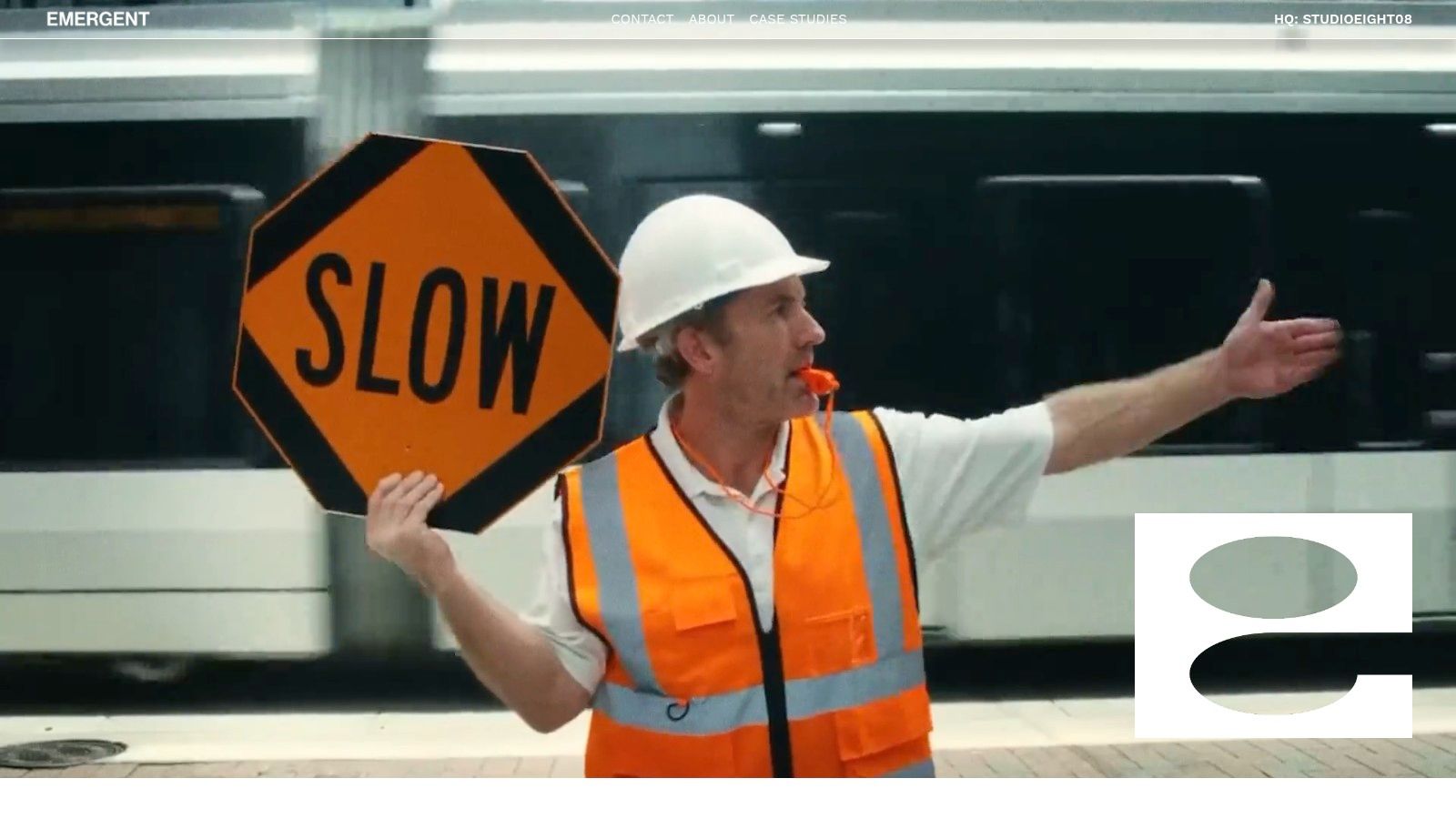
Emergent & Co. sits in a different lane from pure podcast specialists. It’s a better fit when the show is part of a broader brand experience. Think live tapings, event integrations, panel discussions, social capture, and campaign-level creative execution.
That can be a real advantage for companies using podcasts as a visibility layer around launches, executive thought leadership, or customer community building. If you already invest in events, this kind of partner can help make the podcast feel less isolated from the rest of your marketing.
When to hire them
Use Emergent when you want the podcast to show up in physical environments. A live-recorded conversation at an event can create stronger brand momentum than another remote Zoom interview, especially if your team wants footage, social coverage, and a polished in-person set.
The trade-off is obvious. If you just need reliable recurring audio production, Emergent may be more agency than you need. If your priority is growth strategy and promotion rather than event execution, you should also look at firms with clearer podcast marketing services.
- Good fit: Brands combining podcasting with experiential marketing and social capture.
- Less ideal: Lean B2B teams that want efficient remote production and distribution support.
- Question to ask: Who owns the audience-growth plan after the event footage is delivered?
For broader creative activation, Emergent & Co. is worth a look.
5. 201 Lofthaus Podcast Studio
201 Lofthaus is for the executive team that wants speed, simplicity, and almost no production friction. The promise is straightforward. Walk in, record, and leave with something close to publish-ready. That’s appealing for founders and operators who don’t want to become part-time producers just to keep a show alive.
This is one of the better options in Houston if your internal bottleneck is logistics. The studio-centric model reduces coordination overhead, which is often what kills consistency in the first place.
What works and what doesn’t
What works is the fast path to content. If your team already knows the show format, the guests, and the angle, a clean in-and-out workflow can keep momentum high. The clearer your internal ownership, the better this kind of studio performs.
What doesn’t work is expecting a recording experience to solve a strategy problem. If the show has weak positioning, no distribution plan, and no buyer-focused angle, a smooth studio day won’t fix that. Studio setup matters, but so does understanding podcast studio design in the context of the show you’re trying to build.
Buyer lens: Convenience is valuable. But convenience without strategy just helps you publish the wrong show faster.
If you want an efficient recording environment and a low-friction test run, 201 Lofthaus Podcast Studio is a sensible option.
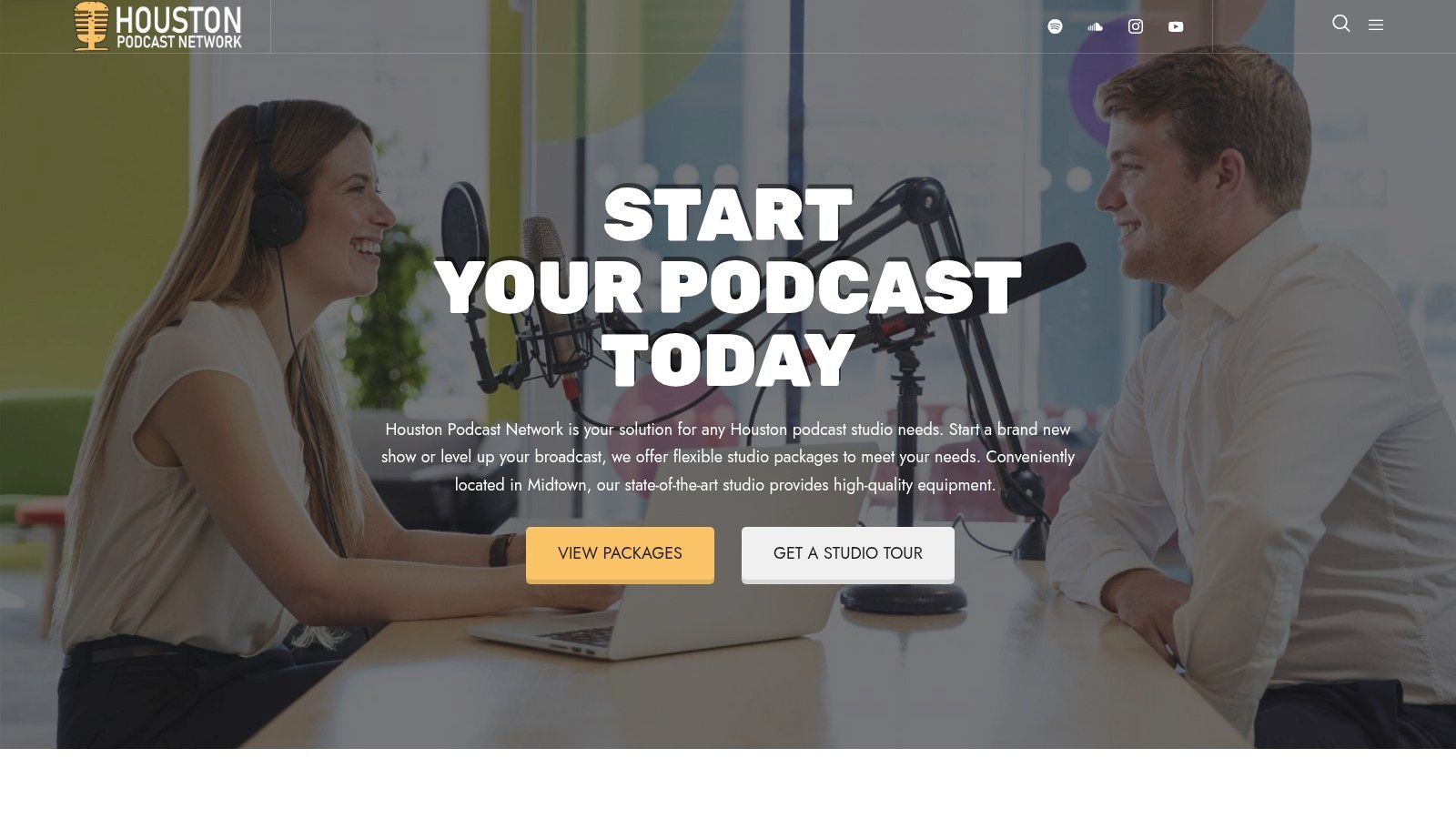
6. Houston Podcast Network Podcast Houston

Houston Podcast Network, also known as Podcast Houston, is a packaged-service option. That’s useful for teams that want predictable cadence, recurring production support, and fewer moving parts. Instead of building a custom stack of freelancers, tools, and ad hoc studio time, you buy a monthly operating rhythm.
That approach tends to appeal to smaller business teams and early-stage shows. If your goal is to launch, stay consistent, and get episodes distributed to the major platforms, a packaged model can lower the operational burden.
The caution with membership-style production
The risk is that the package can drive the strategy instead of the other way around. If the plan assumes a fixed episode cadence that doesn’t match your sales cycle, executive availability, or content depth, you’ll end up recording because the subscription says you should, not because the topic deserves an episode.
That doesn’t mean the model is bad. It means you need discipline. Make sure your recording volume reflects what your company can support with quality conversations, useful promotion, and follow-through from your sales and marketing team.
I’d put Houston Podcast Network in the category of practical and straightforward. It’s better for consistency than for advanced B2B audience development.
7. Houston Podcast Studio

Houston Podcast Studio has a clear appeal. It gives buyers a radio-grade environment, transparent package structure, and a simple path to recurring weekly output. For teams that value predictability, that alone makes it worth considering.
A lot of buyers overcomplicate the early stage of podcast production. Sometimes the right answer is to get a clean room, a reliable engineer, branded visual elements, and a schedule your team can maintain.
Best use case
This is a good fit when you already know why you’re podcasting and need dependable production infrastructure. The radio-station setting can also give some teams extra confidence if they want a more formal, broadcast-style environment.
What I wouldn’t expect from this type of provider is aggressive growth strategy, guest sourcing, or pipeline design. That’s not a criticism. It’s just a different product. If your team still needs the business case for the show itself, read up on the benefits of podcasting before picking a production-first vendor.
- Strong fit: Weekly or recurring shows that need stable studio support.
- Weak fit: Teams looking for deeper marketing strategy or audience-growth planning.
- What to verify: Who handles promotion after the file is delivered?
For straightforward production support, Houston Podcast Studio is a clean option.
8. Houston Creative Media
Houston Creative Media feels better suited to organizations where messaging carries higher reputational stakes. That includes nonprofits, education groups, professional services firms, and institutions that need careful narrative shaping, not just production throughput.
That’s a different buying criterion than most B2B tech teams use. You’re not choosing the shop because it can produce more clips. You’re choosing it because the messaging has to be thoughtful, consistent, and safely handled across a wider communications environment.
Why some teams will prefer this model
If your executives care greatly about tone, governance, and brand voice, a higher-touch producer-led firm can be the right call. The value isn’t speed. It’s judgment. For certain organizations, that matters more than maximizing content volume.
The trade-off is that this kind of partner may not be the strongest choice for aggressive social repurposing or demand-gen style distribution. It’s more about narrative quality and controlled execution.
I’d recommend Houston Creative Media for organizations that need a polished, careful partner. I wouldn’t default to it for a fast-moving B2B software company that wants a show tightly linked to pipeline creation.
9. Adelaido Gene
Adelaido Gene is a better fit for personality-led brands than corporate media programs. If the show revolves around a founder, consultant, or visible operator who wants to turn podcast recordings into social content, this approach has clear value.
That matters because many buyers searching best Houston podcast agency don’t need a full agency. They need someone who can make them look sharp on camera, package the content cleanly, and help them stay visible across short-form channels.
Where Adelaido Gene stands out
The strongest use case is video podcasting as a personal brand engine. Short clips, in-person or remote recording support, and done-for-you production can work well when the person behind the mic is the product, or close to it.
The limitation is scale and depth on the B2B strategy side. A personal brand content partner isn’t always the same thing as a podcast agency that can support a larger revenue team, sales motion, and category positioning effort.
A founder-led show can create trust fast. But if the company wants a durable media asset, the strategy has to outlive one personality.
For expert-led consulting brands, Adelaido Gene is worth considering. For enterprise B2B podcast programs, I’d look for more infrastructure around audience growth, guest strategy, and reporting.
10. Lights Camera Pod
Lights Camera Pod is the most rental-first option on this list. That’s not a drawback if you already have your own production workflow. In fact, it can be the smartest route for experienced teams that just need a professional place to record.
This kind of studio works when your company already has a producer, editor, or content lead who knows how to run the machine. If you don’t, the low hourly cost can become expensive in hidden coordination time because your team has to manage everything else.
The honest assessment
Lights Camera Pod is useful infrastructure. It’s not a growth partner. That distinction is what many buyers miss when comparing podcast vendors in Houston. A studio gives you a place to make content. An agency should help make that content matter.
If your workflow is mature and you want better production conditions without building your own set, this is a sensible option. If you’re still trying to figure out show strategy, promotion, and post-production operations, you’ll probably need more support than a studio rental can provide.
- Choose this if: Your team already owns planning, production, and promotion.
- Skip this if: You want end-to-end help with strategy and audience growth.
- Best mindset: Treat it like infrastructure, not outsourced marketing.
Top 10 Houston Podcast Agencies Comparison
| Provider | 🔄 Implementation complexity | 💡 Resource requirements | ⚡ Speed / Turnaround | 📊 Expected outcomes (⭐ quality) | Ideal use cases |
|---|---|---|---|---|---|
| Fame | End-to-end, managed B2B process with platform integration; low client lift | Premium budget; B2B marketing alignment; minimal internal production staff | Steady, metrics-driven cadence; results measured monthly | High, ROI and pipeline focused; Guaranteed growth ⭐⭐⭐⭐⭐ | B2B companies seeking authority, lead generation and scalable podcast ROI |
| Speakerbox Media | Turnkey studio + consulting; moderate setup for in-person sessions | Transparent baseline pricing; on-site studio time or on-location teams | Batch-friendly workflows; scheduling needed for studio days | Strong production and corporate workflows; predictable quality ⭐⭐⭐⭐ | Companies wanting Houston studio access and clear budget anchors |
| Anthem Content | Full-service content engine; multi-format repurposing complexity | Mid-high budget; coordination for multi-cam and social clipping | Produces high asset volume but engagement is scoped | High impact for demand-gen and repurposing programs ⭐⭐⭐⭐ | Demand-gen teams needing year-round audio/video/social content |
| Emergent & Co. | Complex multidisciplinary production tied to events and campaigns | Campaign budgets, event coordination, creative resources | Project-based timelines; slower for larger activations | High for brand experiences and video-first executions ⭐⭐⭐⭐ | Brands that want podcasts integrated with events, activations and social capture |
| 201 Lofthaus, Podcast Studio | Low client complexity; pre-lit multi-cam walk-in model | Per-session pricing; on-site engineer; minimal client prep | Fast "record-and-leave" turnaround; efficiency-first ⚡ | Good for polished single-session episodes; limited distribution support ⭐⭐⭐ | Founders/executives seeking quick, turnkey studio sessions |
| Houston Podcast Network (Podcast Houston) | Low-moderate via membership packages and standard workflows | Monthly packaged pricing (assumes episode cadence) | Predictable weekly distribution and delivery | Reliable production basics; consistent cadence ⭐⭐⭐ | Teams wanting packaged monthly memberships and steady output |
| Houston Podcast Studio | Low complexity in a broadcast-grade environment | Memberships/hourly rentals; weekday availability limits | Moderate; weekly packages enable steady cadence | Broadcast-quality audio/video; standard reach impact ⭐⭐⭐ | Shows needing radio-grade facilities and consistent weekly production |
| Houston Creative Media | High, strategic narrative and high-touch production | Higher-touch retainers or scoped engagements; senior leadership time | Slower due to strategy, narrative development and production | High-quality, reputationally sensitive outcomes ⭐⭐⭐⭐ | Nonprofits, professional services and institutions needing narrative clarity |
| Adelaido Gene | Moderate, video-first, done-for-you with social focus | Video production and social repurposing resources; flexible scale | Fast clip-focused delivery for social platforms ⚡ | Strong for personality-driven audience growth and short-form content ⭐⭐⭐⭐ | Personal brands and consultants prioritizing video/social distribution |
| Lights Camera Pod | Low, studio rental only; minimal onboarding | Affordable hourly/membership rates; bring your own producer/post | Immediate session availability subject to booking; quick sessions ⚡ | Studio-grade raw footage only; no post or marketing included ⭐⭐ | Creators with in-house production who need affordable, pro studio space |
Your Next Step Choosing the Right Podcast Partner
The right choice depends on what problem you’re trying to solve. If you need a room, a few mics, and a clean recording setup, Houston has several credible studio options. If you need a partner that can help your company build authority, earn trust with buyers, and turn a show into something your sales team can use, you need a different level of support.
That’s the mistake I see most often. Teams compare a studio rental, a creative production shop, and a B2B podcast agency as if they’re interchangeable. They aren’t. One sells production access. Another sells polished content. A smaller number sell a system designed to create business outcomes.
Start with the commercial question, not the content question. Who are you trying to influence? What conversations should the podcast create? How will episodes support demand generation, outbound, partnerships, recruitment, or deal acceleration? If an agency can’t answer those questions in a concrete way, they probably can’t help you build a serious show.
Then look at operating fit. Some teams need local in-person recording. Others are better served by a remote-first partner with stronger strategy and distribution. Some need event integration. Others need a repeatable B2B media engine. None of those paths is wrong. They’re just different purchases.
I’d also pay close attention to how an agency communicates during the sales process. The way they scope, explain trade-offs, and set expectations will usually predict how they’ll manage the relationship after kickoff. These client communication best practices for agencies are a useful lens for evaluating whether you're about to hire a responsive partner or a vendor that disappears once production starts.
If you’re narrowing the field, ask every shortlist candidate one direct question: how will you help us turn listeners into customers? Don’t accept a vague answer about reach, awareness, or content volume. Push for specifics on positioning, guest strategy, distribution, repurposing, and how the podcast supports your broader revenue motion.
For Houston B2B companies, that usually clarifies the field fast. Some providers are strong studios. Some are capable creative teams. Fame is one option specifically built around B2B podcast production, audience growth accountability, and end-to-end execution. That distinction matters if your company is buying a growth asset, not just a recording service.
If your team wants a podcast that does more than ship episodes, talk to Fame. It’s built for B2B companies that want strategic production, distribution support, and a clearer link between podcasting and pipeline.
