

The best way to build real, lasting brand equity is to become the go-to educational voice in your industry. It's that simple. When you consistently show up and provide genuine value and expertise, you build a level of deep-seated trust and authority that makes you the default choice when your ideal clients are finally ready to pull the trigger.
Why Brand Equity Is Your Ultimate B2B Advantage
Brand equity isn't some fluffy marketing concept; it’s a tangible asset that directly pumps up your enterprise value. In a B2B world where every product and service starts to look the same, the only things that truly set you apart are perceived expertise and unshakable trust. A strong brand does more than just look good—it lets you command higher prices, it dramatically shortens those painfully long sales cycles, and it even helps you attract the best talent.
The financial markets have already put a number on this. Data from WIPO shows that the value of the top 5,000 global brands shot up from $11 trillion in 2020 to over $13 trillion in 2024. That's a jump of more than 20%. This growth is completely dominated by tech and commercial services—sectors where long, complex buying decisions all hinge on trust. This makes the trend incredibly relevant for any B2B marketer paying attention.
The Power of Education in B2B Markets
So, how do you actually build this invaluable trust? You teach. You become the resource everyone in your industry turns to, generously sharing insights that help your potential customers solve their real-world problems.
This educational approach is, without a doubt, the most direct path to building brand equity today. Instead of just shouting about your features, you’re demonstrating your expertise with content that actually helps people. This is where a B2B podcast stops being just another marketing tactic and becomes the central engine of your entire brand-building machine. By educating your potential customers and your peers, you will be seen as the leading voice in the industry, ensuring your ideal clients think of you when they're in the market.
A podcast lets you forge a deep, personal connection with your audience. They hear your voice, they absorb your insights, and they start to see your company not as another vendor, but as a trusted advisor. This consistent, authentic presence is the bedrock of modern brand equity.
From Content to Authority
Think of your podcast as a powerful flywheel for your whole marketing ecosystem. Every single episode is a goldmine of insights that you can slice and dice into dozens of other assets—clips for a B2B social media agency to distribute, fodder for a B2B newsletter agency to craft emails around, detailed blog posts, you name it. This isn't just about churning out content; it's about establishing a consistent, authoritative presence across every channel where your ideal customers are hanging out.
By turning insightful conversations into a scalable content engine, you systematically build your reputation as the definitive voice in your space. This guide will walk you through a practical framework to build that authority, but you can get a head start by checking out what goes into a modern B2B brand strategy.
Lock In Your Brand Position and Core Message
Here's a hard truth: before you even think about buying a fancy microphone, you need a compass. A B2B podcast without a sharp, defined point of view is just more noise in an already deafening market. Building real brand equity doesn't start with content; it starts with the strategic heavy lifting you do before hitting record.
This groundwork is what makes every single episode a strategic asset, reinforcing who you are and why you matter to the right people.
It all begins with an almost obsessive focus on your Ideal Customer Profile (ICP). And no, I don't mean surface-level stuff like job titles and company size. I'm talking about getting into their heads. What are their deepest professional fears? What does a massive win actually look like for them?
When you grasp their specific ambitions and roadblocks, you can create content that doesn't just inform them—it connects with them.
Articulate a Value Proposition That Actually Cuts Through
Once you know exactly who you’re talking to, you can finally craft a value proposition that stands out. Let's be honest, most B2B companies sound identical because they all talk about what they do. Great brands talk about why it matters.
Your value proposition is the promise you make to your audience. Your podcast is how you prove you can deliver on that promise, week after week.
To get this right, you need to answer three brutally honest questions:
- What specific pain point do we solve better than anyone else? Don't be generic. Get laser-focused on the one thing you are uniquely equipped to handle for your ICP.
- What is our unique perspective or "secret sauce"? This is your worldview, your methodology, the unique insight that shapes everything you do. This becomes the soul of your podcast.
- What is the tangible transformation we provide? Describe the "after" state. How is your customer's business—or even their career—radically better after engaging with you?
Answering these gives you the raw material for a messaging framework that feels authentic and powerful. It’s not just marketing fluff; it's the core of your brand's story.
Weave Your Brand's Narrative Into Everything
Your brand story is the thread that ties it all together. It's the narrative that explains your purpose, your values, and why you exist beyond just hitting a revenue target. This story needs to be woven into the very fabric of your podcast—from the show's intro music to the specific questions you ask your guests.
A powerful brand story gives your audience something to connect with on an emotional level. It transforms your company from a faceless entity into a group of people on a mission they can believe in and support.
This narrative becomes your strategic filter. It dictates your podcast's theme, guides your guest selection, and shapes your talking points. When your brand position is this sharp, you'll find you naturally attract guests and listeners who see the world the same way you do. That alignment is how you build a real community.
You can even extend this narrative into physical experiences to make it more tangible; exploring top event branding ideas can spark powerful ways to reinforce your story in a live setting.
Ultimately, this level of clarity is what separates a forgettable podcast from one that becomes an indispensable resource for its listeners. It’s the difference between just making episodes and strategically building brand equity with every single conversation. For a deeper dive into this foundational work, check out our complete guide on effective brand positioning strategies.
Building Your Authority Flywheel with a Podcast
With your brand position locked in, it’s time to build the engine that drives your authority. While traditional content marketing still has its place, the single most effective tool for building B2B brand equity today is a podcast. It's the best way to elevate your position in the market.
Think of it as a unique combination of a content machine, a powerful networking tool, and a direct line to the ears of your ideal customers.
A podcast lets you educate your market at scale, carving out a space for your company as the leading voice in your industry. When you consistently deliver value through insightful conversations, your ideal clients naturally think of you first when they're ready to buy. This is how you build the deep-seated trust and loyalty that underpins all strong brands.
Why a Podcast Is a Brand Equity Supercharger
Unlike a blog post or a whitepaper, a podcast creates a uniquely personal connection. Listeners hear the nuance in your voice and the conviction behind your ideas, forging a bond that text alone just can't replicate. This consistent, intimate touchpoint is what turns casual listeners into dedicated brand advocates.
Even better, a B2B podcast is the ultimate content engine. A single one-hour conversation can be sliced, diced, and repurposed into a cascade of marketing assets.
This process creates a self-sustaining authority flywheel. The podcast fuels your content, your content drives awareness, and that awareness brings more listeners back to your podcast. You end up continuously building your brand’s authority across every channel. The core process of aligning your brand's value with your customer and story is the foundation of it all.
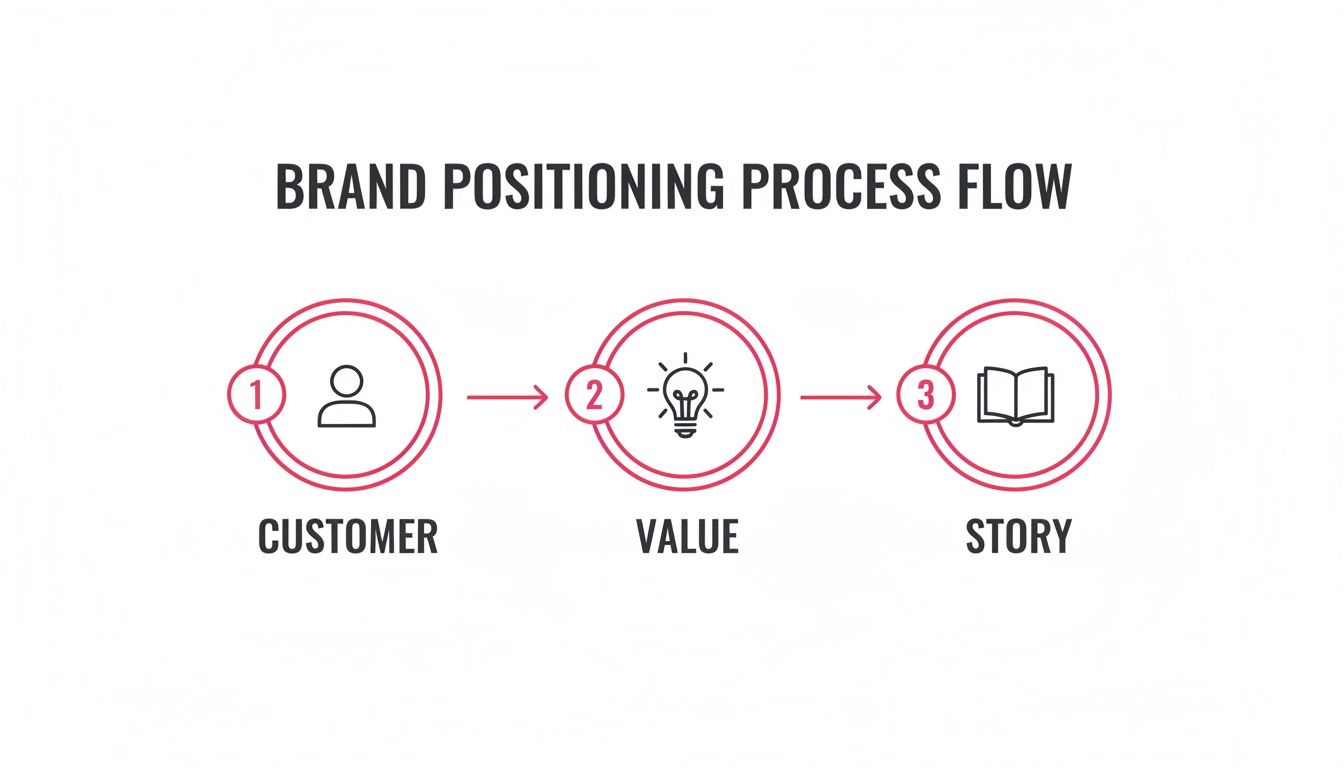
This simple flow—understanding the customer, articulating your value, and telling a compelling story—is what makes a podcast strategy click.
Below is a quick look at how you can get maximum mileage from a single episode.
Podcast Content Repurposing Matrix
As you can see, the podcast becomes the sun in your content solar system, with every other asset orbiting around it.
Planning a Show That Cements Thought Leadership
Launching a successful podcast isn’t about just hitting record. It demands a strategic plan. Start by identifying your unique angle—the specific niche or perspective that only your brand can own. Please, don’t try to be everything to everyone. Focus on a specific segment of the market and become their go-to resource.
Once you have your angle, map out your first ten episodes. This is a great exercise. It forces you to validate your show's concept and proves you have a deep well of topics to draw from. A clear plan also makes it much easier to attract high-profile guests.
Speaking of guests, your selection strategy is critical. Inviting industry experts, respected analysts, and even your ideal customers to be on your show is a game-changer. It provides invaluable social proof, expands your professional network, and introduces your brand to new, highly relevant audiences. Each guest brings their own credibility and followers, creating a powerful network effect that accelerates your growth. To make this process seamless, we've developed a comprehensive B2B branded podcast framework that guides you through every step.
"A podcast is the only form of media where you can borrow the trust and authority of your guests and, through a long-form conversation, make it your own." — Tom Hunt, Founder of Fame
This approach has a real financial impact. Evidence from leading brand valuation studies shows that strong brand equity leads directly to revenue resilience and the ability to command premium prices.
Kantar’s BrandZ analysis, for example, revealed that the top 100 global brands reached $6.9 trillion in total brand value in 2023. That figure is still 47% higher than pre-pandemic levels. The lesson for B2B marketers is clear: markets reward companies that invest in consistent, expert-driven content formats like podcasts that build real authority.
Turning Your Audio Content Into Market Influence
Recording a brilliant conversation is only half the battle. If your ideal customers never actually hear it, all that potential value just evaporates. The next real step in building your brand is turning those raw conversations into genuine market influence. This happens through two key activities: professional production and relentless promotion.
A lot of B2B teams get hung up on the technical side of things, picturing some complicated, expensive recording studio. The reality is much, much simpler. With the right tools, you can capture professional-grade audio remotely with a surprisingly lean setup. We're not aiming for Hollywood-level production here; the goal is clarity and consistency that makes listening a pleasure, not a chore.
When you nail this part, your brand sounds just as credible as the ideas you're sharing. That’s non-negotiable.
Your Essential Remote Recording Setup
Forget the soundproofed room and the mixing board with a million knobs. You want to focus on the fundamentals that deliver 80% of the quality with 20% of the effort. A solid, simple setup removes all the friction for both you and your high-profile guests, making the whole experience feel professional and seamless.
Here’s a practical gear list to get you started:
- A Quality USB Microphone: Please, stop using your laptop's built-in mic. Something like the Blue Yeti or Rode NT-USB+ provides crisp, clear audio and is dead simple to use. This is the single biggest upgrade you can make.
- Decent Headphones: Use a pair of over-ear headphones to kill any echo and feedback. It lets you monitor your own audio and hear your guest perfectly, which leads to a much more natural, flowing conversation.
- Stable Remote Recording Software: Platforms like Riverside.fm or SquadCast were built for this. They record each person’s audio and video locally, which means a spotty internet connection won't tank the final recording quality. It’s a lifesaver.
A smooth recording experience is a sign of respect for your guest's time and expertise. When a high-profile leader has a great time on your show, they're way more likely to share the episode with their network. That's free amplification you can't buy.
A Streamlined Production and Publishing Workflow
Once you’ve hit "stop record," the real work of shaping that conversation into an influential asset begins. A repeatable workflow is your absolute best friend here, turning raw audio into a polished episode that's ready to go.
Think of your production process as a simple checklist you can run through every single time.
- Editing and Mixing: This is where you clean everything up. Cut out the long pauses, the "ums" and "ahs," and any distracting background noise. You’ll also want to balance the volume levels between speakers so the listening experience is smooth.
- Adding Intros, Outros, and Music: Branded intros and outros give your show a consistent, recognizable feel. It’s a small touch, but it adds a massive layer of professionalism that builds listener trust over time.
- Publishing to Major Platforms: Your podcast needs to be everywhere your audience is. That means distributing your show to all the key players: Spotify, Apple Podcasts, and Google Podcasts. It's also critical that you publish to YouTube—it's a huge discovery engine for new listeners.
This disciplined process is what ensures every episode meets a high standard, reinforcing the premium perception of your brand.
Promoting Each Episode to Your Ideal Audience
Hitting "publish" isn't the finish line; it’s the starting gun for promotion. To actually build brand equity, your content has to consistently reach and resonate with the right people.
This is where your podcast truly becomes a content engine. Don't just tweet a link to the full episode and call it a day. Atomize the conversation. Break it down into smaller, highly shareable assets designed for different platforms. There are tons of content repurposing strategies you can use to squeeze every drop of value out of a single recording.
Here are a few tactics that just plain work:
- Create Compelling Social Media Clips: Pull the most insightful 1-2 minute video clips from the conversation. Add captions, slap on a branded frame, and share them on LinkedIn. Make sure to tag your guest and their company to tap into their audience.
- Leverage a Targeted B2B Newsletter: Your email list is one of your most powerful assets. Send out a dedicated newsletter for each new episode that breaks down the key takeaways and includes a direct link to listen. This nurtures your existing audience and keeps them coming back.
- Execute a Guest Promotion Campaign: Make it ridiculously easy for your guest to share the episode. Give them everything they need: pre-written social posts, custom graphics, and those short video clips. When they share, your brand gets incredible third-party validation and reaches a brand new, highly relevant audience.
Measuring the ROI of Your Brand Building Efforts
Pouring time and money into a B2B podcast without knowing if it's actually working is a recipe for disaster. To keep the budget flowing and really understand how your show builds brand equity, you have to connect the dots between your content and real business results.
This means looking past vanity metrics like raw download numbers. We need to focus on the signals that show you’re building genuine influence and trust with the right people.
Proving the ROI of your brand-building efforts isn't a single-metric game. It’s about tracking two types of indicators: the immediate feedback that tells you if you're on the right track, and the long-term business impact that gets the C-suite excited.
Leading Indicators: The Direct Pulse of Your Podcast
Leading indicators give you a real-time read on whether your content is landing. Think of these as the vital signs of your show—the metrics you should be checking weekly or monthly to understand what’s resonating and what isn't.
They’re your early warning system. If engagement dips, you know it's time to rethink your topics, guests, or promotion.
- Audience Growth: Is your month-over-month download number trending up? A steady climb is a great sign that you’re gaining traction and word is spreading.
- Listener Engagement: Dive into your consumption rate. Are people bailing after the first 20%, or are they sticking around for 80% or more? High completion rates mean your content is compelling.
- Website Clicks from Show Notes: Are listeners clicking the links you drop in your episode descriptions? This is a direct line from your podcast to your website, measuring how well you’re motivating people to take the next step.
These metrics are essential for optimizing your podcast day-to-day, but they only tell part of the story. The real magic happens when you connect them to the big-picture results.
Lagging Indicators: The True Markers of Brand Equity
Lagging indicators are the high-value business outcomes that prove your podcast is more than just a show—it's a demand-generation engine. These are the results that emerge after you've been consistently delivering value, and they’re the metrics your CFO and CEO really care about.
Why? Because they tie directly to pipeline and revenue.
Brand equity today is built through consistent, valuable experiences, not just clever visuals. A B2B podcast excels here, creating opt-in touchpoints that compound over time. This consistent engagement reinforces your authority, shortens sales cycles, and can even support higher company valuations by demonstrating both market reach and deep-seated trust.
Here are the key lagging indicators you need to be tracking:
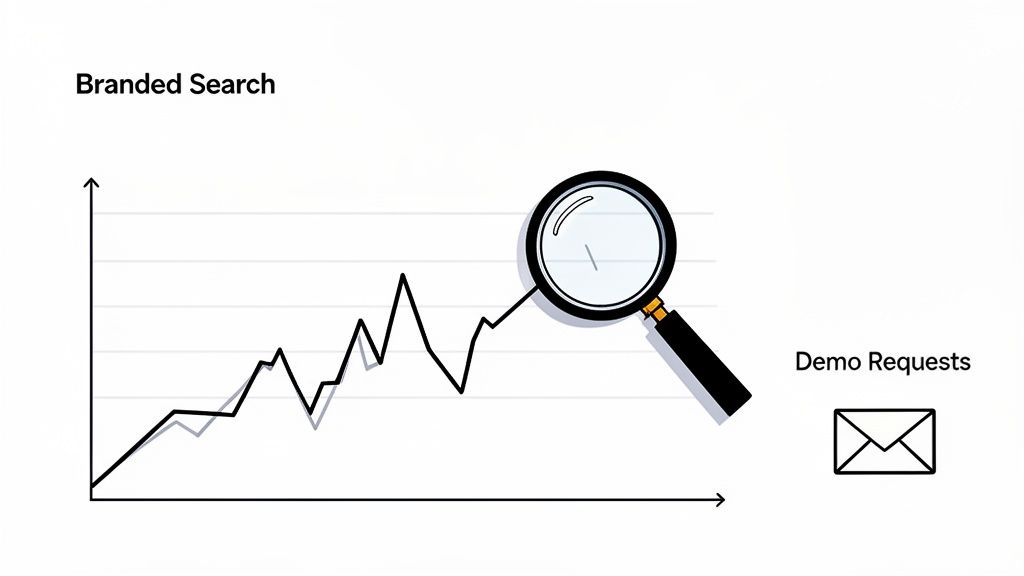
- Increased Branded Search Volume: Fire up Google Search Console and see if more people are searching for your company by name. This is one of the purest signals of growing brand awareness.
- Spikes in Direct Traffic: Line up your episode release dates with your website analytics. See those noticeable bumps in direct traffic on publish days? That's your podcast prompting immediate action.
- "How Did You Hear About Us?" Data: This is the undisputed champion of attribution. Add a simple free-text field to your demo and contact forms. When prospects start typing "Heard you on the podcast," you have stone-cold proof of its impact.
When you track both sets of metrics, you get the full picture. You can clearly show how your weekly podcasting efforts (leading indicators) are directly fueling meaningful business growth (lagging indicators).
Of course, your brand extends beyond digital channels. For insights on physical touchpoints, there are guides on choosing promotional products that build brand loyalty and deliver real ROI.
If you want to go even deeper on measurement, we've laid out more advanced frameworks and techniques in our ultimate guide to measuring B2B podcast ROI.
Got Questions? Let's Get Real.
So, you've seen the framework for building brand equity with a podcast. It's only natural for the "what ifs" and "how to's" to start bubbling up. Let's tackle the big questions that B2B leaders always ask when they're thinking about making a podcast the heart of their brand strategy.
How Much Time Does This Really Take?
I've seen this happen a hundred times: someone underestimates the true time suck of a podcast. They think it's just the one-hour recording. Wrong.
The real work is everything that happens after you hit "stop." For a solid weekly show, you're easily looking at 4-8 hours of additional work per episode.
That's time spent on editing, writing show notes that people actually want to read, creating social assets, and pushing the episode out everywhere. The only way to survive this is to lock down a repeatable, almost boringly simple podcast production workflow. If that sounds like a nightmare, many B2B teams just outsource it. They let a production partner handle the grunt work so they can focus on what matters: having incredible conversations.
How Do I Get Big-Name Guests on My Show?
Trying to land A-list guests isn't about flexing your download numbers. It's about answering their unspoken question: "What's in it for me?" These people guard their time like a dragon guards its gold.
Your pitch needs to cut right to the chase. Forget generic templates and focus on three things:
- Your Angle: What makes your show different from the ten other podcast requests they got this week? Spell it out.
- Your Audience Quality: Don't just say you have listeners. Emphasize who they are. A small, hyper-targeted audience of VPs at their ideal customer accounts is infinitely more valuable than a huge, generic one.
- The Pro Experience: Promise them you'll make them look and sound amazing. This means a dead-simple recording process and slick, shareable assets for their own channels.
A short, personalized pitch that respects their time and clearly benefits their brand will win every single time. And if you want to seal the deal, send them a resource on how guests can prepare. It shows you're a pro.
"A podcast is the only form of media where you can borrow the trust and authority of your guests and, through a long-form conversation, make it your own." - Tom Hunt, Founder of Fame
When Will I Actually See Results?
Look, if you're searching for a short-term hack, this isn't it. Building real brand equity is a long game. You'll get some nice anecdotal feedback early on, but the stuff that makes your CFO happy takes time.
Here's how to think about it. For the first 3-6 months, you'll see "leading indicators." Things like steady audience growth and people telling you they love the show. Those are your signs that you're on the right path.
The big wins—the "lagging indicators" like a jump in branded search or people on demo calls saying, "I know you guys from the podcast"—those usually start kicking in after 9-12 months of weekly episodes. Consistency is the whole game. It’s the engine that compounds trust over time, which is exactly how you build the brand equity you're after.
Ready to turn your company's expertise into your most powerful brand asset? At Fame, we help B2B companies launch and grow podcasts that build authority and drive real business results. Learn more about our B2B Podcast Agency.
