
A B2B team decides the company finally needs a podcast. The goal is clear enough. Build authority in the category, give subject-matter experts a stronger voice, and turn each episode into content sales and marketing can keep using. The hard part is choosing a partner that can tie the show to pipeline, not just produce clean audio.
That distinction matters in Minneapolis. Many local options are built around studio time, engineering, and recording support. Those services solve one part of the job, but they do not automatically give you a show concept that attracts the right buyers, a guest strategy that expands reach, or a distribution plan that helps the podcast contribute to demand generation.
This ranking uses a different filter. It looks past production quality alone and weighs agencies on the things B2B marketers must defend internally. Can the partner shape a show around a business audience? Can they repurpose episodes into assets your team will publish and sales will use? Can they help the podcast strengthen brand authority and support lead generation over time? That is also why remote-first specialists such as B2B podcast agencies with strategy and growth benchmarks belong in the same conversation as local Minneapolis studios.
Minneapolis still gives buyers a strong starting point. The city has real recording infrastructure, experienced production shops, and a healthy base of active shows. That makes it a good market for brands that want either an in-person studio partner or a hybrid model with local recording and outside strategic support.
Use a simple buyer's framework while reading the list. First, define the business outcome. Brand authority, qualified audience growth, customer marketing, or sourced pipeline. Second, decide whether you need a studio, an agency, or both. Third, ask how each firm handles distribution, repurposing, guest operations, and measurement after the recording is done.
That last step is where weak podcast programs usually stall. A polished episode is useful. A repeatable content engine is more valuable.
1. Fame
A familiar B2B problem starts here. The team launches a podcast, records a few solid interviews, then realizes no one owns guest flow, distribution, repurposing, or measurement against pipeline goals. The show exists, but it does not yet function as a marketing program.
Fame ranks first because it is built for that operating gap. It is a remote-first agency, not a Minneapolis studio, and that changes the buying decision. Companies that need a local room for an in-person recording day may prefer a studio partner. Companies that need strategy, production, promotion, and post-episode content tied to business outcomes will usually get more value from Fame's model.
Why it stands out for B2B teams
Fame is stronger on the parts of podcasting that B2B marketers struggle to maintain internally. Show positioning, guest management, content repurposing, publishing workflows, and distribution support all sit inside the same engagement. That matters because the recording itself is rarely the bottleneck. The bottleneck is turning each episode into something sales, content, and demand gen teams can use.
Its own agency roundup also reinforces the standard serious buyers should use. The comparison at B2B podcast agencies with strategy and growth benchmarks focuses attention on delivery models and growth accountability, not just editing quality. That is a more useful frame if you are comparing vendors based on audience growth, brand authority, and contribution to pipeline over time.
One practical advantage is clarity of scope. Buyers can review Fame's breakdown of what full-service podcast production services typically include and compare that against local studio-only offers. That makes trade-offs easier to spot before procurement starts.
- Best for: B2B SaaS, professional services, and enterprise marketing teams that want a podcast tied to brand and demand goals
- Strengths: Strategy plus execution, repurposing support, distribution planning, clear B2B focus
- Watch out for: Premium pricing and a remote-first delivery model may be a poor fit if your main requirement is local in-studio recording time
Visit Fame.
2. Studio Americana

Studio Americana is one of the stronger Minnesota options if your priority is polished audio and a mature production workflow. It sits closer to the production-specialist end of the spectrum than the demand-generation end, which makes it a solid choice for brands that already know what show they want to make.
That distinction matters. Some teams need a strategist. Others need a dependable production partner that can keep episodes consistent, on schedule, and professionally finished. Studio Americana fits the second group well.
Where it fits best
Its positioning around end-to-end podcast production, remote capture, editing, mastering, and publishing makes it practical for business podcasts with multiple stakeholders. The audiobook-grade workflow angle is especially relevant for teams that care about consistency across episodes and hosts.
What it appears to do well is operational polish. What you should verify in sales conversations is how much it supports audience growth, distribution planning, and KPI ownership beyond production delivery.
- Best for: Companies that already have a show concept and need a dependable production team
- Strengths: Strong editing discipline, remote capture support, consistent post-production quality
- Watch out for: If you need active audience development, ask exactly who owns promotion and performance targets
For buyers who want to pressure-test the difference between production support and broader growth support, this guide to podcast production services gives a useful framework.
Visit Studio Americana.
3. DevineFox Productions

DevineFox Productions is a good fit for brands that don't want the podcast to live in isolation. Its appeal is the combination of show development, production, and promotional content. That's valuable when your team wants one partner to help shape both the message and the rollout.
A lot of B2B podcasts fail because the episodes exist, but the surrounding campaign doesn't. Clips aren't published consistently. The launch lacks narrative. Guests don't get activated. Sales never uses the content. DevineFox's broader content orientation can help close that gap.
What to ask before signing
The agency looks strongest when the brief includes both production and social promotion. If your team needs a partner to help define the show, package it, and create supporting content around each episode, that's where it appears most useful.
If you're evaluating agencies in this lane, ask for examples of episode distribution plans, launch sequences, and how they repurpose interviews into assets that matter to marketing and sales. A studio can give you files. A stronger partner gives you a content system.
Buyers often over-focus on microphones and under-focus on message distribution. For B2B shows, the second problem is usually more expensive.
- Best for: Brands that want podcast production paired with social and rollout support
- Strengths: Messaging help, audio and video production, promotional content creation
- Watch out for: Request references and a clear KPI plan, especially if growth outcomes matter
For a benchmark on what specialized promotion can look like, review podcast marketing services.
Visit DevineFox Productions.
4. MN Podcast and Content Studio

A common B2B problem starts after the recording ends. Marketing wants clips for LinkedIn, sales wants short customer proof points, and leadership wants polished video. If the studio only hands over raw files, your team still has to build the content machine internally.
MN Podcast and Content Studio stands out for buyers who want a simpler operating model. Public pricing, defined packages, and video-oriented deliverables make it easier to plan production without a long agency sales process. For teams launching a show with limited internal bandwidth, that clarity can reduce decision friction and speed up approval.
The bigger question is whether the studio fits your growth model.
MN Podcast and Content Studio looks strongest for companies using a podcast as a recurring content source, not just an audio series. The value is less about having a nice set and more about turning one executive interview into clips, social posts, and usable video assets. That approach matches how many B2B teams now justify podcast spend. They need content that supports brand authority and keeps distribution active between episodes. If that is your goal, this guide on the business benefits of podcasting for brands is a useful reference point.
One caution. Visible packages help with budgeting, but they do not always tell you how much strategic support is included. Buyers should ask who owns episode planning, audience targeting, guest selection, and repurposing standards. A studio can improve execution quality. Pipeline impact usually depends on the system around it.
- Best for: B2B teams that want predictable studio pricing and video-first content outputs
- Strengths: Transparent packages, live editing, multiple set options, social-ready deliverables
- Watch out for: Confirm what is included beyond production, especially if you need audience strategy or demand generation support
If your team is still comparing in-house setup against studio production, this breakdown of podcast equipment for beginners helps frame the tradeoff.
Visit MN Podcast and Content Studio.
5. Twin Cities Podcast Studio
Twin Cities Podcast Studio is built for teams that want a predictable, rental-plus-services model. If you don't need a full strategic agency and want reliable recording support, an engineer in the room, and straightforward add-ons, this is a sensible option.
That makes it especially useful for companies testing a show before committing to a larger engagement. You can keep the operating model lean while still producing something that looks and sounds professional.
Best use case
This studio is strongest when your team already owns the content strategy. Maybe marketing knows the audience, sales knows the common objections, and leadership already has the host lined up. In that scenario, a flat-rate studio partner can be exactly the right amount of support.
Where teams get into trouble is assuming studio logistics equal podcast strategy. They don't. If nobody owns guest targeting, distribution, promotion, and episode positioning, the show will probably stall after the early enthusiasm fades.
- Best for: Early-stage company podcasts and lean marketing teams with internal strategy ownership
- Strengths: Clear pricing, engineered sessions, editing and clip support, easy booking
- Watch out for: You may still need a separate partner or internal owner for growth and operations
If you're making the internal case for launching, this overview of the benefits of podcasting can help frame the business value.
Visit Twin Cities Podcast Studio.
6. Undertone Music, Inc.

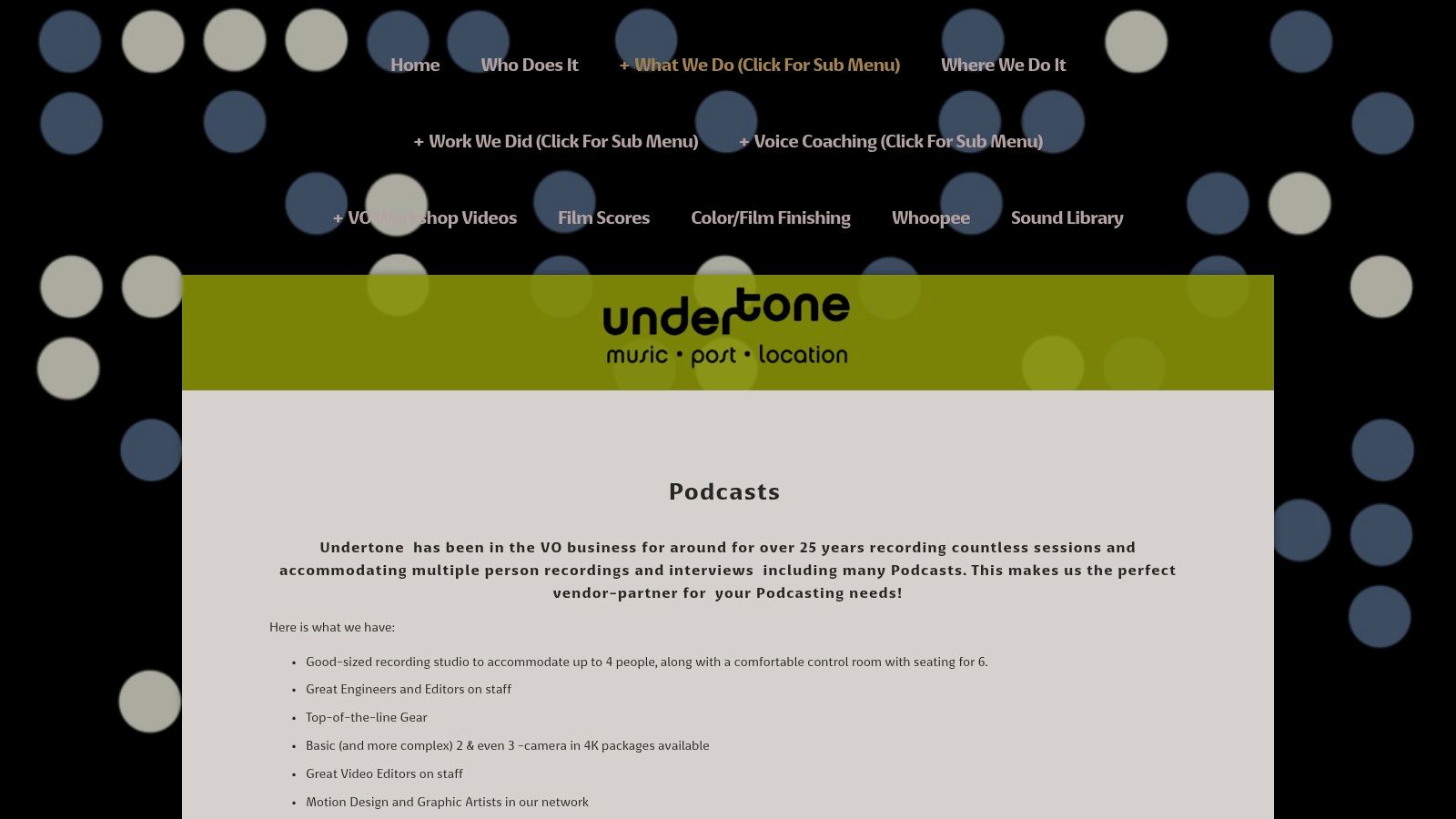
A common B2B problem looks like this: the team has willing executives, solid customer insight, and budget for recording, but the show still needs to sound credible enough to represent the brand well. Undertone Music fits that situation. Its background in voice and audio production suggests a company built around technical execution, which matters when the format includes executive interviews, roundtables, or other sessions where weak audio can undermine authority fast.
That production depth is the main reason to consider them. If your brief includes polished recording, multi-person sessions, and video support alongside the podcast, Undertone appears better suited than a basic room-rental option.
The buyer question is not whether they can record a professional show. It is whether your company also needs help turning that show into pipeline.
For B2B teams, that distinction matters. A production-led partner can improve how the podcast looks and sounds. It will not automatically solve guest strategy, audience development, repurposing for demand gen, or reporting back to marketing leadership. Companies that already have a content leader or demand gen owner in place can work well with this model. Teams hoping the studio will also drive growth should verify exactly who owns promotion, distribution, and performance tracking.
Where Undertone fits best
Undertone makes the most sense for brands that see the podcast as a premium content asset and want high production standards from day one. It is also a practical option if you want related post-production support under one roof, especially for shows that may expand into broader video or branded content work.
- Best for: B2B brands with internal marketing strategy and a high bar for production quality
- Strengths: Experienced audio foundation, support for multi-person recording, likely fit for video-adjacent production needs
- Watch out for: Strategy, distribution, and revenue attribution may need to stay with your internal team or another partner
Visit Undertone Music, Inc.
7. Babble-On Recording
Babble-On Recording makes sense for teams that care about voice performance, post-production detail, and remote guest recording quality. Its commercial audio pedigree is the draw here. For executive-led podcasts, that can matter more than people expect.
A lot of business shows live or die on intelligibility, pacing, and whether remote guests sound credible. Babble-On appears well suited to that part of the job, especially if your format involves high-value interviews with people dialing in from different locations.
The real trade-off
This is not the obvious pick if you want one agency to own strategy, growth, and content distribution. It's a better fit if your team already has a strong editorial plan and needs a specialist to make the actual listening experience feel premium.
That can still be the right decision. Some companies already have internal marketers who can handle positioning and promotion. In those cases, pairing internal strategy with a boutique audio post house often works well.
- Best for: Executive interviews, remote guest shows, and brands that value broadcast-grade sound
- Strengths: Audio craft, remote patching capability, boutique engineering support
- Watch out for: Likely requires outside help for broader marketing operations
Visit Babble-On Recording.
8. MBC Multicast Studio
MBC Multicast Studio is attractive for brands that want podcasting and livestreaming from one provider. If your content plan includes webinars, event-style recordings, or product-launch conversations that need both live and on-demand versions, this setup can be efficient.
That web-first orientation is useful. A B2B team doesn't always need a pure podcast specialist. Sometimes it needs a production partner that can support the whole executive-content environment.
Where it can work well
MBC looks strongest for companies that think in campaigns rather than isolated episodes. A founder conversation can become a livestream, then a podcast episode, then short clips for social and email. That's a sensible production model when your team wants to maximize each recording session.
The question to ask is whether the studio also helps with audience development after the files are delivered. Production breadth is clear. Strategic growth ownership appears less central.
- Best for: Brands combining podcasts with livestreams or event-driven content
- Strengths: Purpose-built studio, web-content orientation, multi-camera production
- Watch out for: Clarify who handles promotion, distribution, and show growth
Visit MBC Multicast Studio.
9. Oberg Media
Oberg Media is better understood as a video production company that can support podcasting than as a podcast-native agency. That's not a criticism. For some B2B teams, it's exactly the right model.
If your real goal is a visually strong executive show for YouTube, LinkedIn, sales pages, and event screens, a video-led partner can outperform an audio-first studio. The podcast then becomes one part of a broader media asset, not the center of the strategy.
Best fit for visual brands
This kind of partner tends to work well when the host is comfortable on camera, the set matters, and you need on-location or multi-camera production. It's especially useful for firms that already invest in brand video and want the podcast to align with that standard.
Where the fit weakens is in audio-only growth strategy, feed optimization, guest operations, and long-term audience development. Those functions typically need more podcast-specific rigor.
- Best for: B2B brands treating the show as a video-first content property
- Strengths: Visual storytelling, polished filming, compatibility with broader video campaigns
- Watch out for: Less specialized on podcast distribution and growth mechanics
Visit Oberg Media.
10. Relic Agency
Relic Agency belongs on this list because some companies don't need a podcast specialist first. They need a content strategy partner that can decide whether the podcast should exist at all, and how it should fit into the rest of the brand system.
That's a different buying motion. Instead of asking, “Who can produce our show?” the better question becomes, “How should this show support our category story, sales narrative, and executive voice?” Relic appears better suited to that strategic layer than a pure studio would be.
When strategy beats specialization
This can be a smart fit if your marketing team is reworking positioning, building a content engine, or trying to create consistency across blog, email, social, and long-form media. A podcast in that context shouldn't be treated as an isolated channel.
The tradeoff is specialization depth. A broad brand agency may not offer the same podcast-specific operational precision as a dedicated production and growth partner. If podcasting is central to the plan, that distinction matters.
- Best for: Companies that need podcasting integrated into a larger brand and content strategy
- Strengths: Big-picture planning, brand narrative alignment, multi-channel content thinking
- Watch out for: Production workflow may be less specialized than dedicated podcast shops
Visit Relic Agency.
Top 10 Minneapolis Podcast Agencies Comparison
| Provider | Implementation complexity 🔄 | Resource requirements ⚡ | Expected outcomes 📊 | Ideal use cases 💡 | Key advantages ⭐ |
|---|---|---|---|---|---|
| Fame | High, end-to-end B2B processes + proprietary platforms | Premium budget; stakeholder time; platform integration | 📊 Pipeline-driven growth; guaranteed ≥10% MoM downloads; measurable ROI | B2B leaders using podcasting as a core growth engine | Performance-driven B2B focus; integrated tech stack; growth guarantee |
| Studio Americana | Moderate, standardized studio & audiobook-grade workflows | Experienced editors; remote kits; studio access | 📊 Consistent broadcast-quality audio and polish | Organizations prioritizing high production quality (business/tech) | Audiobook-grade QC; consistent post-production craftsmanship |
| DevineFox Productions | Moderate, concept-to-distribution with marketing workflow | Custom packages; collaboration on messaging and rollout | 📊 Turnkey podcast + social assets; marketing-aligned launches | Brands wanting combined podcast + social promotion packages | Creator-to-brand services with messaging and promotional support |
| MN Podcast and Content Studio | Low–Moderate, studio-centric live editing workflows | Transparent package selection; studio sessions; video tools | 📊 Fast turnaround; ready-to-post video-first deliverables | Teams needing clear pricing and video-first repurposing | Public pricing; live editing; strong short-form video workflow |
| Twin Cities Podcast Studio | Low, hourly rentals with engineer-on-session | Predictable flat fees; on-site engineer; portable kits | 📊 Quick delivery (e.g., 48h); predictable production costs | Teams seeking engineer-led sessions without building studio | Clear pricing; engineer included; fast turnaround |
| Undertone Music, Inc. | Moderate–High, full post & multi-camera video capabilities | Veteran engineers; high-end gear; motion/color teams | 📊 Broadcast-quality audio/video; high production value | Brands needing integrated audio, video, and motion post services | 25+ years experience; integrated post-production services |
| Babble-On Recording | Moderate, boutique audio post with studio patching | Broadcast-grade signal chain; global patching capability | 📊 Pristine voice-over quality; reliable remote guest capture | B2B teams prioritizing high-fidelity voice and remote guests | Ad-industry pedigree; award-winning audio craft |
| MBC Multicast Studio | Moderate, podcast + livestream + multi-camera workflows | Multi-camera rigs; livestream tech; studio facility | 📊 Integrated podcast and livestream content packages | Brands wanting combined podcast + livestream production | Purpose-built web-content studio; strong livestream expertise |
| Oberg Media | Moderate, video-first production with audio support | Full video production crew; location capabilities | 📊 Visually compelling video podcasts aligned with campaigns | B2B brands treating video as primary medium | Strong visual storytelling; corporate video integration |
| Relic Agency | Moderate–High, strategic content planning across channels | Marketing team; cross-channel coordination; strategy time | 📊 Cohesive brand-aligned podcast supporting marketing goals | Companies needing podcast within broader content strategy | Strategic, big-picture approach; multi-channel alignment |
Next Steps: Launching Your Minneapolis-Based Podcast
A common B2B mistake looks like this: the team approves a podcast because competitors have one, records a few polished episodes, then struggles to connect the show to pipeline, executive visibility, or usable sales content. The problem usually is not effort. It is choosing a production partner before choosing the business job the show needs to do.
That is the lens to use here. A Minneapolis podcast agency is not only a studio or an editing resource. It is part of your operating model for content, distribution, and measurement. If the goal is executive thought leadership, a local production partner may be enough. If the goal is lead generation, category authority, or a repeatable content engine for sales and marketing, the bar is higher.
Minneapolis is a credible place to build from because local business organizations already use podcasts as ongoing communication channels. On its own page for The Minnesota Business Podcast, the Minnesota Chamber presents the show as a source for business and public affairs news. That matters for adoption. Prospects, executives, and internal stakeholders are less likely to treat podcasting as an experiment when they already see it used in the market.
Agency supply is still fairly tight. According to AgencyList's Minneapolis audio and podcast ad agency directory, there are 8 Minneapolis audio and podcast ad agencies listed. That makes the evaluation process more important. Buyers often need to compare local studios, hybrid production shops, and remote B2B specialists that can support strategy, promotion, and measurement.
Use a buyer's framework that goes past recording quality:
- Strategy: Will the agency help define audience, positioning, format, and guest criteria, or will they only execute your brief?
- Distribution: Do they publish, repurpose, and promote the show, or does delivery stop at edited files?
- Workflow: Can they handle scheduling, prep, production, editing, approvals, and publishing without adding work to your team?
- Measurement: Do they report on business outcomes such as reach among target accounts, content reuse, and influence on pipeline, or only on downloads and completion rates?
- Adaptability: Can they adjust if the show needs a tighter format, stronger guests, or a video-first approach?
Local presence is one variable, not the decision. If your executives need recurring in-person recording days, a Minneapolis studio can make operations easier. If your host, guests, and audience are spread across markets, the better fit may be a remote partner with stronger B2B strategy and distribution support.
For teams that want a B2B-specific option, Fame is one relevant agency to consider because its model centers on strategy, production, and growth support rather than studio access alone.
If you want a podcast partner that's built for B2B outcomes, not just production delivery, Fame is worth a closer look. It's a strong fit for teams that want help with strategy, guest-led authority building, production, and distribution in one system.
