
Your B2B podcast needs more than a mic and a mission.
Six months in, the show often looks polished on the surface. The cover art is strong. The host is credible. The audio is clean. But downloads stall, sales doesn’t care, and the podcast starts feeling like an expensive brand exercise with no commercial payoff.
That usually isn’t a content problem. It’s a partner problem.
A strong New York podcast agency shouldn’t just record interviews and send back edited files. It should help you shape positioning, book the right guests, repurpose episodes into usable campaign assets, and connect the show to real growth goals. For B2B teams, that means pipeline influence, executive authority, category education, and support for broader actionable B2B demand generation strategies.
New York is a serious market for podcast production. The city’s ecosystem expanded fast, with the top four NYC podcast networks growing from approximately 115 podcasts in 2015 to almost 200 by 2017, according to the NYC Mayor's Office of Media and Entertainment podcast report. That density is useful for buyers. It also makes the search noisy.
If you’re trying to find the best New York podcast agency, the smartest move is to separate production vendors from growth partners. Some shops are excellent studios. Some are strong creative teams. A smaller group understands B2B distribution, attribution, and executive-led content.
Below are the agencies I’d shortlist, with the trade-offs that matter when you’re choosing one.
1. Fame
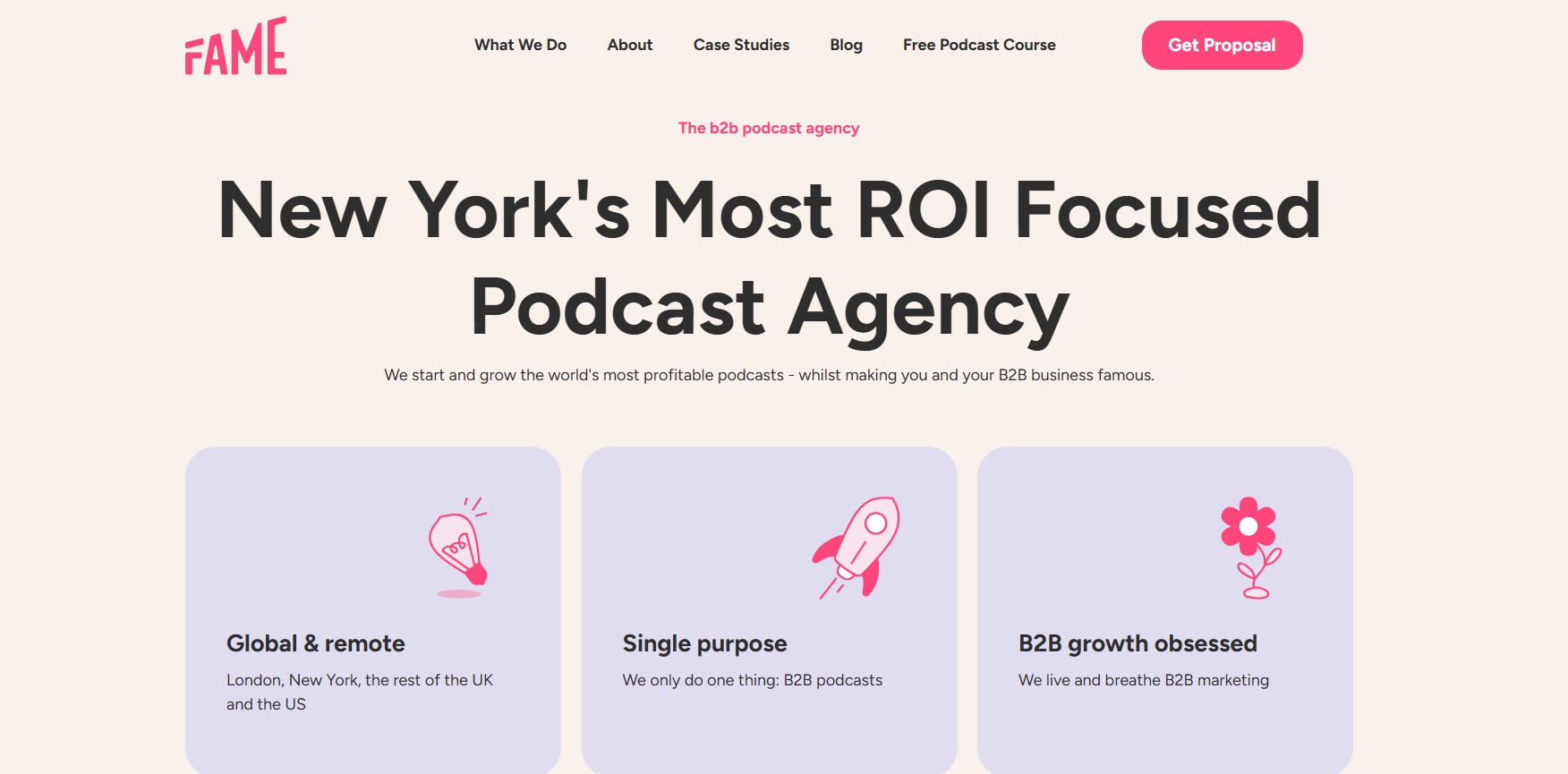
A common buying scenario looks like this. The CMO wants executive content that builds authority. Sales wants something they can send to prospects. The content team wants one recorded conversation to feed email, social, paid, and website channels. In that situation, Fame is usually one of the first agencies I’d assess.
They position podcasting as a B2B growth program, not a studio service. That shows up in how they frame strategy, guest selection, distribution, and reporting. For buyers, that distinction matters because polished production is easy to find in New York. An agency that can connect the show to demand generation, audience growth, and usable campaign assets is harder to find.
Why Fame ranks high
Fame is a strong fit for B2B teams that need a show to serve multiple jobs at once.
- B2B specialization: Their model is built around business audiences, executive positioning, and category education.
- Full program support: Strategy, guest booking, production, promotion, and repurposing sit under one team.
- Content repurposing systems: Their workflow is designed to turn interviews into clips, written content, and sales-friendly assets.
- Performance orientation: They talk like operators who expect the show to contribute to pipeline influence and brand authority.
I’d also review their explanation of what a B2B podcast production agency should do. It’s useful buyer-side material because it clarifies the core decision: are you hiring a team to produce episodes, or a team to build a repeatable content engine around a show?
Buyer test: Ask how they turn one recorded episode into assets your SDRs, AEs, paid team, and content marketers will use within the same quarter. If the answer stays at editing, publishing, and basic clips, you’re looking at a production vendor.
Best fit and trade-offs
Fame fits companies that want clear structure, strong operator support, and a podcast tied to business goals. That usually means B2B SaaS, agencies, consultancies, and professional services firms with executive subject matter experts.
The trade-off is style and process. Teams looking for a loose creative partnership or a purely editorial show may find the model more performance-driven than they want. I wouldn’t treat that as a weakness. I’d treat it as a selection issue. If leadership will ask how the podcast supports revenue, this posture is a good match.
Website: Fame
2. The Hangar
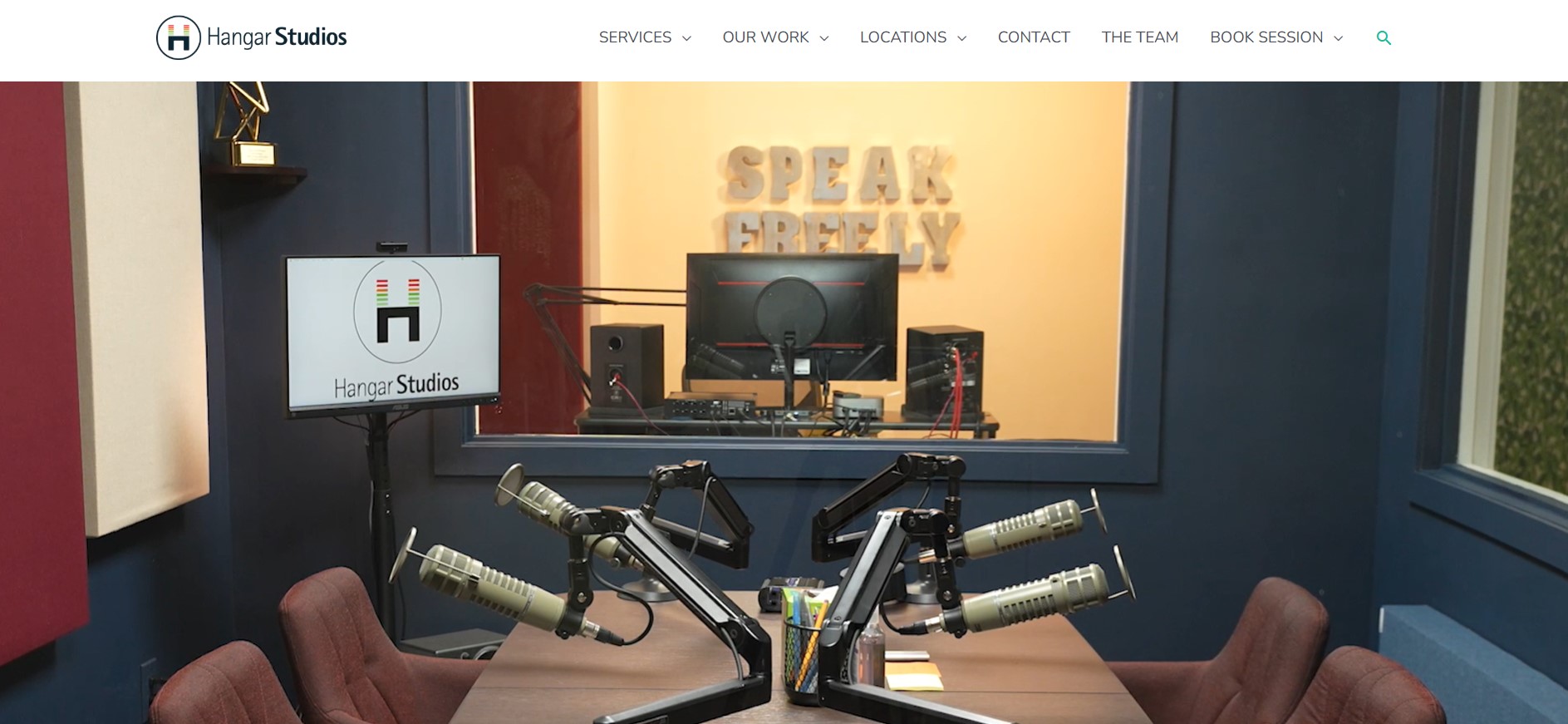
Your VP agrees to record in person. The guest can make one 45-minute window in Midtown. Legal wants a clean process, marketing wants the footage repurposed fast, and nobody on your team wants to coordinate a producer, studio, videographer, and editor separately. That is the buying situation where The Hangar Studios starts to make sense.
They are a practical choice for teams that value production control and in-person execution more than a built-in growth engine. If your show depends on getting executives and customers into a room, a dependable NYC studio partner can remove a lot of operational drag.
Where The Hangar works well
The Hangar is strongest when the core problem is execution.
They offer studio-based and remote production support, which suits branded shows led by a host, founder, or subject matter expert who records regularly in New York. For a B2B marketing team, that can be enough. A missed recording day costs more than a slightly less ambitious strategy deck.
Here’s why buyers usually shortlist them:
- Midtown convenience: Easier to get executives, clients, and local guests to show up on time.
- Hands-on production support: Useful when your internal team wants the show done well without managing every recording detail.
- One production workflow: Strategy, recording, editing, and publishing can run through one partner instead of several vendors.
A key evaluation point is what happens after the episode is finished. The Hangar appears more production-led than demand-gen-led, so I would ask direct questions about audience growth, distribution, and reporting. Ask who owns the post-launch plan. Ask what metrics they expect a B2B team to track. Ask how they support the show beyond delivery.
If you need a partner built around business outcomes, it helps to compare their model against what a B2B podcast production agency is supposed to handle beyond recording and editing.
Best fit and caution
The Hangar fits companies that already know what show they want to make and need a reliable team to produce it well. It is also a smart option when leadership prefers in-person recording and your buyers, customers, or partners are frequently in Manhattan.
The trade-off is strategic depth. I would not assume strong studio operations automatically translate into strong audience development or pipeline impact. Pricing also appears custom, which means you may not get budget clarity until later in the sales process.
Buyer test: Ask, “What do you own after the file is edited?” A strong answer should cover distribution, content repurposing, performance reporting, and how the show supports marketing or sales goals. If the answer stays focused on production logistics, you are hiring a production partner, not a growth partner.
Website: The Hangar Studios
3. Sorrentino Media

Sorrentino Media becomes interesting when your problem isn’t just production. It’s executive readiness.
A lot of B2B podcasts underperform because the spokesperson isn’t comfortable on mic. They ramble, default to corporate phrasing, or struggle to land a point cleanly in an interview. Sorrentino’s mix of podcast production, media training, and on-air coaching can solve that faster than another round of editing.
Why buyers choose them
This is one of the better options for companies that want coaching wrapped around the show.
- Media training: Useful for founders, subject matter experts, and client-facing executives.
- Hybrid capabilities: Podcasting, livestreaming, and event capture can support broader comms needs.
- NYC access: In-person sessions are easier to run when leadership is based in Manhattan.
That cross-training angle matters. In B2B, the host often doubles as a public-facing spokesperson. If the same partner can improve interview presence and produce the show, the output usually gets sharper.
I’d still pressure-test how they think about commercial outcomes. If revenue impact matters, ask them to explain their framework for B2B podcast agency ROI in practical terms, even if they use different language.
Teams often overvalue studio quality and undervalue host coaching. In practice, a clear, disciplined host improves the show more than a more expensive room.
Best fit and caution
Sorrentino Media is a smart choice for companies with strong executive talent that needs polish, confidence, and media discipline.
The trade-off is focus. Podcasting is part of a broader service mix, so if you want a specialist whose entire operating system is built around podcast growth, you may want a narrower partner.
Website: Sorrentino Media
4. Pod People

Pod People is the kind of agency I’d look at when speed and staffing flexibility matter as much as creative quality.
Their model is useful for enterprise teams that need to launch branded audio without building an internal bench of producers, writers, and editors. Instead of hiring around the project, you tap into a vetted network that can scale up or down as needed.
What makes Pod People useful
The strength here is resourcing.
- Turnkey branded production: Helpful for busy marketing teams that need outside ownership.
- Flexible talent network: Producers, editors, and writers can be brought in quickly.
- Multi-market operations: Useful if your leadership and guests aren’t all in one city.
That flexibility can be a real advantage when timelines are tight or multiple stakeholders are involved. It also means the exact workflow can vary based on who’s staffed on your account. That isn’t necessarily a problem, but it does make process consistency something to ask about up front.
If audience growth is part of your mandate, don’t stop at “we can produce and launch.” Ask what happens after publishing. Their model pairs best with a buyer who already understands podcast marketing services and knows what to demand from an agency.
Best fit and caution
Pod People fits brand teams that need turnkey execution and flexible staffing.
The downside is that enterprise-scoped service models can feel less standardized from account to account. You’ll want clarity on who owns strategy, who owns distribution, and how success gets measured.
Website: Pod People
5. MouthMedia Network

MouthMedia Network has a profile that makes sense for business-focused shows, especially in corporate communications and professional services.
Some agencies feel optimized for creative storytelling. MouthMedia feels more aligned to companies that want a controlled, business-oriented show with a stable production environment and hosting support.
Where it can be a strong fit
Their mix of custom development, production, and enterprise-style hosting is useful for teams that care about governance and visibility.
- Business-oriented positioning: Better fit for branded and corporate communication use cases.
- Hosting support through Omny and Triton: Attractive for teams that want a more established analytics environment.
- Experienced production setup: Helpful if internal comms or marketing wants a dependable external partner.
This matters for companies where the podcast serves more than one audience. Maybe marketing wants thought leadership, leadership wants executive visibility, and comms wants message control. Agencies like MouthMedia can work well in that structure because they don’t approach the podcast purely as a creative artifact.
Best fit and caution
I’d look at MouthMedia if your show sits close to enterprise communications, category education, or professional services branding.
The caution is simple. Their positioning emphasizes production and hosting more than paid growth or aggressive audience acquisition. If the board-level question is “how will this contribute to pipeline,” make sure they can answer that in detail before moving forward.
Website: MouthMedia Network
6. Gotham Production Studios
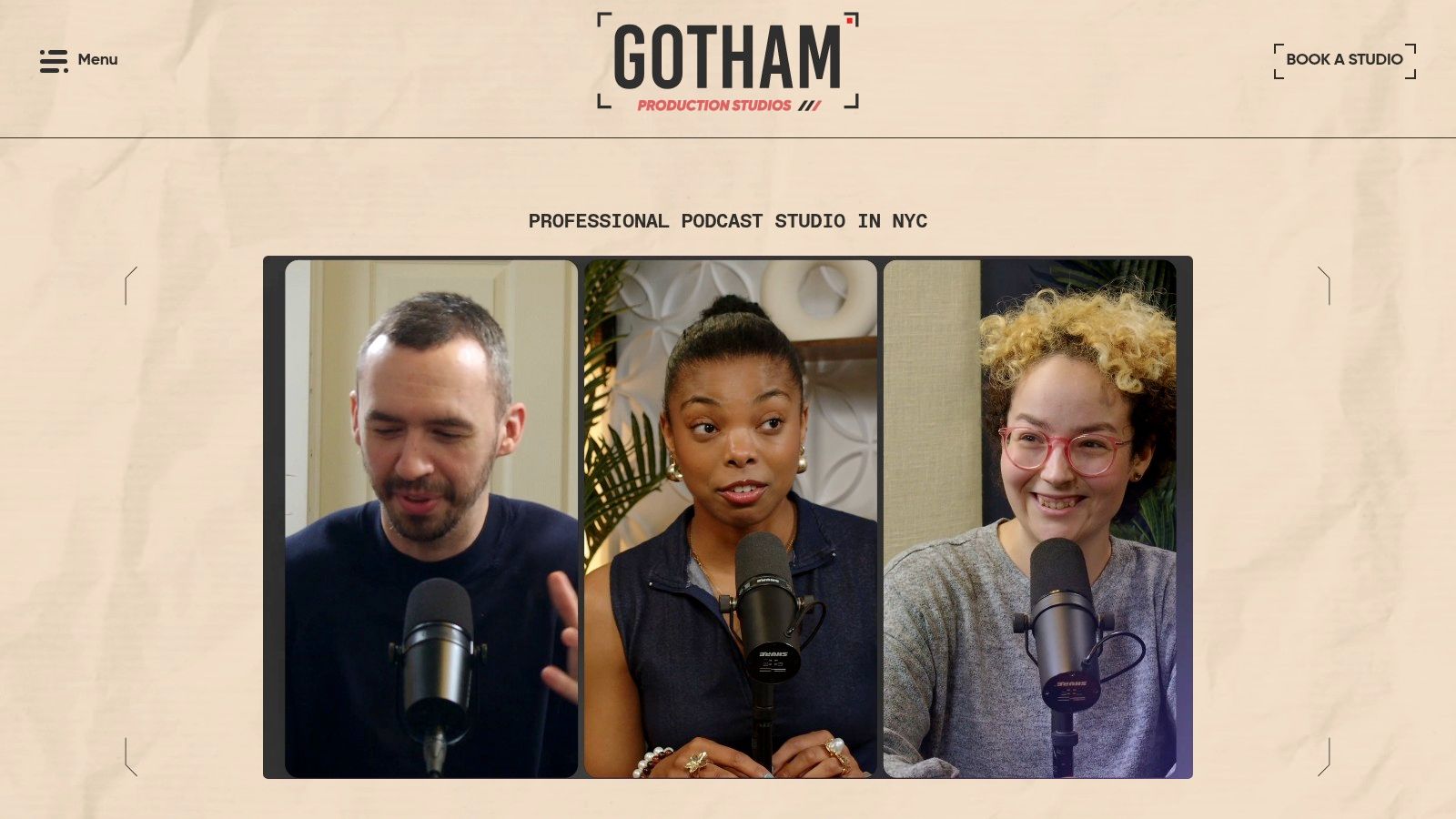
A common buying mistake is treating a studio vendor like a strategy partner. Gotham Production Studios sits firmly on the production side of that decision.
That can be a good thing. If your B2B team already has a clear show thesis, an internal owner, and a realistic promotion plan, Gotham can remove a lot of execution drag. If you are still deciding who the show is for, what the format should be, or how episodes connect to pipeline, you need a more strategic option, such as a New York podcast agency with stronger program support.
Why buyers shortlist Gotham
Gotham is easier to evaluate than many agencies because the offer is concrete. You are buying studio access and production support, not a broad promise about brand growth.
- Dedicated podcast rooms: Useful for batching executive interviews or customer conversations.
- Audio and video capture: Helps teams turn one recording session into a full content package.
- Posted starting rates: Makes procurement and internal budget conversations faster.
- Midtown location: Practical for guest scheduling, especially with Manhattan-based teams.
I put real value on visible pricing. It signals that the provider understands a straightforward buyer case. Sometimes the brief is simple. Record cleanly, edit reliably, and make the experience easy for busy guests.
Best fit and caution
Gotham fits in-house teams that want control. Your team owns strategy, prep, guest outreach, publishing, and promotion. Gotham handles the production environment well.
The red flag to watch for is overestimating what a studio partner will solve. Ask direct questions before signing: Who is responsible for show strategy? Who owns distribution? Who defines success after launch? If the answers all point back to your internal team, that is fine, but only if you planned for it.
Website: Gotham Production Studios
7. The Podcast NYC
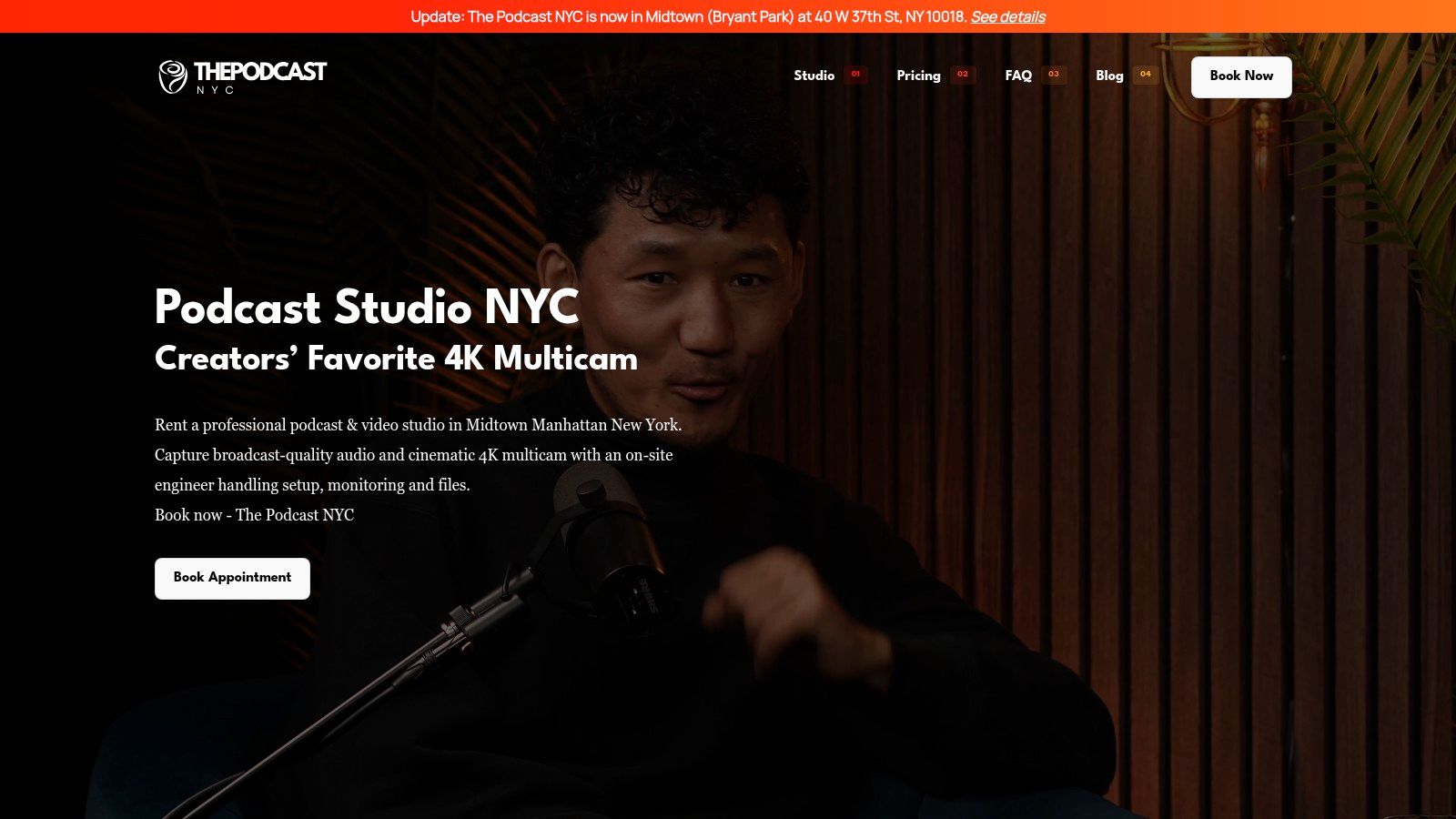
The Podcast NYC is a practical option for brands that want a polished studio environment without building in-house production capacity.
Its appeal is speed. If your team already has a host, rough format, and booking plan, a purpose-built Midtown studio can help you get moving without overcomplicating the setup.
Where it shines
The studio-centric model works best when the bottleneck is capture, not strategy.
- 4K multi-camera setup: Good for teams leaning into video podcast clips.
- Bryant Park area location: Convenient for guests coming from Manhattan offices.
- Post and clips support: Useful if your marketing team needs lighter outsourced help.
- Fast launch potential: Helpful when the internal brief is “start recording soon.”
For many B2B teams, that’s enough. Especially if demand gen, content, and comms already know how they’ll use the material.
If your team already has a clear distribution plan, a studio-first partner can work well. If you don’t, publishing more episodes won’t fix the problem.
Best fit and caution
The Podcast NYC fits companies that want to host the show themselves while outsourcing production logistics.
The main weakness is that this model usually puts more burden on your internal team to handle strategy, promotion, and attribution. If you need one partner to own all of that, look elsewhere.
Website: The Podcast NYC
8. Podmuse

Podmuse is one of the more interesting picks on this list because it combines production with podcast advertising and growth support.
That combination can be valuable for marketers who don’t want the usual handoff problem. One team produces the show, another team buys media, and nobody really owns the full audience acquisition picture. Podmuse is built more directly around that intersection.
Why Podmuse deserves a look
Their model makes sense if you expect paid distribution to be part of the plan.
- Branded production plus ad strategy: Better alignment between content and audience growth.
- Programmatic and host-read planning: Useful if your team already thinks in channel mix terms.
- Audience growth focus: More performance-oriented than studio-only vendors.
For B2B marketers, this can create cleaner coordination. Production decisions affect promotion, and promotion affects what gets prioritized in episode structure and guest selection.
There’s also a broader market reason this matters. Agencies like Podmuse are operating in an ecosystem where 50+ ad networks are part of the New York podcast agency landscape, which makes media relationships and distribution fluency more relevant than they were a few years ago.
Best fit and caution
Podmuse is a good fit for teams that already know they’ll need paid support to build audience momentum.
The caution is vetting. Because interview booking and niche audience quality can vary widely, I’d want to see exactly how they approach audience targeting for your category before committing.
Website: Podmuse
9. JAR Audio
JAR Audio is the strategy-heavy option for buyers who don’t want to rush into production before the show has a clear reason to exist.
That sounds obvious, but a lot of companies skip this step. They decide to launch a podcast because competitors have one or because leadership likes the format. JAR tends to be stronger where audience definition, concept development, and narrative framing need real work before anyone records.
Why buyers choose JAR
JAR provides value:
- Strong upfront strategy: Better for teams still refining audience, premise, and angle.
- Branded content experience: Useful when the show needs to reflect a broader brand story.
- End-to-end support: Good for companies that want continuity from strategy through production.
That strategy-first approach often creates better long-term shows. It can also slow launch timelines. In my experience, that trade-off is worth it only if the business intends to invest in the show beyond a handful of episodes.
Best fit and caution
JAR Audio fits brands that care a great deal about positioning, audience resonance, and quality.
The trade-off is speed and likely budget. If your brief is “we need a credible executive show live fast,” they may be more process-heavy than you need. If your brief is “we need a show with a clear strategic role in the brand,” they’re a much better fit.
Website: JAR Audio
10. Pacific Content
Pacific Content is the premium narrative choice on this list.
If your company wants a show that feels editorially ambitious and highly produced, they’re one of the names that comes up quickly. Their work tends to appeal to brands that want something more documentary in feel and more crafted than a standard interview-led B2B format.
Where Pacific Content excels
They’re strongest when storytelling quality is the priority.
- Narrative format strength: Better for documentary-style branded series.
- High production standards: Strong fit for flagship branded audio projects.
- Audience development included: Helpful when the show needs editorial care plus launch support.
This kind of work can be powerful for brand building. It’s also a different commercial model from a recurring B2B interview show. Narrative series usually require more client input, more planning, and a stronger internal appetite for story development.
Best fit and caution
Pacific Content makes sense for companies that want prestige-level branded storytelling and can support the process.
The caution is fit. If what you really need is a repeatable B2B thought leadership engine that produces regular conversations, clips, and sales-adjacent content, this may be too heavy a lift for the outcome you’re after.
Website: Pacific Content
11. Lower Street
Your CMO is in New York. Your subject matter experts are split across Boston, Austin, and London. Your guest list changes every week. In that setup, a local studio matters less than an agency that can run a disciplined remote process and still produce a show that sounds polished.
That is the case for considering Lower Street.
They tend to fit B2B teams that want more than editing support. The appeal is the operating model. They can help shape the show, manage production, and support distribution without requiring everyone to show up in Manhattan for recording day. For a lot of in-house marketers, that is a practical advantage, not a compromise.
Why Lower Street makes sense for some buyers
I’d put them on the shortlist when the primary buying question is operational fit.
- Strong B2B fit: Better suited to SaaS, tech, and business-focused brand shows than entertainment formats.
- Connected service scope: Strategy, production, promotion, and reporting can sit under one partner.
- Distributed recording model: A good match for remote teams, executive hosts, and non-local guests.
That combination matters if the podcast needs to feed a broader content engine. A remote-first agency can be a better choice than a New York studio if your team wants consistent publishing, usable clips, and less calendar friction.
Best fit and caution
Lower Street is a strong option for B2B brands that care more about process, positioning, and repeatability than physical studio access.
The trade-off is straightforward. If your leadership team wants an in-person Manhattan recording experience, or if studio presence is part of the internal buy-in, another agency on this list will likely be easier to manage. If remote recording is acceptable, I would ask sharper questions in the sales process: Who owns episode strategy, how they prep executive hosts, what their repurposing workflow looks like, and how they report business impact beyond downloads.
Website: Lower Street
Top 11 New York Podcast Agencies Comparison
How to Choose Your Agency A 3-Step Buyer's Guide
Finding the right partner from this list depends on your actual goal, not the prettiest website or the nicest studio photos.
I’ve seen teams waste months because they bought for convenience instead of outcome. They chose the local studio, got clean episodes, and only later realized nobody had built a growth plan around the show. That’s how a podcast becomes a vanity project.
1. Define your why
Before you take a single sales call, write down the primary KPI.
Maybe the show needs to help generate qualified pipeline. Maybe the core task is to enhance your CEO’s influence in a narrow market. Maybe you need a category education asset that sales can reuse for months. Those are different jobs, and they point to different agency types.
If pipeline matters most, I’d bias toward a B2B specialist like Fame. If brand storytelling is the center of the brief, Pacific Content is a better conversation. If you mainly need a studio and smooth in-person logistics, The Hangar Studios or Gotham may be enough.
Don’t let an agency define success for you after the engagement starts. That’s backwards.
2. Ask harder questions
Most agency calls sound great in the first half hour. The trick is getting past polished language and into operating reality.
Ask these questions directly:
- Business outcome question: Walk me through a B2B client success story. What business metrics mattered beyond downloads?
- Distribution question: What specific actions do you take to promote a new episode after it’s published?
- Repurposing question: How do you turn one recording into assets for social, email, sales, and paid channels?
- Recovery question: If growth stalls after a few months, what changes do you make?
Then listen for specificity.
A strong agency will talk about audience targeting, guest strategy, channel repurposing, reporting cadence, and what they’d adjust if the show underperforms. A weak one will keep circling back to production quality.
The best partners talk more about your buyer, your category, and your distribution plan than they do about microphones.
3. Watch the red flags
A few warning signs come up again and again.
- They over-index on craft: Great audio matters. It doesn’t replace a growth strategy.
- They can’t speak B2B: If they only discuss downloads and aesthetics, they may not understand pipeline-driven content.
- They promise outcomes without a method: Vague ranking claims are a bad sign.
- They have no repurposing system: If your team only gets episodes, you’re leaving value on the table.
- They don’t challenge your brief: Good agencies sharpen the strategy. They don’t just say yes to everything.
The Best New York Podcast Agency for your company is the one that matches your business model, internal team structure, and success criteria. Sometimes that’s a studio-centric partner. Sometimes it’s a full B2B growth agency. The mistake is treating those two things as interchangeable.
If your show needs to prove business value, buy accordingly.
If you want a podcast partner that treats your show like a revenue-adjacent B2B growth channel instead of a side project, Fame is the strongest place to start. They combine strategy, production, promotion, and performance accountability in a way most agencies don’t, which makes them especially well suited for B2B teams that need authority, audience growth, and measurable commercial impact from the same program.
