






Key Takeaways
- Corporate videography is a strategic practice of creating purpose-built video content to achieve business goals and drive measurable results.
- To build a successful video library, assign a unique purpose to each video and align it with the buyer's journey stages, from awareness to decision.
- Utilize a variety of corporate video types such as brand films, product demos, explainer videos, and client testimonial videos to effectively communicate with your target audience.
Let's be honest, "corporate videography" sounds a bit stuffy. But it’s simply the practice of creating strategic video content to hit specific goals, whether that's marketing, training, or internal communications. These aren't videos made for Hollywood; they're purpose-built assets designed to build trust, make complicated services easy to understand, and drive measurable business results.
What Is Corporate Videography and Why Does It Matter
Think of your company's video library as a digital headquarters. To build one, you must assign a unique purpose to each video.
Your brand film? Make it a grand, welcoming lobby. A product demo should be your shiny innovation lab, showing off what you've built. And a client testimonial video? That’s your hall of fame, lined with success stories. This isn't just about making videos; it's about creating strategic assets that work for you 24/7.
For B2B companies, these visual tools are non-negotiable for building trust, explaining complex services, and shortening the sales cycle. The proof is in the numbers: the global video production market is on track to hit a staggering USD 746.88 billion by 2030. This boom, detailed in research from Grand View Research, shows just how much businesses are relying on video as a core part of their communication and sales engine.
The Strategic Role of Video in Business
In the B2B world, data tells, but stories sell. Use corporate videos to put a human face on your brand, turning dry data points and technical specs into stories people can actually connect with. Instead of just listing what your company does, create a video that shows why it matters and the impact it has on real people and businesses. This is how you stand out when your competitors are all saying the same thing.
To make your video content more powerful, map different types of videos to each stage of the buyer's journey.
- Awareness Stage: Create a punchy brand film for social media to grab attention and introduce your company’s mission.
- Consideration Stage: Produce a detailed product demo or a clear explainer video for your website to answer key questions and prove your expertise.
- Decision Stage: Film a client testimonial video to deliver crucial social proof and build the confidence needed to close the deal.
To help you visualize this, here's a breakdown of the most common types of corporate videos and where they fit best.
Key Types of Corporate Videos and Their Business Impact
Use this table to connect effective video formats to specific business objectives. This will make it easier to decide what kind of video will deliver the results you're looking for.
Video TypePrimary Business GoalIdeal AudienceKey Performance Indicator (KPI)Brand FilmBuild brand awareness & affinityTop-of-funnel prospects, new hiresVideo views, social shares, brand recallProduct DemoShowcase features & benefitsMid-funnel leads, existing usersConversion rate, feature adoption rateClient TestimonialBuild trust & social proofBottom-of-funnel leads, decision-makersLead-to-customer conversion rateEvent RecapGenerate buzz & FOMOEvent attendees, prospects, employeesEngagement rate, new registrationsInternal CommsAlign teams & boost moraleEmployees, stakeholdersWatch time, employee feedback/surveys
Each of these formats plays a distinct role. To nurture leads from their first touchpoint to the final sale, build a well-rounded strategy that includes a mix of these content types.
A smart corporate video strategy isn’t about chasing a single viral hit. It’s about building a library of assets that consistently tells your story, supports your sales team, and moves leads through the pipeline.
This strategic approach ensures every dollar you spend on video is tied to a clear business goal. By taking control of the video creation process, companies can build a powerful engine for growth, just like we explored in our case study on The Draw Shop's video success.
Navigating the Corporate Video Production Workflow
Creating a powerful corporate video isn't magic; it's a structured process. To make it predictable, think of it like building a house. You don’t just show up and start laying bricks. First, you need a rock-solid blueprint (pre-production), then comes the heavy lifting and construction (production), and finally, all the interior design and finishing touches that make it a home (post-production).
Break the workflow down into these three phases to make the entire journey manageable and ensure the final video hits your business goals. Every decision, from the first line of the script to the final color grade, becomes intentional.
This simple framework shows how different videos guide a prospect from their first interaction with your brand all the way to a signed deal.
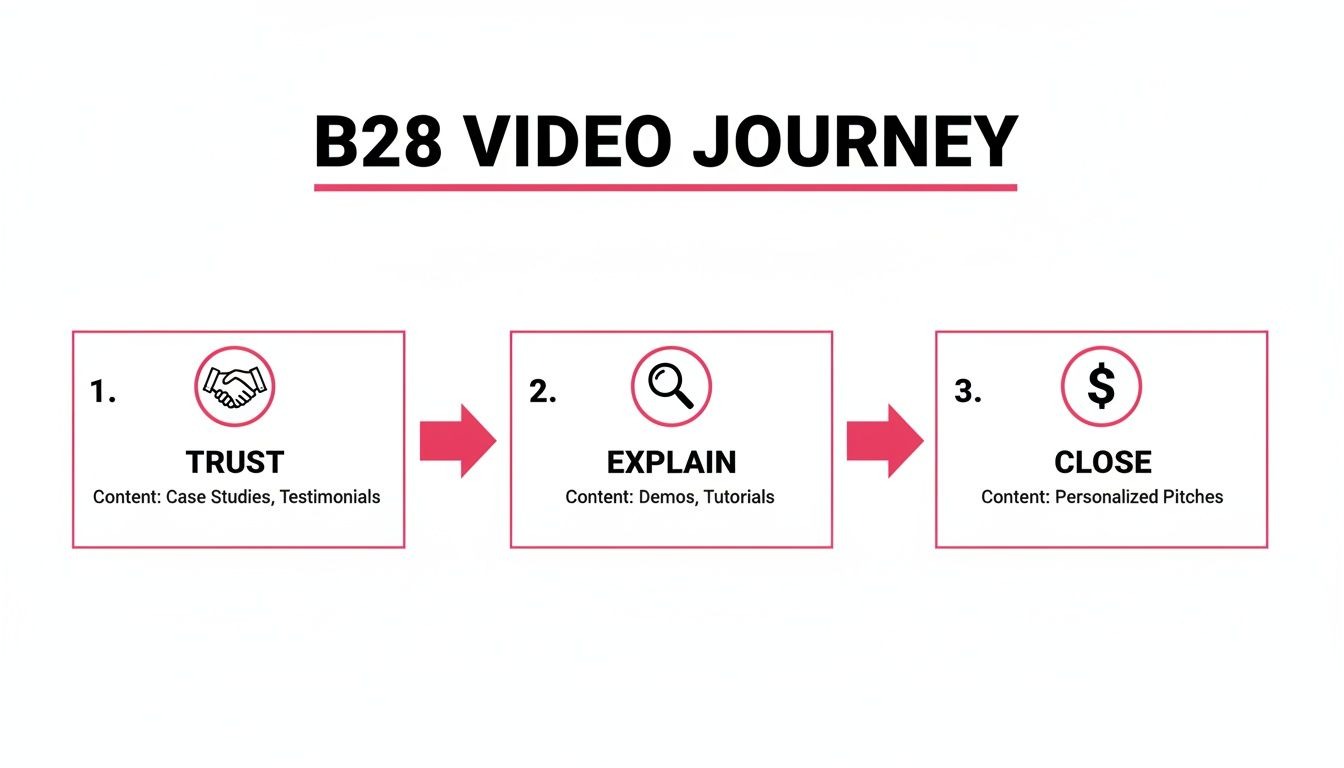
It’s all about using the right video at the right time to build trust, explain your value, and ultimately, get the deal done.
Phase 1: Pre-Production: The Strategic Blueprint
This is, without a doubt, the most important part of the whole process. Get pre-production right to save a staggering amount of time, money, and headaches later on. This is where you anchor the entire project to a clear "why."
To succeed here, plan obsessively and communicate with crystal clarity. Your objective is to leave absolutely nothing to chance before a single camera starts rolling.
Here’s your pre-production checklist:
- Define Goals and KPIs: What, specifically, do you need this video to do? Are you aiming for a 15% increase in demo requests? A better click-through rate on a landing page? Get specific.
- Scriptwriting and Storyboarding: Bring the story alive on paper. Lock in your messaging and tone with the script, then use a storyboard to visually map out every single shot, scene by scene.
- Logistics and Scheduling: Handle all the practical details. Scout locations, cast talent, create a hyper-detailed shot list, and schedule the crew and gear.
A common saying in the industry is that pre-production is where 90% of the problem-solving happens. A well-planned shoot day should feel like you’re just executing a plan that’s already been perfected.
Phase 2: Production: Capturing the Vision
With your blueprint in hand, the production phase is all about capturing the raw ingredients for your video. This is the "shoot day" you see in your mind's eye, the director, camera ops, and sound engineers all working in sync to bring that storyboard to life.
While this phase is often the shortest, it’s easily the most intense. The quality of the footage and audio you capture here sets the ceiling for the final product. You can't "fix it in post" for a poorly lit interview or muffled, unusable audio. For a deeper look at the tech side, our guide on equipment for video podcasting covers a lot of principles that apply directly here, too.
During the shoot, focus squarely on three things:
- Directing: Guide anyone on camera to give an authentic, compelling performance that feels natural and stays on script.
- Cinematography: Capture visually interesting footage that follows the shot list. Focus on camera movement, composition, and framing.
- Lighting and Audio: Use professional lighting to set the mood and high-quality mics to record crystal-clear sound. Make no exceptions.
Phase 3: Post-Production: Assembling the Story
Post-production is where all the puzzle pieces finally click together. The raw footage is cut, colored, and polished into a cohesive story that actually connects with your audience and delivers on the goals you set way back in phase one.
This final stage is a true blend of technical skill and creative artistry. It's where you dial in the video's pacing, tone, and emotional punch.
Follow these post-production workflow steps:
- Editing: Sift through all the takes, sequence the best ones according to the script, build a rough cut, and then refine it into a polished final version.
- Color Correction and Grading: Make sure every shot looks consistent and enhance the mood by tweaking colors, contrast, and brightness.
- Sound Design and Mixing: Clean up the audio, layer in background music, and add sound effects to create a much more immersive experience.
- Motion Graphics and Visual Effects: Add on-screen text, your logo, and any other animated bits to reinforce key messages and your brand identity.
Each phase stacks on top of the last, turning your corporate video project from just a creative idea into a strategic asset that delivers real, measurable results.
How to Budget for Corporate Videography
Let's get right to the question everyone asks: "How much does a corporate video actually cost?" The honest answer? It depends entirely on what you're trying to achieve. There’s no single price tag.
Think of it like building a house. A simple, functional starter home and a custom-built mansion with an infinity pool are both "houses," but their budgets are in completely different universes. The same goes for video.
A straightforward talking-head interview is one thing; a cinematic brand film with actors, drone shots, and multiple locations is another beast entirely. To budget effectively, match your spending to your business goal so every dollar you spend is pushing you toward a specific outcome.
Understanding Common Pricing Models
Production companies usually price their work in one of two ways. Get familiar with these models to find a partner whose process clicks with your financial and strategic plans.
- Project-Based Fees: This is the most common setup. You get a single, flat-rate quote for a clearly defined project, like one client testimonial or a product launch video. Choose this when you have a specific, one-off need and a clear budget.
- Retainer Agreements: If you're serious about making video a consistent part of your strategy, a retainer is often the better choice. You pay a recurring monthly fee for a set amount of production work, say, two social media clips and one explainer video each month. This builds a much deeper partnership and usually leads to more cohesive branding over time.
To decide which is right for you, analyze your content calendar and what you're trying to accomplish this quarter.
What Drives the Cost of Production?
A few key factors will always shape the final price of any video project. Knowing what they are lets you make smart decisions and tweak the scope to fit your budget.
The three biggest levers you can pull to manage video production costs are time, talent, and tools. Adjusting any one of these, like reducing the number of shoot days, using internal team members instead of professional actors, or opting for simpler graphics, can significantly impact the final quote.
Here’s a breakdown of the main cost drivers:
- Crew Size and Expertise: A simple interview might just need a two-person crew (camera and sound). A more complex commercial shoot could require a director, multiple camera operators, a lighting guru, and a production assistant, each adding to the day rate.
- Equipment and Technology: The gear really matters. A project needing a high-end cinema camera, specialized lenses, a drone, and a complex lighting setup will cost way more than one shot on a standard professional camera.
- Filming Days and Locations: Every day on set means paying for the crew and renting equipment. Shooting in multiple spots adds travel time and logistical headaches, which also bumps up the budget.
- Editing and Post-Production Complexity: This is where costs can sneak up on you. A basic edit is just simple cuts and adding a logo. Advanced post-production can involve custom motion graphics, professional color grading, sound design, and multiple rounds of revisions, all of which demand specialized skills and many, many hours of work.
Typical Pricing Tiers for Corporate Videos
To make this all a bit more concrete, here’s a rough guide to what you can expect at different investment levels. Use these as benchmarks; actual quotes will vary based on your project and where you're located.
Tier Level: Typical Price Range. What You Get: Basic $2,000 - $7,000A simple, single-location shoot with a small crew. Great for internal communications, basic social media clips, or a single talking-head interview with minimal graphics.Professional$7,000 - $20,000A high-quality production with a pro crew, better equipment, and maybe one or two shoot days. Perfect for polished client testimonials, product demos, or event recaps that need slick motion graphics.Premium$20,000+A full-scale, cinematic production. This means a detailed pre-production process, a large crew, multiple locations, professional actors, and high-end post-production with custom animations and sound design. This is for the big stuff, flagship brand films, and major campaigns.
By understanding these tiers and the factors that drive them, you can build a solid business case for your next video project and set realistic expectations with your team from the get-go.
Maximizing Your Video's Reach and ROI
So, you’ve made a fantastic corporate video. That’s a huge win, but it’s really only half the battle. A brilliant film with no audience is just a file sitting on a server, a wasted investment. To achieve real success, you must execute a smart, deliberate distribution and repurposing strategy that gets your message in front of the right people.
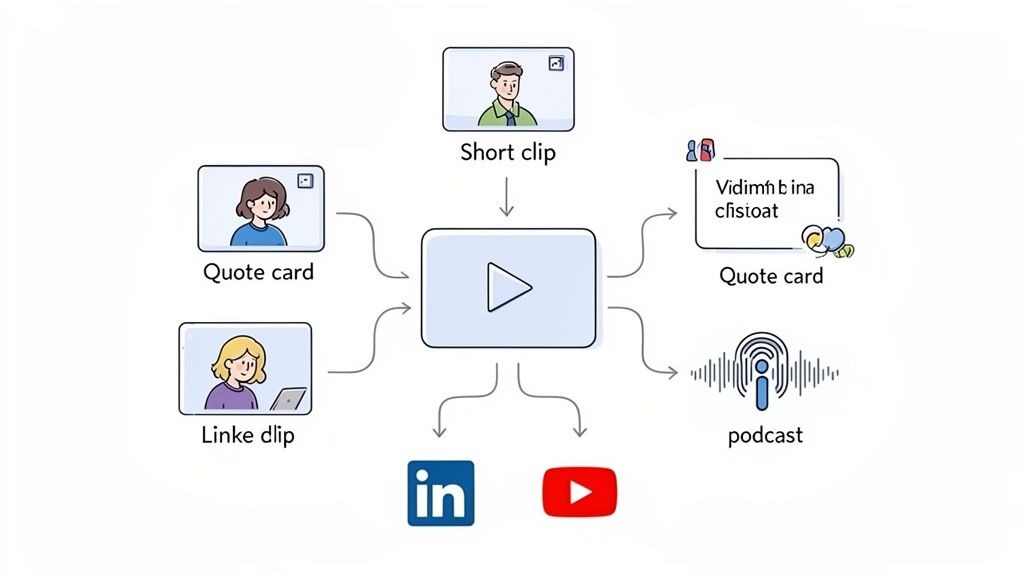
This isn’t about just uploading your video and crossing your fingers. It’s about building a content ecosystem where one big production effort fuels your marketing channels for weeks, or even months, to come.
Building Your B2B Distribution Playbook
For B2B companies, distribution has to be precise. You need to meet your ideal customers where they’re already hanging out, looking for professional insights and solutions. Forget casting a wide net; focus on platforms that are built for business conversations.
Your distribution strategy should be multi-channel, but with a sharp focus on two main hubs for B2B engagement:
- LinkedIn: This is ground zero for professional networking and B2B marketing. Share short, punchy clips from your main video, tag relevant companies or people, and use targeted ads to zero in on decision-makers in specific industries or roles.
- YouTube: As the world’s second-largest search engine, YouTube is non-negotiable for discoverability. Optimize your video titles, descriptions, and tags with the right keywords to catch prospects who are literally searching for the solutions you offer. Getting a handle on how to find low-competition keywords for video SEO can give you a massive visibility boost.
Beyond these two powerhouses, make sure to embed your videos on key pages of your website, think homepages or product pages, to crank up engagement and conversions. And don't forget to drop them into your email marketing campaigns; it’s a proven way to boost click-through rates and keep your leads warm.
The Power of Repurposing Your Pillar Content
The real secret to squeezing every drop of ROI out of your video budget? Repurposing.
Think of your main corporate video, a big client case study, or a brand film as a "pillar" asset. From this one pillar, you can carve out dozens of smaller "micro-assets" to keep your content calendar full and your audience engaged.
This approach lets you amplify your message without constantly spinning up new, expensive production cycles. It’s a massive time and money saver. The numbers don't lie, either. A whopping 93% of marketers report a strong ROI from video, and 84% say video has directly helped them increase sales.
A single 10-minute client testimonial video isn't just one piece of content. It’s a goldmine of potential assets: ten 60-second social clips, five powerful quote graphics, and ten minutes of high-quality audio perfect for a podcast episode.
Actionable Repurposing Strategies
Here are a few practical ways you can break down one pillar video into a whole library of hard-working micro-content.
- Create Short Social Clips: Pull out the most compelling 30-90 second soundbites. Add bold, branded captions; most people watch social videos with the sound off. Each clip can hammer home a different key message.
- Design Quote Graphics: Transcribe the most powerful lines from the video and turn them into shareable, visually appealing graphics. These are perfect for reinforcing your message on LinkedIn, X (formerly Twitter), and Instagram and driving people back to the full video.
- Extract Audio for Podcasts: The audio track from an interview or testimonial can easily become a podcast episode or a segment in a larger show. This opens up a whole new channel to reach people who prefer listening during their commute or workout.
- Write Blog Posts and Articles: Use the video's transcript as the foundation for a detailed blog post. You can expand on the topics, embed the video itself, and add relevant calls-to-action to create a killer resource for your audience. For more ideas, check out our guide on effective content repurposing strategies.
- Develop Sales Enablement Materials: Give your sales team some ammunition. Short testimonial clips are incredibly persuasive when dropped into an outreach email, way more effective than another block of text.
By adopting this content ecosystem approach, you turn a single corporate video project into a long-term strategic asset that just keeps on giving, generating leads, building authority, and driving real, measurable growth.
Measuring the Success of Your Video Strategy
Creating a genuinely powerful corporate video is only half the battle. If you can’t prove its value, you’ll struggle to get the budget for the next one. To do that, stop talking about vanity metrics like “views” and start connecting video performance to actual business outcomes.
A video view is like someone glancing at your storefront as they walk by. It’s a nice signal, but it tells you nothing about whether they came inside, browsed, or bought something. You must look deeper and trace how a video influences the entire customer journey, from first glance to final sale.
Matching KPIs to Your Marketing Funnel
The real trick is to stop using one-size-fits-all metrics. The Key Performance Indicators (KPIs) you track for a top-of-funnel brand film must be worlds apart from what you measure for a bottom-of-funnel product demo.
Here's how to structure your measurement:
- Top of Funnel (Awareness): Your main goal is grabbing eyeballs and making an impression. So, how much of your video are people actually watching? Track audience retention and watch time.
- Middle of Funnel (Consideration): Now you need to know if you're holding their attention and prompting them to learn more. Measure if they are taking the next step you want them to take.
- Bottom of Funnel (Decision): This is where the rubber meets the road. Your video needs to push prospects toward a purchasing decision. Look for a direct link between someone watching a video and taking a sales-qualified action.
When you align your KPIs this way, you can finally tell a compelling story about how your corporate videos are nurturing leads from their very first touchpoint all the way through to a closed deal.
The most effective video strategies don't just count views; they measure influence. The right question isn't "How many people watched our video?" but rather, "How did watching this video change a prospect's behavior?"
Calculating Your Video ROI
Calculating a clear Return on Investment (ROI) is how you get leadership to sit up and take notice. It’s what turns your video production from a "cost" into an "investment."
The process is straightforward. First, tally up the total cost of your video, production, distribution, and the whole nine yards. Then, track the value generated from leads who interacted with it. This might be the average value of a demo request, a trial signup, or a closed deal that can be traced back to your video campaign.
For a deeper dive into the formulas and frameworks behind this, you’ll find our guide to measuring content marketing ROI super helpful. The principles apply directly to video.
B2B Video Marketing KPI Framework
To make this crystal clear, use a framework that ties every metric back to a business objective. The table below breaks down exactly what to track at each stage of the sales funnel to build a bulletproof ROI case.
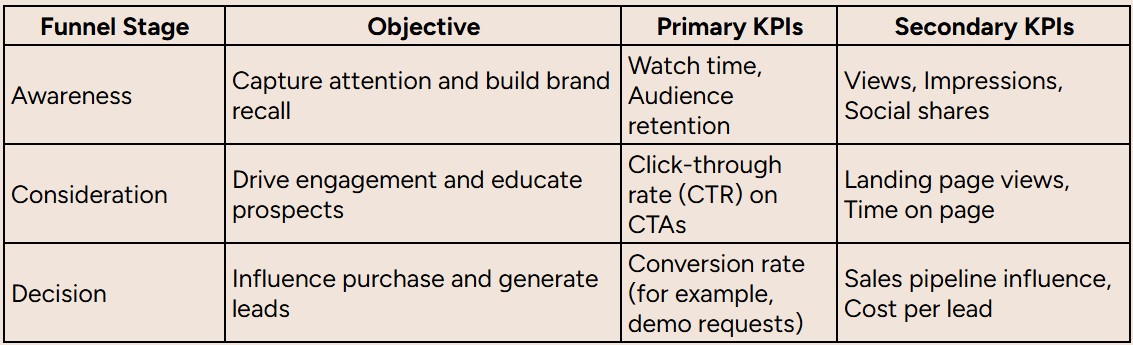
By tracking these specific KPIs, you shift the internal conversation from "we're making videos" to "we're making videos that drive revenue." This data-driven approach doesn't just justify your budget; it gives you the insights you need to make your next video project an even bigger success.
Choosing the Right Production Partner
Picking the right team for your corporate video is a make-or-break decision. It's the difference between a video that just looks nice and a strategic asset that actually moves the needle on business goals. You're not just hiring a camera crew; you're looking for a seamless extension of your marketing department.
This means you must look past the slick demo reels. A flashy portfolio is a great starting point, but it doesn't tell the whole story. Find a partner who gets the nuances of B2B marketing, someone who asks about your sales cycle, target customer, and business objectives before they even mention a camera.
Evaluating Potential Partners
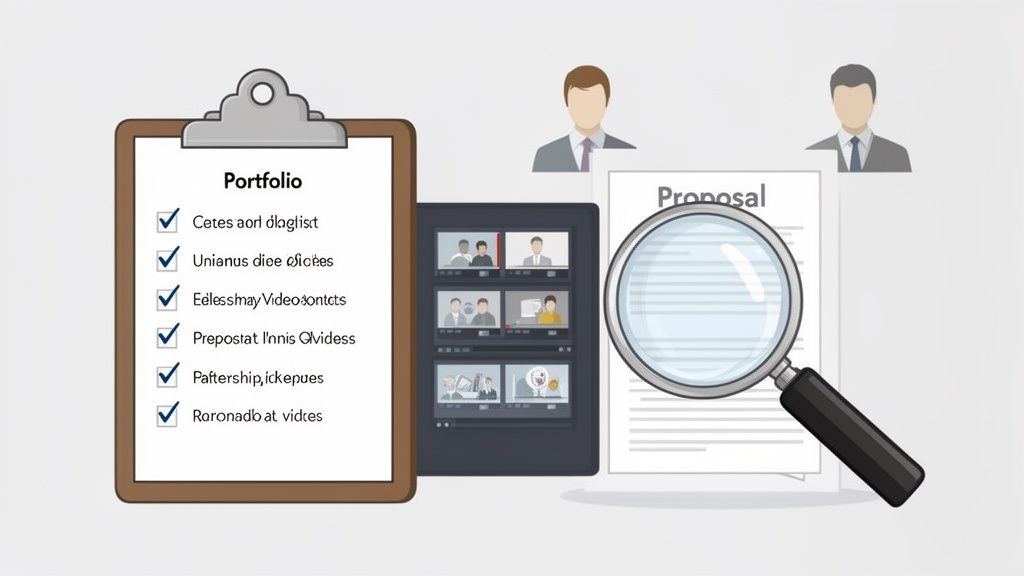
Start by diving deep into their portfolio. Don't just watch the highlight reel; look for work they’ve done for companies similar to yours, whether in the same industry, of a similar size, or chasing the same audience. This proves they know how to speak the right language to the right people.
Next, get serious about their client testimonials. Go beyond the glowing quotes plastered on their website. Ask for actual references you can talk to. This is your chance to get an unvarnished look at their process, communication style, and whether they can stick to a timeline and a budget. To get a better handle on what to look for, you can learn more about finding the right video production crew services for your specific needs.
Key Questions for Your Initial Calls
When you finally get on the phone with a potential vendor, your questions need to be as much about strategy as they are about logistics. Their answers will tell you everything you need to know about whether they're a true partner or just a hired gun.
Here are a few essential questions to get the conversation started:
- "How do you measure the success of a video project?" A great partner will immediately talk about KPIs like lead generation, conversion rates, or sales enablement, not just view counts.
- "Can you walk me through your pre-production process?" You're listening for a detailed, strategic approach that starts with digging into your goals. Anything less is a red flag.
- "How do you handle feedback and revisions during post-production?" You need a partner with a clear, collaborative process that doesn't leave you in the dark.
A true partner invests time upfront to understand your unique challenges and goals. Watch out for vague answers, a lack of strategic questions about your business, and proposals that feel like they were copied and pasted.
To really nail your decision, it helps to see how other creative industries handle this. This comprehensive buyer's guide for animation studio selection is a great resource that covers budgets, timelines, and red flags that apply here, too. The right partner will be transparent, strategic, and genuinely invested in your success from day one.
Common Questions About Corporate Videography
Even with the best strategy in place, you’re going to have questions once you get your hands dirty with corporate videography. That’s perfectly normal. Getting straight answers to these practical questions is what separates a smooth, successful project from a frustrating one.
Let’s tackle some of the most common ones we hear from B2B marketers. The data shows everyone is jumping in; by 2026, 91% of businesses were using video, and 93% of marketers swear by it. It’s no longer optional, especially for B2B brands trying to build real authority. The most popular formats are pretty telling: explainer videos (68%), testimonials (57%), and product demos (39%), with YouTube (82%) and LinkedIn (70%) being the primary battlegrounds. You can dig into more of this in recent video marketing statistics reports.
How Long Should a Corporate Video Be?
There’s no magic number. The right length depends entirely on the video’s job and where people will be watching it. To choose the right length, match it to the platform and the viewer's intent.
- Social media (like LinkedIn): You’re fighting for attention here. Keep it snappy. Use 30-90 seconds to grab someone scrolling their feed.
- Website explainers or demos: You have more of their focus on your own turf. A 2-5 minute video works well to explain something of value in more detail.
- In-depth testimonials: When you have a truly compelling customer story, you can go longer. A 5-10 minute video can build a ton of trust, but the story has to earn that runtime.
Can We Actually Make Good Videos on a Small Budget?
Absolutely. A smaller budget can be a creative advantage. It forces you to get crystal clear on what really moves the needle: a killer script, clean audio, and decent lighting. You don't need a Hollywood-level production to make a video that works.
Start simple. Create talking-head interviews, animated explainers, or even screen-recorded demos. These are often less intensive on crew and gear than a massive brand film, yet they can be incredibly effective at educating your audience and nudging them toward a decision.
Key Takeaway: A tight budget is not a deal-breaker. Focus your resources on a clear message and high-quality audio first. A well-told story with basic visuals will always beat a beautiful-looking video that’s confusing or has nothing to say.
How Often Should We Be Releasing New Videos?
Here's the secret: consistency trumps frequency, every single time. For most B2B companies, the goal isn't to become a daily vlogger. It's about creating a steady, reliable pulse of valuable content.
Instead of going wide, go deep. Focus on creating one high-quality "pillar" video each quarter, such as a comprehensive case study or a major product launch video. Then, slice and dice that single asset into a dozen smaller clips, quotes, and GIFs to share weekly or bi-weekly across your channels. This way, you maintain a constant presence without the constant pressure and burnout of a production treadmill.
Ready to transform your B2B marketing with a podcast that builds authority and drives real business growth? At Fame, we specialize in creating strategic audio experiences that connect with your ideal customers.
