

In B2B, a great marketing campaign isn't just creative-it's a growth engine. It builds authority, generates pipeline, and turns prospects into advocates. But which campaigns truly set the standard? We're moving past the surface-level success stories to dissect the specific strategies, tactics, and metrics behind some of the world's best b to b marketing campaigns. This isn't another generic list; it's a strategic teardown designed for action.
You'll learn not just what iconic brands like Salesforce and HubSpot did, but why their approaches worked so effectively. We will break down the frameworks, the key performance indicators, and the tactical execution that drove their success. This deep analysis is designed to provide you with replicable models you can adapt to your own marketing efforts, whether you're building a demand generation pipeline, establishing thought leadership, or preparing for an IPO.
Throughout our analysis, we will also explore how modern tactics, particularly strategic B2B podcasting, can amplify these classic approaches to build unparalleled brand authority and drive measurable growth. In a market where trust and expertise are paramount, a well-executed podcast can become a powerful asset for creating authentic connections and owning a specific niche. This guide will give you the blueprints to not only understand exceptional marketing but also to build it yourself, with actionable takeaways you can implement immediately to see tangible results.
1. HubSpot's Inbound Marketing Revolution
HubSpot didn't just create a great marketing campaign; they created an entire marketing philosophy that has become a cornerstone of the industry. The Inbound Marketing Revolution represents a fundamental shift from interruptive, outbound tactics (like cold calls and ad blasts) to an approach focused on attracting customers with valuable content and tailored experiences. This methodology positions the brand as a helpful guide rather than an aggressive seller, building trust and authority over time.
This approach is one of the best B2B marketing campaigns because it transforms the sales funnel into a flywheel, where delighted customers fuel referrals and repeat business. Instead of a one-time transaction, it creates a sustainable growth engine.
Strategic Breakdown
HubSpot's strategy was built on providing immense value upfront, completely free of charge. This wasn't just a gimmick; it was a comprehensive ecosystem designed to educate, empower, and eventually convert users into paying customers.
- Free Tools: The launch of the free HubSpot CRM was a masterstroke. It provided immediate, tangible value to small businesses and startups, embedding the HubSpot brand into their daily operations long before they considered a paid plan.
- Educational Content: HubSpot Academy offers robust, free certification courses on everything from content marketing to sales enablement. This created an army of over 500,000 certified professionals who are not only skilled marketers but also brand advocates trained on HubSpot’s platform.
- Authoritative Research: The annual "State of Inbound" report became a must-read industry benchmark, cementing HubSpot's status as a thought leader and generating countless backlinks and media mentions.
Actionable Takeaways for Your Business
- Develop a "Freemium" Entry Point: Create a free tool, template, or resource that solves a genuine pain point for your ideal customer. This lowers the barrier to entry and demonstrates your product's value firsthand. For example, B2B SaaS company Chili Piper offers a free "Book a Demo" button to help businesses convert inbound leads more effectively.
- Build an Educational Hub: Don’t just blog. Create structured courses, certifications, or webinars that teach your audience a valuable skill related to your industry. This builds a loyal community and establishes your expertise. To delve deeper into this approach, explore this comprehensive guide to B2B content marketing strategy.
- Publish Original Data: Conduct your own research, surveys, or industry analyses. Publishing unique data-driven reports is a powerful way to generate high-quality backlinks, attract media attention, and become the go-to source in your niche.
2. Salesforce's 'No Software' Campaign
Salesforce fundamentally altered the enterprise software landscape with its provocative 'No Software' campaign. This B2B marketing campaign was a masterclass in disruptive positioning, directly challenging the dominance of traditional, on-premise software giants like Oracle and Siebel. By framing their cloud-based CRM as the antithesis of clunky, expensive, and difficult-to-maintain software, Salesforce created a new category and positioned themselves as its undisputed leader.
This campaign is considered one of the best B2B marketing campaigns because it brilliantly simplified a complex technological shift into a powerful, memorable message. It targeted the core frustrations of C-suite executives and IT departments, turning the perceived weakness of a new model (the cloud) into its greatest strength: simplicity, cost-effectiveness, and accessibility.
Strategic Breakdown
Salesforce's 'No Software' strategy was an integrated effort to attack the status quo and build a movement around the future of business technology. They used bold, guerrilla-style tactics alongside sophisticated thought leadership to create a compelling narrative of innovation versus legacy.
- Aggressive Competitive Positioning: Salesforce famously staged a protest at a competitor's conference, hiring actors to carry "No Software" signs. This generated massive press and immediately established their brand as a rebellious and innovative alternative.
- Experiential Marketing: The creation of the Dreamforce conference turned a user event into a massive industry spectacle. It wasn't just about product demos; it was a festival of innovation that cultivated a loyal community and demonstrated the power of the cloud ecosystem.
- Focus on TCO and ROI: Digital and print campaigns were laser-focused on the total cost of ownership (TCO). Messaging emphasized the elimination of hardware costs, lengthy implementations, and expensive maintenance contracts associated with on-premise software.
Actionable Takeaways for Your Business
- Define Your Enemy: Clearly identify the old way of doing things or the established competitor you are disrupting. This creates a clear narrative and helps prospects quickly understand your unique value proposition. Explore this concept further in this guide to brand positioning strategies.
- Create an Unforgettable Event: Go beyond webinars and build a marquee event, whether virtual or in-person, that becomes a cornerstone of your industry. Use it to foster community, showcase customer success, and define your brand's vision for the future.
- Build Your Case with Customer ROI: Don't just list features. Develop powerful case studies with early adopters in your target segments, focusing on quantifiable metrics like cost savings, efficiency gains, and revenue growth. Frame your solution as a financial and strategic advantage.
3. LinkedIn's 'Open Networker' Thought Leadership Strategy
LinkedIn didn’t just build a professional network; it architected the world’s largest B2B content distribution platform by empowering its users and employees to become thought leaders. The 'Open Networker' strategy is a distributed model where the brand's voice is amplified exponentially through the authentic, individual voices of its community. This approach turns employees and executives into powerful brand advocates, positioning the company as the epicenter of professional conversation.
This campaign is one of the best B2B marketing campaigns because it leverages the most trusted asset a company has: its people. By encouraging employees to share their expertise, LinkedIn cultivated an environment of organic reach and credibility that paid advertising could never replicate, driving immense platform engagement and solidifying its market dominance.
Strategic Breakdown
LinkedIn's success was rooted in a decentralized approach to content creation and distribution. Instead of a top-down corporate monologue, they fostered a bottom-up dialogue, providing the tools and encouragement for individuals to build their personal brands on the platform.
- Executive Thought Leadership: Co-founder Reid Hoffman led by example, using his profile to share insights on technology and entrepreneurship. This set the precedent for other leaders and employees to view their profiles not just as resumes, but as publishing platforms.
- Employee Advocacy Programs: LinkedIn actively encouraged its own employees to post content, share industry news, and engage in conversations. This created a groundswell of authentic promotion that collectively reached millions, demonstrating the platform's power from within.
- LinkedIn Influencer Program: By formally recognizing and promoting top voices in various industries, LinkedIn created aspirational role models. This program incentivized high-quality content creation and showed users the potential of building a professional brand on the platform.
Actionable Takeaways for Your Business
- Launch a Formal Employee Advocacy Program: Don’t leave it to chance. Create clear guidelines, provide content templates or thought-starters, and offer training to help your team build their personal brands. Recognize and reward top contributors to maintain momentum.
- Empower Your Leadership Team to Post: Your executives are the face of your company. Encourage them to mix personal stories with company messaging and industry insights to appear more authentic and relatable. This humanizes the brand and builds trust. As our founder Tom Hunt shares, the key is consistency and focusing on one core topic to build authority.
- Focus on Platform-Native Content: Create content specifically designed for LinkedIn, such as text-plus-image posts, short videos, and carousels. Analyze performance data to identify high-performing topics and formats, then double down on what works. To truly master this, explore this guide on how to become a thought leader.
4. IBM's 'Think' Campaign and Thought Leadership Ecosystem
IBM's 'Think' campaign is a masterclass in evolving a legacy hardware brand into a forward-thinking solutions and consulting powerhouse. Rather than focusing on products, IBM shifted the conversation to the big ideas shaping the future of business, such as AI, big data, and cloud computing. This was achieved by creating a vast ecosystem of high-value thought leadership content, positioning IBM not as a vendor, but as an indispensable strategic partner.
This strategy is one of the best B2B marketing campaigns because it builds immense brand equity and credibility. By owning the conversation around key industry challenges, IBM ensures that when businesses search for solutions, they inevitably find IBM’s expertise, insights, and, ultimately, their technology. It’s a long-term play that establishes deep-rooted authority.
Strategic Breakdown
IBM's strategy was to become the definitive source of insight for C-suite executives and technical leaders. They invested heavily in producing original, data-driven content that addressed the most pressing challenges their target audience faced, effectively educating the market while building a pipeline for their services.
- Original Research: The IBM Institute for Business Value (IBV) publishes premier, data-backed reports on global business trends. These reports are not sales pitches; they are credible, academic-level studies that provide genuine value to decision-makers.
- Brand Personification: By branding its AI technology as "Watson," IBM gave an abstract concept a relatable identity. Watson's success on Jeopardy! was a brilliant PR move that made AI tangible and demonstrated its power in a universally understandable way.
- Comprehensive Content Hubs: IBM created dedicated learning platforms like Think Academy and topic-specific resource centers. This organized their expertise, making it easy for prospects to explore complex subjects and see IBM as the go-to guide.
Actionable Takeaways for Your Business
- Invest in Original Data: Don't just regurgitate existing information. Commission your own surveys or analyze proprietary data to publish unique industry reports. This makes your company the primary source, attracting high-authority backlinks and media coverage.
- Create Vertical-Specific Content: Tailor your thought leadership to the specific pain points of different industries. An executive in finance has different challenges than one in healthcare. Create targeted white papers, webinars, and case studies that speak their language directly.
- Build a Branded Content Platform: Launch a podcast or a video series to serve as the hub for your expertise. A well-produced B2B podcast, for instance, allows your executives to discuss industry trends and build a loyal following. At Fame, we find that a consistent podcast is a powerful tool for establishing this type of authority and driving measurable audience growth.
5. Slack's Product-Led Growth and Community Building
Slack championed a bottoms-up adoption model that sidestepped traditional, top-down enterprise sales. Instead of convincing executives, they created a product so intuitive and valuable that individual teams would adopt it organically. This product-led growth (PLG) strategy hinges on the software itself being the primary driver of customer acquisition, conversion, and expansion. By focusing on user experience and viral adoption, Slack turned its product into its most powerful marketing asset.
This is one of the best B2B marketing campaigns because it demonstrates how a frictionless user experience can generate unstoppable momentum. It builds a loyal user base from the ground up, making the eventual enterprise-wide sale a natural and inevitable conclusion rather than a cold pitch.
Strategic Breakdown
Slack's strategy was to make its platform indispensable for a single team, which would then act as an internal advocate to spread its adoption across the entire organization. This land-and-expand approach was fueled by a freemium model and a focus on community.
- Frictionless Freemium Model: Slack offered a robust free version that was powerful enough for small teams to use indefinitely. This eliminated the barrier to entry and allowed the product's value to be proven before any purchase was required.
- Viral Loop Integration: The platform was inherently viral. To collaborate effectively, a user had to invite their colleagues, creating an organic, built-in growth mechanism that drove team-by-team adoption.
- Developer Ecosystem: Slack invested heavily in its App Directory and APIs, encouraging third-party developers to build integrations. This transformed Slack from a simple chat app into a central work hub, dramatically increasing its stickiness and value.
Actionable Takeaways for Your Business
- Prioritize the User Experience: Design your product to be so intuitive and valuable that users can onboard themselves without a sales demo. The product itself should be your best salesperson.
- Engineer Virality: Build features that naturally encourage users to invite their colleagues. This could be collaboration tools, sharing capabilities, or referral programs that create an organic growth engine.
- Cultivate a Community: Create spaces, both in-product and externally, where users can connect, share best practices, and get support. This customer-led growth approach transforms users into advocates. Exploring how a B2B podcast can support customer-led growth can provide deeper insights into building this type of engaged community.
6. Microsoft's 'Cloud-First, Mobile-First' Strategic Pivot
Microsoft executed one of the most successful corporate turnarounds in modern history, shifting its entire identity from a legacy desktop software giant to a dominant force in cloud computing. The "Cloud-First, Mobile-First" campaign was a monumental strategic pivot that repositioned the company around its Azure cloud platform and Office 365 suite, emphasizing digital transformation for its enterprise customers. This wasn't just a marketing slogan; it was a company-wide mission that realigned product development, sales, and messaging.
This initiative is one of the best B2B marketing campaigns because it demonstrates how to successfully steer a massive organization through fundamental market changes. Microsoft built a cohesive narrative that resonated with developers, IT decision-makers, and C-suite executives, proving that even the largest incumbents can reinvent themselves to lead the next wave of technology.
Strategic Breakdown
Under CEO Satya Nadella, Microsoft's strategy was to meet customers wherever they were, embracing open-source technologies and hybrid environments instead of locking them into a closed Windows ecosystem. This comprehensive shift was communicated and executed through several key initiatives.
- Coordinated Messaging: The Microsoft Ignite conference series became the central stage for unveiling new cloud capabilities and reinforcing the digital transformation narrative. Messaging consistently focused on empowering businesses with intelligent cloud and intelligent edge solutions.
- Strategic Acquisitions: The acquisition of GitHub was a masterstroke in winning over the developer community. Instead of being perceived as a hostile takeover, it was positioned as an investment in the open-source world, directly supporting the "Cloud-First" mission by integrating a critical developer platform.
- Vertical-Specific Solutions: Microsoft developed industry-specific cloud offerings for sectors like finance, healthcare, and retail. This tailored marketing approach demonstrated a deep understanding of unique customer challenges and positioned Azure as a specialized partner, not just a generic infrastructure provider.
Actionable Takeaways for Your Business
- Articulate a Clear Transformation Narrative: If your business is pivoting, create a simple, powerful, and consistent story. Your "Cloud-First, Mobile-First" equivalent should guide all marketing, sales, and product decisions to ensure internal and external alignment.
- Invest to Fill Capability Gaps: Don't be afraid to acquire companies or technologies that accelerate your strategic goals. A key acquisition can quickly grant you market credibility and access to a new customer base, just as GitHub did for Microsoft.
- Build and Nurture Developer Communities: If your product relies on developers, invest heavily in advocacy programs, open-source contributions, and community events. Winning the hearts and minds of technical users builds a powerful moat and a loyal base of evangelists who drive adoption from the ground up.
7. Adobe's Acquisition-Driven Growth and Platform Positioning
Adobe’s transformation from a single-product company into an end-to-end digital experience platform is a masterclass in strategic acquisition and integrated marketing. By acquiring key companies like Magento, Workfront, and Frame.io, Adobe didn't just add features; it absorbed entire ecosystems and then brilliantly marketed the combined entity as an indispensable, unified solution. Their campaigns shifted the narrative from selling individual tools to providing a comprehensive platform for creation, marketing, and analytics.
This strategy earns its place among the best B2B marketing campaigns because it demonstrates how to create exponential value. Instead of customers piecing together disparate tools, Adobe presented a single, cohesive ecosystem that streamlines workflows and delivers unparalleled business intelligence, effectively locking in customers and increasing their lifetime value.
Strategic Breakdown
Adobe's success lies in its ability to weave a cohesive story around a portfolio of acquired technologies. The marketing wasn't just about announcing a new purchase; it was a deliberate effort to reposition the entire brand as a one-stop-shop for digital transformation.
- Unified Platform Messaging: Campaigns for the "Adobe Experience Cloud" and "Creative Cloud" focused on the seamless integration between products. Marketing materials highlighted how a creative asset designed in Photoshop could move effortlessly into Adobe Experience Manager to power a global campaign.
- Value-Centric Storytelling: Adobe published countless customer stories and case studies showing how businesses achieved significant ROI (often 3-5x) by leveraging the full suite. This proved the ecosystem was more valuable than the sum of its parts.
- Targeted Education: With each acquisition, Adobe invested heavily in educating the existing user bases of companies like Magento and Marketo. They used webinars, certifications, and community forums to demonstrate the new, enhanced value available within the Adobe family.
Actionable Takeaways for Your Business
- Craft a "Better Together" Narrative: If you acquire a company or launch a new product, your marketing must clearly articulate the integration benefits. Create content that showcases how the combined solution solves a bigger, more complex problem for the customer.
- Develop Ecosystem-Wide Case Studies: Don't just show how one product works. Build case studies that feature customers using multiple products from your suite to achieve a major business outcome. This proves the value of your platform strategy.
- Invest in Post-Acquisition Customer Education: Create dedicated onboarding paths, certification programs, and community spaces for the users of newly acquired products. This reduces churn, builds loyalty, and accelerates the adoption of your full ecosystem.
8. Twilio's Developer-First API Marketing Strategy
Twilio didn't market a sleek, finished product to executives; they marketed building blocks to the people who build things: developers. Their pioneering developer-first approach treated software engineers as the primary customer, focusing on making their APIs easy to integrate, backed by world-class documentation and a supportive community. This strategy flips the traditional B2B model, empowering the end-users to become internal champions for the product.
This campaign is one of the best B2B marketing examples because it understood a critical truth: in a tech-driven world, developers hold immense purchasing influence. By winning their loyalty through utility and support, Twilio embedded its technology into the core of thousands of businesses, making its platform indispensable long before a sales team ever made contact.
Strategic Breakdown
Twilio’s success was built on removing friction and fostering a sense of community for developers. They focused on enablement rather than persuasion, providing all the resources a developer would need to start building immediately and successfully.
- Exceptional Documentation: Twilio's API documentation is legendary. It’s clear, comprehensive, and filled with code samples, making it a powerful organic search magnet and the first point of contact for countless developers.
- Community Building: Events like the SIGNAL conference bring thousands of developers together, while the Twilio Marketplace encourages an ecosystem of third-party integrations. This created a network effect where the platform's value grew with each new member.
- Developer Evangelism: Twilio invested heavily in a team of developer evangelists who actively participate in forums, create tutorials, and speak at events. They acted as authentic, trusted guides for the community.
Actionable Takeaways for Your Business
- Treat Documentation as a Core Marketing Asset: Invest in making your API or technical documentation best-in-class. It should be easy to find, easy to understand, and filled with practical examples. This will become your most effective lead-generation tool.
- Empower Your Technical End-Users: Create starter templates, sample code, and sandboxes that allow users to experience your product's value instantly. The goal is to get them to a "wow" moment as quickly as possible.
- Cultivate a Community: Host developer-focused events, build dedicated community spaces (like a Discord or Slack channel), and actively sponsor forums where your target users gather. Nurture these spaces to foster brand advocacy and gather invaluable product feedback.
9. Atlassian's 'Built for Teams' Community-Centric Marketing
Atlassian’s growth is a masterclass in building a B2B empire not with a massive sales team, but by fostering a vibrant, self-sustaining community. Their "Built for Teams" ethos is more than a slogan; it's a marketing strategy centered on empowering users, partners, and developers to become its most powerful advocates. By focusing on product-led growth and community engagement, Atlassian turned its user base into a formidable marketing engine.
This approach is one of the best B2B marketing campaigns because it creates a powerful network effect. As the community grows, the value of the platform increases for everyone, driving organic adoption and creating a deep competitive moat that is nearly impossible for rivals to replicate.
Strategic Breakdown
Atlassian’s strategy was to invest heavily in the infrastructure that allows a community to thrive. They treated their users not as customers to be sold to, but as partners in innovation, providing platforms for them to connect, share knowledge, and extend the products' functionality.
- Community Hubs: The Atlassian Community platform is a massive online forum where over 500,000 members ask questions, share solutions, and provide direct feedback. This reduces support costs and creates a treasure trove of user-generated content.
- Empowered Local Leaders: Atlassian encourages and supports user-led groups in over 50 countries. By providing resources and a framework, they empower local champions to host events and build micro-communities, scaling their marketing reach globally.
- Open Ecosystem: The Atlassian Marketplace allows third-party developers to build and sell apps that integrate with Jira and Confluence. This enriches the core products, solves niche customer problems, and creates a powerful revenue stream built on partnership.
Actionable Takeaways for Your Business
- Invest in a Centralized Community Platform: Don't just rely on a social media group. Create a dedicated, branded space (like a forum or Slack channel) where your customers can interact with each other and your team. This fosters a sense of belonging and provides invaluable product feedback.
- Launch a Partner Certification Program: Create a program that trains and certifies partners or agencies on how to use your product effectively. This not only scales your customer support and implementation capabilities but also creates an incentivized network of evangelists. Our partner Belkins, a leader in B2B appointment setting, is a great example of how this model can drive mutual growth.
- Empower User-Generated Content and Leadership: Identify your most active and knowledgeable customers and give them a platform. Feature them in webinars, highlight their solutions in blog posts, or create a "community champion" program to formally recognize their contributions and encourage others.
10. Dropbox's Referral Loop and Product-Driven Growth
Dropbox's early growth is a masterclass in product-led marketing, where the product itself becomes the primary driver of acquisition. Instead of relying on a massive advertising budget, Dropbox built a simple yet powerful referral mechanism directly into its user experience. This strategy turned its user base into an enthusiastic and highly effective sales force, creating a viral loop that powered exponential growth.
This campaign is one of the best B2B marketing examples because it demonstrates how a well-designed incentive can transform users into advocates. The genius was in its simplicity and mutual benefit: give a little, get a little. This built-in growth engine allowed the company to scale rapidly with minimal marketing spend, focusing resources on perfecting the core product.
Strategic Breakdown
Dropbox’s strategy was to make sharing inherent to the value of the product. The more people a user brought into their network, the more useful the product became for them, creating a self-perpetuating cycle of acquisition and retention.
- Integrated Referral Program: Dropbox offered free storage space to both the referrer and the new user upon signup. This incentive was not just a bonus; it directly enhanced the product's utility, encouraging widespread sharing.
- Frictionless Sharing: The process was incredibly simple. Users could invite contacts with just a few clicks, making participation effortless. This ease-of-use was critical to achieving a high viral coefficient.
- Product-First Messaging: Early marketing, including its famous Y Combinator demo day pitch, focused squarely on the product's core value proposition: "It just works." This message of simplicity and reliability built trust and resonated with users frustrated by complex file-sharing solutions.
Actionable Takeaways for Your Business
- Build Incentives into the Product Experience: Don't just tack on a referral program as an afterthought. Integrate it into the core user journey where it feels natural and adds immediate value, like offering feature unlocks or usage credits.
- Make Sharing Effortless: Reduce the number of steps required to refer someone to the absolute minimum. Use pre-populated messages and one-click sharing options to remove any friction that might deter users from participating.
- Focus on a Single, Powerful Value Proposition: Clearly articulate what your product does better than anyone else and build your messaging around that singular strength. Simplicity and reliability can be your most powerful marketing assets. For more ideas, explore these proven B2B customer acquisition strategies.
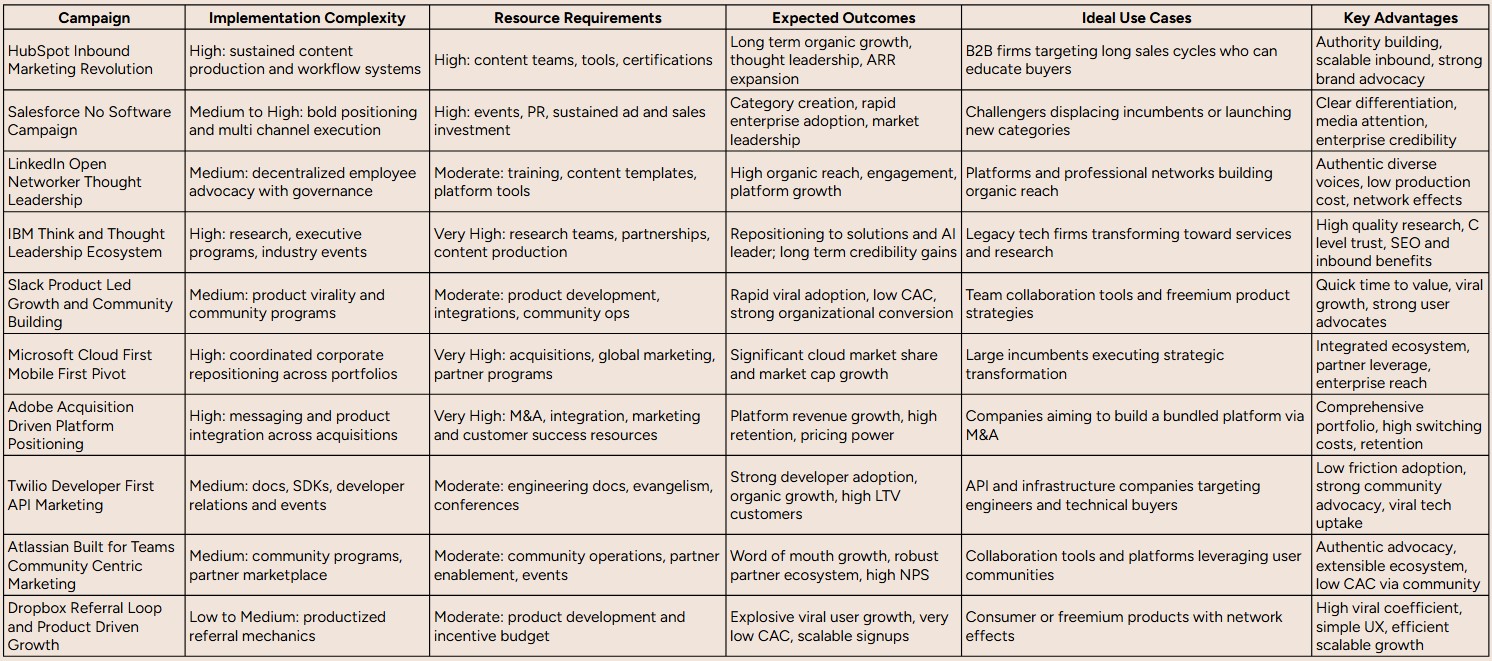
Top 10 B2B Marketing Campaigns Comparison
How to Build Your Next Breakthrough B2B Campaign
We've explored a decade of groundbreaking B2B marketing, from HubSpot's content-driven inbound machine to Twilio's developer-first API evangelism. Analyzing these successful initiatives reveals a clear pattern: the best b to b marketing campaigns are not just about clever ads or big budgets. They are holistic ecosystems built on a deep, almost obsessive, understanding of a specific customer segment.
These campaigns succeeded because they moved beyond simply selling a product. Salesforce didn't sell CRM software; it sold the end of software. Slack didn't just offer a messaging tool; it provided a better way for teams to work. This strategic shift from product features to customer transformation is the foundational element that turns a good campaign into a legendary one.
The Unifying Principles of B2B Marketing Success
Across all the examples, from Atlassian's community-led growth to IBM's thought leadership dominance, several core principles emerge as non-negotiable for building a breakthrough campaign today:
- Audience-Centricity is Everything: Every successful campaign started with a precise definition of the ideal customer. They understood their pain points, their workflows, and their aspirations, then built the entire marketing motion around serving that specific persona.
- Create a Category, Don't Just Compete in One: The most powerful campaigns didn't just aim to be the best option in a crowded market; they created a new category or a new way of thinking. HubSpot defined "inbound marketing," while Salesforce championed "the cloud." This positions you as the default leader.
- Authenticity Builds Trust and Moats: Modern B2B buyers are skeptical of traditional marketing. They crave authenticity and genuine expertise. Campaigns that build community, foster peer-to-peer conversations, and deliver real value before asking for a sale create durable competitive advantages that are difficult for others to replicate.
- Consistency Compounds Results: A one-off viral video or a single great event is not a strategy. The campaigns we studied demonstrate the power of relentless, long-term execution. Whether it was IBM's decades-long commitment to the "Think" platform or LinkedIn's consistent focus on professional thought leadership, sustained effort is what builds brand equity and market authority.
Activating These Principles with a Modern B2B Playbook
So, how do you translate these high-level principles into an actionable plan? It starts with a strategic commitment to building a direct, value-driven relationship with your audience. In today's media landscape, one of the most effective ways to do this is by creating a branded podcast.
A podcast is not just another content channel; it is a strategic platform that allows you to execute on all of the unifying principles we've discussed. It's a vehicle to establish deep thought leadership, build a loyal community, and educate your market on your unique point of view. It creates an intimate connection, allowing your brand's voice and expertise to reach your ideal buyers during their commute, at the gym, or while they work. When planning your campaign, remember that a strong online presence is key; explore this a strategic guide to designing a B2B website that converts, a crucial asset for any modern B2B initiative. Your podcast and website should work in tandem to create a cohesive brand experience.
At Fame, we've seen firsthand how a well-executed B2B podcast can become the engine of a company's entire marketing strategy. As the world's largest producer of B2B podcasts, we’ve developed a promotion system built for measurable growth. We are so confident in our ability to deliver results that if we don’t hit an average of 10% monthly download growth over the first six months, you get the seventh month of services for free. This isn't just about creating audio content; it's about building an asset that generates demand, nurtures leads, and solidifies your brand as the definitive voice in your industry. The next breakthrough campaign won't be a repeat of the past; it will be a conversation, and a podcast is the best place to start it.
Ready to make your brand the undisputed thought leader in your category? Fame helps B2B companies launch and grow podcasts that drive real business results, turning your expertise into your most powerful marketing asset. Learn how we can build the core of your next breakthrough B2B marketing campaign at Fame.
