
Your Ottawa B2B Podcast is already approved internally. Budget is allocated. Someone on the team has promised it will build authority, attract better conversations with buyers, and give sales something more useful than another gated PDF.
Then a key question shows up. Who should run it?
If you search best-ottawa-podcast-agency, most results push studio photos, camera specs, or room rental details. That helps if you only need a place to record. It does not help if you need a show that earns attention from executives, supports demand gen, and gives your team a repeatable content engine.
That distinction matters in Ottawa. Canada's podcast services market is heavily concentrated in Ontario and Quebec, which account for roughly 64% of podcast marketing activity by volume, with British Columbia adding another 14%, Alberta 11%, and the remaining provinces and territories sharing about 11%, according to Canadian podcast marketing statistics. The same source projects the Canadian addressable market for podcast marketing to grow 14 to 18% year over year through 2025. In plain English, Ottawa sits inside a serious demand corridor, and buyers are treating podcasting more like a business channel than a side project.
That creates a better local market for B2B firms, but it also creates noise. Some providers are excellent studios. Some are strong creative shops. A smaller group can connect strategy, production, distribution, and business outcomes.
Practical rule: If an agency can't explain how one recording becomes sales enablement, executive thought leadership, social cutdowns, and follow-up content, you're not hiring a growth partner. You're renting production.
1. Fame

An Ottawa leadership team records six episodes, publishes them, and then asks the wrong question: "Why didn't the show grow?" The core issue usually starts earlier. The show had no clear buyer angle, weak guest selection, no repurposing plan, and no path from attention to pipeline.
Fame ranks first here because it is built for that business problem. It is a remote-first B2B podcast agency, and that model fits companies that care more about market reach, executive positioning, and content output than access to a local room for half a day.
That difference matters in Ottawa. Plenty of providers can capture clean audio and video. Far fewer can help a B2B company shape the show around sales conversations, category authority, strategic partnerships, and long-term brand value.
Why Fame ranks first
Fame's model is closer to a growth program than a production vendor. The agency handles strategy, guest research, production, editing, distribution, and repurposing, so internal teams are not left stitching together freelancers and approval workflows after recording.
For B2B firms, that reduces a common failure point. A show does not create much value if the only output is a published episode. The upside comes from turning one recording into clips, founder content, sales follow-up assets, relationship-building with guests, and a body of proof that strengthens the company's position in the market. That is also the standard I use to judge a serious enterprise podcast production program.
Fame also points to a monthly download growth guarantee and proprietary tools that support host prep and AI-assisted production. Those details matter less than the operating model behind them. The stronger signal is that the agency is set up to run the full machine consistently, which is what B2B teams usually need.
Best fit and trade-offs
- Best for B2B companies with revenue goals: SaaS, financial services, agencies, and professional services firms that want a show tied to authority, relationships, and demand generation.
- Best for teams with limited internal bandwidth: Marketing leaders who need a partner to own planning, execution, and repurposing, not just editing.
- Less ideal for studio-only needs: If your team already has strategy, distribution, and content operations covered, a local studio may be enough.
- Less ideal for cost-sensitive buyers: This is a managed service built around outcomes, so it will not compete with hourly recording rates.
The practical trade-off is simple. If your priority is local convenience, Fame will not be the obvious pick. If your priority is measurable B2B impact, it deserves the top spot in an Ottawa-specific ranking.
2. Canadian Podcasting Productions

Canadian Podcasting Productions is one of the more complete agency-style options in Ottawa for organizations that want help from strategy through distribution. That already puts it above providers that mainly sell recording time.
The company positions itself around pre-production, production, and post-production. That matters for enterprise and institutional buyers because they often need more than “show up and talk.” They need planning, workflow, approvals, transcripts, subtitles, and marketing support.
Where it stands out
Canadian Podcasting Productions is a good fit for teams that want one vendor handling story development, capture, editing, and rollout. It also supports onsite and remote production, which is useful if your guests are split across Ottawa, Toronto, Montreal, or farther afield.
For larger organizations, that broader scope can simplify procurement and execution. It feels closer to an agency relationship than a studio booking. If you're comparing providers against enterprise requirements, this is the kind of capability set to benchmark against a broader enterprise podcast production approach.
Best fit and trade-offs
- Best for organizations with internal stakeholders: Good match for teams that need coordination across departments.
- Best for branded shows: Useful when a company wants a managed launch and ongoing support.
- Trade-off on transparency: Pricing appears proposal-based, so expect a consultative sales process.
- Trade-off on specialization: Strong agency shape, but buyers should still ask how much of the engagement focuses on audience growth versus content completion.
A practical note. Ottawa's own production ecosystem has matured beyond hobbyist setups. Ottawa Business Journal highlighted Pop Up Podcasting's refreshed studio and noted support from concept through recording, post-production, and distribution to Apple Podcasts, Spotify, and YouTube in its coverage of Ottawa's new-look podcast studio. That broader market maturity makes agencies like Canadian Podcasting Productions more relevant, because buyers now expect full execution, not just raw recordings.
3. Surgo Studios
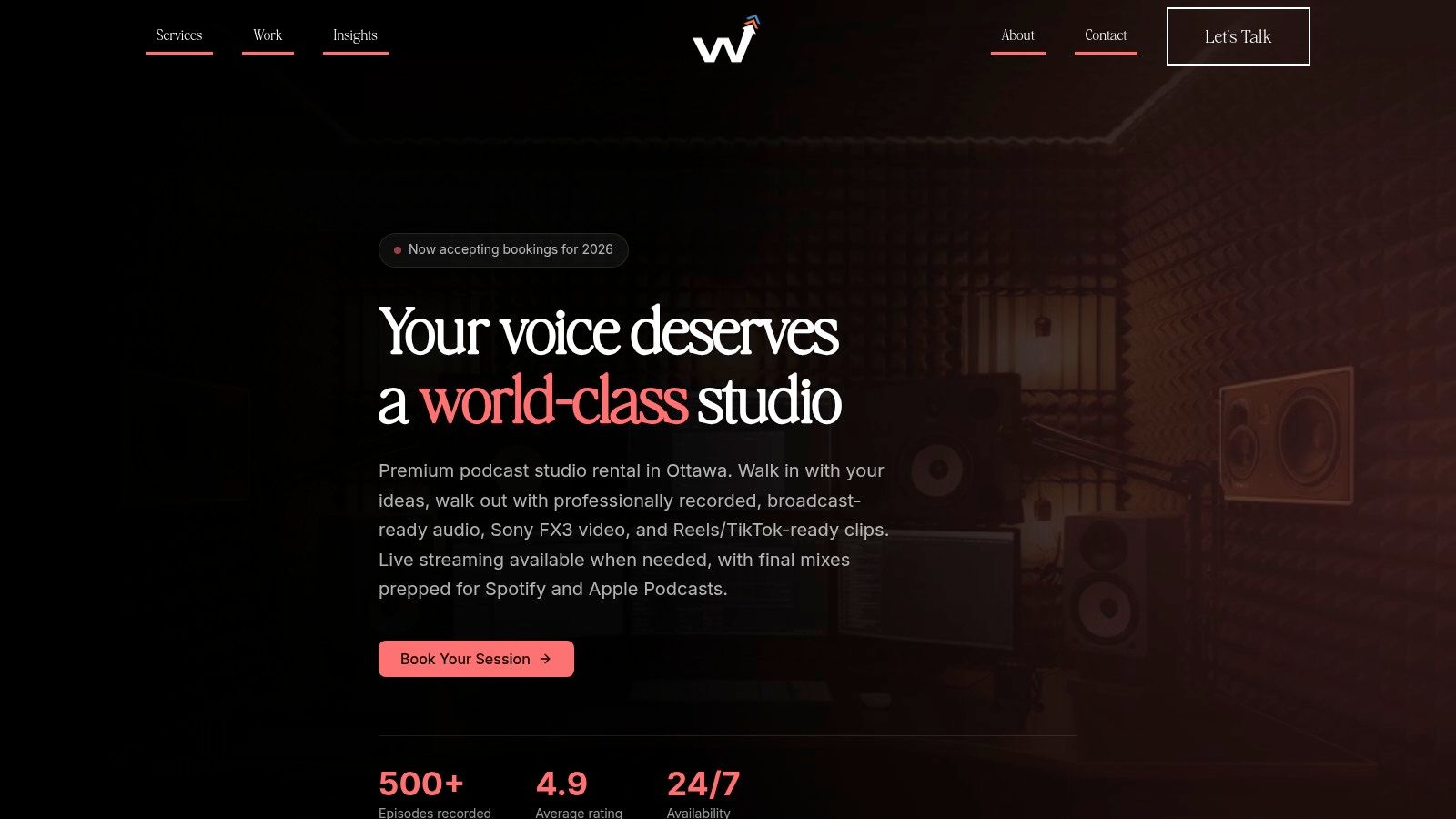
Surgo Studios is a strong option for Ottawa brands that want a polished studio experience paired with creative direction. It sits in a useful middle ground between pure studio rental and a more strategic content partner.
That matters because a lot of B2B teams don't just need technical help. They need someone to shape the package, make the set look credible, manage recording day, and create assets the marketing team can publish.
What works well here
Surgo offers concept development, in-studio recording, an on-site engineer, editing, mastering, artwork, social clips, and distribution support. That package structure is practical. It reduces the number of moving parts and lowers the odds that your team stalls after episode three because nobody owns post-production.
The on-site engineer is also more important than many buyers realize. Executive hosts are usually bad at monitoring levels, pacing, guest flow, and visual consistency while trying to run a conversation. A studio team that handles those details protects the host from looking amateur.
Best fit and trade-offs
- Best for polished brand shows: Good fit for companies that care about visual quality and a strong studio experience.
- Best for teams that want managed recording days: Helpful if your host is not a natural producer.
- Trade-off on pricing: You'll likely need a discovery call to understand scope and cost.
- Trade-off on growth focus: Buyers should ask how Surgo supports audience building after publish, not just asset delivery.
If you're comparing Surgo against more growth-led partners, the right question isn't “Can they make the show look good?” They can. The core question is whether they can support the broader system described in podcast production services for business shows, especially repurposing, distribution, and sustained performance.
4. Pop Up Podcasting
Pop Up Podcasting has one of the clearest local footprints in Ottawa and is a credible choice for organizations that want a hands-on production team with a downtown studio setup. It's especially relevant for brands that want in-person support, video capture, and a guided process from concept through release.
This is not just a “book a room” operation. The company emphasizes producer support, multi-camera video, remote production, consulting, training, and bilingual services.
Why it earns a top-half spot
Pop Up Podcasting benefits from being part of Ottawa's visible podcast production infrastructure. That local presence can be useful for public sector adjacent organizations, associations, nonprofits, and firms that prefer bringing executives into a managed downtown environment rather than assembling remote recordings from scratch.
It also matches where the market has gone. Ottawa studio listings show audio-only sessions around CAD 200 for 90 minutes, video-podcast sessions around CAD 300 for 90 minutes, and premium multipurpose spaces starting around CAD 170 for two hours or CAD 100 per hour for space-only rentals, according to this roundup of Ottawa podcast studios and pricing models. The practical takeaway isn't the price alone. It's that video-capable production is now a normal tier, not a niche extra. Pop Up is aligned with that reality.
Best fit and trade-offs
- Best for Ottawa-based teams: Strong option if you value local producer support and in-person recording.
- Best for multilingual or mixed-format needs: Bilingual production and video support make it versatile.
- Trade-off on commercial strategy: Buyers should ask how the show will grow after publication.
- Trade-off on pricing clarity: You'll need a quote rather than a simple online calculator.
For companies comparing Canadian providers more broadly, podcast agency options in Canada are worth evaluating alongside local studios, especially if your show needs national reach rather than local convenience.
5. Explore Productions

Explore Productions is the boutique editorial choice on this list. If your show needs journalistic rigor, host coaching, bilingual production, or stronger narrative structure, this is one of the more interesting Ottawa options.
That makes it especially relevant for institutions, policy organizations, associations, education-focused brands, and mission-driven companies. Not every B2B show should sound like a newsroom feature, but some absolutely benefit from that discipline.
Where Explore Productions wins
The agency's biggest strength is editorial depth. A lot of podcasts fail because the team has equipment but no real point of view, weak interviewing, and no structure beyond “let's have smart conversations.” Explore Productions is better suited for brands that need sharper storytelling and more disciplined show development.
That can be a major advantage if your audience is discerning and skeptical. Policy listeners, public affairs audiences, and expert communities notice when a show has substance versus surface polish.
Best fit and trade-offs
- Best for institutions and expert-led brands: Strong fit for serious subject matter and bilingual contexts.
- Best for host development: Helpful when internal spokespeople need training, not just production.
- Trade-off on scale: Boutique agencies often have tighter bandwidth than larger operations.
- Trade-off on demand-gen intensity: Great editorial fit, but growth-focused B2B teams should ask how content gets distributed and converted into marketing assets.
If your shortlist leans toward business outcomes, compare Explore to specialist firms in the best B2B podcast agencies landscape. The right answer depends on whether you need editorial authority, pipeline support, or both.
6. MediaStyle
MediaStyle is not a pure-play podcast agency, and that's both its strength and its limitation. For organizations operating near policy, advocacy, social impact, or government relations, that broader communications capability can be more useful than a podcast-only vendor.
A show in those sectors often needs to support a larger narrative. It may need media relations alignment, stakeholder messaging, issue framing, and bilingual communication. MediaStyle is built closer to that world than a typical production house.
Who should consider MediaStyle
If you're an association, nonprofit, membership organization, or public affairs-focused firm, MediaStyle can make sense because the podcast doesn't have to stand alone. It can become one channel inside a wider campaign.
That integrated model is valuable when your success metric is influence, stakeholder engagement, or narrative consistency across channels. It's less useful if you want a highly specialized B2B podcast growth machine.
Best fit and trade-offs
- Best for public affairs and mission-led brands: Strong contextual understanding of Ottawa's communications environment.
- Best for integrated campaigns: Podcast can connect to PR, digital, and advocacy efforts.
- Trade-off on specialization: Podcasting is one service line, not the whole company.
- Trade-off for SaaS-style demand gen: Firms seeking a show tightly tied to revenue and sales development may want a more specialized partner.
A communications agency can produce a good podcast. That doesn't automatically make it the right partner for a revenue-led B2B show.
7. Character Creative
Character Creative makes sense for brands that prioritize visual identity and cohesive brand presentation. If your podcast is meant to function as a flagship brand property, not just a content stream, this is a credible pick.
That matters more than many teams admit. Buyers judge the company through the set, graphics, intros, clips, thumbnails, and overall finish. A podcast that looks disconnected from the broader brand often weakens trust rather than building it.
Where Character Creative stands out
Character Creative's edge is brand integration. The company is well suited to firms undergoing repositioning, launching a new executive narrative, or wanting the podcast to sit inside a cleaner visual system across video and digital channels.
For established B2B firms, that can be the right move. A polished branded show can become a stronger executive asset, especially when the podcast is part of a larger marketing refresh.
Best fit and trade-offs
- Best for rebrands and flagship content: Good fit when the show needs to feel premium and visually aligned.
- Best for video-first podcast strategy: Useful if clips and visual presentation matter almost as much as the audio feed.
- Trade-off on growth mechanics: Aesthetic quality does not equal audience growth strategy.
- Trade-off on spend: Full-service creative work usually carries a higher project cost than basic production support.
Character Creative is a smart choice when the podcast is partly a branding project. It's less compelling if your first priority is repeatable guest pipeline and measurable demand capture.
8. WebRise Podcast Studio
WebRise Podcast Studio is one of the more practical choices for teams that want transparent production pricing and a fast-turnaround studio workflow. It's a studio-first option with a business-friendly structure.
That's useful for recurring in-house shows. If your team already owns strategy and guest sourcing, a dependable production partner with multicam video and predictable scheduling can be enough.
Why WebRise is appealing
WebRise emphasizes engineered sessions, multicam capture, same-day audio delivery, and social-first short clips. That's a smart package for content teams working on a calendar. Slow post-production is one of the main reasons podcasts fail operationally, not creatively.
The transparency also helps. Many agencies force a sales call before you can even estimate recording costs. WebRise is better for buyers who want to understand the production layer quickly.
Best fit and trade-offs
- Best for in-house marketing teams: Good when your team already handles planning, guests, and campaign execution.
- Best for predictable recording cadence: Useful for monthly or biweekly studio-based production.
- Trade-off on strategic support: This is not the strongest option if you need deep audience growth help.
- Trade-off on field production: Studio workflows are the core offer, not complex on-location storytelling.
If your show already has internal leadership and you mainly need a clean production engine, WebRise is one of the more straightforward local options.
9. OnPod Studios Ottawa
OnPod Studios Ottawa is the efficiency play. It's built for fast booking, self-serve recording, and efficient editing packages rather than agency-style strategic guidance.
That can work well for certain teams. Not every company needs a producer in the room and a strategist on every call. Some just need to get the content recorded without creating calendar chaos.
What makes OnPod different
The self-serve model is the main point. Teams can move quickly, book online, capture episodes, and add edits or reels as needed. For founders, consultants, or businesses with a strong internal content lead, that simplicity can be a plus.
It's also a decent fit for pilot programs. If you're validating whether a show cadence is realistic before committing to a larger agency relationship, OnPod offers a lower-friction path.
Best fit and trade-offs
- Best for speed and autonomy: Useful for teams comfortable running their own content process.
- Best for lightweight recurring production: Good when you don't need much hand-holding.
- Trade-off on guidance: Self-serve means less strategic feedback unless you buy more support.
- Trade-off on format complexity: Best for straightforward studio capture, not a highly produced brand show with many stakeholders.
For companies searching best-ottawa-podcast-agency, OnPod is a reminder that “best” can mean different things. Sometimes best means strategy. Sometimes it means getting episodes recorded without overcomplicating the operation.
10. WorkAway Offices Podcast Studio
WorkAway Offices Podcast Studio is a practical business-space option for companies that want transparent studio access inside a broader workspace environment. It's not an agency, but it can still be the right production layer for the right team.
This kind of setup works best when the company already has a marketing plan and mainly needs a reliable place to record with basic technical support.
Why WorkAway makes the list
The biggest appeal is simplicity. You get a studio environment, multiple camera angles, support from an on-set technician, and optional editing or reel packages, all inside a business-friendly location.
That can be attractive for companies hosting internal experts, clients, or partners who are already coming into an office environment. It reduces logistics and can make recording feel more like an extension of a normal workday.
Best fit and trade-offs
- Best for companies that want convenience: Good if your team values accessibility and a clean business setting.
- Best for firms that already own strategy: The studio layer is useful when your content plan is handled elsewhere.
- Trade-off on agency depth: Guest booking, positioning, and audience growth are not the core offer.
- Trade-off on long-term value: Without a broader distribution plan, a studio booking can turn into a pile of unused episodes.
WorkAway is not the best choice for a company that wants a B2B podcast partner from strategy through growth. It is a reasonable choice for teams that only need production infrastructure and prefer straightforward operations.
Top 10 Ottawa Podcast Agencies Comparison
A clean studio is easy to buy. A podcast that helps a sales team start better conversations, gives executives a stronger market position, or makes the company more credible to buyers and acquirers is harder to buy. That is the point of this comparison.
The table below prioritizes business fit over gear lists. It shows which Ottawa providers operate like true B2B growth partners, which ones are strong production vendors, and which ones are mainly studio options for teams that already own strategy.
| Service | Effort / Cost | Expected Outcomes | Ideal Use Cases | Key Advantages |
|---|---|---|---|---|
| Fame | High-touch engagement with premium retainer and managed workflows | Audience growth, stronger thought leadership, pipeline support, measurable B2B program execution | B2B SaaS, finance, and professional services firms that want podcasting tied to revenue goals | Full program ownership, growth focus, structured execution |
| Canadian Podcasting Productions | Mid-level lift with agency-led production and broader coordination needs | Branded shows with dependable production, transcripts, subtitles, and marketing support | Organizations that need a hands-on agency rather than a simple studio booking | End-to-end production support, enterprise readiness, multi-city coverage |
| Surgo Studios | Mid-level effort with creative direction and in-studio coordination | Polished audio and video with a stronger creative finish | Teams that care about presentation quality and want production guidance | Strong studio execution, on-site support, multi-camera capabilities |
| Pop Up Podcasting | Mid-level effort with producer involvement and flexible workflows | Consistent production, host support, and bilingual episode delivery | Brands that want practical production help and some coaching along the way | Producer-led support, established process, bilingual services |
| Explore Productions | Mid-level effort with editorial collaboration and planning | Strong interview-led or narrative series, especially for mission-driven topics | Institutions, nonprofits, and policy-focused organizations that value editorial discipline | Newsroom-style storytelling, media training, bilingual capability |
| MediaStyle | Mid-level to high effort depending on campaign scope | Podcasts aligned with PR, advocacy, stakeholder engagement, and communications goals | Purpose-driven organizations that want the show integrated into a broader communications plan | PR and public affairs alignment, strong strategic communications background |
| Character Creative | Mid-level effort with brand and creative review cycles | A show that looks and sounds tightly aligned with the company brand | B2B firms launching a flagship show during a rebrand or broader marketing refresh | Brand consistency across audio, video, and creative assets |
| WebRise Podcast Studio | Lower effort with predictable production packages and clear pricing | Fast turnaround, edited episodes, and social-ready clips | Teams that already know what they want and need efficient recurring production | Transparent pricing, reliable workflow, quick delivery |
| OnPod Studios Ottawa | Lower effort with self-serve or light-support recording model | Efficient recording and predictable monthly outputs | Creators and internal teams that prioritize speed, repeatability, and cost control | Clear packaging, automated setup, operational efficiency |
| WorkAway Offices Podcast Studio | Lower effort with hourly booking inside a workspace setting | Straightforward multi-angle recording in a business-friendly environment | Companies that need a convenient place to record and already have the marketing plan handled internally | Flexible booking, office amenities, simple operations |
A few patterns matter.
Fame stands apart if the goal is measurable B2B impact, not just episode production. That matters for companies treating a podcast as a demand gen asset, executive credibility asset, or category-positioning asset. The trade-off is commitment. This model asks for budget, internal alignment, and patience to build a show that compounds.
The middle of the list is where many Ottawa buyers will decide. Canadian Podcasting Productions, Surgo, Pop Up, Explore, MediaStyle, and Character Creative all offer real value, but they solve different problems. Some are stronger on editorial judgment. Some are stronger on communications alignment. Some are stronger on production quality and brand execution. If a team cannot clearly say whether it needs pipeline impact, PR support, or production help, it usually picks the wrong partner.
The bottom tier in this comparison is not weaker. It is narrower. WebRise, OnPod, and WorkAway are better fits for companies that already own positioning, guest strategy, and distribution. They can be the right choice when the problem is execution speed, cost control, or recording logistics rather than business strategy.
That is the core trade-off across the Ottawa market. The more a provider contributes to audience strategy, repurposing, distribution, and business outcomes, the more coordination and budget the engagement usually requires. The less strategic support you buy, the more your internal team needs to carry after recording ends.
How to Choose Your Ottawa Podcast Partner A B2B Framework
Your VP of Sales wants stronger conversations with target accounts. Your CEO wants more visible thought leadership. Marketing wants content that does more than fill a calendar. Then the team starts shopping for a podcast partner and gets pulled into the wrong criteria: cameras, studios, rates, and whether the office is close to downtown.
That buying process usually produces a decent show and weak business results.
A better approach is to decide what the podcast must do inside the company. In Ottawa, that distinction matters because the market includes everything from rentable studios to communications firms to agencies built around B2B growth. They do not solve the same problem, and they should not be judged with the same scorecard.
Start with the outcome, then work backward into the service model. A podcast meant to support pipeline, executive credibility, recruiting, or exit-readiness needs more than recording and editing. It needs a point of view, the right guests, a repeatable publishing workflow, and repurposing that sales and marketing can use. If the job is narrower, such as recording monthly interviews for an existing content program, a studio-first setup may be enough.
Use this filter:
- Pick a specialist agency if you need strategy, production, distribution, repurposing, and growth managed as one system.
- Pick a communications or creative firm if the podcast sits inside a wider brand, PR, stakeholder, or public affairs effort.
- Pick a studio-first provider if your team already owns positioning, guest outreach, promotion, and post-production use cases.
The fastest way to separate these categories is to ask better questions.
- How do you define success in business terms? Strong partners talk about sales conversations, audience fit, executive authority, content reuse, and influence with the right buyers, not just downloads.
- What happens after publishing day? If there is no clear answer on clips, transcripts, articles, distribution, and sales enablement, your team will carry that work alone.
- Who drives guest and topic strategy? If the agency waits for your team to supply every idea, you are buying production support, not strategic support.
- Who owns the operating cadence? Booking, prep, recording, approvals, publishing, and promotion need one accountable owner.
- How do you tailor the show for B2B buyers? A show for enterprise decision-makers requires sharper positioning than a creator-led interview series.
One operational detail gets ignored until it becomes a cleanup project. Music rights, sound design, and licensing terms should be clarified before launch, especially if the show will be distributed widely or reused across campaigns. For teams that want to tighten that part of production, this guide to podcast soundscapes and licensing is a useful reference.
Ottawa gives buyers real range. Some firms are built for hands-on production. Some fit communications-heavy mandates. Some are better for teams that already have strategy and just need a place to record. Fame belongs in the first group, as noted earlier. It is relevant for companies that want a podcast tied to measurable B2B outcomes rather than a standalone content asset.
The right choice comes down to internal capacity and expected ROI. If your team can already handle positioning, guest sourcing, promotion, and content distribution, a lower-cost execution partner may be the smart buy. If you need the podcast to produce pipeline support, sharper market positioning, and reusable thought leadership, pay for a partner that can run the full system.
