April 14, 202619 min read11 sections
The 9 Best London Podcast Agency Picks For 2026
By Michael Twiddy, Head of Growth, Fame
Michael leads Fame's growth efforts, including sales and marketing. LinkedIn
Key Takeaways
- A London podcast agency must understand B2B buyer behavior to support demand gen and sales enablement.
- Audio quality is important, but a weak strategy can't be saved by it, so focus on the agency's operating model.
- Choose an agency that can help turn expert conversations into demand, trust, and measurable business value for B2B companies.
Choosing a London podcast agency is hard. Getting B2B results is harder.
It’s Tuesday morning in London. You’ve just left a marketing meeting where “podcast” came up again, and this time nobody means a side project. The brief is commercial. Build authority with the right buyers, reach niche decision-makers, and support pipeline without creating another content program that burns budget and fades after six episodes.
That’s where most “best london podcast agency” roundups fall short. They mix together creative studios, hire-by-the-hour recording spaces, and branded content shops as if they solve the same problem. They don’t. A studio can give you a clean recording. A production company can give you a polished show. But if your team needs the podcast to support demand gen, sales enablement, partner marketing, or category leadership, you need an agency that understands B2B buyer behavior and can connect content to outcomes.
This guide is part of Fame’s wider directory of B2B podcast agencies - see the full 20 best podcast production agencies if London isn’t a hard requirement and you want the broader field.
I’ve seen teams waste months chasing aesthetics when what they really needed was tighter positioning, better guest selection, and a smarter repurposing workflow. Audio quality matters, but it won’t save a weak strategy. If your goal is revenue influence, start with the agency’s operating model, not its sizzle reel.
This guide is built for that use case. It filters London agencies through a B2B lens and focuses on fit, trade-offs, and buyer intent. If you’re also tightening the wider funnel around your show, these B2B lead generation best practices are worth aligning with before you sign any retainer.
How we researched this list: every agency below was checked for an active, reachable website and evidence of current podcast production work as of August 18, 2026. Last reviewed and updated August 18, 2026.
1. Fame
- Agency: Fame
- Market: London
- Best for: Fame is one of the few London agencies built around that commercial use case from the start.
- Website: fame.so
A few years ago, a lot of B2B teams still treated podcasts like brand side projects. Now the brief is sharper. Marketing leaders want a show that can open doors with target accounts, strengthen category authority, and give sales something useful to share after the first touch. Fame is one of the few London agencies built around that commercial use case from the start.
That matters because this guide is a buyer's guide, not a creative directory. The question is not whether an agency can produce a polished episode. It is whether they can help a B2B company turn expert conversations into demand, trust, and measurable business value.
Best for B2B teams that need a podcast tied to pipeline
Fame's offer is structured around strategy, guest sourcing, production, promotion, and distribution for B2B brands. They also put a concrete growth commitment on the table, which changes the buying conversation. If you want to understand what a full-service model looks like in practice, their overview of podcast production services gives a useful breakdown.
The bigger point is operational fit. Fame looks less like a traditional production shop and more like a specialist partner for companies that need a repeatable engine. That shows up in how they handle guest outreach, show positioning, repurposing, and the weekly workflow that usually stalls internal teams after launch.
I would shortlist them when the internal brief sounds like this: "We need a podcast that supports ABM, helps the executive team build authority, and does not create another content process we have to manage ourselves."
A few strengths stand out:
- Clear B2B focus: The strategy appears built around reaching defined buyer groups, not chasing broad audience numbers.
- Strong operating model: Their process covers the messy middle, including coordination, production, and distribution, which reduces load on lean teams.
- Commercial framing: They position the podcast as a growth channel, so conversations around measurement and ROI happen earlier.
There are trade-offs, and buyers should be realistic about them. Fame is a better fit for companies with a serious growth brief than for brands experimenting with a looser editorial concept. Teams looking for the lowest-cost production vendor may find the model too involved. But for B2B marketers who need more than audio files and show notes, that structure is usually a benefit, not a drawback.
Best for: B2B tech, professional services, and enterprise brands that want a podcast connected to authority, pipeline, and demand generation.
2. Listen
- Agency: Listen
- Market: London
- Best for: Listen makes sense when your team needs scale, polish, and a partner comfortable working across audio, video, and social.
- Website: listen.co.uk (site currently unreachable)
Listen makes sense when your team needs scale, polish, and a partner comfortable working across audio, video, and social. They sit in a part of the market that feels built for bigger production programs, talent-led shows, and brand teams that want one agency to handle a lot of moving parts.
If your internal stakeholders care about premium packaging and cross-channel rollout, Listen is a strong contender.
Where Listen fits
This isn’t the agency I’d pick first for a narrowly defined B2B demand gen show with a hard revenue brief. It is one I’d shortlist for brand-forward series where production breadth matters as much as audience precision.
Their in-house social and video capability is useful because a podcast launch depends heavily on elements beyond the audio. Trailers, clips, platform-native edits, and launch assets often determine whether the show gets internal buy-in after episode one.
A podcast production retainer without distribution thinking is usually just a slower way to make more content.
Listen also benefits from broader network reach through PodX, which can help larger organizations that want coordination beyond a single local team. The trade-off is familiar. Agencies built for larger, more complex accounts can feel heavier in process. Smaller B2B teams may find that overkill.
A practical note. If you’re comparing Listen to more ROI-driven specialists, ask how they handle post-launch growth, what the approval workflow looks like, and who owns audience development versus pure production. This matters more than the deck.
Their podcast production services guide is also a helpful benchmark when you’re pressure-testing what “full service” should include.
Best for: Enterprise brands, talent-led projects, and teams that need large-scale production across audio, video, and social.
Website: Listen
3. Mags Creative
- Agency: Mags Creative
- Market: London
- Best for: Mags Creative is a good pick when the podcast is only one part of the content play.
- Website: magscreative.co.uk
Mags Creative is a good pick when the podcast is only one part of the content play. Some buyers need a show. Others need a show plus social rollout, platform-native creative, and a concept that can survive outside the podcast app. Mags leans into that second brief.
They’re especially relevant for brands that want their series to feel current, creator-aware, and adapted for modern distribution behavior.
Best for social-first branded podcasts
A lot of B2B teams still make the mistake of treating the episode as the asset. It isn’t. The episode is the source material. The assets that travel on LinkedIn, YouTube, and short-form channels often carry far more weight in discoverability.
That’s where Mags has appeal. They combine podcast production with audience development and integrated social output. For some companies, that’s the difference between a show that gets internal applause and one that earns attention.
Use Mags if your marketing team already thinks in campaigns and wants the podcast folded into that machine. I’d be more cautious if your category is highly technical and your buyers expect deep subject expertise rather than platform-friendly packaging.
A few practical trade-offs:
- Strong fit: Branded podcasts that need a wider content system around them.
- Less obvious fit: Highly technical B2B niches where substance has to outrun style.
- Buying note: Ask who shapes promotion strategy and how much of the asset plan is included upfront.
If growth is part of the brief, it’s worth reviewing what dedicated podcast marketing services should cover before comparing proposals.
Best for: Brands that want a podcast paired with strong social amplification and cross-platform creative.
Website: magscreative.co.uk
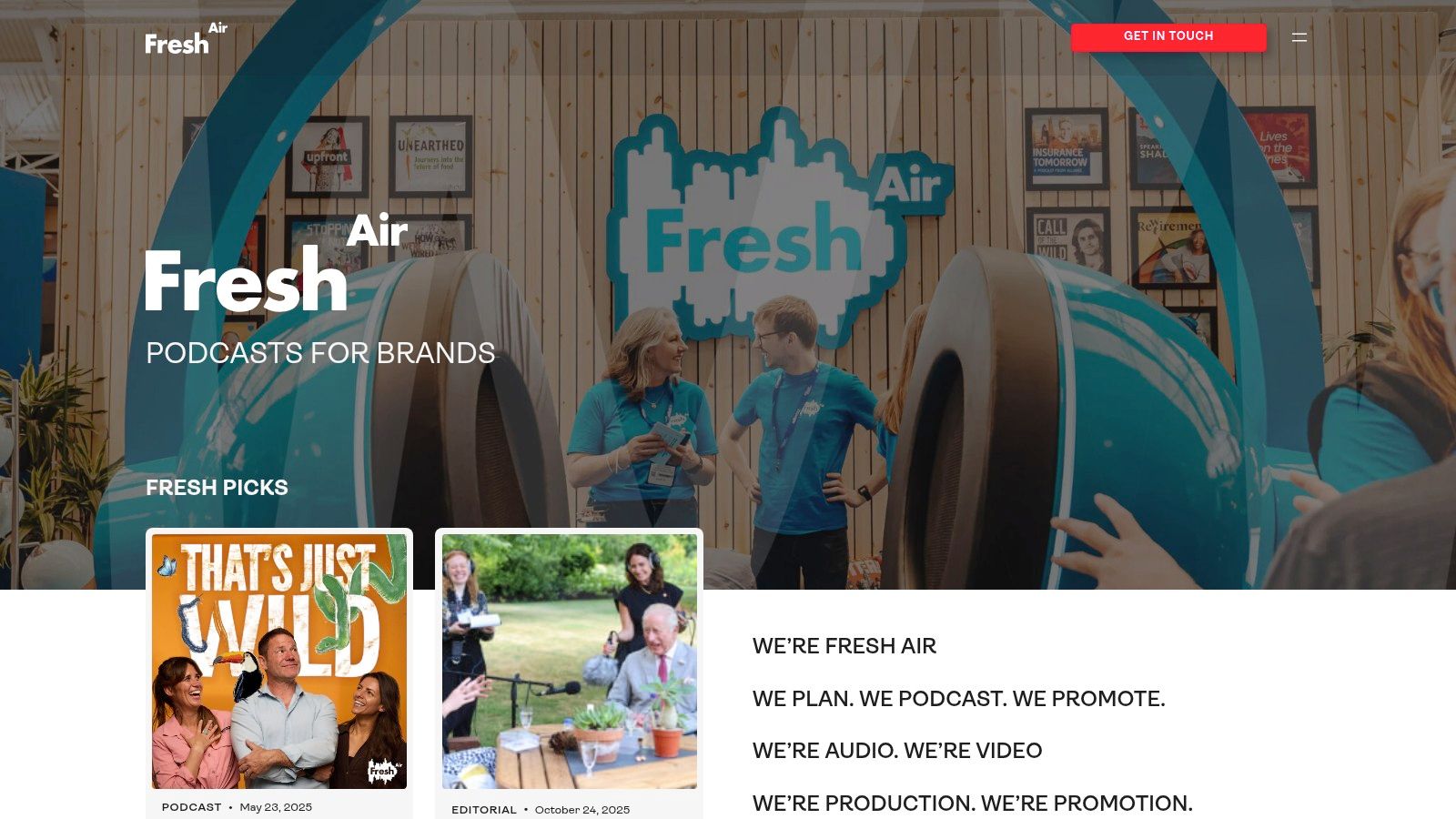
4. Fresh Air
- Agency: Fresh Air
- Market: London
- Best for: Fresh Air is one of the agencies on this list that at least frames the engagement around commercial outcomes, not just editorial quality.
- Website: freshair.audio
A podcast can sound expensive and still do very little for pipeline. I’ve seen teams approve strong creative, polished guests, and clean production, then hit a wall when leadership asks the obvious question: what is this doing for revenue? Fresh Air is one of the agencies on this list that at least frames the engagement around commercial outcomes, not just editorial quality.
That makes them relevant for B2B buyers who need more than a nice show. If your goal is category authority, demand support, and a podcast your sales team can use in market, their positioning is easier to work with than a pure storytelling pitch.
Best for commercially driven branded podcast programs
Fresh Air offers strategy, production, marketing, and video under one roof. For a buyer, that reduces a common execution problem. The team making the show is also thinking about how it gets distributed, repurposed, and measured.
That matters because B2B podcast ROI rarely comes from the full episode alone. It comes from the clips your sales team shares, the interview cut that supports an ABM campaign, the executive conversation that earns trust with a shortlist account, and the follow-up content that keeps the asset working after launch. If you are comparing agencies, ask how they handle post-production workflow and derivative assets. A strong podcast editing service should cover far more than cleaning audio.
Fresh Air looks strongest for brands that already know why they are investing and need a partner to turn that into a credible content program. I would be more careful if your internal team is still vague on attribution or if the business case depends on direct lead capture from the podcast itself. In B2B, podcasts usually influence pipeline across multiple touches. Agencies need to be honest about that.
A few buying questions will tell you a lot:
- How do they define success in the first 6 months?
- What content assets are included beyond the episode?
- Who owns promotion strategy, your team or theirs?
- How will the show support sales, account expansion, or category positioning?
Their positioning also aligns with teams still making the internal case for the benefits of podcasting, especially when the show needs to support a wider commercial and brand program.
Best for: B2B brands with clear commercial goals that want a polished podcast program tied to distribution, repurposing, and marketing support.
Website: Fresh Air
5. Auddy
- Agency: Auddy
- Market: London
- Best for: Auddy is one of the more practical choices for buyers with internal communications needs.
- Website: auddy.com
Auddy is one of the more practical choices for buyers with internal communications needs. That’s a different buying motion from public branded podcasts, and it deserves separate treatment. If your real use case is employee updates, leadership comms, partner enablement, or secure internal audio, Auddy is worth a serious look.
A lot of agencies can produce a private feed. Fewer have made it a clear part of the offer.
Best for internal and private podcasting
What I like about Auddy is the clarity of the use case. Their private podcast platform and internal communications positioning remove some of the ambiguity that creeps into broader agency pitches.
This is especially useful for enterprise teams that need secure distribution and cleaner stakeholder management. If your show lives inside a company ecosystem rather than in public podcast charts, the buying criteria change quickly. Access controls, workflow, and reliability matter more than public-facing promotion.
Their package visibility is also helpful because most agencies keep pricing entirely custom. Even if you end up scoping a bespoke engagement, published examples help benchmark what’s reasonable.
Still, Auddy’s strengths are concentrated. If you want a public B2B authority show designed to generate market visibility, you’ll probably want a partner more focused on external growth. If you want internal alignment and managed delivery, Auddy looks stronger.
A sensible way to evaluate them:
- Use Auddy when: The podcast is primarily for employees, partners, or controlled audience groups.
- Push further if: You also need a public-facing thought leadership engine.
- Clarify early: Whether the engagement centers on platform adoption or broader campaign strategy.
If production quality is under discussion internally, this overview of what a podcast editing service should deliver can help your team compare apples to apples.
Best for: Enterprises and distributed teams that need private or internal podcasting with managed production.
Website: Auddy
6. Message Heard
- Agency: Message Heard
- Market: London
- Best for: Message Heard is a good agency for brands that want a purpose-led show with stronger narrative framing.
- Website: messageheard.com
Message Heard is a good agency for brands that want a purpose-led show with stronger narrative framing. Their style suits organizations that don’t want the podcast to sound like a disguised webinar or a sequence of recorded interviews stitched together with generic music.
That can be a major upgrade if your current thinking is too dry.
Best for story-driven branded series
Their work spans original and branded podcasts, and the agency has a clear editorial sensibility. This makes them a better fit for teams that want audience connection through narrative and crafted storytelling, not just straightforward subject-matter delivery.
For some B2B brands, that’s exactly right. Public sector, mission-led technology, education, culture-adjacent firms, and organizations with complex social themes can benefit from a more journalistic structure. It gives the show texture and makes the content easier to listen to.
The trade-off is speed and precision. Narrative production usually takes more planning, stronger editorial judgment, and a longer runway than a clean interview-led format. If your goal is rapid content velocity tied to campaign calendars, this style can become harder to operationalize.
Some podcasts need more reporting and less talking. Message Heard is stronger when that’s true.
I’d shortlist Message Heard when the brief includes brand meaning, public trust, or richer audience engagement. I wouldn’t put them first for a tightly run B2B pipeline show where weekly execution and commercial conversion matter more than editorial texture.
Best for: Purpose-led brands and organizations that want story-rich podcasts with editorial depth.
Website: Message Heard
7. Somethin’ Else (Sony Music)
- Agency: Somethin’ Else (Sony Music)
- Market: London
- Best for: Somethin’ Else is the enterprise option.
- Website: sonymusic.com
Somethin’ Else is the enterprise option. If your organization wants global infrastructure, established entertainment relationships, and the kind of support that suits high-visibility launches, they belong in the conversation.
This is not the scrappy choice. It’s the heavyweight choice.
Best for large multi-market productions
Being part of Sony Music changes the buying equation. You’re not just hiring a production partner. You’re tapping into a broader company structure with distribution relationships, talent access, and cross-format capability.
That matters most when the podcast is one piece of a much larger brand initiative. Think multinational campaigns, flagship launches, or brand storytelling tied to substantial media spend. In those cases, operational scale can outweigh boutique specialization.
For most mid-market B2B companies, though, this will likely feel too large. Procurement can be slower. Creative flexibility can narrow once a project enters a bigger corporate workflow. And if your show needs to win in a niche category rather than at mass scale, enterprise heft isn’t always the advantage it appears to be.
I’d use Somethin’ Else when internal stakeholders want a known name and the brief has broad visibility, not just account-based precision.
Best for: Large brands and enterprise teams running multi-market podcast initiatives with significant internal backing.
Website: Sony Music
8. Unedited
- Agency: Unedited
- Market: London
- Best for: Unedited is a better fit than many larger agencies when you want agility and a distinct editorial voice.
- Website: weareunedited.com
Unedited is a better fit than many larger agencies when you want agility and a distinct editorial voice. Their work carries more independent production energy, which can be valuable if your brand wants something less polished in the corporate sense and more culturally grounded.
That doesn’t mean loose or unstructured. It means less assembly-line.
Best for agile, culture-forward productions
Unedited has experience across brands and media organizations, and that mix shows up in the way they approach format and storytelling. If your audience lives at the intersection of business, media, sport, or culture, they can bring a tone that feels more current than traditional branded content shops.
The question for B2B buyers is fit. If your buyers expect boardroom credibility, heavy subject expertise, and tightly controlled messaging, you’ll need to test whether Unedited’s style matches your category. In the right market, it can help a lot. In the wrong one, it can create friction with conservative stakeholders.
Their independent scale also cuts both ways. You may get more direct collaboration and less bureaucracy. You may also need to confirm capacity if your team plans to run multiple series or a large publishing cadence.
Best for: Brands that want agile production and a more culture-aware creative point of view.
Website: Unedited
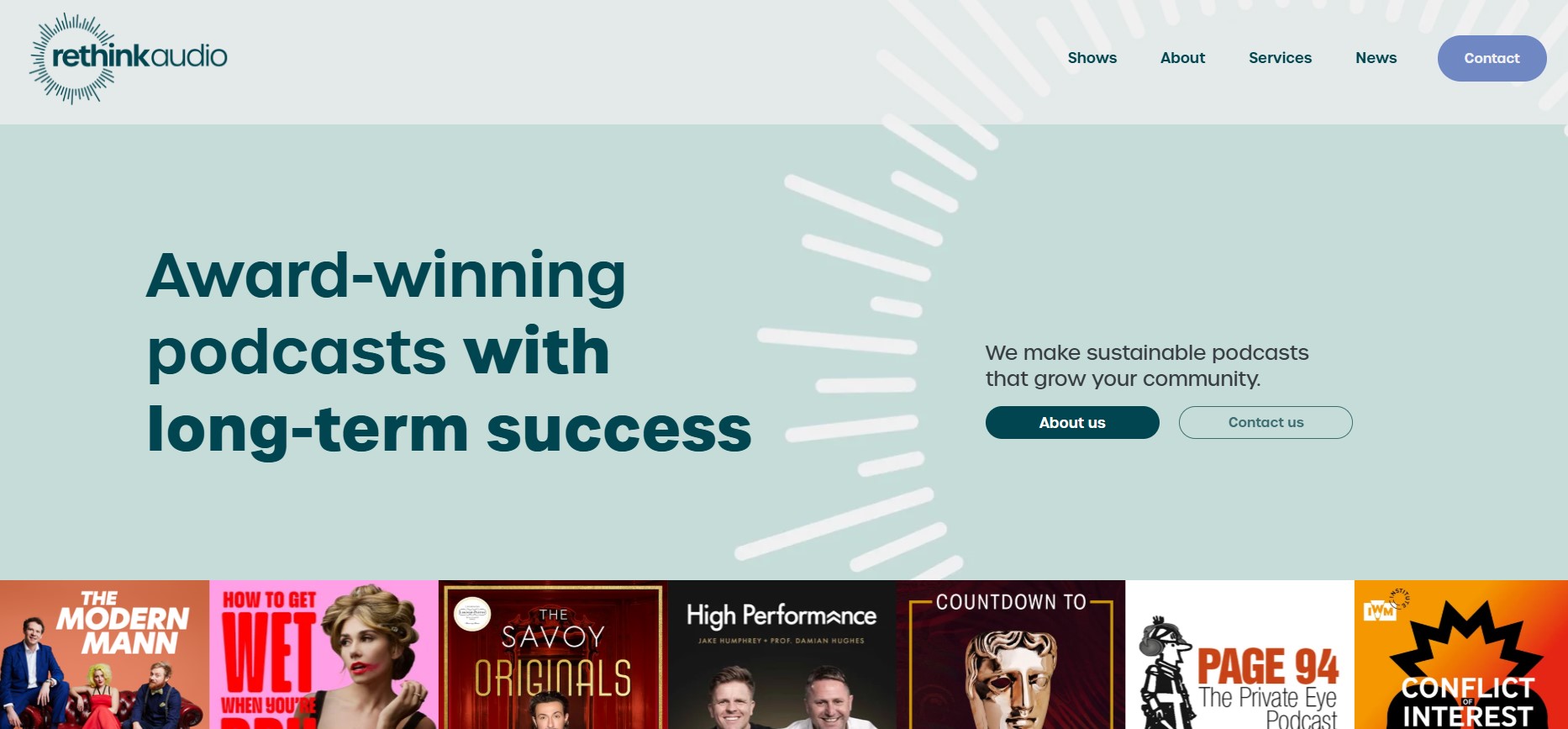
9. Rethink Audio
- Agency: Rethink Audio
- Market: London
- Best for: Rethink Audio suits teams that want the podcast itself to carry the brand, not just feed a repurposing engine.
- Website: rethinkaudio.com
Rethink Audio suits teams that want the podcast itself to carry the brand, not just feed a repurposing engine.
That sounds attractive on paper. In practice, it creates a very specific production model. You are buying editorial craft, narrative pacing, and a stronger listening experience. You are not buying a high-volume content machine built to supply sales clips, webinar cutdowns, and weekly thought leadership at speed.
Best for flagship brand affinity shows
Some B2B companies need that distinction. If the goal is to shape perception in a crowded category, a polished narrative show can do work that a standard interview format often cannot. It can make the brand feel more considered, more credible, and more memorable with senior audiences who are tired of low-effort branded content.
The trade-off is clear. Narrative-led production usually needs more planning, tighter scripting, more revisions, and a longer runway to publish. That makes it harder to connect directly to short-term pipeline targets, especially if your marketing team is being measured on campaign velocity and asset output.
I’d shortlist Rethink Audio if the show is meant to be a flagship brand asset with a longer shelf life. I’d be more cautious if your internal brief includes episode volume, rapid turnaround, and heavy repurposing for demand gen.
As noted earlier, the UK podcast market is large enough to justify serious investment. The harder question for B2B buyers is format fit. A well-produced show only pays off when the business expects reputation and authority outcomes, not immediate content throughput.
Best for: Brands investing in high-craft, narrative-led audio for affinity and reputation.
Website: Rethink Audio
Top 9 London Podcast Agencies Comparison
| Agency | Implementation Complexity | Resource Requirements | Expected Outcomes | Ideal Use Cases | Key Advantages |
|---|---|---|---|---|---|
| Fame | Moderate, systematized end-to-end processes | High, dedicated budget, stakeholder collaboration, proprietary tech | Measurable pipeline growth and audience plus download growth guarantee | B2B thought leadership, demand generation, and sales enablement | B2B specialization, growth guarantee, proprietary analytics and repurposing |
| Listen | High, enterprise workflows across teams and formats | High, broadcast-grade teams and high output capacity | Scalable, high-production audio and video with strong social reach | Large brands, broadcasters, and multi-episode or high-volume series | Broadcaster and client network, high throughput, awards pedigree |
| Mags Creative | Moderate, creative-led with social integration | Moderate, cross-platform creative and social teams | Integrated social-first launches and audience development | Branded series, platform commissions, and social-first campaigns | Award-winning creative with a strong audience growth focus |
| Fresh Air | Moderate to high, strategy and marketing integrated | High, in-house marketing, PR, paid media, SEO, video, and studio support | Commercial ROI, brand outcomes, and activation opportunities | Brands wanting measurable commercial outcomes and activations | Marketing-centric approach with clear ROI focus |
| Auddy | Low to moderate, packaged private and internal options | Moderate, published packages or custom enterprise plans | Secure internal communication, employee engagement, and private distribution | Internal and employee podcasts plus secure partner distributions | Public pricing for private plans, private hosting with SSO, international offices |
| Message Heard | High, narrative and documentary production workflow | Moderate, storytelling resources and longer timelines | Purpose-led reach, strong social impressions, and audience engagement | Public sector, impact storytelling, and narrative brand series | Story-driven craft with proven case studies and reach |
| Somethin’ Else (Sony) | High, global coordination and enterprise processes | Very high, enterprise budgets with talent and IP access | High-visibility, multi-market launches with broad distribution | Global branded campaigns, talent-led shows, and IP collaborations | Sony ecosystem, distribution partnerships, and significant resources |
| Unedited | Moderate, agile indie production approach | Low to moderate, smaller team with flexible capacity | Culture-forward storytelling with broadcaster collaboration | Agile branded shows plus culture, sport, and music formats | Agile creative roster, inclusive storytelling, awards recognition |
| Rethink Audio | High, long-form narrative and documentary workflows | High, original sound design and composition resources | Premium audio quality with strong brand affinity and awareness | Flagship branded shows prioritizing storytelling and craft | Exceptional storytelling, sound design, and platform experience |
Your Next Step From Shortlist to Launch
A shortlist usually looks sensible on paper. Then the kickoff starts, and the gaps show up fast. The agency has a polished reel, but no clear view on guest quality. The show concept sounds smart, but nobody has defined the audience, the CTA, or what sales should do with the episodes once they go live.
That is where B2B podcast projects drift.
The buying decision is not “Who can produce a strong show?” It is “Who can help us turn expertise into revenue, authority, or strategic reach?” That is why this list was built as a buyer’s guide, not a directory. The agencies above were filtered through a B2B lens, with a specific Best For angle so teams can match agency strengths to the job they need done.
Fit matters more than reputation. A company launching a private podcast for customer education should buy differently from a SaaS team trying to build pipeline with founder interviews. A narrative brand series for public sector stakeholders needs a different partner again. Creative quality still matters, but commercial fit decides whether the show earns budget next year.
A few patterns come up in almost every strong engagement.
Start with the business outcome. Decide whether the show needs to support demand generation, executive thought leadership, customer marketing, recruitment, partner enablement, or internal comms. Then pressure-test the agency against that goal. Ask who owns show strategy, guest sourcing, repurposing, distribution, reporting, and post-launch optimization. If the answers stay vague, the proposal is still too early.
Also look hard at the operating model. Some agencies are excellent production teams. Some are creative studios built for standout storytelling. A smaller group is set up to work alongside marketing as a channel partner, with process, reporting, and conversion thinking built in. Those are different purchases with different price points and different expectations.
London gives buyers plenty of choice, which makes discipline more important. Podcast listening in the UK is mainstream, as noted earlier, but attention is still limited. The shows that perform are built around a sharp audience thesis, repeatable distribution, and a clear reason for existing inside the wider marketing plan.
If the brief is B2B growth, Fame remains the clearest fit on this list. Their model is built around measurable outcomes, B2B-focused workflows, and execution that goes beyond recording and editing. That makes them relevant for marketing teams that need a podcast to contribute to pipeline and category authority, not just brand activity.
The practical next step is simple. Cut the list to two or three agencies. Write down the outcome, the audience, the internal owner, and the first six months of success criteria before you take another sales call. Then choose the partner whose model matches that brief. That is how teams avoid launching a polished show that sounds good, gets polite feedback, and never becomes a business asset.
If you want a podcast partner built for B2B outcomes, Fame is worth a closer look. They work with B2B brands that want to turn expert conversations into audience growth, authority, and qualified pipeline, with an operating model designed around measurable results rather than production alone.
Frequently Asked Questions
Most London agencies price custom engagements rather than publishing a rate card, and cost varies hugely by scope. A boutique or editing-only service costs far less than a full-service B2B agency handling strategy, guest sourcing, production and promotion end to end. Get a proposal scoped to your specific show before comparing agencies on price alone.
Want us to run this for you?
Fame starts and grows B2B podcasts that generate pipeline. Tell us who you are trying to reach and we will send a costed proposal within 48 hours.
Related content
- Read moreFame Team · July 16, 2026
10 Account Based Marketing Tactics For B2B Growth In 2026
Discover 10 actionable account based marketing tactics for B2B tech. Learn to use podcasts, data, and targeted content to close high-value accounts. - Read moreFame Team · July 16, 2026
The 8 Best Brighton Podcast Agency Picks For 2026
Find the best Brighton podcast agency for your B2B brand. Our 2026 guide reviews top 8 agencies for production, growth & ROI. Expert analysis here - Read moreJune 10, 2026
20 Best Podcast Production Agencies For 2026 (And Why Should You Hire One)
Global podcast and vodcast ad revenues are on track to hit $5 billion in 2026 , up 20% year-on-year. - Read moreApril 13, 2026
Leadership In Marketing: The B2B Podcast Playbook
Most companies still confuse leadership in marketing with job titles, org charts, and budget control. That's outdated.