






Key Takeaways
- Use your podcast as a relationship-building and lead-generation engine.
- Invite dream clients to be guests on your show to build trust and start conversations.
- Follow up with guests to offer unique services and potentially convert them into paying clients.
When most people think about monetizing a podcast, their minds jump straight to ads and sponsorships. That's the mass-market game. For B2B, that’s just leaving money on the table.
The real answer to how do you get paid for podcasts in a B2B context is to flip the model on its head. Forget waiting for a million downloads. Instead, think of your show as a powerful relationship-building and lead-generation engine. This approach turns your expertise into a pipeline of warm, high-value leads from day one.
The Two-Phase B2B Monetization Playbook
Instead of chasing advertisers, the B2B podcast game is about creating revenue opportunities directly. It's a more profitable, targeted approach that doesn't rely on huge audience numbers.
The strategy unfolds in two distinct phases. The first is all about direct, high-touch value creation, and the second scales that value out to your growing audience.
Phase 1: The First Six Months
Right out of the gate, your fastest path to ROI is using the podcast as an Account-Based Marketing (ABM) and networking powerhouse. It’s surprisingly simple.
First, map out your dream clients. Who are the top 20-50 companies you’d kill to work with? List the key decision-makers at those firms.
Next, you invite them to be a guest on your show. This isn't a sales pitch; it's a genuine invitation to highlight their expertise. It’s a brilliant, non-salesy way to get a foot in the door and start a real conversation.
During the interview, your only job is to make them the hero. This builds incredible trust and positions you as an industry peer, not just another vendor clamoring for their attention.
Once the episode is live, follow up. Thank them for their time. Then, further down the line, you can circle back with a unique or preferential offer on your services, just as a thank-you for being a guest. It works. One of our clients, Yellowbird, landed a 20% conversion rate turning their podcast guests into paying clients with this exact playbook. Check out the case study on how they did it here: 20% Conversion Through Podcasting: Yellowbird's Winning Strategy.
We've broken down this monetization journey into two clear stages. This table gives you a quick overview of what to focus on and when.
B2B Podcast Monetization Timeline
This timeline isn't rigid, but it provides a solid framework for shifting your focus from direct outreach to scalable lead generation as your show matures.
Phase 2: Six Months and Beyond
After about six months of consistent episodes, something magical happens. You'll have built a real, albeit niche, following. If you've been disciplined about your topics, this audience will be packed with your ideal customers. Now it's time to scale.
The goal is to turn passive listeners into active leads. The trick is to offer something so valuable they'll happily trade their email address for it.
This is where your lead magnet comes into play. Create a killer free resource—an exclusive guide, a practical template, maybe even a special discount—and talk about it on your show. A clear mention in your intro or outro with a link in the show notes is all you need.
Once someone signs up, they’re in your world. They’ve entered your marketing funnel as a warm lead who already knows, likes, and trusts your company's point of view. Putting out great content warms up leads, making the sales team's job a whole lot easier.
If you want to go deeper on this, you can learn more about how to make money podcasting in our complete playbook.
Your Fastest Path to ROI: The Guest-to-Client Strategy
Sponsorships are great. Ad revenue is a nice bonus. But both are a long game. If you're wondering how to get paid from your B2B podcast now, not in a year, you need a different playbook.
The most direct—and frankly, most powerful—method I've seen is the Guest-to-Client Strategy.
Forget about waiting to build a massive audience. Instead, you can start monetizing from day one by strategically inviting your ideal clients to be guests. This flips your show from a simple content channel into a powerful account-based marketing (ABM) engine. It’s all about building high-value relationships and driving revenue from the very first episode.
Pinpointing Your Ideal Guests
The whole process kicks off with a simple, powerful question: If you could work with any company, who would it be? Don't get hung up on who you think might say yes. Aim high.
- Build a Dream List: Write down 20 to 50 high-value companies that are a perfect match for what you sell.
- Identify the Decision-Makers: Now, who at those companies actually signs the checks? Pinpoint the key people with purchasing power. These are your future guests.
- Frame the Invite as an Opportunity: This is crucial. Your outreach isn't a sales pitch. It’s an invitation to share their expertise on a platform that makes them look like a rockstar. You're offering them a valuable PR opportunity, not asking for a sales meeting.
This completely flips the typical sales dynamic. Instead of chasing them, you're giving them a stage. Getting booked on shows is a huge goal for most executives, and you can get a masterclass in pitching by seeing how to get booked on podcasts.
Structuring the Interview for Rapport
Once they say yes, the interview itself becomes the perfect moment to build a real relationship. Your goal isn't to sell them on the spot. It's to build genuine rapport and subtly show off your own expertise.
The secret here is to make your guest the hero of the story. When you make them look good, you build an incredible amount of trust. You become a valued partner, not just another vendor.
During your chat, ask smart, insightful questions that let them shine. Let them talk about their wins and their knowledge. You're creating a friendly, non-salesy environment where a professional relationship can naturally blossom. You’re not just a host; you're facilitating a great conversation, which automatically positions you as an expert in your own right.
This is the direct path from identifying a dream client to turning them into an actual client. It's the foundation of your monetization strategy.
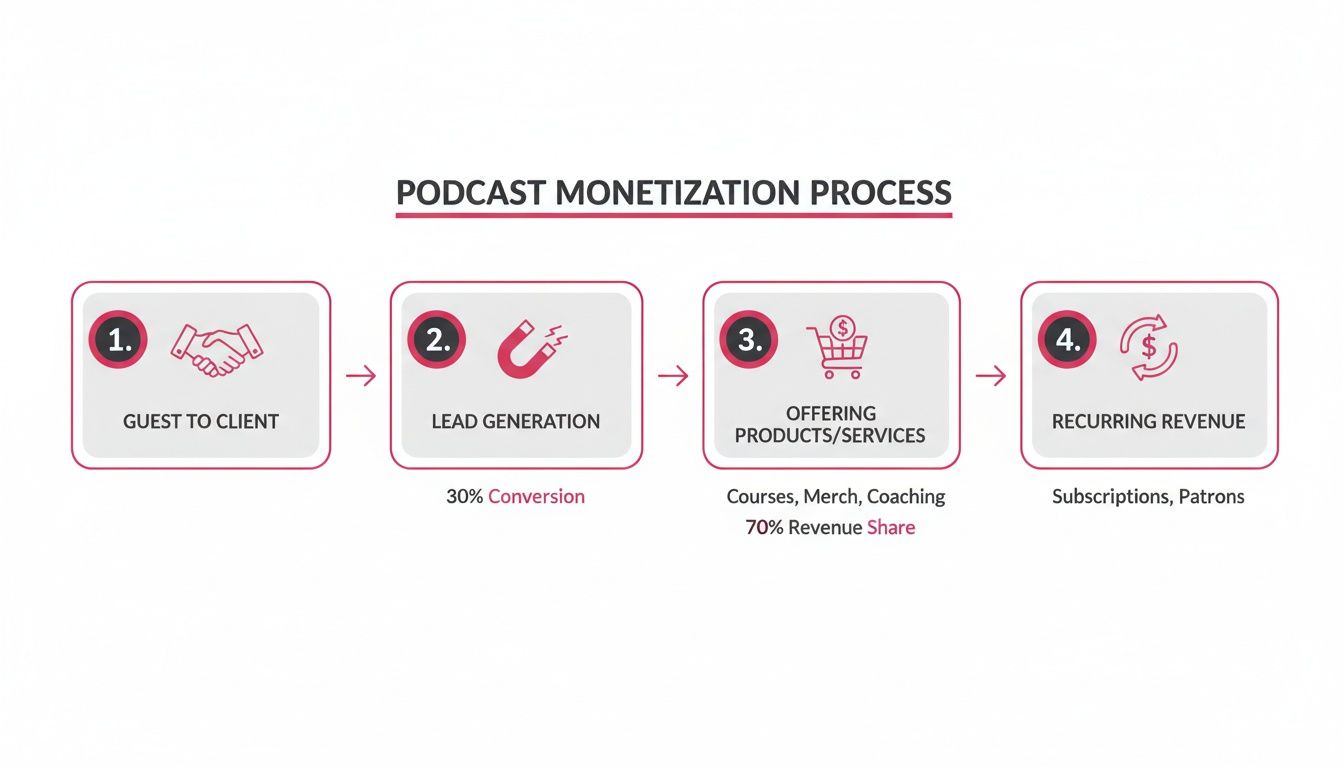
This flowchart breaks down the entire journey. As you can see, the "Guest to Client" phase is where it all begins, setting the stage for more scalable methods later on.
From Conversation to Conversion
So, how do you turn that great conversation into actual business? It’s all in the follow-up. But it needs to be thoughtful and natural, not aggressive.
Once the episode is live, the conversation doesn't end. First, send a thank-you note. Share the link to the live episode and any cool social assets you created for them. Give it a few weeks, then reconnect. This is where you gently pivot.
A brilliant, low-pressure tactic is to offer them an exclusive deal on your services as a small "thank you" for being a guest. It's a soft offer that respects the relationship you've built.
For example, you could say: "As a thank you for coming on the show, we put together a special offer exclusively for our podcast guests. Thought you might find it interesting."
This isn't just theory; it works. The B2B safety company Yellowbird ran this exact playbook with us. They achieved an incredible 20% guest-to-client conversion rate, proving just how much immediate ROI this approach can generate. By focusing on relationships first, the revenue just follows. You can learn more about how they convert both guests and listeners in this breakdown of their B2B podcast ROI.
Scaling Your Revenue with a Lead Generation Machine
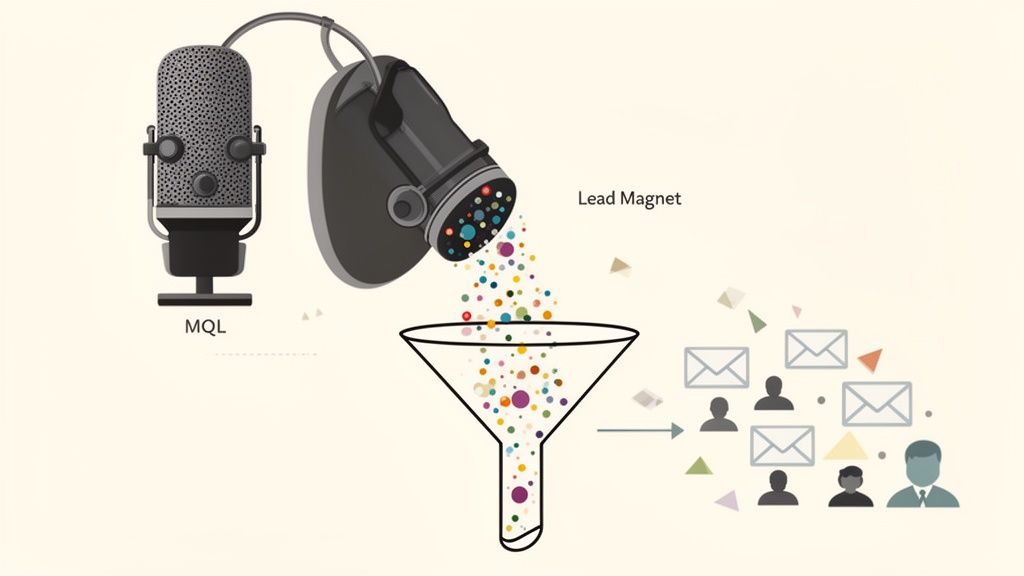
The guest-to-client playbook is the fastest way to get your first dollars in the door, but it's only first gear. Once you've been consistently publishing for about six months, something starts to shift.
You’ve built an actual audience. People who are your ideal customers are tuning in specifically to hear your take on things. It's time to shift gears from one-to-one conversions to a one-to-many system.
This is where your podcast becomes a predictable, scalable marketing funnel. It sits at the very top, churning out marketing qualified leads (MQLs) for your sales team like clockwork. This is the real long-term value, and it’s a critical piece of the puzzle for understanding how do you get paid for podcasts at scale.
Creating an Irresistible Lead Magnet
To turn a passive listener into an active lead, you need to offer them something so valuable they'll happily trade their email for it. This is your lead magnet.
Forget generic checklists. Your lead magnet has to solve a real, nagging problem for your audience.
- An Exclusive Template: A ready-to-use spreadsheet, project plan, or doc that saves them hours.
- An In-Depth Guide: A deep-dive eBook or whitepaper that expands on a topic you've covered on the show.
- A Special Offer: A unique discount, a free consultation, or a product trial that's only for your listeners.
The key is making a direct connection. If your episode is on sales outreach, your lead magnet should be a pack of high-converting email templates. That direct link makes the call-to-action a no-brainer. For most B2B podcasts, learning how to generate B2B leads without wasting time is the make-or-break skill for scaling revenue.
Promoting Your Lead Magnet Effectively
A great resource is useless if nobody knows it exists. You have to shout about it right inside your episodes.
Your lead magnet is the bridge between your free content and your paid solutions. Shout it out confidently in your intro and outro, making it an unmissable part of the listener experience.
A simple script works wonders. In your intro: "Before we dive in, we've put together a free [Lead Magnet Name] to help you implement what we discuss today. Grab it exclusively at yourcompany.com/podcast."
Then, hit them with it again in the outro as a final reminder. And always, always link it clearly in your show notes. This repetition is what drives sign-ups and turns listeners into leads.
Integrating Leads into Your Sales Funnel
Once a listener downloads your lead magnet, the real work starts. They're not just a number on a download counter; they're a warm lead who just raised their hand.
This is where your podcast plugs into the rest of your sales and marketing machine.
- Automated Nurture Sequence: That new lead should immediately drop into an email nurture sequence. This is your chance to deliver more value, share related content, and gently introduce your company's solution.
- Alerting the Sales Team: Set up your marketing automation to ping your sales team when a lead shows serious interest—like opening multiple emails or clicking on a pricing page link.
- Warming Up the Prospect: By the time sales reaches out, the prospect is already warm. They've listened to you, they trust your point of view, and they've already gotten value from you. That sales call is going to be a whole lot easier. You can find a more detailed playbook in our guide on how to build a sales pipeline with a B2B podcast.
Tracking Your Success
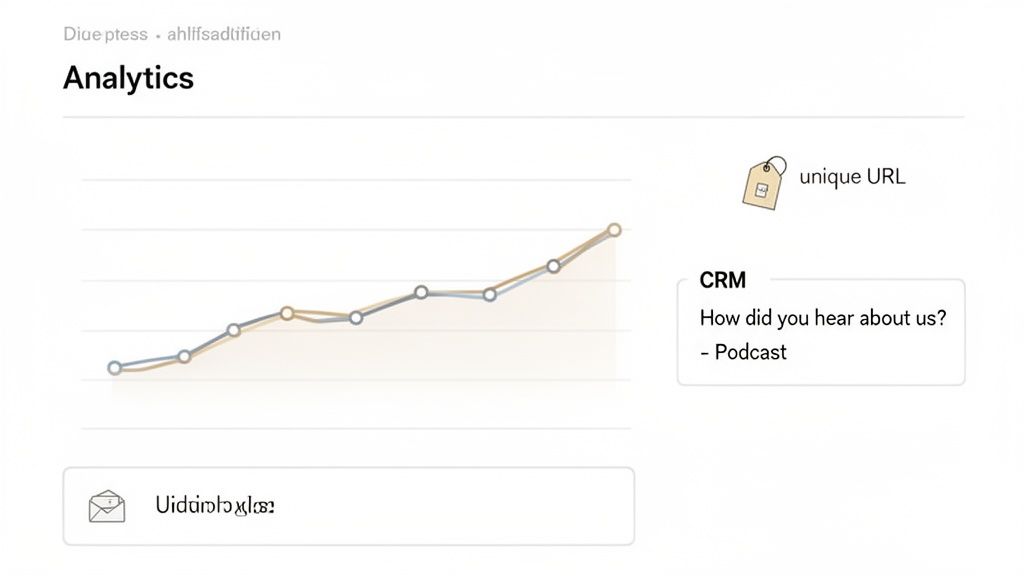
To prove your podcast's ROI, you have to track its impact on the bottom line. The simplest way is to make one small tweak to your CRM.
Just add "Podcast" as an option in the "How did you hear about us?" field on your forms.
This simple change lets you attribute real customers and revenue directly back to the show. Suddenly, you're not just talking about downloads; you're talking about dollars. That’s a conversation everyone wants to have.
Measuring What Matters to Prove Podcast ROI
If you can't measure your podcast, you can't prove its worth. It's that simple.
Vanity metrics like download numbers are fine, but they don't tell the real story. They don't answer the question that actually matters in B2B: how do you get paid for podcasts? To justify the investment, you need to connect your show directly to pipeline and revenue.
The good news? Setting up a basic attribution model is way easier than you think. It all starts with one tiny tweak to the systems you already have.
Start with Simple Attribution
The most straightforward way to see your podcast’s influence is to just… ask. Ask new leads how they found you. It's a low-tech, high-impact first move that anyone can make right now.
All you have to do is add “Podcast” as a dropdown option to the "How did you hear about us?" field on your demo and contact forms. That’s it.
This one change gives you a direct line of sight from your show to your inbound leads. When your sales team closes a deal and that customer's record says "Podcast," you've got undeniable proof of ROI.
Attribution doesn't have to be perfect to be powerful. Just knowing that deals are coming from your podcast gives you a rock-solid business case to keep investing in the channel.
This simple tracking method gives you a constant pulse on your podcast's performance. It’s the foundation of any real B2B podcast measurement strategy. For a much deeper dive, our full guide on measuring B2B podcast ROI and pipeline breaks down the entire process.
Level Up Your Tracking with Unique Offers
Once you have that basic attribution running, you can get a lot more granular. This works especially well when you’re promoting specific lead magnets or offers on your show.
The goal here is to create trackable assets that are exclusive to your podcast audience. This completely removes any guesswork.
- Create Unique URLs: Instead of just sending listeners to your homepage, create a specific landing page like
yourcompany.com/podcast. All traffic and conversions from that URL can be credited directly to your show. - Use Exclusive Coupon Codes: If you're promoting a product or paid resource, create a discount code just for listeners (e.g., PODCAST20). Every time that code gets used, you’re directly tracking sales from the podcast.
These methods give you clean data that isolates the impact of your on-air promotions. You can see exactly how many people took a specific action after hearing an episode, tying your content directly to conversion. Our ultimate guide to measuring B2B podcast ROI goes into even more detail on these advanced tracking techniques.
The Power of Qualitative ROI
Not all value can be jammed into a spreadsheet. Some of the biggest returns you'll get from a B2B podcast are qualitative, but they have a very real, tangible impact on your business.
Think about it: your podcast is pre-educating your entire market.
Listeners who eventually become leads are already warmed up. They get your point of view, they understand your approach to the industry, and they’re aligned with you before they even hop on a sales call.
This creates some powerful knock-on effects:
- Shorter Sales Cycles: Warm leads who already trust you move through the pipeline faster.
- Easier Sales Conversations: Your sales team spends less time on basic education and more time solving real problems.
- Higher Close Rates: Prospects who are already bought into your philosophy are far more likely to become customers.
Just ask your sales team. They'll tell you that a lead who says, "I've been listening to your podcast for six months," is a completely different—and much, much better—conversation. That feedback is a crucial piece of your ROI story.
When to Consider Traditional Monetization Models
Let's be clear: for a B2B podcast, turning listeners into leads is your bread and butter. It's the most direct path to revenue. But once you’ve built a solid foundation and a loyal following, you can start layering in some of the more traditional monetization plays.
Think of sponsorships and premium content as a secondary income stream. They shouldn't distract from your main goal of building pipeline, but they can absolutely supplement it. The trick is to approach them with a B2B mindset—this isn't about slapping on generic ads. It's about strategic partnerships and exclusive content that your niche audience will actually thank you for.
The Right Time for Niche Sponsorships
Sponsorships for a B2B show are not about casting a wide net. They’re about finding a handful of hyper-relevant partners who serve the exact same audience as you, without being direct competitors. It’s a strategic alliance, not an ad break.
But before you even start dreaming up a media kit, you need proof. You need a consistent show and, more importantly, a real audience. For most niche B2B shows, the magic number is somewhere between 5,000 to 10,000 downloads per episode. Once you hit that range, you have a listener base that's valuable enough to attract serious partners.
The best sponsorships feel less like an ad and more like a trusted recommendation. Seek out brands whose products or services you genuinely respect and that solve a real problem for your ideal customer.
When you're ready, forget programmatic ads and go straight for direct deals with brands you've hand-picked. This gives you total control over the message and ensures it feels native to your content. If you need a playbook for this, our guide on how to get podcast sponsorships walks you through the entire outreach process.
The market is definitely there. Globally, podcast advertising was a $3.46 billion market in 2023 and is on track to hit $5.03 billion by 2027. In the US alone, spending is projected to reach $2.38 billion in 2025.
The best part? Premium B2B niches can command CPM rates 10-30% higher than the average $15 to $30 for host-read ads because the audience is so valuable. And it works: 46% of weekly podcast listeners have bought something after hearing an ad. You can dig into more of these trends over at Podcastatistics.com.
Creating Premium Content for Your Superfans
As your authority in the space grows, you'll notice a small but mighty segment of your audience that wants more. They want to go deeper. These are your superfans, and they're the perfect audience for a premium, paid content offering.
This isn't about putting your main show behind a paywall. It's about creating exclusive, high-value experiences for your most dedicated listeners.
Think beyond just ad-free episodes. We're talking about tangible business value.
- Exclusive Deep-Dive Episodes: Offer hyper-tactical episodes that walk through a specific framework or methodology in painstaking detail.
- Private Q&A Sessions: Host a monthly or quarterly live Q&A where paying members can ask you or your expert guests anything.
- Gated "Narrative" Content: If your company is on a unique journey—maybe heading for a funding round or an IPO—you could create a private series documenting the lessons learned. This is stuff that's too sensitive for a public feed but invaluable to others on a similar path.
The barrier to entry here isn't a massive download number; it's audience loyalty. If you have a core group of even a few hundred "superfans" who hang on your every word, you can launch a successful premium offering. The key is to provide so much value that the subscription price feels like an absolute steal for the insights they're getting.
We Get These Questions A Lot...
We get it. You've probably heard the old-school advice on monetizing a podcast, and it sounds like a long, slow grind.
Let's cut through the noise. Here are the straight-up answers to the questions we hear all the time, specifically for B2B.
"How Many Downloads Do I Need to Monetize?"
For a B2B podcast, the answer is shockingly low: basically zero.
Seriously. You can generate revenue from your very first episode by using what we call the guest-to-client strategy. This isn't about the quantity of your listeners; it’s all about the quality of your relationships.
When you invite a high-value prospect to be a guest, you’re not just making content. You're building a real relationship in a setting that has nothing to do with sales. If you convert just one of those guests into a five or six-figure client, you've just monetized your podcast with an audience of one. It’s that simple.
"What’s a Realistic ROI for My Podcast?"
It's completely realistic to see a massive return on your investment within the first 6 to 12 months.
The math is simple. If one guest becomes a client, that single deal often pays for your entire podcast production for a year or even longer.
We’ve seen clients like Yellowbird hit a 20% guest-to-client conversion rate, generating huge ROI right out of the gate. Once you layer in a lead magnet funnel after six months, that ROI becomes even more scalable and predictable.
"Should I Put Ads on My B2B Podcast?"
Our advice? A hard no. Especially in the beginning.
Your main goal with a B2B podcast is to build authority and generate leads for your business. Splicing in ads for other companies just distracts from your message and dilutes your brand.
Focus on turning your guests and listeners into your own customers first. Once your show gets huge—we're talking over 10,000 downloads per episode—then you can think about sponsorships. But even then, they should be from highly relevant, non-competing brands that actually add value for your audience.
"What About Subscriptions or Premium Content?"
While your core strategy should be direct lead generation, paid subscriptions can become a great secondary revenue stream as your show matures.
People are getting tired of ads, and they're willing to pay for a better experience. In fact, industry data shows that 25% of podcast listeners are willing to pay for content, with many open to subscriptions for their favorite shows. You can dig into these podcast monetization trends to see how listener behavior is changing.
For B2B shows, this could look like gating exclusive content—like deep-dive strategy sessions or private Q&As—behind a paywall. This model really only works once you have a loyal audience of superfans who can't get enough of your stuff. With the global podcasting market projected to hit $131 billion by 2030, there's massive potential for creators who offer unique value directly to their listeners.
At Fame, we turn B2B podcasts into powerful revenue engines. Our end-to-end production service is built to help you build authority, create a pipeline of qualified leads, and get measurable ROI. See how we can do it for you at https://www.fame.so.
