April 8, 202616 min read8 sections
A Good Mic for Home Recording: The B2B Podcaster's Guide
By Fame Team
Key Takeaways
- A good microphone is crucial for B2B podcasting as it shapes how a brand sounds.
- Investing in quality audio is more important than video, as bad sound can drive listeners away.
- A strong mic setup supports brand authority, listener trust, and content reuse, making it a key part of a content strategy.
A few months ago, we had a guest every B2B brand would want. Sharp point of view, real operating experience, clear stories. The problem was not the conversation. The problem was the laptop mic. The episode sounded amateur, and that changed how the insight landed.
Why Your Mic Is Your Most Important B2B Marketing Tool
In B2B podcasting, the microphone is not a side decision. It shapes how your brand sounds before a listener evaluates a single argument.
Marketing teams often spend weeks refining positioning, guest selection, and distribution. Then they record through a weak mic in a reflective home office and lose the authority they worked to build. Listeners can tolerate imperfect video. They stop trusting content much faster when the audio is thin, echoey, or harsh.
Audio changes perceived credibility
A good mic for home recording does one job better than anything else in your setup. It makes your voice sound intentional.
That matters more in B2B than in entertainment. You are asking a buyer, partner, candidate, or investor to spend time with your ideas. If the host sounds distant, noisy, or distorted, the brand feels less prepared. That is a business problem, not an engineering problem.
For teams studying successful podcasts in the industry, one lesson carries across categories. The shows people return to create a reliable listening experience. In B2B, that reliability signals competence.
Great audio beats great video
A polished camera shot cannot rescue bad sound. Good lighting can improve weak video. Clean framing can help. But muddy audio makes people work to follow the conversation, and many will not keep working for long.
That is why the mic deserves priority over almost every visual upgrade in an early setup.
Key takeaway: If budget forces a choice between better video and better audio, choose audio first.
The mic is part of the content strategy
This is especially true for remote interviews. Remote recording makes it easier for strong guests to say yes because they do not need to travel or block out half a day. It also reduces operational friction. But remote convenience only helps if the final result still sounds professional.
A strong mic setup supports three things marketing directors care about:
- Brand authority: The host sounds clear, calm, and credible.
- Listener trust: The audience can focus on the argument instead of the room noise.
- Content reuse: Clean audio is easier to edit into clips, newsletters, and social assets.
If you are building a show to support category leadership, the microphone is not just gear. It is part of the delivery system for your message. That is why this decision belongs next to your format, guest strategy, and distribution plan, not underneath them. If you are still shaping the wider program, this guide to how to start a B2B podcast is a useful next read.
The First Big Decision USB vs XLR Microphones
The first question is not dynamic or condenser. It is USB or XLR.
That choice determines how simple your setup is today and how flexible it will be later.
USB is the fastest path to recording
A USB mic is the point-and-shoot camera of podcast gear. Plug it into a laptop, select it in your recording software, and you are ready.
That makes USB practical in a few common situations:
- New internal hosts: You want the team recording quickly with minimal setup.
- Guest kits: You want to ship something easy to use.
- Lightweight production: You do not want an audio interface on every desk.
USB works because it removes variables. Fewer boxes, fewer cables, fewer ways to get the setup wrong.
For many guest appearances, that simplicity matters more than chasing an ideal signal chain. If you need a broader buying list around the mic itself, this guide on equipment needed for a podcast covers the rest of the setup.
XLR is the better long-term system
An XLR mic is the DSLR version. It needs an audio interface, an XLR cable, and a little more setup knowledge. In return, you get a more professional signal chain and more room to grow.
With XLR, you can change one part of the setup without replacing everything. Upgrade the interface. Add another microphone. Improve the preamp path. Build a repeatable studio for multiple hosts or guests.
That makes XLR the better fit when:
- The podcast is a brand channel, not an experiment
- Multiple team members may record
- You want cleaner control over gain and monitoring
- You expect the show to become a long-term authority asset
The practical trade-off
Here is the simplest way to think about it.
| Option | Best for | Strength | Limitation |
|---|---|---|---|
| USB | Fast setup, guest kits, solo beginners | Simple and convenient | Less flexible as your needs grow |
| XLR | Long-term branded shows | Scalable and more professional | Requires more gear and setup |
The mistake is not choosing USB. The mistake is choosing USB for a show that already has enterprise expectations attached to it.
What I would tell a marketing director
If the podcast is still proving internal demand, USB is fine. Get moving. Record cleanly. Learn your format.
If the show is already tied to pipeline, thought leadership, executive visibility, or a category play, start with XLR. It will save you from rebuilding your setup later, retraining hosts, and explaining why the show sounds inconsistent from episode to episode.
Tip: USB is often the right answer for guests. XLR is often the right answer for hosts.
That split works well in real production. Your host setup stays controlled and repeatable. Your guest setup stays simple enough that people use it.
Understanding Mic Guts Dynamic vs Condenser
Once you know how the mic connects, the next decision is how it captures sound. At this stage, many buying guides go wrong for B2B teams. They borrow advice from music recording and assume the same logic applies to a home office.
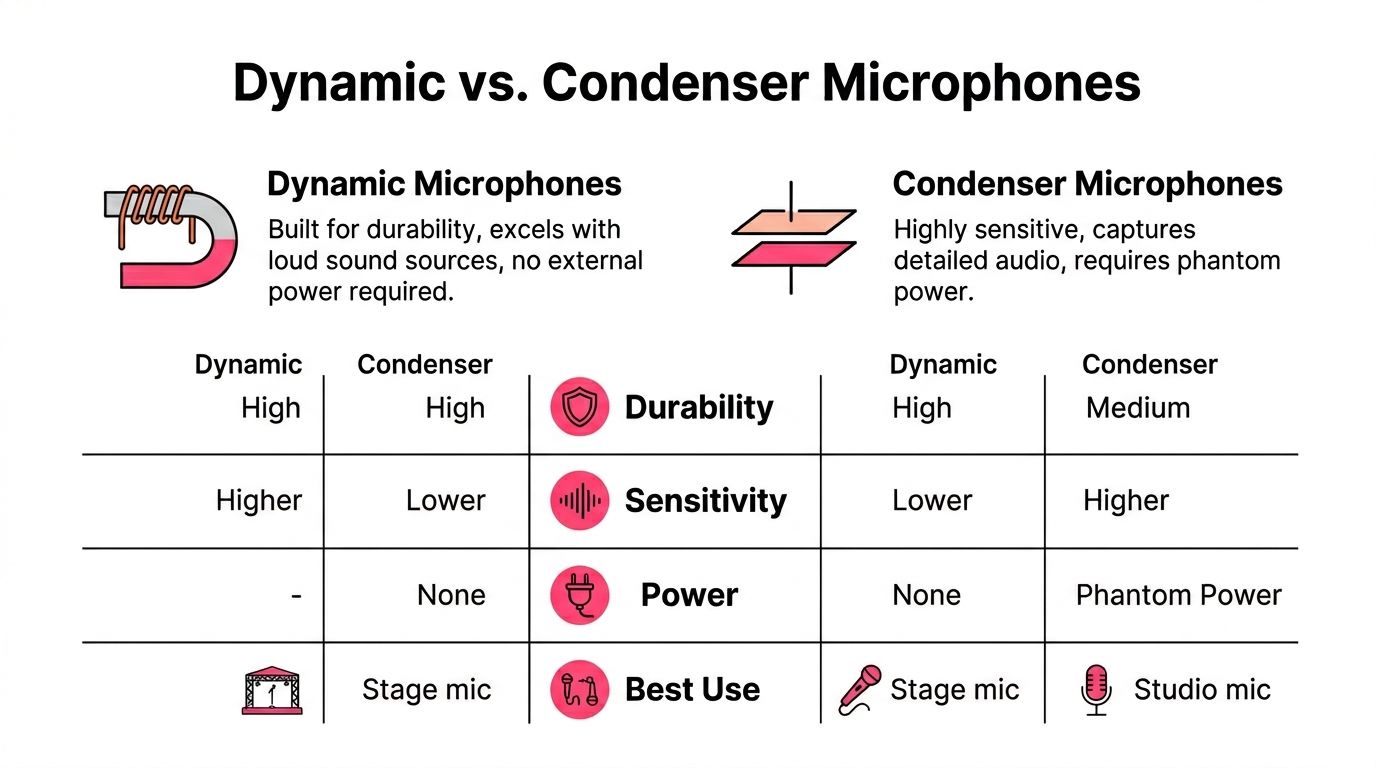
Dynamic mics are focused and forgiving
A dynamic microphone is the workhorse option. It is less sensitive, more rugged, and usually better at ignoring some of the room around the speaker.
That is why dynamics are so useful in real home recording environments. If someone is recording in a spare bedroom, near a mechanical keyboard, with a reflective wall behind them, a dynamic mic often gives a cleaner result than a more sensitive alternative.
This is one reason many producers favor options like the Shure SM7B for spoken-word content in untreated rooms. The common thread in user discussions gathered in this guide on home vocal microphones is clear. A dynamic mic can reject more of the ugly parts of a bad room, which makes it a strong fit for podcasts recorded in normal home offices.
Condenser mics capture more detail
A condenser microphone is more sensitive. It picks up nuance, air, and detail. It also requires phantom power.
That sensitivity is one reason condenser mics are so common in studio work. According to Sweetwater, cited by 100 Sutton Studios, condenser studio microphones are the top choice for approximately 70 percent of studio vocal recordings (reference).
That statistic makes sense in a controlled studio. Condensers capture subtle vocal information beautifully.
Why common advice breaks down in home offices
The mistake is assuming studio logic transfers cleanly into B2B podcast production at home.
A condenser can make a strong voice sound polished in a treated room. In an untreated room, the same mic may capture HVAC noise, desk reflections, keyboard clicks, and room reverb. Instead of sounding premium, the recording sounds wider, splashier, and less focused.
A dynamic often wins because it creates a more usable recording at the source. Not the most flattering in theory. The most usable in practice.
Contrarian but practical: In many home offices, a dynamic mic is a better mic for authority-building podcasts than a condenser.
When to choose each
Use a dynamic if:
- Your room is untreated
- You have background noise you cannot fully control
- You want a tighter, more broadcast-style spoken-word sound
- Your host is not highly technical and needs a forgiving setup
Use a condenser if:
- Your room is quiet and reasonably controlled
- You want more vocal detail and openness
- You know how to manage mic placement and room sound
- You have an interface that provides phantom power
If you want a model-by-model list built specifically for spoken-word content, this roundup of best microphones for podcasting is a good companion.
What works vs what does not
What works is choosing for the room first and the spec sheet second.
What does not work is buying a sensitive condenser because it looked more professional on a music blog, then recording in a glass-walled home office and trying to repair the result in post. Editing can help. It cannot remove every bad acoustic decision.
Key Microphone Specs That Matter for Voice
Most mic spec sheets are harder to read than they need to be. For B2B podcasting, only a few specs really affect whether the result sounds clean and authoritative.
Polar pattern matters more than many realize
Start with the polar pattern.
For most solo podcast setups, cardioid is the safest choice. It focuses on the sound in front of the mic and reduces what it hears from the rear and sides. That helps when your room is not perfect.
If a mic offers multiple patterns, that can be useful for advanced setups, but cardioid is the default most marketing teams should stick with.
Frequency response shapes how the voice lands
Frequency response tells you how a mic captures low, mid, and high frequencies.
You do not need to obsess over graphs. The practical question is simpler. Does the mic help the voice sound clear without getting thin, brittle, muddy, or boomy?
For spoken-word content, the best response is usually one that keeps speech intelligible and natural. A mic that flatters a singer is not automatically the right mic for an executive interview.
Maximum SPL protects you from ugly distortion
The most overlooked spec for podcast buyers is maximum SPL, or sound pressure level.
According to Samson, dynamic and condenser microphones typically handle SPL in the range of 130 dB, which professionals consider sufficient for nearly every music application. The same source notes that vocal SPL can reach over 150 dB when speakers position themselves close to the microphone (reference).
That matters because podcasts are not always calm. Guests laugh. Hosts lean in. Executives punch a key point harder than expected. If the mic or chain cannot handle that moment, the take distorts.
For a good mic for home recording, a healthy maximum SPL rating gives you more margin when the conversation gets energetic.
Self-noise and usable cleanliness
If you are considering a condenser, check self-noise. Lower self-noise means less hiss from the microphone itself.
This matters most when the speaker has a quiet delivery or when the production style leaves space around the voice. A noisy mic floor makes the whole show feel cheaper.
A quick spec filter for buyers
When reviewing a mic page, ask these questions:
- Is the pattern cardioid? Good for most solo spoken-word recording.
- Does it fit the room? Sensitive mics punish bad acoustics.
- Can it handle energetic speech? Maximum SPL matters more than many buyers expect.
- Will your setup power it properly? Condensers need phantom power.
- Is the voice natural on this mic? Specs help, but your voice is the final test.
For a fuller system view around interfaces, headphones, and mounting, this guide to podcast setup equipment is useful.
Tip: Read the spec sheet to eliminate bad fits. Use a test recording to choose between good ones.
Our Recommended Mics for B2B Podcasters
The right recommendation depends less on abstract “best” lists and more on the role the mic has to play. A founder recording from a home office has different needs than a distributed guest program. Below is a simple way to buy based on intent.
The getting started kit
This is for teams launching a show, testing host fit, or creating a guest kit that people use.
Good options:
- Blue Yeti
- Audio-Technica AT2020 USB
- Samson Q6 pack for simple multi-voice scenarios
The point of this tier is not perfection. It is reliability and speed. USB is often enough here, especially when you need a non-technical guest to plug in and record without support.
These mics can produce solid spoken-word audio if the room and technique are handled well. What they do not solve is a noisy environment or poor mic discipline.
The authority builder kit
Most serious B2B hosts should aim for this level.
Good options:
- Shure SM7B
- Rode PodMic
- Electro-Voice RE20
- Audio-Technica AT2020 in XLR form, if the room is under control
This tier is where dynamic mics often become the smarter choice. The SM7B, in particular, remains popular for a reason. It is forgiving in untreated spaces, it manages spoken-word well, and it produces a familiar broadcast texture that suits executive-led content.
The trade-off is gain. Some dynamic mics want a strong, clean interface or inline gain support. That is part of why the whole chain matters, not just the capsule.
The category leader kit
This tier is for brands treating the podcast like a flagship media property. You want flexibility, refined vocal capture, and room to grow into more advanced recording scenarios.
The standout option here is the AKG C414 XLII. It is an expert-level microphone for home recording because it combines versatility with serious control. It offers nine selectable polar patterns, three switchable low-cut filters, and three pre-attenuation pads. With the pads engaged, its maximum SPL extends to 158dB, which helps prevent distortion during louder speech or executive interviews with sharp plosives (reference).
That feature set matters in practice. Multiple patterns give you options. Filters help control low-end rumble from desks, HVAC, or foot movement. Pads create more headroom when speakers get forceful.
The caution is straightforward. This is still a sensitive condenser. If the room is bad, the mic will tell the truth about it.
Comparison table
| Mic Name | Type | Capsule | Price Range | Best For |
|---|---|---|---|---|
| Blue Yeti | USB | Condenser | Entry level | Easy guest kits and simple solo recording |
| Audio-Technica AT2020 USB | USB | Condenser | Entry level | Solo hosts in quieter rooms |
| Samson Q6 | XLR | Dynamic | Entry level | Multi-person voice setups on a budget |
| Rode PodMic | XLR | Dynamic | Mid range | Solo hosts who want a tighter spoken-word sound |
| Shure SM7B | XLR | Dynamic | Mid range | Untreated rooms and executive hosts |
| Electro-Voice RE20 | XLR | Dynamic | Mid to premium | Broadcast-style delivery |
| AKG C414 XLII | XLR | Condenser | Premium | Advanced hosts with more control over room and technique |
How to choose without overthinking it
If your room is average, buy a dynamic.
If your room is controlled and you want more vocal detail, buy a condenser.
If you are buying for guests, bias toward ease of use.
If you are buying for a long-term host, bias toward consistency and upgrade potential.
That is the ultimate filter. Not what sounds most impressive on a product page. What produces the cleanest, most repeatable result for the way your team records.
If you want a broader shortlist before you buy, this guide to recommended microphones for podcasting goes deeper into specific options.
Beyond the Mic Your Room and Your Technique
A great microphone in a bad room still produces a bad recording. Many teams overspend on the mic and underthink the environment as a result.
Fix the room before you fix the waveform
A condenser can capture a lot of vocal detail, which is one reason condensers are used so often in professional setups. As noted earlier, Sweetwater data cited by 100 Sutton Studios says condenser studio microphones account for approximately 70 percent of studio vocal recordings because they capture subtle nuance well. That same sensitivity is exactly why room control matters so much for podcasting.
In practical terms, most home offices need less “studio treatment” and more absorption in the right places.
Start with simple adjustments:
- Add soft surfaces: Rugs, curtains, couches, and fabric chairs reduce reflections.
- Use bookshelves well: Books break up flat reflective surfaces better than blank walls.
- Avoid glass and corners: Do not place the speaker facing a hard reflective wall at close range.
- Record in the quieter room: The best room is often the bedroom or closet-sized office, not the big open-plan space.
For a more detailed walkthrough, this guide on podcast room setup is worth keeping open while you test your space.
Technique changes the result fast
Mic choice matters. Mic technique matters just as much.
A few habits improve almost any setup:
- Stay consistent with distance: If the speaker moves around, the tone changes.
- Use a pop filter: It helps control plosives before they hit the capsule.
- Aim slightly off-axis: Speaking just past the mic can reduce harsh bursts of air.
- Wear wired headphones if possible: They reduce bleed and avoid Bluetooth issues.
Practical rule: If the recording sounds roomy, move the mic closer before you buy new gear.
This walkthrough is useful if you want to see how small recording decisions affect the final result:
Remote guest recordings need a process
Remote recording is often the most impactful format for B2B shows because it expands your guest pool and removes travel friction. But remote quality does not happen by accident.
Give guests simple preparation instructions. Ask for wired headphones. Ask them to sit in a quiet room. If video matters, natural light from a window helps. If the budget allows, sending a simple mic as a gift can materially improve the session.
For the recording itself, platforms like Riverside.fm are useful because they are built for remote podcast capture. If you want a full process for managing these sessions, this guide on how to record podcasts remotely is a strong operational reference.
Your Purchase and Setup Checklist
If you are ready to buy, keep the process simple. Most poor outcomes come from skipping basics, not from choosing the “wrong” famous mic.
Purchase checklist
- Microphone: Choose based on room quality first, then connection type.
- Connection chain: USB cable for USB mics, or XLR cable plus interface for XLR mics.
- Audio interface: Required for XLR microphones and phantom power for condensers.
- Boom arm or stand: Keeps placement stable and off the desk.
- Pop filter or foam windscreen: Helps control plosives.
- Closed-back headphones: Useful for monitoring and avoiding speaker bleed.
- Recording software: Any reliable platform is fine if it captures clean local audio.
- Room basics: Rug, curtains, or other soft materials if the room is reflective.
Initial testing checklist
- Record a short sample: Speak at normal volume, then speak more emphatically.
- Listen for room sound: Echo usually means the mic is too far away or the room is too reflective.
- Check for clipping: Loud phrases should stay clean.
- Test plosives: Say words with strong P and B sounds.
- Review background noise: HVAC, fans, keyboards, and traffic are easier to fix before recording.
- Save a reference setup: Keep the same position, gain, and room layout for every session.
If you want to connect your recording setup to the larger production process, this guide to podcast production workflow is the right next step.
Frequently Asked Questions
Do I really need a pop filter
Yes.
A pop filter is one of the cheapest ways to prevent avoidable problems. It reduces plosives before they hit the mic. That means less distortion, fewer ruined takes, and less cleanup in editing.
What is the difference between a preamp and an audio interface
A preamp boosts the microphone signal.
An audio interface is the box that connects your mic to your computer and usually includes one or more preamps inside it. For most podcasters, buying a solid interface is the practical move. You do not need to buy a separate standalone preamp first.
Can I use my laptop mic or gaming headset
For internal calls, yes. For a branded B2B podcast, no.
Laptop mics sound distant and room-heavy. Gaming headsets are built for convenience, not polished spoken-word brand content. If you are comparing consumer headset options for casual use, lists like these best gaming headsets under $50 can be useful. They are still not a substitute for a proper podcast microphone.
Should I buy a condenser because studios use them
Not automatically.
Studios can control noise and reflections. Many home offices cannot. If your room is untreated, a dynamic mic is often the safer purchase.
Is USB good enough for a serious podcast
It can be, especially for guests or early-stage internal pilots.
But if the show is becoming a core brand asset, XLR usually gives you a better long-term foundation and a more flexible setup.
If your team wants help choosing gear, designing a remote-friendly recording setup, and turning clean audio into a B2B podcast that supports authority and pipeline, Fame can help. They specialize in B2B podcast production, from strategy and recording to editing, distribution, and promotion.
Want us to run this for you?
Fame starts and grows B2B podcasts that generate pipeline. Tell us who you are trying to reach and we will send a costed proposal within 1 working day.
Related content
- Read moreFame Team · July 16, 2026
10 Account Based Marketing Tactics For B2B Growth In 2026
Discover 10 actionable account based marketing tactics for B2B tech. Learn to use podcasts, data, and targeted content to close high-value accounts. - Read moreFame Team · July 16, 2026
The 8 Best Brighton Podcast Agency Picks For 2026
Find the best Brighton podcast agency for your B2B brand. Our 2026 guide reviews top 8 agencies for production, growth & ROI. Expert analysis here - Read moreJune 10, 2026
20 Best Podcast Production Agencies For 2026 (And Why Should You Hire One)
Global podcast and vodcast ad revenues are on track to hit $5 billion in 2026 , up 20% year-on-year. - Read moreApril 13, 2026
Leadership In Marketing: The B2B Podcast Playbook
Most companies still confuse leadership in marketing with job titles, org charts, and budget control. That's outdated.