Vaibhav Namburi’s media page
Scaling High-Volume Outbound with Smartlead
Vaibhav Namburi is challenging how SaaS companies scale growth with AI systems that turn teams into revenue engines
Featured In
- Media outlet 1
- Media outlet 2
- Media outlet 3
- Media outlet 4




Watch this short video about Vaibhav
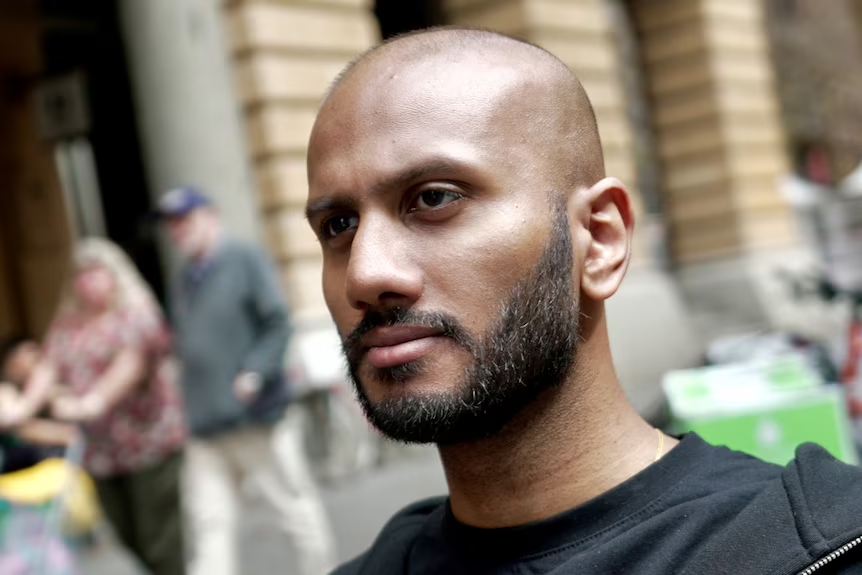
Who is Vaibhav?
Vaibhav Namburi is the founder and CEO of Smartlead, an email and outbound infrastructure platform. In just four years, Smartlead has scaled to power outbound for over 100,000 businesses, manage over 8 million mailboxes, and process 20–30 million emails daily for SaaS companies and agencies worldwide. Smartlead is trusted by leading brands including Nasdaq Inc., Reddit, Brex, and many Fortune 500 companies.
Vaibhav grew up in Dubai and across several countries in East Africa before moving to Sydney, Australia, where he now runs Smartlead. Before Smartlead, Vaibhav launched multiple businesses, with 11 failed ventures shaping his approach to growth, product, and execution.
A corporate consulting role triggered his shift away from a traditional path. He previously founded Five2One, scaling it significantly in under a year, and later launched and exited Cenario. He also founded a company called SmartWriter and grew it to 14,000 users, including Facebook, Stripe, and VaynerMedia.
He studied mechanical engineering in Australia before moving into coding and software development, and built Smartlead’s core infrastructure himself in the early days before expanding the team. Today, he focuses on building scalable systems and shares insights on growth, AI, and outbound, helping founders build repeatable processes.
Highlights
- Smartlead is trusted by leading brands including Nasdaq Inc., Reddit, Brex, and many Fortune 500 companies
- Smartlead is a bootstrapped, highly profitable, 50-person company
- Vaibhav has mentored for world-class accelerators such as Startmate, Antler UK, Incubate, UNSW Founders, and Australia’s largest VC fund, Blackbird
- Smartlead powers outbound for over 100,000 businesses, manages over 8 million mailboxes, and processes 20–30 million emails daily
Book Vaibhav Now!
Vaibhav is looking forward to sharing his story and message with your audience. Simply reply to the email you’ve just received from Fame Connect to arrange an interview.
Media Appearances
Listen to Vaibhav's previous interview
Watch
6 VideosTopics
What Your Audience Could Learn
AI Is Forcing a Reset in Sales and Growth Operations
Vaibhav believes AI is fundamentally changing how SaaS and AI-native companies run sales and growth. The real shift, in his view, is that sales, growth, and outbound are no longer just about execution, but about building systems that can adapt to how modern platforms and customer behaviour actually work.
Vaibhav states that outbound systems are no longer judged only by execution quality, but by how intelligently they adapt to increasingly algorithmic environments. For sales leaders, the biggest shift is in how outreach is delivered and how inbox placement is decided.
Emails are no longer just competing with spam filters, they are now being evaluated by AI-driven email categorisers that decide whether a message belongs in the primary inbox or in marketing or notification folders. Success now depends on understanding how these systems classify and prioritise communication, not just how to “avoid spam.”
Vaibhav also points to how AI is starting to reshape how teams understand their leads. Through Smartlead’s high-intent data capabilities, AI can analyse how different leads are likely to respond and highlight which prospects are more reactive, along with the kinds of messaging that are more likely to work for them.
Instead of relying on static list-building, this shifts focus toward understanding intent and tailoring outreach based on real behavioural signals. In his view, this is shifting teams away from static outbound execution toward adaptive systems that continuously improve based on real-world algorithms and customer behaviour.
How GTM Teams Avoid Drowning in AI’s Sea of Sameness
Vaibhav Namburi challenges the growing “AI SDR” hype and helps GTM leaders think more critically about where AI actually creates value in sales. While he acknowledges that foundation models are improving, he argues that current AI tools still lack the nuanced “intuition” needed for high-level sales conversations and attribution.
For sales and growth teams, his view is that AI should be used to remove operational friction, not replace human judgment. He emphasizes that AI can make tasks like prospect research “free” at scale, helping teams personalize outreach without sounding robotic. At the same time, he believes context-based selling and strong signaling are becoming even more important as AI-generated outreach floods the market.
He also helps SaaS founders rethink how AI changes service businesses. In his view, the future is companies that still offer services, but use AI to make those services scalable like software. Rather than removing humans entirely, he advocates for strategic human-AI integration: using AI for backend work like research and data management, while keeping humans involved in high-context touchpoints such as contextual calling.
Vaibhav repeatedly highlights that as AI tools become more accessible, the real advantage is no longer simply having AI, but knowing how to use unique data, positioning, and social presence to stand out from the growing “sea of sameness” created by widespread AI adoption.
Onboarding Should Be an Agentic System, Not a Flow
Most SaaS and AI-native companies still treat onboarding like a generic workflow. Every user gets the same signup flow, the same onboarding emails, and the same product tour, regardless of who they are or what problem they are trying to solve.
Vaibhav believes AI should completely change this, and this is where he helps GTM leaders and SaaS founders rethink onboarding. His view is that onboarding should become person-based, not persona-based. Instead of putting users through static onboarding flows, he believes AI systems should instantly learn about the customer the moment they sign up.
For GTM leaders and SaaS founders, this means using AI agents to analyze a customer’s website, competitors, positioning, and existing tools in real time. From there, the product can identify likely pain points, understand what the customer is trying to achieve, and guide them through a much more relevant onboarding experience.
Smartlead is taking this a step further by moving from a traditional outbound SaaS tool to an agentic AI platform that runs outbound for you. Instead of requiring users to handle deliverability, warmup, domains, and sequencing, its AI assistants can build campaigns, write messages, manage setup, execute workflows and even provide coaching support. The goal is simple: move from “here’s the software” to “tell the system what you want to achieve, and it helps you do it.” In Vaibhav’s view, the goal of onboarding is now intelligent activation.
60 Leads Is All It Takes to Know Your Outbound Is Broken
Vaibhav believes that most SaaS teams are failing because they don’t have a reliable way to consistently reach and convert the right customers. Real scale doesn’t come from ads or random growth hacks, but from structured outbound systems that repeatedly target the right prospects, test messaging quickly, and turn outreach into a predictable source of revenue.
His approach is built on volume with discipline. He stresses that outbound is a numbers game, but only works when it’s structured properly: high lead volume, constant testing of messaging variations, personalization through agentic solutions, and strong alignment between offer and audience.
A key part of his system is improving targeting through intent signals. Instead of broad ICP assumptions, he focuses on identifying people already showing buying intent in places like niche communities, job posts, and industry discussions. Prospects are then engaged with useful insights or context before any sales ask.
Vaibhav is big on fast feedback loops and quick decisions. He often uses the “60-lead rule”: no meaningful replies after 60 targeted outreaches means something in the ICP or messaging is off and needs to change. For GTM teams, his view is simple: growth comes from tight systems, fast iteration, and treating outbound as a constantly improving engine, not a one-off campaign.
Customer Support Is the Real Engine Behind Product-Led Growth
For most SaaS and AI-native teams, scaling growth is harder than it should be. They don’t learn fast enough from customers, and GTM teams often make decisions without clear signals.
Vaibhav Namburi has built his approach around fixing this for sales-led SaaS teams. After 11 failed ventures and scaling Smartlead to $20M+ ARR in 3 years, he focuses on what actually drives growth in practice: learning directly from customers, turning feedback into product changes quickly, and building systems that improve how teams sell and scale.
For GTM leaders and founders, one of his core beliefs is that customer support is one of the most overlooked growth hacks. He sees growth as a simple loop: customers raise issues or request features, the product team builds improvements quickly, and customers respond with stronger trust as they see their feedback turned into real changes.
He often describes this as doing the same loop “100 times over 100 days,” where small cycles of feedback and execution compound into momentum. His advice for GTM leaders is to get closer to customer feedback, shorten the time between insight and product change, and treat support as a direct input into revenue and product direction.
This is the same approach he used scaling Smartlead. He first built SmartWriter, a personalization tool for outbound messaging, and iterated based on user feedback. This eventually led to Smartlead, created when customers asked for a simpler, more affordable way to run multi-mailbox cold email at scale.
You Don’t Need External Funding to Build a Scalable SaaS Business
A lot of SaaS and AI-native teams struggle with the same issue when it comes to growth: They often assume they need funding or a fully finished product before they can really scale, which leads to long build cycles without real market validation.
Vaibhav challenges this way of thinking. He built Smartlead without external venture capital, relying instead on early customers and aggressive outbound methods to fund and shape what he built. In his view, bootstrapping is not about doing everything yourself, but about building directly around customers from day one so the business is shaped by real demand, not assumptions or outside capital.
His goal has always been to build products that help people make money, allowing the business to grow through the value it provides to customers. His first company, Five2One, served as a portfolio company that helped fund and build his various SaaS projects, including SmartWriter and Smartlead.
He believes founders should validate demand before heavy product investment, making sure there is real pull from the market before scaling development. He also stresses discipline over motivation, focusing on showing up daily and compounding small progress even when results are slow.
His advice to SaaS founders is simple: don’t wait for funding to start, build systems that bring in customers early, because that’s what ultimately funds and shapes the business.
Your Suggestion...
If there is a specific topic you would like Vaibhav to focus on during the interview that is not listed here, please let us know.
We would be more than happy to run this by Vaibhav to see if he would be able to discuss it in detail and deliver value to your audience.
Want to interview Vaibhav?
To schedule an interview with Vaibhav Namburi, please reply to the email you’ve received from the Fame Connect team or click the button below.
Email Us